Overview
- The Levallois technique is a prepared-core method of stone tool production in which a knapper carefully shapes a stone core to a predetermined convex geometry before striking a single blow to detach a flake, point, or blade of predictable size and form — a process demanding multi-step planning, mental templating, and hierarchical organization that most researchers regard as evidence for a qualitative advance in hominin cognition.
- Named after the Parisian suburb of Levallois-Perret where characteristic flakes were first recognized in the nineteenth century, the technique appears in the African archaeological record by at least 300,000 years ago and possibly as early as 500,000 years ago, subsequently spreading across Europe and Asia in association with both Neanderthal and archaic Homo sapiens populations.
- As the defining technological signature of Clark's Mode 3 and a central component of Mousterian and Middle Stone Age assemblages, the Levallois technique occupies a pivotal position in the trajectory from simple Oldowan flaking through Acheulean bifacial reduction to the systematic blade technologies of the Upper Paleolithic, illustrating how lithic innovation tracked — and may have driven — the evolution of modern human cognitive architecture.
The Levallois technique is a method of stone tool production in which a knapper shapes a lithic core to a carefully predetermined convex geometry — resembling an inverted turtle shell — before detaching one or more flakes, points, or blades of predictable size and shape from the prepared surface.1, 2 Named after Levallois-Perret, a northwestern suburb of Paris where distinctive flakes were recovered from Pleistocene river gravels during the nineteenth century, the technique has come to be recognized as one of the most cognitively demanding and technologically significant innovations in the entire record of stone tool technology.3, 4 Unlike simpler reduction strategies in which a knapper strikes flakes from an unprepared core and selects useful products after the fact, the Levallois method requires the toolmaker to envision the final product before the decisive blow is struck and to execute a lengthy sequence of preparatory removals to create the conditions for that product — a cognitive operation that most researchers interpret as evidence for hierarchical planning, mental templating, and the capacity for abstract spatial reasoning.1, 10
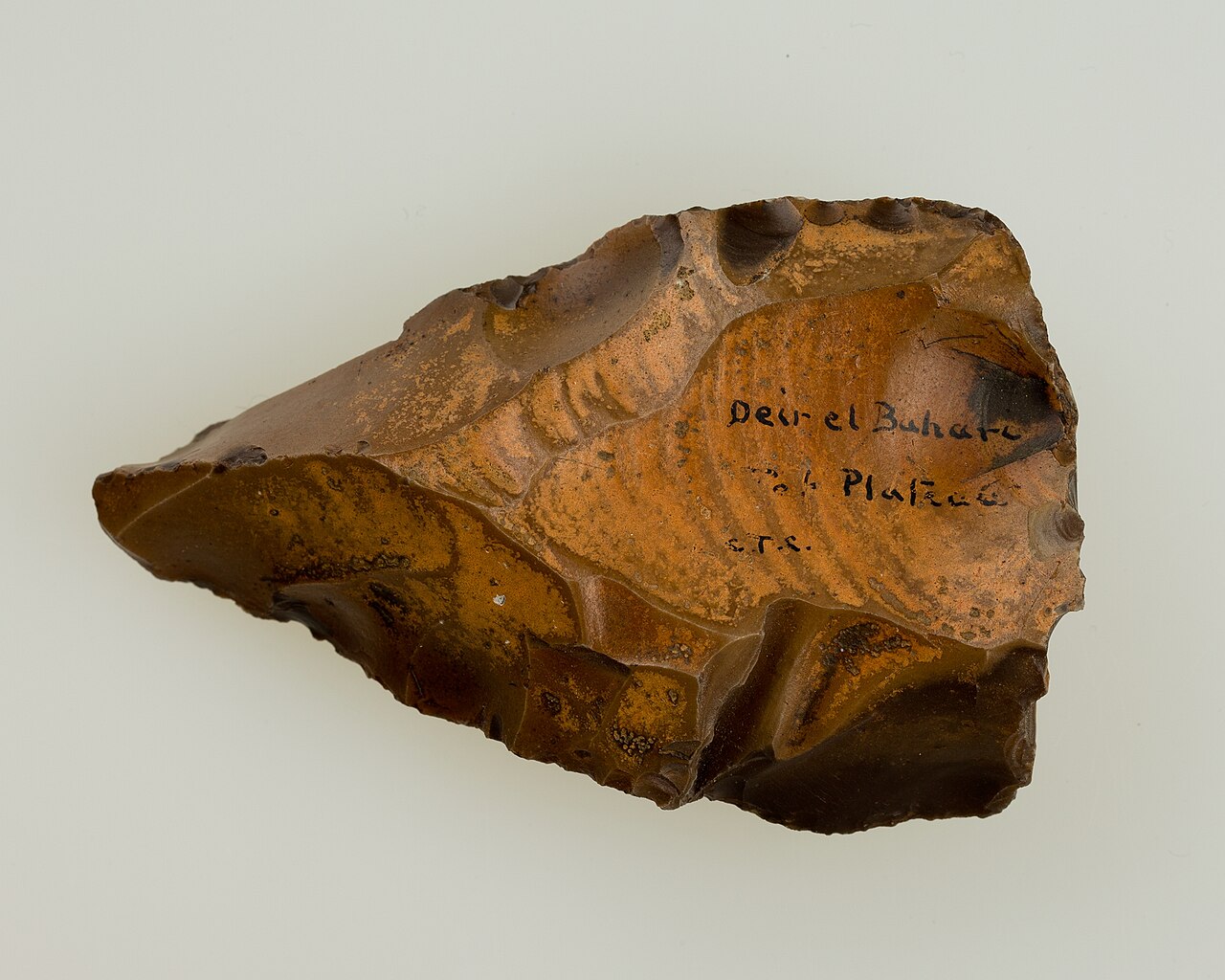

The Levallois technique is the defining characteristic of Grahame Clark's Mode 3 technology, occupying a central position in the trajectory from the simple core-and-flake [Oldowan industry](/human-evolution/oldowan-industry) (Mode 1) through the bifacially shaped handaxes of the [Acheulean industry](/human-evolution/acheulean-industry) (Mode 2) to the systematic prismatic blade production of the Upper Paleolithic (Mode 4).4, 14 Assemblages dominated by Levallois products appear in association with both Neanderthals in Europe and the Levant, where the technique forms a core element of the Mousterian industrial complex, and with archaic and early modern Homo sapiens populations in Africa, where it is integral to the [Middle Stone Age](/human-evolution/middle-stone-age-innovation).4, 5 This broad geographic and taxonomic distribution has made the Levallois technique a touchstone for debates about the cognitive capacities of different hominin species, the mechanisms of cultural transmission in the Pleistocene, and the relationship between technological sophistication and [behavioral modernity](/human-evolution/behavioral-modernity).7, 10
History of recognition
The Levallois technique takes its name from Levallois-Perret, a commune immediately northwest of Paris that in the mid-nineteenth century was the site of extensive sand and gravel quarrying along Pleistocene terraces of the Seine.3 Workers extracting construction material from these deposits regularly encountered large, thin flakes of flint with distinctive features: a flat ventral surface bearing the bulb of percussion, a convex dorsal surface covered by the scars of earlier removals radiating from the center, and a carefully prepared striking platform at the proximal end. These artifacts were first described in detail in the 1860s and 1870s by French prehistorians, and by the late nineteenth century the term "Levallois flake" had entered the standard vocabulary of European archaeology.3, 4
For much of the twentieth century, the significance of the Levallois technique was understood primarily within the framework of François Bordes's typological classification of Middle Paleolithic assemblages. Bordes recognized the Levallois as a method that could co-occur with various tool types in Mousterian assemblages, and he quantified the proportion of Levallois products in an assemblage through his "Levallois index," a ratio that became a standard descriptive statistic in lithic analysis.5 However, it was the work of Éric Boëda in the 1980s and 1990s that transformed understanding of the technique from a typological category into a technologically defined concept. Boëda's doctoral research, published in his influential 1994 monograph Le Concept Levallois, recast the Levallois as a volumetric concept defined by six technical criteria governing the spatial relationship between two intersecting surfaces — the flaking surface and the striking-platform surface — rather than by the morphology of any individual product.1, 2 This conceptual shift allowed researchers to recognize Levallois technology even when final products were atypical and to distinguish true Levallois reduction from superficially similar but technologically distinct methods.2
The chaîne opératoire
Understanding the Levallois technique requires following the complete chaîne opératoire — the operational sequence — from raw nodule to finished product. The process begins with the selection of a suitable blank, typically a large cobble or tabular piece of fine-grained stone such as flint, chert, obsidian, or quartzite that possesses adequate size and homogeneous fracture properties.1, 4 The knapper then undertakes a systematic series of preparatory removals that serve two distinct functions: shaping the convex flaking surface (the surface de débitage) and establishing the striking platform (the plan de frappe) from which the target product will be detached.1, 2
Boëda's volumetric definition specifies six criteria that collectively define the Levallois concept.1, 2 First, the core volume is conceived as two intersecting convex surfaces: an upper flaking surface and a lower platform surface. Second, the flaking surface and platform surface are hierarchically related, with the flaking surface serving as the productive surface and the platform surface existing solely to support and orient flake detachment. Third, the convexity of the flaking surface — both lateral and distal — is carefully maintained through preparatory removals to control the propagation of the fracture front. Fourth, the striking platform is prepared at a specific angle to the flaking surface to ensure that the percussion force is transmitted correctly. Fifth, the fracture plane of the intended product is parallel to the intersection of the two surfaces. Sixth, the technique of percussion is applied with sufficient force and precision, typically through direct hard-hammer percussion, to detach the product along the predetermined plane.1, 2
The preparatory phase is the most time-consuming portion of the sequence and the aspect that distinguishes Levallois most clearly from simpler flaking strategies. The knapper removes a series of centripetal or convergent flakes from the margins of the flaking surface, each removal serving to increase and regulate the convexity of the surface while simultaneously creating the dorsal ridge pattern that will guide the fracture of the intended product.1 The platform is typically prepared by a single large removal or a series of small faceting blows that create an angled, often faceted surface at the proximal end of the core. When the geometry of both surfaces is satisfactory — when the convexities are correct, the platform angle is appropriate, and the volume is sufficient — the knapper delivers the decisive blow. If all preparatory steps have been executed correctly, a large, thin flake separates cleanly from the core, its dorsal surface bearing the characteristic radial or convergent scar pattern of the preparatory removals.1, 3
Methods and variants
Boëda and subsequent researchers have identified several distinct methods within the overarching Levallois concept, each representing a different strategy for organizing production from the prepared core.1, 2 These methods share the same underlying volumetric principles but differ in the number and sequence of products extracted from a single core preparation.
The preferential method is the classic form most commonly illustrated in textbooks. In this approach, the entire preparation of the flaking surface is directed toward the removal of a single large flake. After the preferential flake is detached, the core is either discarded or completely re-prepared before another product can be struck.1, 3 The resulting Levallois flake is typically large, thin, and oval or sub-circular in plan, with a characteristic pattern of centripetal dorsal scars and a faceted platform. This method maximizes the size and regularity of individual products but is the most wasteful of raw material, since the volume of preparatory debitage greatly exceeds the volume of the final product.1
The recurrent centripetal method takes a more economical approach. After the initial preparation of the flaking surface, multiple flakes are detached in succession from different points around the core's perimeter, each removal exploiting the convexity created by preceding removals. The flaking surface is thus maintained as a productive surface through the sequence of removals themselves, reducing the need for complete re-preparation between products.1, 2 The products of recurrent centripetal Levallois tend to be somewhat smaller and less standardized than preferential flakes, but the method yields a greater total number of usable edges per unit of raw material.7
The recurrent unidirectional method involves detaching a series of elongated flakes or blades from the same end of the flaking surface, each removal running roughly parallel to the preceding one. This method produces standardized, parallel-sided products that approach true blades in their proportions and represents a technological bridge between the Levallois concept and the fully prismatic blade cores of the Upper Paleolithic.1, 4 The recurrent bidirectional method extends this principle by detaching products alternately from opposite ends of the core, allowing the knapper to maintain surface convexity more efficiently.2
A particularly significant variant is the Levallois point, produced by preparing the flaking surface with two convergent lateral removals that create a raised central ridge terminating in a pointed distal end. When the decisive blow is struck, the resulting flake is triangular in plan with a sharp, reinforced tip — a geometry well suited for use as the business end of a thrusting or throwing spear.9, 15 Jayne Wilkins and colleagues demonstrated in 2012 that Levallois points from Kathu Pan 1 in South Africa, dated to approximately 500,000 years ago, bear damage patterns consistent with hafting and use as spear tips, providing some of the earliest evidence for [composite tool technology](/human-evolution/middle-stone-age-innovation).9
Chronology and geographic spread
The earliest appearances of Levallois technology remain a subject of active investigation, complicated by the difficulty of distinguishing incipient Levallois preparation from the more generalized platform preparation seen in late [Acheulean](/human-evolution/acheulean-industry) assemblages. In Africa, prepared-core technologies consistent with the Levallois concept appear at several sites dating to the Middle Pleistocene. Barham reported Levallois cores from Twin Rivers in Zambia in contexts dated to approximately 300,000 years ago, and similar early dates have been proposed for sites in the Kapthurin Formation of Kenya and the Fauresmith assemblages of South Africa.6, 17 The hafted Levallois points from Kathu Pan 1, if the associated dates of approximately 500,000 years ago are accepted, would push the origins of the technique back even further, though some researchers have questioned whether these early examples fully meet Boëda's criteria.9, 17
In Europe, the transition from Acheulean to Levallois-bearing Middle Paleolithic assemblages is best documented in the period between roughly 300,000 and 250,000 years ago. Sites in Britain, France, and Germany preserve sequences showing the gradual emergence of Levallois methods from late Acheulean reduction strategies, a pattern that White and Ashton have argued reflects local, in situ technological development rather than the arrival of a new population carrying the technique from Africa.17, 18 The Levallois technique subsequently became the dominant reduction strategy in European [Neanderthal](/human-evolution/neanderthal-behavior-and-culture) assemblages of the Mousterian industrial complex, persisting until the disappearance of Neanderthals around 40,000 years ago.4, 5
In western and central Asia, Levallois technology appears in Middle Paleolithic contexts at sites across the Levant, the Caucasus, and Central Asia, where it is associated with both Neanderthal and early modern human populations.8, 15 Shea's detailed analyses of Levantine Middle Paleolithic assemblages have documented considerable variability in Levallois methods between sites, suggesting that different hominin groups adapted the technique to local raw material conditions and functional requirements.15 In East Asia, the presence of Levallois technology was long debated, but Hu and colleagues reported in 2019 the discovery of Levallois cores and flakes at the Guanyindong Cave site in southwestern China, dated to between 170,000 and 80,000 years ago, extending the geographic range of the technique into a region previously thought to lack prepared-core technologies.20
Taxonomic associations
The Levallois technique is most closely associated with two broad hominin groups: the [Neanderthals](/human-evolution/neanderthal-behavior-and-culture) of Europe and western Asia and the archaic and early anatomically modern Homo sapiens populations of Africa and the Levant.4, 5 In Europe, Levallois products are a hallmark of Mousterian assemblages, the predominant industrial complex of the Middle Paleolithic, which spans from approximately 300,000 to 30,000 years ago. Neanderthals were highly skilled Levallois knappers, and the variability of Levallois methods documented across Mousterian sites — from the preferential flake production at Le Moustier to the recurrent centripetal methods at Combe-Grenal — attests to a sophisticated understanding of fracture mechanics and core geometry.5, 15
In Africa, the Levallois technique is a defining feature of the Middle Stone Age (MSA), the technological period that spans from approximately 300,000 to 30,000 years ago and encompasses the emergence and early dispersal of Homo sapiens.4, 6 African MSA assemblages show the full range of Levallois methods, with some regions exhibiting particularly sophisticated variants. The Still Bay and Howiesons Poort technocomplexes of southern Africa, which postdate the initial MSA, incorporate elements of Levallois reduction alongside more advanced techniques including pressure flaking and microlithic production, suggesting a cumulative trajectory of technological development building on the Levallois foundation.4
The species traditionally credited with the initial development of the Levallois technique is [Homo heidelbergensis](/human-evolution/homo-heidelbergensis) (sensu lato), the Middle Pleistocene hominin that many paleoanthropologists regard as the common ancestor of both Neanderthals and modern humans.4, 18 If this phylogenetic reconstruction is correct, the Levallois concept may have been inherited by both descendant lineages from a shared H. heidelbergensis ancestor, rather than independently invented by Neanderthals and H. sapiens separately. However, the question of whether the technique was invented once and diffused or arose independently in multiple populations remains unresolved and continues to generate productive debate.7, 17
Cognitive implications
The Levallois technique has attracted sustained attention from cognitive scientists and evolutionary psychologists because the mental demands it places on the knapper appear to exceed those of any earlier stone tool technology by a considerable margin. The production of even a simple [Oldowan](/human-evolution/oldowan-industry) flake requires an understanding of fracture mechanics and the ability to select appropriate striking angles, while the manufacture of an [Acheulean](/human-evolution/acheulean-industry) handaxe demands bilateral symmetry, planning depth, and sustained attention over a longer reduction sequence.10, 11 The Levallois technique, however, introduces a qualitatively new cognitive element: the toolmaker must hold in mind a mental template of the desired end product and work backward through a series of preparatory steps — none of which produces a useful tool in itself — to create the conditions for that product's extraction.1, 10
This form of cognition has been described by Dietrich Stout and others as hierarchical action planning — the ability to organize behavior into nested sequences of goals and sub-goals, where intermediate steps have no immediate functional payoff but serve a higher-order objective.10, 12 Neuroimaging studies of modern experimental knappers have shown that Levallois reduction activates right dorsolateral prefrontal cortex and bilateral inferior frontal gyrus to a significantly greater degree than simpler Oldowan flaking, with the activated regions substantially overlapping with areas involved in language production, working memory, and executive control.11, 12 This neural overlap has been interpreted as evidence that the cognitive capacities required for complex stone tool production and for language share a common evolutionary substrate — a hypothesis with profound implications for understanding the [evolution of the human brain](/human-evolution/evolution-of-the-human-brain).10, 11
Morgan and colleagues provided further support for this hypothesis in 2015 with an experimental study demonstrating that Levallois-like prepared-core techniques could not be reliably transmitted between naïve learners through imitation alone. Successful transmission required verbal instruction or, at minimum, gestural teaching with intentional demonstration of key procedural steps.13 By contrast, simpler flaking techniques could be learned through observation without explicit instruction. This finding suggests that the cultural transmission of Levallois technology in prehistoric populations may have required some form of proto-linguistic or linguistic communication, lending empirical support to the hypothesis that technological and linguistic evolution were mutually reinforcing processes.13
The concept of a mental template — an internal representation of the desired product that guides the preparatory reduction sequence — is central to cognitive interpretations of the Levallois technique. Unlike the production of an Acheulean handaxe, where the form of the tool emerges progressively during the reduction process and can be adjusted at each stage, the Levallois knapper must commit to the geometry of the intended flake before the decisive blow and cannot modify the product once it is detached.1, 10 This front-loading of decision-making — investing substantial effort in preparation for a single, irreversible extraction — requires a degree of prospective cognition and impulse control that some researchers have linked to the development of enhanced working memory and executive function in Middle Pleistocene hominins.12
Raw material economy
One of the adaptive advantages of the Levallois technique is its efficiency in converting raw stone into usable cutting edge. Experimental replication studies and analyses of archaeological assemblages have consistently demonstrated that Levallois methods produce a greater total length of usable edge per unit volume of raw material than either Oldowan core-and-flake or Acheulean bifacial reduction, though the absolute efficiency varies with the specific Levallois method employed.7, 16 The recurrent methods, in particular, allow multiple products to be extracted from a single core preparation, and each product arrives pre-shaped with a thin, sharp margin that requires little or no secondary retouch to be functional.1, 7
Eren and Lycett quantified this advantage experimentally in 2012, demonstrating that Levallois cores yielded significantly more cutting edge per gram of stone than unprepared cores when flaked by experienced knappers, although the advantage diminished when the cost of the preparatory debitage was factored into the calculation.16 This finding has led to a nuanced view of Levallois efficiency: the technique is most advantageous when raw material must be transported over long distances, because the knapper can prepare cores at the source and carry them to the use site, extracting products as needed along the way. In environments where suitable stone was locally abundant, the high preparation costs of the Levallois method conferred less benefit, which may explain the considerable variability in Levallois usage documented across Middle Paleolithic landscapes.16, 19
Floss's analyses of Middle Paleolithic raw material transport in the Rhineland of Germany demonstrated that the frequency of Levallois products in an assemblage correlated positively with the distance to the nearest source of high-quality flint, supporting the hypothesis that the technique was preferentially employed when raw material economy was at a premium.19 Similarly, at sites in the Negev Desert, Munday documented a shift toward more intensive Levallois production at greater distances from flint sources, a pattern consistent with the economizing function of prepared-core technology.8
Experimental archaeology and replication
Modern experimental archaeology has played a central role in advancing understanding of the Levallois technique. Because the products of Levallois reduction — flakes, points, blades, and exhausted cores — are static artifacts that preserve only the end state of a dynamic process, the behavioral and cognitive dimensions of the technique must be inferred from replication experiments in which modern knappers reproduce archaeological specimens under controlled conditions.7, 10
Replication studies have established several important findings. First, the Levallois technique is genuinely difficult to learn and execute. Novice knappers require extensive practice, typically measured in months or years, before they can reliably produce well-formed Levallois flakes, and even experienced practitioners regularly produce failures when experimental conditions — unfamiliar raw materials, time pressure, or fatigue — are less than optimal.10, 13 Second, successful Levallois knapping depends critically on the accurate assessment and maintenance of core convexity throughout the preparatory sequence. Minor errors in the angle or depth of early preparatory removals can propagate through the sequence and result in the catastrophic failure of the final extraction, a phenomenon that underscores the high level of perceptual-motor skill required.1
Third, the debitage — the waste flakes produced during core preparation — preserves a detailed record of the knapper's decision-making process, and refitting studies that reconstruct the original core from its detached pieces have allowed archaeologists to identify specific errors, corrections, and strategic choices made during individual reduction episodes at archaeological sites.3, 5 These refitting analyses have revealed that Pleistocene Levallois knappers were at least as skilled as modern experimental replicators and in some cases employed strategies that modern knappers find challenging to reproduce, a finding that has important implications for assessments of Neanderthal and archaic human cognitive capacities.5
Technological transitions
The Levallois technique occupies a pivotal position between the bifacial shaping traditions of the [Acheulean](/human-evolution/acheulean-industry) and the systematic blade technologies of the Upper Paleolithic, and the transitions into and out of Levallois-dominated industries illuminate fundamental shifts in hominin technological organization.4, 18
The Acheulean-to-Levallois transition is not a clean replacement but a gradual, regionally variable process of technological transformation. In many parts of Africa and western Eurasia, late Acheulean assemblages already incorporate elements of prepared-core reduction, and the boundary between "late Acheulean with prepared cores" and "early Middle Paleolithic with Levallois" is often impossible to draw with precision.17, 18 Adler and colleagues have argued that the transition represents a fundamental shift in the conceptual organization of lithic reduction: from a focus on shaping a single tool (the handaxe) by progressively removing material from a blank, to a focus on preparing a core in order to extract predetermined products, with the core itself becoming a means rather than an end.18 This conceptual inversion — from tool-as-shaped-object to tool-as-extracted-product — may represent one of the most significant cognitive transitions in the history of technology.2, 18
The transition from Levallois-based Middle Paleolithic industries to Upper Paleolithic blade technologies is equally complex. In Europe, the replacement of Mousterian by Aurignacian and other Upper Paleolithic industries between approximately 45,000 and 30,000 years ago is associated with the arrival of anatomically modern humans and the eventual disappearance of Neanderthals, though transitional industries such as the Châtelperronian — which blends Mousterian and Upper Paleolithic elements — complicate any simple narrative of technological replacement.4 In Africa, the Middle Stone Age to Later Stone Age transition is even less clearly defined, with some MSA traditions persisting well after the appearance of microlithic technologies in other regions.4, 14
The recurrent unidirectional Levallois method, which produces elongated flakes approaching blade proportions, is of particular interest in the context of technological transitions because it demonstrates that the conceptual foundation for systematic blade production existed within the Levallois framework.1, 4 Whether the prismatic blade cores of the Upper Paleolithic evolved directly from this Levallois variant or represent an independent technological development remains debated, but the morphological and technical continuities are difficult to dismiss entirely.4
Independent invention versus diffusion
The wide geographic distribution of the Levallois technique — from southern Africa to western Europe to East Asia — has generated a long-running debate about whether the technology was invented once and spread through population movement or cultural diffusion, or whether it was independently invented by different hominin populations in response to similar functional or cognitive pressures.7, 17
Proponents of the single-origin hypothesis point to the technique's complexity and the improbability that the same specific set of volumetric principles would be independently conceived by multiple groups without cultural contact.7 Under this view, the Levallois concept diffused outward from an initial point of invention — most likely in Africa, given the continent's earlier dates — carried by dispersing hominin populations or transmitted through inter-group contact networks. The discovery of Levallois technology in southwestern China by Hu and colleagues in 2019, in a context with no evidence of westward population influx, complicated this narrative but did not resolve it, as indirect diffusion through intermediate populations remains possible.20
Proponents of independent invention argue that the Levallois concept, while complex, represents a logical extension of knapping principles already present in the Acheulean, and that any sufficiently skilled knapper working with suitable raw materials might arrive at prepared-core methods through experimentation.17 White and Ashton's analysis of the British record, for example, documented what they interpreted as the gradual, in situ development of Levallois methods from late Acheulean prepared-core traditions, without any evidence of technological import from the continent.17 Lycett and Eren applied phylogenetic methods to Levallois assemblages in 2013 and found patterns consistent with both convergent evolution and historical transmission, concluding that the question cannot be resolved on purely typological grounds and will require integration with genetic and demographic evidence.7
Mode 3 and classificatory frameworks
The Levallois technique corresponds to Mode 3 in the classificatory framework proposed by Grahame Clark in 1969, a scheme that organizes the entire record of stone tool technology into five successive modes of increasing complexity.4, 14 Mode 1 encompasses the simple core-and-flake industries of the [Oldowan](/human-evolution/oldowan-industry); Mode 2 corresponds to the bifacial shaping traditions of the [Acheulean](/human-evolution/acheulean-industry); Mode 3 is defined by prepared-core technologies, of which the Levallois is the paradigmatic example; Mode 4 comprises the prismatic blade industries of the Upper Paleolithic; and Mode 5 includes microlithic and composite tool technologies.14
Clark's framework, while useful as a broad organizational scheme, has been criticized for implying a unilineal progression that does not accurately reflect the archaeological record. Mode 3 technologies do not simply replace Mode 2 industries everywhere at the same time; instead, the two coexist for tens of thousands of years in some regions, and certain populations appear to have used prepared-core methods intermittently rather than exclusively.4, 14 Furthermore, the equation of Mode 3 with the Levallois technique alone is overly restrictive. The Middle Paleolithic and Middle Stone Age include a range of prepared-core methods that share the underlying principle of predetermination but differ in their specific technical execution, and some of these methods do not conform strictly to Boëda's Levallois criteria.2, 3 Despite these limitations, Clark's framework remains widely used as a convenient shorthand for discussing broad patterns in lithic technological evolution.14
Significance
The Levallois technique is significant not merely as a method of stone tool production but as a window into the cognitive evolution of Middle Pleistocene hominins. Its appearance in the archaeological record marks the point at which toolmakers demonstrably transcended the cognitive demands of earlier industries and began to impose abstract, predetermined form on stone through extended sequences of hierarchically organized behavior.1, 10 The technique's association with both Neanderthals and early Homo sapiens demonstrates that advanced technological cognition was not unique to our species but was shared across multiple hominin lineages, a conclusion reinforced by the skill and sophistication evident in Neanderthal Levallois assemblages.4, 5
The role of the Levallois technique in the production of hafted composite tools — spear points mounted on wooden shafts using adhesive and binding — further underscores its technological significance. The standardized, thin, convergent points produced by the Levallois point method were ideal for hafting, and evidence for hafted Levallois points extends back to at least 300,000 years ago in South Africa.9 Composite tool technology represents yet another level of cognitive complexity beyond the Levallois reduction itself, requiring the integration of multiple raw materials, adhesive preparation (often involving controlled heating of plant resins), and the mental coordination of disparate technical sub-routines into a unified manufacturing process.9, 4
As the pivotal technology between simple flaking and systematic blade production, the Levallois technique illuminates the trajectory of cumulative cultural evolution in the hominin lineage. Each successive stage of lithic technology — from [Oldowan](/human-evolution/oldowan-industry) to [Acheulean](/human-evolution/acheulean-industry) to Levallois to Upper Paleolithic blade production — builds on the cognitive and technical foundations established by its predecessors, and the Levallois represents the critical inflection point at which the ratchet of cumulative culture began to accelerate toward the technological explosion of the Late Pleistocene.10, 14 Understanding the Levallois technique is therefore essential to understanding how the human mind, in all its capacity for planning, abstraction, and cultural transmission, came to be.
References
Neural correlates of Early Stone Age toolmaking: technology, language and cognition in human evolution
Experimental evidence for the co-evolution of hominin tool-making teaching and language
The origins of Levallois prepared core technology: defining its emergence and significance
Prepared core technologies and the Acheulean to Middle Paleolithic transition in western Eurasia