Overview
- Archaeological evidence from Madjedbebe rock shelter in northern Australia indicates that Homo sapiens reached the continent by approximately 65,000 years ago, requiring a maritime crossing of at least 90 kilometers from the Sunda shelf through the islands of Wallacea to the Sahul landmass.
- Genetic studies of Aboriginal Australians reveal deep population continuity stretching back tens of thousands of years and confirm that the initial colonizers diverged from the ancestors of Eurasian populations around 50,000–70,000 years ago, representing one of the oldest continuous cultures on Earth.
- The successful colonization of Australia required sophisticated watercraft construction, open-ocean navigation, and the cognitive and social organization to sustain a founding population in an unfamiliar environment, providing some of the earliest evidence for behavioral modernity outside Africa.
The peopling of Australia represents one of the most remarkable episodes in the global dispersal of Homo sapiens. Reaching the Australian continent required crossing a significant body of open water, at minimum approximately 90 kilometers even at the lowest Pleistocene sea levels, making the colonization of Sahul (the combined Pleistocene landmass of Australia, New Guinea, and Tasmania) the earliest evidence for intentional maritime voyaging by any human population.4, 6 Archaeological evidence from Madjedbebe rock shelter in the Northern Territory indicates a human presence by approximately 65,000 years ago, while genetic analyses of living Aboriginal Australians reveal one of the deepest continuous population histories documented anywhere on Earth.1, 2

Archaeological evidence
The oldest accepted archaeological site in Australia is Madjedbebe (formerly Malakunanja II), a sandstone rock shelter in western Arnhem Land, Northern Territory. Excavations led by Chris Clarkson and colleagues, published in 2017, used single-grain optically stimulated luminescence (OSL) dating on more than 28,500 individual sand grains to establish that the lowest cultural layers, containing ground-edge axes, grindstones, and ochre, date to approximately 65,000 years ago.1 This age significantly predates the previously accepted estimates of around 45,000–50,000 years for the earliest human presence in Australia and places the initial colonization within the broader timeframe of the first Homo sapiens dispersals out of Africa.1, 5
The Madjedbebe dating has been debated, with some researchers arguing that post-depositional disturbance of the sediments could have displaced artifacts downward into older layers, inflating the apparent age of earliest occupation.5 O'Connell and Allen have noted that the stratigraphic distribution of artifacts and the large gap between the lowest dated cultural material and the next-oldest occupation layers raise questions about the continuity of the record.5 Clarkson and colleagues responded by pointing to the consistency of their single-grain OSL ages, the absence of evidence for significant bioturbation in the relevant levels, and the agreement between multiple dating techniques applied to the sequence.1, 16 Other early sites in Australia include Nawarla Gabarnmang in Arnhem Land and Barrow Island off the coast of Western Australia, both with occupation dates exceeding 45,000 years ago, confirming that humans were widely distributed across the continent by that time.5
The maritime crossing
During the Late Pleistocene, lower sea levels exposed vast continental shelves, connecting mainland Southeast Asia into a larger landmass known as Sunda and connecting Australia with New Guinea and Tasmania into Sahul. However, between Sunda and Sahul lies Wallacea, a region of deep-water channels and volcanic islands that was never connected to either continental shelf, even during the most extreme glacial lowstands.6 To reach Sahul from Sunda, the earliest colonizers had to make multiple water crossings through the islands of Wallacea, with the longest single open-water passage estimated at approximately 90 kilometers under the most favorable sea-level conditions, and potentially much farther during periods of higher sea level.4, 6
The precise route or routes taken remain debated. Two principal pathways have been proposed: a northern route through Sulawesi and the Molucca Islands to western New Guinea, and a southern route through the Lesser Sunda Islands (Timor) to northwestern Australia.6 Kealy, Louys, and O'Connor modeled visibility and distance between islands under various sea-level scenarios and found that both routes were feasible, though the northern route offered more island-hopping opportunities with shorter individual crossings.6 Bird and colleagues have argued that the successful colonization of Sahul was not an accident or the result of people being swept away on natural rafts, but rather the product of intentional voyaging by groups equipped with watercraft and sufficient provisions for multi-day ocean crossings.12 Demographic modeling by Bradshaw and colleagues estimated that a minimum founding population of 1,300–1,550 individuals would have been required to establish a viable population on Sahul, implying that the colonization involved multiple crossings or a single large-scale migration event.11
Lake Mungo and early human remains
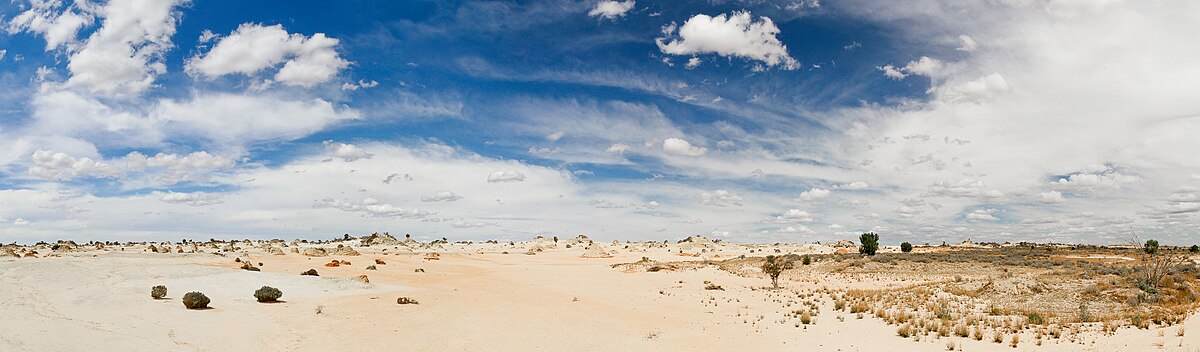
The oldest human skeletal remains in Australia come from the Willandra Lakes region of southwestern New South Wales, a system of now-dry Pleistocene lakes that was once a productive freshwater environment. The most significant remains are those of Mungo Lady (Lake Mungo 1, or LM1) and Mungo Man (Lake Mungo 3, or LM3), both recovered from the lunette dunes of Lake Mungo.7, 9 Mungo Lady, discovered by Jim Bowler in 1969, is one of the earliest known cremation burials in the world, with the partially cremated and fragmentary remains of a young woman dated to approximately 40,000 years ago.7 Mungo Man, discovered in 1974, was buried in an extended position with the hands clasped over the pelvis and the body covered with red ochre, and has been dated by multiple methods to approximately 40,000–42,000 years ago.7, 9
The Mungo remains are significant beyond their age. The cremation of Mungo Lady represents complex mortuary behavior requiring sustained high-temperature fire and deliberate post-mortem processing of the body, while the ochre-covered burial of Mungo Man implies ritual treatment of the dead at a remarkably early date.7 Together, the Mungo burials demonstrate that the people living in interior Australia by 40,000 years ago possessed a rich behavioral repertoire that included elaborate funerary practices, consistent with full behavioral modernity.7, 14
Genetic evidence
Genomic studies of Aboriginal Australians have provided critical insights into the timing and demographic history of the initial colonization. The first whole-genome sequence from an Aboriginal Australian, published by Rasmussen and colleagues in 2011, was derived from a century-old hair sample and revealed that Aboriginal Australians diverged from the ancestors of other Eurasian populations approximately 62,000–75,000 years ago, consistent with a very early dispersal from Africa to Australasia and one of the deepest population splits outside the continent.3, 10 A larger-scale study by Malaspinas and colleagues in 2016, sequencing 83 Aboriginal Australian and 25 Papuan genomes, confirmed this deep divergence and estimated the split between Aboriginal Australians and Papuans at roughly 25,000–40,000 years ago, corresponding to the period when rising sea levels began to separate Australia from New Guinea.2
One of the most striking findings from genetic research is the deep population continuity within Australia. Tobler and colleagues' 2017 analysis of 111 Aboriginal Australian genomes demonstrated that regional population structure within Australia extends back at least 50,000 years, with limited gene flow between geographically distant groups, indicating that after initial colonization the continent's populations remained remarkably stable in their geographic distributions for tens of thousands of years.13 Y-chromosome studies by Bergstrom and colleagues found that Aboriginal Australian Y-chromosome lineages are deeply divergent from all other known lineages, consistent with the population having been effectively isolated since initial colonization.15 These genetic patterns confirm that Aboriginal Australians represent one of the longest continuous human populations outside Africa.2, 13
Implications for human cognition and dispersal
The colonization of Australia carries profound implications for understanding the cognitive and technological capabilities of early Homo sapiens. The construction of watercraft capable of sustained open-ocean voyaging, the navigation required to identify and reach distant landmasses, and the social organization needed to sustain a founding population of over a thousand individuals all point to a species in full possession of modern cognitive faculties by at least 65,000 years ago, and possibly earlier.1, 11, 12 The ground-edge axes and ochre found in the earliest levels at Madjedbebe represent technologies that in other parts of the world appear much later, suggesting that the earliest Australians brought a sophisticated technological repertoire with them from their point of origin in mainland Asia or ultimately Africa.1, 14
The timing of Australian colonization also has implications for the relationship between human arrival and megafaunal extinction. Australia's Pleistocene megafauna, including giant marsupials such as Diprotodon, giant short-faced kangaroos, and the large monitor lizard Megalania, went extinct approximately 46,000 years ago according to the dating of Roberts and colleagues.8 If humans arrived by 65,000 years ago, as the Madjedbebe evidence suggests, then humans and megafauna coexisted for approximately 20,000 years before the megafauna disappeared, arguing against a model of rapid overkill and in favor of more gradual environmental transformation through landscape burning and hunting pressure over millennia.1, 8 The peopling of Australia thus stands as both a testament to early human ingenuity and a case study in the long-term ecological consequences of human colonization of new environments.8
References
New ages for the last Australian megafauna: continent-wide extinction about 46,000 years ago
The revolution that wasn't: a new interpretation of the origin of modern human behavior