Overview
- Humans are uniquely hairless among primates, a trait most likely driven by natural selection for enhanced thermoregulation as early hominins adopted upright postures and endurance activities in open, sun-exposed environments beginning roughly 1.5 to 2 million years ago.
- The evolution of a dense carpet of eccrine sweat glands across the body, capable of producing 2 to 4 liters of sweat per hour, gave Homo erectus and its descendants an unparalleled capacity for evaporative cooling that enabled sustained aerobic activity in midday heat when most predators and prey were forced to rest.
- Genetic evidence, including molecular dating of the divergence between head lice and clothing lice at approximately 70,000 to 170,000 years ago, constrains the timing of functional body hair loss and the subsequent adoption of clothing, while genes such as EDAR and keratin cluster variants have been linked to human hair follicle modification.
Humans are, among the roughly five thousand living species of mammals, conspicuously naked. While fine vellus hairs cover most of the body, the thick, pigmented terminal hair that insulates nearly all other primates has been reduced in humans to a few isolated patches—the scalp, axillae, and pubic region. This condition, sometimes called "functional hairlessness," has puzzled naturalists since Darwin, who considered it one of the most difficult traits to explain by natural selection alone.3 Over the past four decades, a convergence of biomechanical modelling, comparative physiology, genetics, and molecular clock evidence has produced a coherent explanation: the loss of body hair was driven primarily by selection for improved thermoregulation as early members of the genus Homo moved into open, equatorial habitats and adopted increasingly active foraging strategies that demanded efficient heat dissipation.
.png)
The naked ape problem
The question of why humans lost their body hair—the so-called "naked ape" problem—has generated a remarkably diverse set of hypotheses. Darwin himself suggested sexual selection, proposing that ancestral humans preferred less hairy mates and that this preference gradually reduced pelage density over generations. Others have invoked aquatic adaptation, ectoparasite avoidance, fire use, and even neoteny (the retention of juvenile features into adulthood).3, 12 The hypothesis that has accumulated the most empirical support, however, is the thermoregulatory model, which holds that hair loss evolved in concert with an expansion of eccrine sweat glands to create the most efficient evaporative cooling system in the mammalian world.1, 7
Understanding why this trait evolved requires appreciating the thermal challenge that faced early hominins. A large-bodied, bipedal primate foraging actively on the open African savanna during the hottest hours of the day would generate enormous metabolic heat. Without an effective mechanism for shedding that heat, core body temperature would rise to lethal levels within minutes of sustained exertion. The answer, unique among primates, was to strip away the insulating fur and replace it with a system of sweat-mediated evaporative cooling that could operate continuously over hours of sustained activity.1, 5
Eccrine sweat glands and evaporative cooling
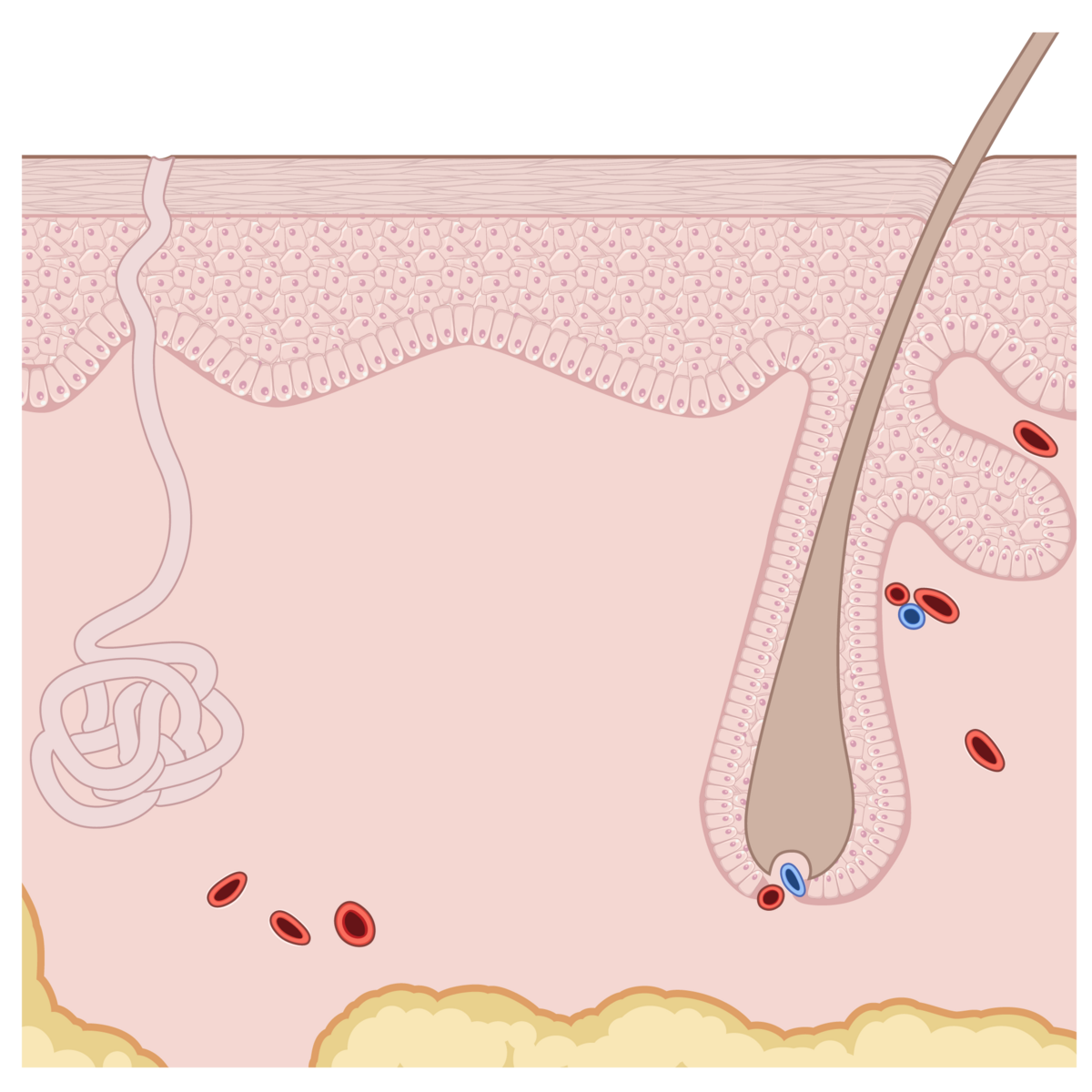
Mammals possess two principal types of sweat glands. Apocrine glands, found in the axillary and inguinal regions of humans, produce a viscous, lipid-rich secretion that is odorless until metabolized by skin bacteria. These glands are ancestral in mammals and are associated primarily with scent signalling rather than thermoregulation. Eccrine glands, by contrast, produce a dilute, watery fluid composed mainly of sodium chloride and water. In most mammals, eccrine glands are limited to the palms and soles, where they function to improve grip. In humans, however, eccrine glands blanket virtually the entire body surface at a density of 150 to 350 glands per square centimetre, for a total of approximately two to five million glands.3, 7, 13
This eccrine carpet gives humans a sweating capacity unmatched by any other mammal. Under conditions of maximal exertion in hot environments, a well-acclimatized human can produce 2 to 4 litres of sweat per hour, with some trained athletes exceeding this range during prolonged endurance exercise.13 Because evaporation of water from the skin surface requires energy (approximately 2,430 joules per gram at body temperature), this profuse sweating provides an extraordinarily effective heat sink. A human dissipating sweat at a rate of 1.5 litres per hour can shed roughly 1,000 watts of heat, enough to offset the metabolic heat production of vigorous running.1, 13
The efficiency of this evaporative system depends critically on the absence of dense body hair. Fur traps a boundary layer of humid air against the skin, drastically reducing the rate at which sweat can evaporate. In furred mammals, sweat either saturates the pelage and drips off wastefully or is prevented from reaching the surface altogether. By reducing body hair, early hominins allowed sweat to spread across exposed skin and evaporate directly into the moving air, maximizing the thermodynamic efficiency of each millilitre of fluid lost.1, 7
Wheeler's thermoregulatory model
The thermoregulatory hypothesis for human hair loss was developed most rigorously by Peter Wheeler in a series of influential papers in the 1980s and 1990s. Wheeler used biophysical modelling to calculate the radiative, convective, and evaporative heat exchange between a hominin body and the equatorial African environment. His models demonstrated that an upright, bipedal posture substantially reduced the solar radiation load on the body compared to a quadrupedal posture, because a vertical body presents a smaller cross-sectional area to the overhead sun during the hottest hours of the day. This reduction could amount to as much as 60 percent less direct solar radiation at midday.1, 2
Wheeler further showed that the benefits of bipedalism for thermal management were amplified enormously when combined with the loss of body hair and the expansion of eccrine sweating. A naked, bipedal hominin could maintain thermal balance during sustained locomotion in open grassland environments that would have been thermally lethal for a fur-covered quadruped of equivalent size. The model predicted that these thermoregulatory advantages would have been most pronounced in the hot, arid, and seasonally open habitats that expanded across East Africa during the late Pliocene and early Pleistocene, precisely the period and place where the genus Homo appears in the fossil record.1, 2
Nina Jablonski extended Wheeler's work by integrating it with the evolution of skin pigmentation. She argued that once body hair was lost, the newly exposed skin required protection from ultraviolet radiation, driving the evolution of dark, melanin-rich skin in equatorial populations. The subsequent evolution of human skin color variation as humans dispersed into higher latitudes is thus a secondary consequence of the initial thermoregulatory adaptation that stripped away the body's fur covering.3, 7
Persistence hunting and endurance running
The thermoregulatory hypothesis gains additional force from evidence that early Homo was adapted for endurance running. Bramble and Lieberman documented a suite of anatomical features in Homo erectus—including long legs, short toes, a well-developed Achilles tendon, enlarged gluteus maximus, a nuchal ligament stabilizing the head during running, and expanded semicircular canals for balance—that collectively indicate adaptation for sustained running over long distances. These features are absent in australopithecines and appear in the fossil record around 1.8 to 1.9 million years ago, roughly coinciding with the inferred timing of functional hair loss.5
The hypothesis of persistence hunting proposes that early humans exploited their thermoregulatory superiority to run down prey animals over long distances during the heat of the day. Most large African ungulates rely on panting to dissipate heat, a respiratory mechanism that is incompatible with galloping because the thoracic muscles involved in locomotion are also required for rapid breathing. A running quadruped must therefore alternate between sprinting and stopping to pant, while a sweating biped can run and cool simultaneously. By pursuing prey at a moderate pace through the midday heat, a human hunter could force the animal into repeated sprint–pant cycles until it collapsed from hyperthermia, a strategy documented ethnographically among the San people of the Kalahari, the Tarahumara of Mexico, and Aboriginal Australians.5
This scenario places the loss of body hair and the expansion of eccrine sweating at the centre of a suite of co-adapted traits—bipedalism, endurance running, hairlessness, and enhanced sweating—that together enabled a new ecological niche: the diurnal endurance predator.5, 7
Brain cooling requirements
The thermoregulatory demands of a large brain imposed an additional and perhaps even more critical constraint on hominin heat management. The human brain constitutes roughly 2 percent of body mass but consumes approximately 20 to 25 percent of resting metabolic energy, generating substantial heat in the process. Neural tissue is exquisitely sensitive to temperature: an increase of even 2 to 3 degrees Celsius above the normal core temperature of 37 degrees can cause confusion, seizure, and irreversible cell death. The evolution of the human brain, which tripled in volume between Australopithecus and modern Homo sapiens, therefore required increasingly effective mechanisms for keeping the brain cool.6
Dean Falk's "radiator hypothesis" proposed that the expansion of emissary veins—networks of blood vessels that pass through the skull bones and connect the intracranial venous system with superficial scalp veins—played a critical role in brain thermoregulation. When the body is hot, blood can be shunted through these emissary veins to the scalp surface, where it is cooled by evaporative heat loss before returning to the brain. This mechanism works best when the scalp and body are capable of vigorous sweating, which in turn requires the absence of insulating body hair over most of the body surface. Falk argued that the expansion of emissary veins, visible as enlarged foramina in fossil hominin skulls, preceded and enabled brain expansion by removing the thermal constraint that would otherwise have limited brain size.6
The retention of dense hair on the scalp itself is not contradictory to this model. Scalp hair, unlike body fur, functions as a radiation shield, reducing direct solar heating of the cranium while still allowing air circulation and evaporative cooling at the scalp surface. Measurements have shown that a covering of curly or tightly coiled hair, the ancestral state for equatorial human populations, is particularly effective at blocking solar radiation while maintaining an air gap above the scalp that promotes convective heat loss.3, 4
Genetics of hair reduction
The genetic basis of human functional hairlessness remains incompletely understood, in part because hair follicle density, thickness, and growth cycle are polygenic traits influenced by many loci with individually small effects. Humans and chimpanzees possess a roughly similar number of hair follicles per unit area of skin; the difference lies not in follicle number but in the miniaturization of most body hair follicles, which produce fine, short, unpigmented vellus hairs instead of the thick, pigmented terminal hairs typical of other great apes.3, 7
The gene EDAR (ectodysplasin A receptor) has attracted particular attention because a derived variant, V370A, which is nearly fixed in East Asian and Native American populations, has been shown experimentally to affect hair follicle morphology, sweat gland density, and mammary gland branching. Kamberov and colleagues demonstrated using transgenic mouse models that the 370A allele increases eccrine sweat gland density, thickens hair shafts, and alters hair follicle shape. This finding is significant because it shows that a single gene can simultaneously influence both hair characteristics and sweat gland output, suggesting that the evolutionary transition from fur-covered to sweating-dominated thermoregulation may have involved mutations at loci that jointly regulate both systems.11
Comparative genomic studies have identified accelerated evolution in keratin-associated protein genes and hair keratin gene clusters on human lineages relative to other great apes, consistent with relaxed constraint or positive selection on genes involved in hair structure. The MC1R gene, best known for its role in skin pigmentation, also influences hair colour and has been shown to be under strong purifying selection in African populations, likely reflecting its importance in melanin production for UV protection in exposed, hairless skin.7
Timing of hair loss in the hominin lineage
Because hair does not fossilize, the timing of functional body hair loss must be inferred from indirect evidence. Several lines of reasoning converge on the period between roughly 2 million and 1.2 million years ago, corresponding to the emergence and early dispersal of Homo erectus.
The most ingenious molecular dating approach exploits the biology of human lice. Humans harbour two subspecies of Pediculus humanus: the head louse (P. humanus capitis), which lives exclusively in scalp hair, and the body louse (P. humanus corporis), which lives and lays its eggs in clothing. The body louse is entirely dependent on clothing for its habitat and could not have evolved until its host began wearing garments. Kittler, Kayser, and Stoneking used mitochondrial DNA divergence rates to estimate that head lice and body lice diverged approximately 72,000 years ago, with wide confidence intervals.8 Toups and colleagues, using a larger dataset and nuclear loci, refined this estimate to approximately 83,000 to 170,000 years ago.9
This divergence date provides a minimum age for the habitual use of clothing, which in turn implies that by this time, humans had long since lost sufficient body hair to require clothing for thermal insulation in cooler environments. Because Homo sapiens populations in equatorial Africa would not have needed clothing for warmth, the adoption of garments is most plausibly associated with dispersal into temperate latitudes, suggesting that functional hairlessness was well established long before 170,000 years ago. The thermoregulatory demands of Homo erectus, with its modern body proportions, tropical habitat, and endurance-running adaptations appearing around 1.8 million years ago, provide the most likely selective context for the loss of body hair.5, 8, 9
Alternative hypotheses
While the thermoregulatory model commands the broadest support, several alternative or complementary hypotheses deserve consideration. The aquatic ape hypothesis, advanced most prominently by Elaine Morgan, proposed that early hominins passed through a semi-aquatic phase during which body hair was lost to reduce drag in water, subcutaneous fat was retained for insulation and buoyancy, and bipedalism developed for wading. Though the hypothesis attracted popular attention, it has been largely rejected by the paleoanthropological community on the grounds that it lacks direct fossil support, invokes an ecological scenario for which there is no archaeological evidence, and fails to account for the full suite of hominin adaptations more parsimoniously explained by terrestrial models.12
The ectoparasite reduction hypothesis proposes that hairlessness evolved because it reduced the body's burden of ticks, fleas, lice, and other parasites that shelter in dense fur. Rantala argued that parasite load was a significant selective pressure, particularly as hominins began living in larger social groups and fixed sleeping sites where ectoparasite transmission would have intensified. Under this model, individuals with less body hair would have harboured fewer parasites and suffered lower rates of vector-borne disease, conferring a survival advantage. While this hypothesis is plausible as a contributing factor, it struggles to explain the full magnitude of human hair reduction on its own and is better viewed as a supplementary benefit that reinforced selection already driven by thermoregulatory demands.10
Sexual selection, Darwin's original proposal, also likely played a role. Once the initial reduction in body hair occurred for thermoregulatory reasons, mate preferences may have amplified the trend, favouring individuals with smoother skin as indicators of health, youth, or parasite resistance. The difficulty with invoking sexual selection as the primary driver, however, is that it does not explain why hair loss would have been uniquely advantageous for hominins and not for other savanna-dwelling primates that were also subject to mate choice.3
Comparison with other primates
The uniqueness of human hairlessness becomes apparent when compared to other primates. Chimpanzees and gorillas, our closest living relatives, retain dense body hair despite occupying tropical environments. They thermoregulate primarily through behavioural means—resting in shade during the hottest hours, reducing activity, and seeking breezy locations—rather than through evaporative cooling. Chimpanzees do possess eccrine sweat glands, but at far lower densities than humans, and their sweating capacity is modest compared to that of even an untrained human.3, 7
This difference reflects a fundamental divergence in ecological strategy. Great apes are primarily forest-dwelling animals that avoid prolonged exposure to direct sunlight. Their fur insulates against heat gain in dappled forest environments and protects against radiative cooling at night. The hominin lineage, by contrast, moved into open woodland and grassland habitats where thermoregulatory demands were far more extreme, and where the selective premium on efficient evaporative cooling was correspondingly higher. The shift from a forest-adapted, behaviourally thermoregulating ape to an open-country, physiologically thermoregulating hominin was one of the most consequential ecological transitions in human evolutionary history, and the loss of body hair was its most visible signature.1, 3, 7
Among non-primate mammals, only a few lineages have evolved substantial hairlessness, and in each case the functional explanation differs. Elephants, hippopotamuses, and rhinoceroses are large-bodied animals with low surface-area-to-volume ratios that shed hair to facilitate radiative and convective heat loss. Naked mole-rats have lost their fur in adaptation to a subterranean, thermally stable environment. Cetaceans lost their hair as part of a comprehensive adaptation to aquatic life. None of these lineages evolved the eccrine sweating system that is the hallmark of the human thermoregulatory strategy, underscoring the distinctiveness of the hominin solution to the problem of heat management.3, 13
Synthesis
The loss of functional body hair in the human lineage is best understood not as a single adaptation but as one component of an integrated thermoregulatory system that co-evolved with bipedalism, eccrine sweating, dark skin pigmentation, and endurance locomotion. Wheeler's biophysical models established that the combination of upright posture and naked, sweating skin could maintain thermal homeostasis during sustained activity in equatorial open habitats. Bramble and Lieberman's work on endurance running demonstrated the anatomical context in which this thermoregulatory system would have been most strongly selected. Falk's radiator hypothesis explained how the same cooling system supported the metabolically expensive expansion of the brain. And molecular evidence from louse phylogenetics provided independent temporal constraints on when the transition to functional nakedness occurred.1, 5, 6, 8
The result is an animal uniquely adapted to sustained aerobic activity in hot environments: a sweating, hairless, bipedal endurance specialist whose thermoregulatory physiology set the stage for the large brains, long-distance dispersal, and persistence-based foraging strategies that came to define the genus Homo.
References
The loss of functional body hair in man: the influence of thermal environment, body form and bipedality
Origin of clothing lice indicates early clothing use by anatomically modern humans in Africa
Ecto- and endoparasites of humans: appraisal of the hypothesis of the reduction of body hair