Overview
- Crocodylomorphs are a clade of archosaur reptiles that originated in the Late Triassic approximately 230 million years ago as small, agile, fully terrestrial predators and subsequently diversified into an astonishing range of body plans including ocean-going marine predators, herbivorous armored forms, giant semi-aquatic apex predators, and gracile terrestrial runners — a morphological breadth that makes modern crocodilians a deeply unrepresentative sample of the group's evolutionary history.
- The clade survived the end-Triassic, end-Cretaceous, and end-Eocene extinction events while their close archosaur relatives the non-avian dinosaurs and pterosaurs did not, with selective survival likely favoring semi-aquatic generalists and freshwater-associated lineages whose habitats buffered them from the worst environmental disruptions.
- Modern crocodilians (alligators, crocodiles, and gharials) comprise only 28 living species descended from a single surviving lineage of the once far more diverse Crocodylomorpha, representing an extreme case of a clade whose present diversity drastically underestimates its evolutionary past.
Modern crocodilians — the alligators, crocodiles, and gharials that inhabit tropical and subtropical waterways today — are the last surviving representatives of a far more ancient and spectacularly diverse lineage. Crocodylomorpha, the clade encompassing all crocodilians and their extinct relatives, originated in the Late Triassic approximately 230 million years ago and has since produced an extraordinary range of body plans that bear little resemblance to the heavy-bodied, semi-aquatic ambush predators of the present day.1, 6 Over their 230-million-year history, crocodylomorphs have included small bipedal sprinters, fully marine predators with flippers and tail fins, armored herbivores, dog-sized terrestrial pursuit predators, and semi-aquatic giants exceeding 10 metres in length.2, 14 The 28 living species represent a sliver of this former diversity, and understanding crocodylomorph evolution requires looking far beyond their modern descendants to appreciate the clade’s remarkable adaptive range.
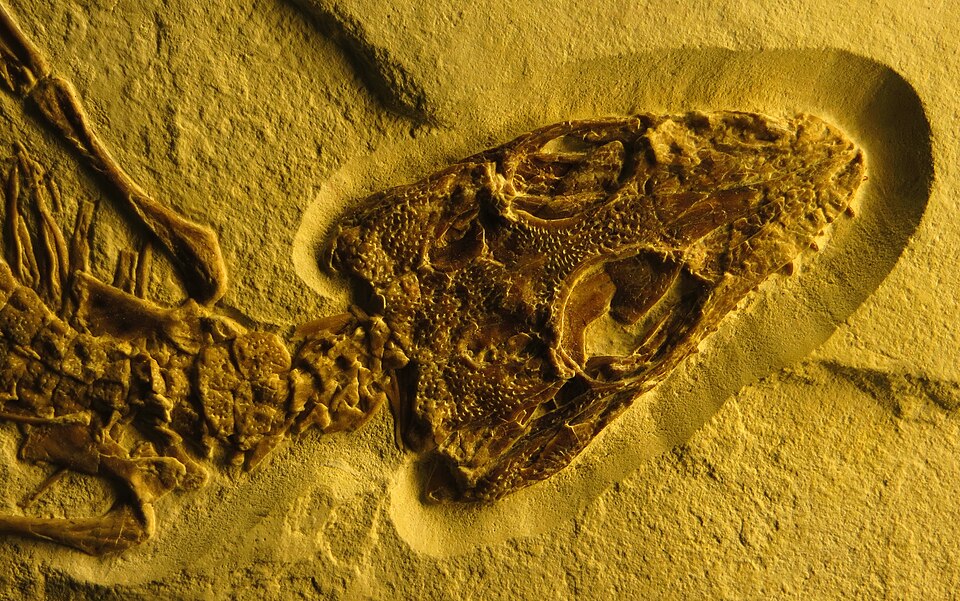

Archosaur origins and the earliest crocodylomorphs
Crocodylomorphs belong to the Archosauria, the group that also includes dinosaurs (and their descendants the birds) and the extinct pterosaurs. Within Archosauria, crocodylomorphs fall on the “crocodile-line” (Pseudosuchia), one of two major branches that diverged in the Early Triassic, the other being the “bird-line” (Avemetatarsalia) that gave rise to dinosaurs and pterosaurs.4 During the Triassic, pseudosuchians were the dominant large terrestrial predators, with groups such as the rauisuchids and aetosaurs filling ecological roles later occupied by theropod dinosaurs. Crocodylomorphs emerged within this pseudosuchian radiation as small-bodied forms near the end of the Triassic.4, 6
The earliest crocodylomorphs, such as Hesperosuchus and Terrestrisuchus from the Late Triassic of North America and Europe, would have been virtually unrecognizable as relatives of modern crocodilians. These animals were small (typically less than one metre long), lightly built, and fully terrestrial, with long limbs held in an erect posture beneath the body rather than sprawling to the sides.6, 11 Terrestrisuchus, known from Late Triassic fissure fills in Wales, was a gracile, long-legged animal probably capable of rapid pursuit of small prey — more greyhound than alligator in its proportions and locomotion.6 Pol and colleagues argued that these earliest crocodylomorphs were ecological generalists in a world dominated by larger pseudosuchian predators, and that their small body size and agility may have been key to surviving the end-Triassic extinction that eliminated most other pseudosuchian lineages.6, 1
Mesozoic diversity: marine, terrestrial, and everything between
The Jurassic and Cretaceous periods witnessed a remarkable diversification of crocodylomorphs into ecological roles with no modern analogue. Among the most striking were the thalattosuchians, a clade of marine crocodylomorphs that adapted to life in the open ocean. Metriorhynchids, the most specialized thalattosuchians, evolved paddle-like limbs, a hypocercal tail fin (with the vertebral column bending downward into the lower lobe of the tail), salt-excreting glands, and streamlined skulls with reduced or lost bony armor — a suite of adaptations convergent with those of marine reptiles such as ichthyosaurs and plesiosaurs.3, 7 Genera such as Dakosaurus bore massive, serrated teeth adapted for capturing large prey, leading some researchers to describe them as the “T. rex of the seas,” while smaller metriorhynchids like Rhacheosaurus were probably fish and squid specialists.7 Young and colleagues demonstrated that metriorhynchid body plans evolved rapidly during the Middle to Late Jurassic, with lineages independently evolving increasingly pelagic adaptations across multiple subclades.3, 7
On land, Cretaceous crocodylomorphs were equally diverse. The Notosuchia, a primarily Gondwanan radiation, produced a bewildering array of terrestrial forms. Simosuchus clarki, described by Turner and Sertich from the Late Cretaceous of Madagascar, was a small, heavily armored animal with a blunt, pug-nosed skull and leaf-shaped, multicusped teeth unmistakably adapted for herbivory — one of the most morphologically unexpected crocodylomorphs ever discovered.5 The baurusuchids of South America were large-headed, ziphodont (blade-toothed) terrestrial predators that occupied the apex predator niche in ecosystems where large theropod dinosaurs were absent or rare.16 Sereno and Larsson documented an assemblage of bizarre Cretaceous crocodylomorphs from the Sahara including Kaprosuchus (“boar croc”), with enlarged, tusk-like caniniform teeth, and Araripesuchus (“rat croc”), a small omnivore with heterodont dentition — demonstrating that crocodylomorph ecological diversity in the Cretaceous rivaled that of mammals in the Cenozoic.12
At the opposite end of the size spectrum, some semi-aquatic crocodylomorphs attained gigantic proportions. Sarcosuchus imperator, from the Early Cretaceous of Niger, reached an estimated length of 11 to 12 metres and a body mass of roughly 8 tonnes, making it one of the largest crocodylomorphs ever to have lived.9 In North America, Deinosuchus, an alligatoroid from the Late Cretaceous, grew to comparable sizes and occupied the apex predator role in coastal and estuarine environments, with bite marks on dinosaur bones demonstrating that it preyed on large terrestrial animals.10
Body plan evolution and the crocodylian bauplan
The characteristic body plan of modern crocodilians — dorsoventrally flattened skull, sprawling limbs, heavy dermal armor, and semi-aquatic lifestyle — is not the ancestral condition for Crocodylomorpha but rather a derived state that evolved convergently in multiple lineages. Wilberg, Turner, and Brochu demonstrated that the semi-aquatic, generalist predator bauplan characteristic of living crocodilians evolved independently at least three times within Crocodylomorpha, representing a recurring evolutionary solution to the challenges of freshwater ambush predation.14
Body size evolution within Crocodylomorpha has been far from linear. Turner and Nesbitt showed that the clade began small, with Triassic forms typically under 1.5 metres, and subsequently underwent multiple independent transitions to large body size in different lineages and different ecological contexts — marine thalattosuchians, terrestrial notosuchians, and semi-aquatic neosuchians all independently evolved large-bodied forms.11 The repeated evolution of large body size across disparate ecological settings suggests that crocodylomorph physiology and growth patterns were predisposed to gigantism given appropriate ecological opportunities, a pattern that contrasts with the more constrained body-size evolution of most modern reptile lineages.11
Surviving mass extinctions
One of the most remarkable aspects of crocodylomorph evolutionary history is the clade’s survival through multiple mass extinction events that decimated their archosaur relatives. The end-Triassic extinction approximately 201 million years ago eliminated most pseudosuchian lineages, including the large-bodied rauisuchids and the armored aetosaurs, yet small-bodied crocodylomorphs persisted and subsequently diversified into the ecological space left vacant.6, 1 The end-Cretaceous extinction 66 million years ago — which eliminated all non-avian dinosaurs and pterosaurs — again spared certain crocodylomorph lineages while devastating others. The marine thalattosuchians had already gone extinct by the Early Cretaceous, and the diverse terrestrial notosuchians were eliminated at or near the K-Pg boundary, but the freshwater and estuarine neosuchians — ancestors of modern crocodilians — survived.8, 13
Mannion and colleagues analyzed patterns of crocodylomorph diversity and extinction across the Mesozoic and Cenozoic, finding that the clade’s survival through the K-Pg event was associated with occupation of freshwater habitats, which are generally buffered from the catastrophic disruption of marine and terrestrial food webs caused by the Chicxulub impact.8 Stubbs and colleagues further demonstrated that extinction selectivity within Crocodylomorpha tended to eliminate ecologically specialized and morphologically extreme forms while preserving generalist lineages, a pattern that explains why the surviving crocodilians represent a narrow slice of the clade’s former ecological and morphological diversity.13
Cenozoic radiation and modern crocodilians
Following the end-Cretaceous extinction, crocodylomorphs experienced a significant Paleogene radiation. The Eocene epoch (56 to 34 million years ago) was a warm interval during which crocodilians ranged far beyond their present tropical and subtropical distribution, with fossils recovered from localities as far north as Ellesmere Island in the Canadian Arctic and northern Europe.2, 8 Eocene crocodilian diversity was substantially higher than today, with multiple lineages of alligatoroids, crocodyloids, and gavialoids coexisting across warm temperate to tropical environments worldwide.2
The progressive cooling of global climates through the late Eocene and into the Oligocene and Miocene gradually restricted crocodilian distributions toward the tropics, and the Pleistocene glaciations further contracted their ranges. Brochu documented that the modern pattern of crocodilian biogeography — with diversity concentrated in tropical freshwater habitats — is an artifact of Cenozoic climate deterioration rather than a reflection of inherent ecological limitation, since crocodilians thrived in high-latitude environments whenever global temperatures were sufficiently warm.2
The 28 living crocodilian species are divided among three families: Alligatoridae (alligators and caimans), Crocodylidae (true crocodiles), and Gavialidae (the gharial). Molecular and morphological phylogenetic analyses have debated the placement of the gharial (Gavialis gangeticus) and the false gharial (Tomistoma schlegelii), with morphological data typically placing them in separate families while molecular data groups them together, a discrepancy that remains one of the most persistent phylogenetic controversies in vertebrate systematics.2, 1 Whatever their precise relationships, the living species collectively represent only one of the many ecological strategies that crocodylomorphs have explored over their 230-million-year history — a powerful reminder that the present is a poor guide to the evolutionary past of even the most familiar animal groups.14
References
A new metriorhynchid crocodylomorph from the Oxford Clay Formation (Callovian, Middle Jurassic) of England
Crocodylomorph body size evolution: constraints, transitions, and punctuated equilibrium
Selective extinction against redundant species dampens the ecological impact of mass extinctions on Crocodylomorpha
The ecological history of crocodylomorphs and the evolution of the modern crocodylian body plan