Overview
- Dorudon atrox was a fully aquatic archaeocete whale from the Late Eocene (approximately 40–37 million years ago), approximately 5 meters in length, that retained tiny but anatomically complete hind limbs incapable of supporting the animal on land, providing key evidence for the evolutionary transition from semi-aquatic to fully aquatic cetaceans.
- The inner ear of Dorudon shows critical adaptations for underwater hearing, including a pachyosteosclerotic (dense and thickened) tympanic bulla acoustically isolated from the skull, a configuration necessary for directional hearing in water and a hallmark of the fully aquatic cetacean condition.
- Dorudon was long confused with juvenile Basilosaurus until Gingerich and colleagues demonstrated in 1990 that the two were distinct genera, with Dorudon more closely representing the ancestral body plan from which modern whale lineages, both odontocetes and mysticetes, likely diverged.
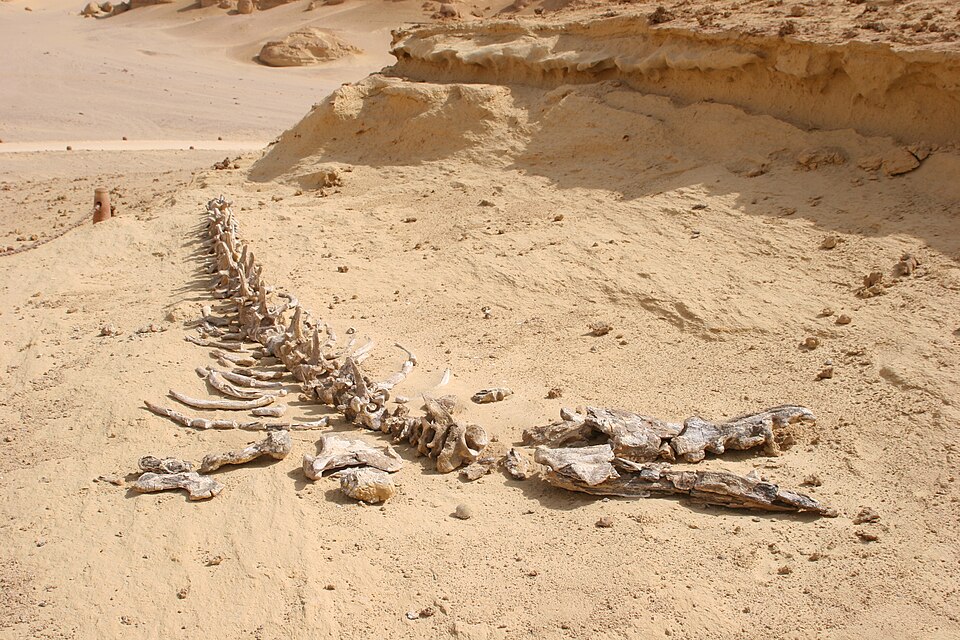
Dorudon is an extinct genus of basilosaurid archaeocete whale from the Late Eocene epoch, approximately 40 to 37 million years ago, known primarily from exceptionally preserved fossils in the Birket Qarun Formation of the Fayum Depression, Egypt, a site now designated the UNESCO World Heritage Site of Wadi Al-Hitan (Valley of the Whales).3, 4, 16 The best-known species, Dorudon atrox, was a fully aquatic whale approximately 5 meters in total length that retained small but anatomically complete hind limbs, a vestigial pelvis, and an inner ear transitional between the terrestrial mammalian condition and the fully aquatic configuration of modern cetaceans.3, 4 As a relatively generalized basilosaurid that represents the body plan from which both modern whale suborders, Odontoceti (toothed whales) and Mysticeti (baleen whales), likely descended, Dorudon occupies a pivotal position in the evolutionary history of whales and stands as one of the most informative transitional fossils in the vertebrate record.4, 15

Discovery and distinction from Basilosaurus
Fossils now attributed to Dorudon were collected from Egyptian Eocene deposits beginning in the early twentieth century, but for decades they were misidentified as juvenile specimens of Basilosaurus, the much larger archaeocete (up to 18 meters long) from the same formations.3, 11 The distinction between the two genera was established by Philip Gingerich and colleagues in 1990, who demonstrated that the specimens previously attributed to juvenile Basilosaurus possessed dental and cranial features inconsistent with ontogenetic variation within a single species, including differences in vertebral morphology, tooth structure, and skull proportions that indicated a separate, smaller-bodied genus.2 Mark Uhen's comprehensive monograph on Dorudon atrox, published in 2004, provided a detailed osteological description based on multiple nearly complete skeletons and confirmed the genus as taxonomically distinct, phylogenetically close to but separate from Basilosaurus.3, 4
The recognition of Dorudon as a distinct genus was significant because it demonstrated that the Eocene seas supported a diversity of archaeocete whales spanning a wide range of body sizes and ecological roles, rather than being dominated by a single giant species.4, 15 Wadi Al-Hitan preserves hundreds of whale skeletons, predominantly Dorudon and Basilosaurus, in shallow marine sediments that document a nearshore to open-marine paleoenvironment, and the site has yielded some of the best-preserved archaeocete material in the world.4, 16
Vestigial hind limbs
The hind limbs of Dorudon are among the most important features of its anatomy for understanding cetacean evolution. Each hind limb consisted of a reduced but anatomically identifiable femur, tibia, fibula, tarsals, metatarsals, and phalanges, retaining the basic structural plan of a terrestrial mammalian leg in miniature but far too small (approximately 13 centimeters in total length) to have supported the animal's weight on land or contributed meaningfully to aquatic locomotion.4, 13 The pelvis was reduced and no longer articulated with the vertebral column, having lost the sacroiliac joint that in terrestrial mammals transmits the forces of hindlimb locomotion to the spine.4 These vestigial hind limbs represent a late stage in the progressive reduction of the hindquarters that characterizes the land-to-sea transition in cetaceans, a process documented by a series of intermediate forms including the semi-aquatic Ambulocetus (which used its large hind limbs for swimming), the more aquatic Rodhocetus (with reduced but still substantial hind limbs), and ultimately modern cetaceans, in which external hind limbs are entirely absent.7, 8, 12
The function, if any, of the vestigial hind limbs in Dorudon has been debated. Gingerich suggested they may have served as claspers during mating, based on the observation that the limbs show sexual dimorphism in some specimens and that their position relative to the body would have placed them near the genital region.2, 13 However, the limbs may equally have been non-functional vestiges retained simply because insufficient evolutionary time had passed for complete loss, a process that was completed in the odontocete and mysticete lineages that descended from basilosaurid-grade ancestors.4, 15
Inner ear and underwater hearing
The evolution of hearing is central to the cetacean transition from land to water, because sound propagation differs fundamentally between air and water, and the mammalian ear as inherited from terrestrial ancestors is poorly suited for directional hearing underwater.5, 14 In terrestrial mammals, sound is conducted to the inner ear via the external ear canal, tympanic membrane, and middle ear ossicles, and the tympanic bulla (the bony housing of the middle ear) is firmly fused to the skull, a configuration that works well in air but creates acoustic interference underwater because sound conducted through the skull bones reaches both ears simultaneously, destroying directional cues.5
The tympanic bulla of Dorudon shows a suite of adaptations intermediate between the terrestrial condition and the fully aquatic configuration of modern cetaceans. The bulla is pachyosteosclerotic, meaning the bone is unusually dense and thick, a specialization that provides acoustic isolation by creating an impedance mismatch between the bulla and the surrounding skull bones, allowing each ear to receive sound independently and thus enabling directional hearing underwater.3, 5 Sirpa Nummela and colleagues documented this progression in a landmark 2004 study that compared the hearing apparatus across a series of Eocene cetaceans, from the land-dwelling Pakicetus (which retained a terrestrial-type ear) through the amphibious Ambulocetus and Remingtonocetus to the fully aquatic Dorudon and modern whales, demonstrating a stepwise acquisition of aquatic hearing adaptations that closely parallels the locomotor transition from land to sea.5 In Dorudon, the external auditory meatus (ear canal) was reduced but still present, suggesting that the animal may have retained some capacity for hearing in air, though underwater hearing was almost certainly the dominant sensory mode.3, 5
Ecology and paleoecology
The dentition of Dorudon was heterodont, retaining differentiated incisors, canines, premolars, and molars, a condition inherited from terrestrial ancestors and retained in early whales but subsequently lost in modern odontocetes (which have homodont, cone-shaped teeth) and mysticetes (which replaced teeth with baleen).3, 4 The cheek teeth bore multiple cusps with shearing surfaces, indicating a diet of fish and possibly cephalopods, and the skull morphology suggests a relatively generalized predatory ecology.3 Dorudon is commonly found alongside Basilosaurus in the same deposits, and there is evidence that Basilosaurus preyed on Dorudon: several Dorudon skulls from Wadi Al-Hitan bear bite marks matching the tooth morphology of Basilosaurus, particularly on juvenile individuals, suggesting that young Dorudon were a significant prey item for the larger archaeocete.4, 11
The abundance of Dorudon fossils at Wadi Al-Hitan, including many juveniles and sub-adults, has been interpreted as evidence that the area served as a calving and nursery ground, analogous to the warm, shallow-water calving areas used by many modern whale species.4, 16 If correct, this implies that Dorudon already exhibited the migratory calving behavior that is a hallmark of modern cetacean ecology, representing yet another aspect of the modern whale lifestyle that was established before the divergence of the two living suborders.4, 15
Evolutionary significance
Dorudon occupies a critical position in cetacean phylogeny. Cladistic analyses consistently place it within the Basilosauridae, close to the node from which the two modern cetacean suborders diverged, making it one of the best available models for the ancestral body plan of crown-group Cetacea.4, 15 Unlike the highly elongated and probably serpentine Basilosaurus, which was likely a specialized apex predator with derived vertebral morphology, Dorudon possessed a more generalized body plan with a proportional relationship between skull size and body length that is closer to the condition seen in early odontocetes and mysticetes.3, 4, 11 Mark Uhen argued that the ancestor of modern whales was more likely a Dorudon-like animal than a Basilosaurus-like one, based on the derived nature of Basilosaurus body proportions and the closer correspondence of Dorudon cranial and dental features to the ancestral condition inferred for crown-group cetaceans.4, 15
Together with other key transitional cetaceans, from the terrestrial Pakicetus through the amphibious Ambulocetus and Rodhocetus to the fully aquatic basilosaurids, Dorudon is part of one of the most complete evolutionary transitions documented in the fossil record, tracking the transformation of a small, terrestrial artiodactyl into a fully marine mammal over approximately 15 million years of Eocene evolution.7, 8, 10 Its vestigial hind limbs, transitional inner ear, heterodont dentition, and generalized body plan make it an essential specimen for understanding how the distinctive features of modern whales were assembled, step by step, from the ancestral mammalian condition.3, 4, 5
References
Form, function, and anatomy of Dorudon atrox (Mammalia, Cetacea): an archaeocete from the middle to late Eocene of Egypt
Basilosaurus isis (Mammalia, Cetacea): new observations and a reevaluation of the skull
New protocetid whale from the middle Eocene of Pakistan: birth on land, precocial development, and sexual dimorphism
Locomotion in early whales: biomechanical analysis of the pelvic region and hind limb of Basilosaurus and Dorudon