Overview
- Dromaeosauridae were a family of small to medium-sized feathered theropod dinosaurs characterized by a hyperextensible second toe bearing a large, sickle-shaped claw, which was likely used for pinning prey rather than slashing, as once assumed.
- Discoveries of exquisitely preserved specimens such as Microraptor gui with asymmetric flight feathers on all four limbs have demonstrated that dromaeosaurs were among the most bird-like of all non-avian dinosaurs, occupying a phylogenetic position immediately outside Avialae and providing critical evidence for the dinosaurian origin of birds.
- The popular image of pack-hunting 'raptors' remains poorly supported by direct fossil evidence; while some multi-individual death assemblages exist, taphonomic analysis suggests these may reflect aggregation rather than cooperative hunting behavior.
Dromaeosauridae are a family of theropod dinosaurs that lived from the Middle Jurassic to the end of the Cretaceous, approximately 167 to 66 million years ago, and are among the closest non-avian relatives of birds.1, 10 Commonly called "raptors" in popular culture — a usage popularized by the 1993 film Jurassic Park, though scientifically imprecise — dromaeosaurs are defined by a suite of shared derived characters including a stiffened tail reinforced by elongate bony rods (prezygapophyses), a specialized wrist joint allowing a wing-folding motion, and most distinctively, an enlarged, recurved claw on the second toe that could be hyperextended upward during locomotion and rapidly flexed downward during predation.3, 10 The discovery and description of Deinonychus antirrhopus by John Ostrom in 1969 was a pivotal event in the history of theropod paleontology, as it provided some of the first compelling evidence that at least some dinosaurs were agile, active predators rather than sluggish reptiles, helping to catalyze the "Dinosaur Renaissance" that transformed scientific and public understanding of the group.3
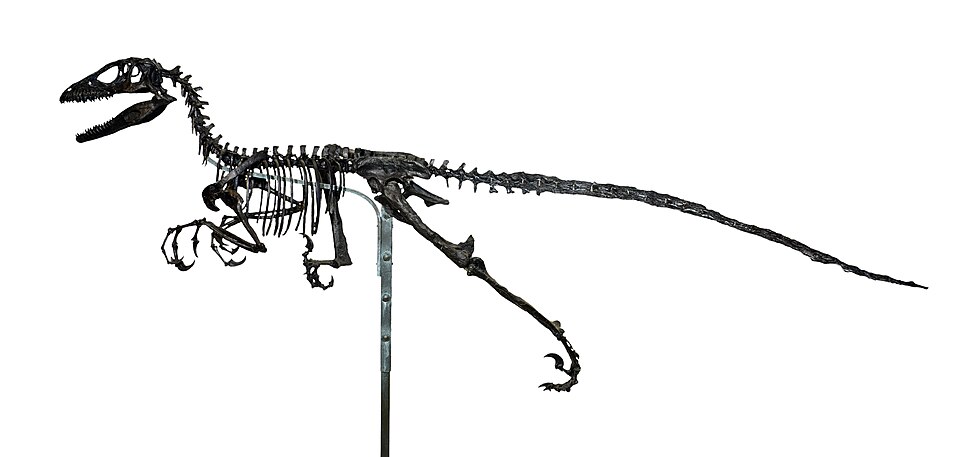

Anatomy and the sickle claw
The dromaeosaur body plan is that of a lightly built, bipedal predator with relatively long arms, three-fingered grasping hands, a large head bearing serrated teeth, and a distinctive tail stiffened along most of its length by bundles of ossified tendons and elongated prezygapophyses.1, 10 This tail stiffening has been interpreted as an adaptation for dynamic balance during high-speed maneuvers, functioning as an inertial stabilizer analogous to the tail of a cheetah.3 The forelimbs were proportionally long and bore a semilunate carpal bone in the wrist that permitted the hand to fold tightly against the body — the same mechanism that allows modern birds to fold their wings, and strong evidence of shared ancestry.8, 10
The most iconic feature of dromaeosaurs is the enlarged, sickle-shaped ungual on pedal digit II, which in life was sheathed in a keratinous claw significantly larger than the underlying bone.3 Ostrom originally proposed that this claw was used to slash at prey in a kicking motion, but more recent biomechanical analyses by Fowler and colleagues have challenged this interpretation.12 Fowler's "raptor prey restraint" model, based on comparison with the predatory mechanics of modern accipitrid hawks and owls, argues that the sickle claw functioned primarily as a pinning device: the dromaeosaur would leap onto prey, grip it with the claws of both feet (the sickle claw penetrating to hold the animal in place), and then use its body weight and flapping forearms to maintain balance while consuming the still-living victim — a predatory strategy strikingly similar to that of extant raptorial birds.12 The famous "fighting dinosaurs" specimen from Mongolia, which preserves a Velociraptor locked in combat with a Protoceratops, is broadly consistent with this model: the Velociraptor's sickle claw is embedded in the throat region of the ceratopsian rather than having been used in a slashing motion.11
Feathered dromaeosaurs
Beginning in the late 1990s, a series of spectacular fossil discoveries from the Yixian and Jiufotang formations of Liaoning Province, China, demonstrated unambiguously that dromaeosaurs bore feathers — in many cases, feathers structurally identical to those of modern birds.8, 5 The most dramatic of these discoveries was Microraptor gui, described by Xu Xing and colleagues in 2003, which possessed asymmetric pennaceous feathers not only on its arms but also on its hindlimbs, producing a "four-winged" configuration that may have been used for gliding or rudimentary powered flight.5 The asymmetry of the feather vanes — with a narrower leading edge and broader trailing edge — is a hallmark of aerodynamic function in modern birds and indicated that these feathers were not merely for display or insulation.5, 8
Subsequent discoveries reinforced the conclusion that feathers were widespread or universal in dromaeosaurs. Quill knobs — bony attachment points for large wing feathers — have been identified on the ulna of Velociraptor mongoliensis, a species from the arid Late Cretaceous of Mongolia where soft-tissue preservation is almost nonexistent, demonstrating that even dromaeosaurs known only from skeletal material bore well-developed pennaceous feathers in life.15, 10 The closely related troodontids, which together with dromaeosaurs form the clade Deinonychosauria (or Paraves in some phylogenies), also bore feathers, and the boundary between feathered non-avian dinosaurs and the earliest birds such as Archaeopteryx has become increasingly blurred as more specimens are described.4, 8
Key genera and diversity
Deinonychus antirrhopus, from the Early Cretaceous (Aptian–Albian) Cloverly Formation of Montana and Wyoming, remains one of the most thoroughly studied dromaeosaurs. Reaching approximately 3.4 meters in length and an estimated 70 to 100 kilograms in mass, Deinonychus was a mid-sized predator whose detailed osteology, as described by Ostrom, provided the anatomical foundation for the theropod origin of birds hypothesis.3, 14 Velociraptor mongoliensis, from the Late Cretaceous Djadokhta Formation of Mongolia, was considerably smaller — roughly two meters long and 15 to 20 kilograms — and is known from multiple well-preserved specimens including the iconic fighting dinosaurs fossil.15, 9
Microraptor, from the Early Cretaceous of China, represents the small-bodied, arboreal end of the dromaeosaur spectrum. At less than one meter in length and perhaps one kilogram in mass, Microraptor was among the smallest known non-avian dinosaurs, and its four-winged morphology suggests an ecological role quite different from the ground-based pursuit predator traditionally envisioned for dromaeosaurs.5 At the opposite extreme, Utahraptor ostrommaysi from the Early Cretaceous of Utah reached an estimated five to seven meters in length, making it the largest known dromaeosaur and demonstrating the family's capacity for significant body-size variation.1 Gondwanan dromaeosaurs such as Buitreraptor gonzalezorum from Patagonia, with its gracile skull and unusually small teeth, indicate that the family achieved a global distribution and diversified into ecological niches quite different from those occupied by their Laurasian relatives.7
The pack hunting debate
The idea that dromaeosaurs hunted cooperatively in packs was popularized by Ostrom's original description of Deinonychus, in which he noted that multiple individuals were found associated with the ornithopod Tenontosaurus tilletti and suggested coordinated predation on prey much larger than any single dromaeosaur could subdue.3 This hypothesis captured the public imagination and became a staple of dinosaur media, but subsequent taphonomic analysis has cast significant doubt on the cooperative hunting interpretation. Roach and Brinkman's 2007 study of the Deinonychus–Tenontosaurus bonebeds found that the evidence was more consistent with mobbing behavior or competitive aggregation around a carcass — analogous to the feeding behavior of Komodo dragons or crocodilians — than with mammalian-style cooperative pack hunting.13
Roach and Brinkman further noted that among living diapsid reptiles and birds, true cooperative hunting is extremely rare and phylogenetically restricted, making it an unlikely ancestral condition for dromaeosaurs.13 While some subsequent discoveries of multi-individual dromaeosaur trackways have been cited as possible evidence for gregarious behavior, these do not necessarily imply coordinated hunting as opposed to simple aggregation at water sources or along game trails.10 The question remains open but the balance of evidence currently favors individual or opportunistic group predation rather than the sophisticated pack tactics often depicted in popular media.
Phylogenetic position and the bird connection
Dromaeosauridae are placed within Maniraptora, the clade of theropods most closely related to birds, and within Maniraptora they are grouped with Troodontidae in the clade Deinonychosauria, which is the sister group to Avialae (the clade containing Archaeopteryx and all modern birds).10, 8 This phylogenetic position means that dromaeosaurs share a more recent common ancestor with birds than do any other non-avian dinosaurs, and it explains the extraordinary number of anatomical similarities between the two groups: feathered integument, a furcula (wishbone), hollow pneumatized bones, a semilunate carpal permitting wing folding, and in some taxa evidence of brooding behavior over nests.8, 6
The phylogenetic proximity of dromaeosaurs to birds has raised the question of whether flight evolved once at the base of Paraves and was subsequently lost in dromaeosaurs, or whether the flight-related features of dromaeosaurs represent independent evolutionary "experiments" in a lineage that was ancestrally flightless. The discovery of Microraptor and other four-winged paravians has been interpreted by some researchers as evidence that the ancestors of dromaeosaurs and birds passed through a four-winged gliding stage, with true powered flight evolving only in the avian lineage while dromaeosaurs either lost or never fully achieved it.5, 4 The transition from non-avian maniraptoran to bird was not a single leap but a mosaic process in which different flight-related features were assembled incrementally across several related lineages, of which Dromaeosauridae was one of the most important.10, 8
References
A new dromaeosaurid (Dinosauria: Theropoda) from the Upper Cretaceous Djadokhta Formation of Mongolia
Raptor prey restraint and kill mechanics: implications for the predatory ecology and behaviour of dromaeosaurids
An exceptionally preserved Deinonychus specimen and the early evolution of avian-style digitigrady
The phylogenetic position of the Tyrannosauridae: implications for theropod systematics