Overview
- Proboscideans originated in Africa during the late Paleocene and early Eocene as small, trunkless mammals, and over the following 55 million years diversified into more than 170 species spanning every continent except Antarctica and Australia, including four-tusked gomphotheres, down-tusked deinotheres, shovel-jawed platybelodons, and the iconic mammoths of the Pleistocene.
- The trunk left no direct trace in the fossil record, but progressive retraction of the nasal bones and enlargement of the nasal opening in successive proboscidean skulls indicate that elongation of the nose and upper lip into a muscular proboscis was a gradual process driven by the mechanical demands of reaching food while supporting an increasingly heavy head.
- Ancient DNA extracted from frozen mammoth remains confirms that the woolly mammoth’s closest living relative is the Asian elephant rather than the African elephant, a relationship supported by molecular clock analyses placing the mammoth–Asian elephant divergence at approximately 5–6 million years ago.
Proboscideans — the order that encompasses living elephants, the extinct mammoths, mastodons, and a rich diversity of vanished relatives — represent one of the most thoroughly documented adaptive radiations in the fossil record. The order originated in Africa at a time when that continent was an isolated island landmass, diversified explosively during the Eocene and Oligocene, and ultimately spread across every major continent except Antarctica and Australia, reaching their greatest species richness during the Miocene and Pliocene before a catastrophic Pleistocene decline left only three living species.4 Their evolution is marked by remarkable convergences and elaborations: progressive molarization of the teeth, repeated independent evolution of tusks from both upper and lower incisors, and the gradual development of the trunk, an organ so anatomically complex that it incorporates over 40,000 individual muscle fascicles yet leaves almost no direct trace in the fossil record. Proboscidean history, spanning approximately 60 million years, is a story of giants adapting to changing climates, migrating across newly connected continents, and ultimately succumbing to a combination of environmental instability and human hunting pressure at the close of the last ice age.
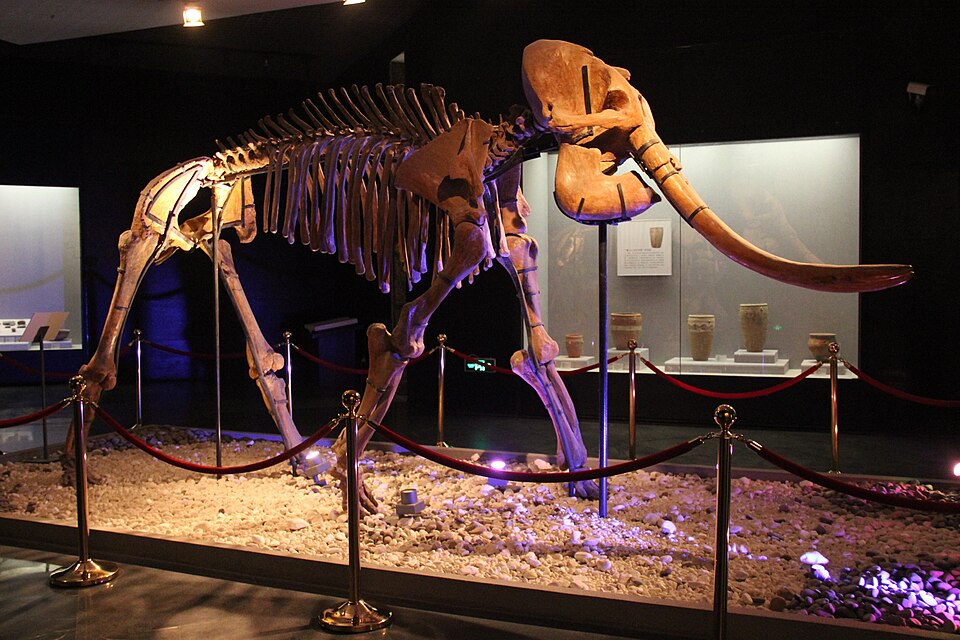

Origins: the earliest proboscideans
The deepest roots of the proboscidean lineage were established in Africa during the late Paleocene. Eritherium azzouzorum, described from phosphatic deposits in the Ouled Abdoun Basin of Morocco and dated to approximately 55–60 million years ago, is currently the oldest known proboscidean. Known from jaw fragments, teeth, and partial skull material, Eritherium was a small animal with a body mass estimated at around 5 kilograms — roughly the size of a domestic cat. Its teeth already showed derived features linking it to later proboscideans, including bilophodont molars with transversely oriented ridges, but in overall body plan it would have resembled a generalized Paleocene placental mammal with no suggestion of the trunk or tusks that define later members of the order.1
Slightly younger but better known is Phosphatherium escuilliei, also from the Ouled Abdoun phosphates of Morocco and dating to approximately 56 million years ago in the early Eocene. Phosphatherium is known from more complete dental material and shares with Eritherium the bilophodont molar pattern that characterizes proboscideans throughout their history. Both genera belong to a paraphyletic grade of early African ungulates that also gave rise to hyraxes and sirenians, groupings collectively known as Afrotheria, and their African origin is consistent with the geographic isolation of that continent during the Paleocene and early Eocene, when it was separated from Eurasia by the Tethys Sea.2 Neither Eritherium nor Phosphatherium possessed any anatomical indication of a trunk: their nasal bones extended to the front of the skull in the manner of typical small mammals, and their limb proportions indicate fully terrestrial, cursorial habits rather than the graviportal stance of later proboscideans.
Moeritherium and the early radiation
Moeritherium, known from Eocene deposits of Egypt, Libya, and Senegal and dating from approximately 37 to 35 million years ago, represents an important but enigmatic early stage in proboscidean evolution. Pig-sized and estimated at 235 kilograms, Moeritherium had a low, elongated skull and teeth that, while showing clear proboscidean affinities, retained a more generalized ungulate character than those of later members of the order.3 The nasal bones of Moeritherium were somewhat retracted compared to the earliest proboscideans, hinting at the beginning of the facial restructuring that would eventually produce the trunk, though the degree of retraction was far less than in later forms. Its skeletal proportions — short limbs, dense bones, and broad feet — are consistent with a semi-aquatic lifestyle analogous to that of a modern tapir or hippopotamus, and the depositional environments in which its fossils occur, predominantly coastal swamps and deltaic sediments, reinforce this interpretation.
Whether Moeritherium lies on the direct ancestral line to later proboscideans or represents a divergent side branch has been debated. Cladistic analyses consistently place it as either the most basal proboscidean or as the sister group of all other members of the order, and in either case it preserves anatomy close to the ancestral condition from which the spectacular diversity of the Oligocene and Miocene radiation emerged.4 By the Oligocene, more derived forms with clearly elongated skulls, the earliest incipient tusks, and larger body sizes had appeared across Africa, documenting the rapid morphological elaboration of the lineage once the continent began re-establishing terrestrial connections with Eurasia across the closing Tethys Sea.
The Miocene radiation: gomphotheres, deinotheres, and platybelodons
The most spectacular phase of proboscidean diversification unfolded during the Miocene, roughly 23 to 5 million years ago, as the order spread from Africa into Eurasia, and eventually into the Americas via the Bering land bridge. This radiation produced at least six distinct families with strikingly different tusk morphologies, skull proportions, and dietary adaptations, making the Miocene the golden age of proboscidean diversity.
The Gomphotheriidae, often called four-tusked mastodons, were the most ecologically successful Miocene proboscideans and the group that ultimately colonized the Americas. Gomphotheres possessed both upper and lower tusks, the latter formed from the second lower incisors, giving them a formidable four-tusked appearance. The lower tusks were variable in form across genera: in some they were straight and pointed for digging; in others they were flattened and spatulate; in still others they were reduced and eventually lost in derived lineages. Gomphothere molars showed a progression from the simple bilophodont pattern of early proboscideans toward more complex, multi-ridged teeth suited to processing a variety of vegetation, and their success across multiple continents attests to a generalist browsing and digging ecology well suited to the diverse forest and woodland environments of the Miocene.4
The Deinotheriidae represent one of the most anatomically distinctive of all proboscidean families. Deinotheres lacked upper tusks entirely; instead, their lower jaw bore a pair of large, downward-curving tusks that hooked back toward the chest. The function of these unusual tusks has been debated for over a century: proposed uses include stripping bark from trees, anchoring the animal while it pulled branches down with its trunk, or digging up roots and tubers. Deinotherium giganteum, one of the largest species, stood approximately 4 metres at the shoulder and may have exceeded 10 metric tons, making it among the largest land mammals ever to exist. Deinotheres first appear in the early Miocene of Africa and persist until the early Pleistocene, a longevity of some 20 million years that suggests a highly successful ecological strategy.5
Platybelodon, a gomphothere from the Miocene of Central Asia and China, carries among the most bizarre feeding adaptations in proboscidean history. Its lower jaw was dramatically flattened and broadened into a shovel-shaped structure, with the lower tusks forming a broad, spade-like blade. For decades this anatomy was interpreted as an adaptation for scooping aquatic vegetation from lakebeds and river margins, consistent with the waterlogged depositional environments in which platybelodon fossils are typically found. More recent biomechanical analysis of wear patterns on the tusks suggests an alternative: the lower jaw functioned as a bark-stripping or branch-cutting tool, with the trunk and lower jaw working together to slice vegetation rather than scoop sediment.6 Whatever the precise feeding mechanism, Platybelodon illustrates the remarkable morphological experimentation that characterized proboscidean evolution during the Miocene, with multiple lineages independently exploring the ecological possibilities opened by having both a mobile trunk and elaborated tusks.
The evolution of the trunk
The proboscidean trunk is the most anatomically elaborate nose of any mammal, incorporating the fused upper lip and elongated nasal passages into a muscular, prehensile structure capable of lifting hundreds of kilograms, detecting scents across kilometres, and performing precise manipulations delicate enough to pick up a single blade of grass. Yet the trunk is composed entirely of soft tissue and leaves essentially no direct record in the fossil record: no impressions, no mineralized structures, no associated bones. Its evolutionary history must therefore be reconstructed entirely from the indirect evidence preserved in skull morphology.4
The key skeletal indicator is the position and size of the nasal opening on the skull. In small-bodied early proboscideans such as Eritherium and Phosphatherium, the nasal bones extended to the front of the face and the bony nasal opening was positioned anteriorly, as in typical small mammals. Through the Eocene and Oligocene, successive proboscidean lineages show progressive retraction of the nasal bones, moving the bony nasal opening further back along the skull roof. This retraction reflects the elongation of the cartilaginous and muscular components of the nose ahead of the bony skull. By the time of Moeritherium in the late Eocene, modest retraction was already apparent. In Miocene gomphotheres and deinotheres, the nasal opening had moved substantially posteriorly. In living elephants and their immediate fossil predecessors, the nasal opening sits near the top of the skull between the orbits, far removed from the front of the face, and the nasal bones are vestigial structures. This progressive posterodorsal migration of the nares, mapped across dozens of proboscidean taxa and correlated with increasing skull size and upper tusk development, is the primary evidence that trunk elongation was gradual rather than a sudden evolutionary event.4
The selective pressure driving trunk evolution is understood in terms of a functional dilemma posed by increasing skull size and the development of upper tusks. As proboscideans grew larger and their upper incisors were elaborated into tusks, the skull became progressively heavier and was elevated higher above the ground. A short nose and neck would make ground-level foraging increasingly difficult as body size increased. Elongation of the nose and upper lip into a prehensile trunk resolved this tension elegantly: the animal could support its massive head on a shortened, reinforced neck while still reaching the ground, water, and overhead vegetation through the flexible reach of the trunk. The co-evolution of trunk length, skull size, tusk development, and neck shortening is thus a mechanically integrated complex rather than a collection of independent traits.4
Stegodontidae and the origin of Elephantidae
The Stegodontidae, a family appearing in the late Miocene and persisting into the Pleistocene across Africa and Asia, occupy a pivotal position near the origin of true elephants. Stegodontids possessed high-crowned, multi-ridged molars that superficially resemble those of true elephants but differ in important details of ridge morphology and hypsodonty. For much of the twentieth century, stegodontids were considered potential ancestors of Elephantidae, but current cladistic analyses generally place them as a separate lineage that evolved molar complexity convergently rather than ancestrally to true elephants.7
The family Elephantidae, which includes all living elephants and their immediate extinct relatives, first appears in the fossil record in Africa during the late Miocene, approximately 6–7 million years ago. The defining feature of elephantidae molars is the lophed, high-crowned enamel ridge pattern, with successive molars increasing in ridge count, height, and enamel thickness through the life of the individual. Elephants are the only living mammals with a diphyodont replacement system that works horizontally rather than vertically: rather than having a milk tooth replaced by a permanent tooth emerging from below, elephants cycle through a series of molars that erupt at the back of the jaw and migrate forward as the previous molar wears down and is shed. An elephant will use six sets of cheek teeth in its lifetime, and when the last set is worn out, the animal can no longer process food efficiently and typically dies, usually in its sixties or seventies near water sources where softer vegetation is available.4 This highly derived dental system, shared by mammoths and all members of Elephantidae, is among the most specialized tooth replacement mechanisms in any mammal.
Mammoth diversity
Within Elephantidae, the genus Mammuthus diversified into a series of species across the Pliocene and Pleistocene, adapting to a range of environments from the warm savannas of Africa to the frigid tundra of the Arctic. The ancestral mammoth, Mammuthus africanavus, appeared in Africa around 5 million years ago and gave rise to Mammuthus meridionalis, the southern mammoth, which spread into Europe and Asia during the early Pleistocene and is known from sites across much of Eurasia. The steppe mammoth, Mammuthus trogontherii, succeeded the southern mammoth in Eurasia during the middle Pleistocene and was among the largest proboscideans that ever lived, with shoulder heights estimated at up to 4.5 metres and body masses perhaps approaching 14 metric tons.9
The woolly mammoth, Mammuthus primigenius, evolved from steppe mammoth stock during the middle Pleistocene and became the iconic megafaunal species of the last glacial maximum. Its adaptations to cold environments included a thick undercoat of dense wool covered by long guard hairs up to a metre in length, a large fat hump behind the skull for energy storage, small rounded ears that minimized heat loss, and highly curved, spiraling tusks that may have been used for sweeping snow from vegetation. The dental morphology of woolly mammoths was highly derived: their molars had exceptionally high ridge counts (up to 26 or more enamel plates) and very thin enamel, maximising grinding surface for processing coarse grasses and sedges in the mammoth steppe environment.8
The Columbian mammoth, Mammuthus columbi, colonized North America after crossing the Bering land bridge and became the dominant large herbivore of the Pleistocene Americas. Larger than the woolly mammoth and adapted to the temperate grasslands, forests, and shrublands of North America rather than to arctic conditions, the Columbian mammoth ranged from southern Canada to Mexico and Central America. Its molars were less hypsodont than those of the woolly mammoth, consistent with a more varied, mixed-feeding diet in warmer, more productive environments.9 Genetic evidence has revealed that Columbian mammoths and woolly mammoths were not only contemporaneous in some regions but hybridized where their ranges overlapped, producing a genetically mixed population that has been informally termed the Repin mammoth from the Yukon.16
Among the most remarkable phenomena in proboscidean evolution is the repeated dwarfism of island populations. Dwarf mammoths evolved independently on at least four island chains: the Channel Islands off California (Mammuthus exilis, shoulder height around 1.2 metres), Sardinia and Corsica (from M. meridionalis), Cyprus (Mammuthus cypriotes), and Wrangel Island in the Arctic Ocean. The Wrangel Island population, which may have been the last surviving mammoths anywhere on Earth, persisted until approximately 4,000 years ago, overlapping with the construction of the Egyptian pyramids. Island dwarfism in proboscideans followed the island rule: reduced resource availability on islands selected for smaller body sizes within a few thousand generations, a remarkably rapid evolutionary response to insular conditions.14
Mastodons: a separate lineage
The American mastodon, Mammut americanum, is frequently conflated with mammoths in popular accounts, but the two represent entirely distinct proboscidean families that diverged more than 25 million years ago. Mastodons belong to Mammutidae, an ancient lineage that split from the ancestors of elephants and mammoths deep in the Oligocene, while mammoths are true elephants within Elephantidae. The differences between the two groups are most clearly seen in their teeth. Mammoth and elephant molars are lophodont: they bear transverse enamel ridges and are highly hypsodont, suited for grazing on abrasive grasses. Mastodon molars are bunodont: they bear rounded cusps arranged in pairs and are low-crowned, suited for browsing on leaves, twigs, bark, and shrubs. Meso-wear and microwear analyses of mastodon teeth consistently show a browsing signal, while mammoths show a predominantly grazing signal, confirming that the two groups occupied distinct dietary niches despite sharing many of the same geographic ranges.10
The mastodon lineage had a long independent history stretching back to the Oligocene of Africa. By the Miocene, mastodons of the genus Mammut had spread across Eurasia, and they entered North America via the Bering land bridge during the late Miocene, eventually becoming one of the most abundant large herbivores in Pleistocene North America. Unlike mammoths, which thrived in open grassland environments, mastodons were predominantly woodland and forest browsers, and their range contracted as forests retreated during the last glacial maximum before recovering during the early Holocene. The American mastodon was among the last surviving mastodontids, finally going extinct in North America between approximately 13,000 and 10,500 years ago.10
Pleistocene extinctions
The late Pleistocene megafaunal extinctions devastated proboscideans with particular severity. Of the roughly 30 proboscidean species that existed at the start of the Pleistocene, all but three are now extinct. The extinctions unfolded across different continents at different times, broadly tracking both major climate shifts and the arrival of modern humans. In Africa, proboscidean diversity declined significantly during the Pleistocene, leaving only the two living African elephant species. In Eurasia, the woolly mammoth and the straight-tusked elephant (Palaeoloxodon antiquus) both disappeared during the late Pleistocene. In the Americas, mammoths and mastodons both went extinct within a relatively narrow window between approximately 13,000 and 10,000 years ago, coinciding with the arrival of Clovis and related cultures.13
Two primary hypotheses have been advanced for the Pleistocene proboscidean extinctions: climate-driven habitat change and human hunting. Proboscideans had survived multiple earlier glacial–interglacial cycles without mass extinctions, which weakens purely climatic explanations and points toward human arrival as a decisive new variable. At the same time, climatic data show that the last deglaciation was accompanied by exceptionally rapid vegetation changes that compressed suitable habitat for many cold-adapted species. The current consensus in paleontology and paleoecology favors a synergistic model: climate change stressed populations and reduced habitat, while human hunting pressure — even at relatively low levels, given the slow reproductive rates of proboscideans — drove them below viable population thresholds from which recovery was impossible.15 Isotopic and ancient DNA studies of mammoth populations from the final millennia before extinction document progressive loss of genetic diversity and population size, consistent with a long decline rather than a sudden catastrophe.16
Molecular phylogeny and living relatives
The advent of ancient DNA analysis transformed understanding of mammoth phylogeny by providing molecular evidence that could be compared directly with the molecular phylogenies of living elephants. Early mitochondrial DNA studies, including a complete mammoth mitochondrial genome sequenced by Krause and colleagues in 2006, placed the woolly mammoth as the sister group of the Asian elephant (Elephas maximus) rather than of either African elephant species, with the mammoth–Asian elephant divergence estimated at approximately 5–6 million years ago.12 This result was unexpected because African savanna elephants (Loxodonta africana) and Asian elephants are more similar in body size and general appearance than Asian elephants are to woolly mammoths, illustrating the extent to which superficial morphological resemblance can be misleading about evolutionary relationships.
Subsequent nuclear genome sequencing of woolly mammoths by Miller and colleagues confirmed and extended the mitochondrial result. Analysis of multiple nuclear loci consistently supported a tree in which African forest elephants (Loxodonta cyclotis) and African savanna elephants form one clade, while Asian elephants and woolly mammoths form the sister clade, with the two major clades diverging approximately 6 million years ago — roughly coinciding with the earliest Elephantidae in the African fossil record.11 A comprehensive study by Palkopoulou and colleagues using genomic data from multiple mammoth individuals further resolved the evolutionary history of the genus, documenting the population dynamics and divergence times of woolly and Columbian mammoths and confirming hybridization between the two North American species.16
These molecular findings have important implications for conservation genetics. The close relationship between woolly mammoths and Asian elephants has been invoked in proposals to introduce mammoth genetic variants — including genes for cold-adapted hemoglobin, subcutaneous fat deposition, and hair growth — into Asian elephant genomes using CRISPR gene-editing technology, as part of efforts both to understand mammoth cold adaptation and to potentially restore cold-adapted megaherbivores to the Siberian tundra. Whatever the ultimate verdict on such proposals, the molecular phylogeny that makes them conceivable is itself a product of the same fossil-calibrated genomic analysis that has illuminated the 60-million-year evolutionary history of the proboscidean order as a whole. From the tiny, trunkless Eritherium of the Moroccan Paleocene to the last dwarf mammoths of Wrangel Island, proboscidean evolution represents one of the most richly documented and biologically illuminating lineages in the history of life on Earth.
References
Phosphatherium escuilliei from the late Paleocene of Morocco and early radiation of Proboscidea
Nuclear genomic sequences reveal that woolly mammoths were the last surviving members of an ancient lineage
Complete mitochondrial genome of a Pleistocene mammoth suggests a close relationship with Asian elephant
Mammoth genomes provide a comprehensive window into the evolutionary history of the extinct proboscideans