Overview
- The Machairodontinae were a diverse subfamily of felids defined by elongated, laterally compressed upper canines that dominated large-predator guilds across four continents from the middle Miocene until their extinction roughly 10,000 years ago, with Smilodon populator of South America reaching an estimated 400 kg and ranking among the largest felids ever to have lived.
- Biomechanical analyses reveal that saber-toothed cats killed with a fundamentally different mechanism than modern big cats: a wide gape enabled by reduced coronoid processes and modified jaw musculature allowed a precision canine-shear bite to the throat, powered less by jaw adductors than by massive cervical and forelimb muscles that drove the skull downward into prey.
- The saber-tooth morphotype evolved independently at least five times in unrelated mammalian lineages—nimravids, barbourofelids, thylacosmilid marsupials, machaeroidine creodonts, and machairodont felids—representing one of the most striking examples of convergent evolution in the mammalian fossil record.
Few extinct animals have captured the public imagination as thoroughly as the saber-toothed cats, and few are as persistently misunderstood. The popular image — a lumbering, oversized feline wielding a pair of fragile, unwieldy fangs — bears little resemblance to the animals reconstructed from decades of functional morphology, biomechanical modelling, and taphonomic analysis. The Machairodontinae were a subfamily of true felids that radiated across four continents from the middle Miocene to the terminal Pleistocene, producing at least four distinct tribes of hypercarnivorous predators adapted to killing prey far larger than themselves.6, 7 Their elongated, laterally compressed upper canines — the defining saber-tooth morphotype — evolved not as a liability but as a precision killing instrument, integrated into a biomechanical system fundamentally different from anything seen in living cats.5 More remarkable still, the saber-tooth adaptation arose independently in at least five separate mammalian lineages over the past 50 million years, making it one of the most compelling case studies in [convergent evolution](/evolution/convergent-evolution) across the entire fossil record.19
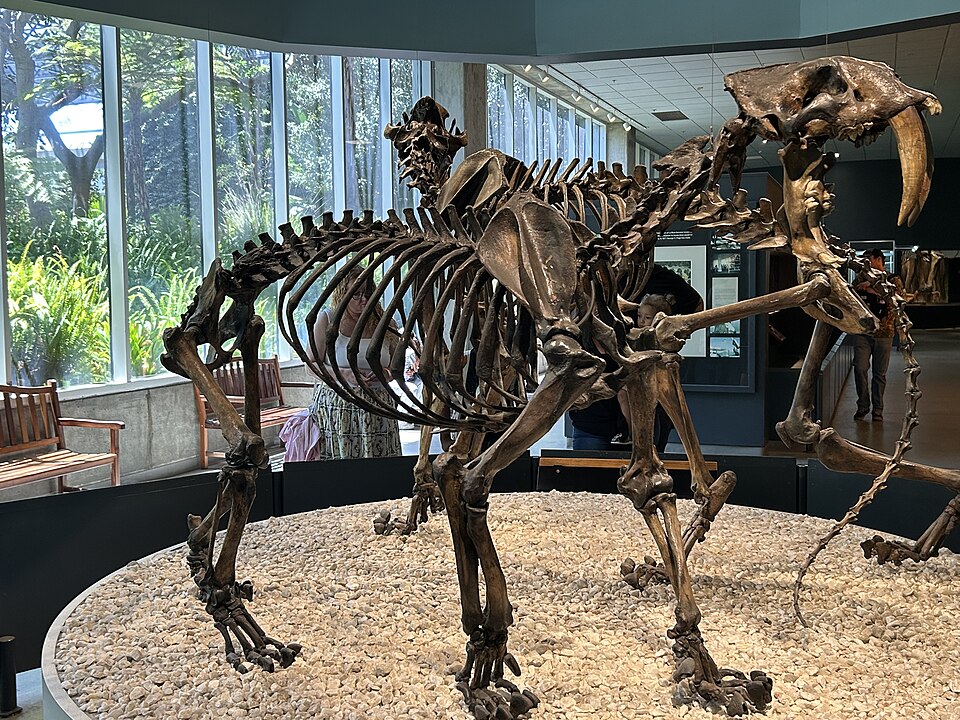

Taxonomy and classification
The Machairodontinae are classified within Felidae, the true cat family, and are therefore genuine cats — not merely cat-like predators bearing a superficial resemblance. Phylogenetic analyses based on cranial and postcranial morphology, supplemented in recent years by ancient DNA from Late Pleistocene specimens, consistently place the machairodonts as a monophyletic sister group to the Felinae and Pantherinae (the subfamilies containing all living cats).7 The subfamily originated in the middle Miocene of Africa or Eurasia, likely around 16–14 million years ago, and by the Late Miocene had diversified into four recognized tribes: Metailurini, Smilodontini, Homotherini, and Machairodontini.6, 7
The Smilodontini include the most famous genus, Smilodon, along with its probable ancestor Megantereon, a panther-sized saber-tooth with a nearly cosmopolitan Pliocene–Pleistocene distribution across Africa, Eurasia, and North America.2 The Homotherini are represented principally by Homotherium, the scimitar-toothed cat, which ranged across Eurasia, Africa, and North America and survived in Europe until at least 28,000 years ago — far later than previously recognized.21 Xenosmilus, known from only two nearly complete skeletons from the early Pleistocene of Florida, combined the robust build of Smilodon with the serrated, relatively shorter canines of the homotherines, and has been described as a “cookie-cutter cat” adapted for removing large chunks of flesh with each bite.16 The Metailurini were generally smaller, less specialized forms sometimes called “false saber-tooths” because their canines, while elongated, did not reach the extreme proportions seen in other tribes.6
Smilodon: anatomy and species
Smilodon is by far the best-known machairodont, owing principally to the extraordinary sample from the Rancho La Brea asphalt seeps in Los Angeles, California. Three species are currently recognized. Smilodon gracilis, the smallest and oldest, appeared in eastern North America during the late Pliocene and weighed an estimated 55–100 kg, roughly the size of a modern jaguar.2 Smilodon fatalis evolved in North America during the early to middle Pleistocene and is the species overwhelmingly represented at Rancho La Brea, with over 2,000 individual specimens recovered — making it one of the most thoroughly sampled fossil carnivores in the world.9 Adult S. fatalis are estimated to have weighed 160–280 kg, comparable to a modern African lion but with a more robust, shorter-limbed build and proportionally much more powerful forelimbs.2, 5
Smilodon populator, the largest species, inhabited South America from the middle Pleistocene onward, arriving after the closure of the Isthmus of Panama permitted faunal interchange between the continents during the [Great American Biotic Interchange](/paleontology/mammalian-adaptive-radiation). With estimated body masses reaching 400 kg or more, S. populator was among the largest felids ever to have lived, exceeded only by the Pleistocene cave lion (Panthera spelaea) and the American lion (Panthera atrox) at the upper end of their size ranges.12 Its upper canines could exceed 28 cm in total length (including the root), with the exposed crown reaching approximately 17–18 cm — by far the longest canines of any machairodont.2 Isotopic analyses of S. populator from the Argentine Pampas indicate a diet focused on large herbivores, including giant ground sloths and native South American ungulates, with carbon isotope values consistent with hunting in open grassland and mixed woodland habitats.12
Canine morphology
The defining feature of all machairodonts is the hypertrophied upper canine tooth, but the specific morphology of these teeth varied substantially among tribes and carried direct implications for killing mechanics. In Smilodon, the canines were laterally compressed into a blade-like cross section, with finely serrated margins along both the anterior and posterior keels.13 This geometry maximized cutting efficiency while minimizing the cross-sectional area that had to be driven through tissue, reducing the force required for penetration. The enamel was thin relative to the canines of modern big cats, and the dentine core was dense and finely structured — a construction that produced a stiff, sharp tooth but one vulnerable to lateral bending forces.13
Van Valkenburgh and Ruff’s classic study of canine bending strength demonstrated that Smilodon’s canines were considerably weaker in the labiolingual (side-to-side) plane than in the anteroposterior plane, meaning the tooth could withstand forces directed along the axis of penetration but risked catastrophic fracture if the animal twisted its head while the canines were embedded in struggling prey.13 This structural constraint has been central to nearly all subsequent biomechanical models of machairodont predation: the saber-tooth was a precision instrument that demanded a particular mode of use. In Homotherium, the canines were shorter, broader, and more coarsely serrated — a scimitar-like morphology that traded maximum penetration depth for greater resistance to lateral stress, suggesting a somewhat different killing technique in which slicing rather than deep stabbing was the primary function.1, 4
The killing bite debate
How saber-toothed cats actually used their canines to kill has been debated since the nineteenth century, and the question remains one of the most productive intersections of paleontology and biomechanical engineering. The two principal competing models are the canine-shear bite hypothesis and the stabbing hypothesis, though modern analyses have largely converged on a refined version of the former.
The stabbing model, which dominated early twentieth-century interpretations, proposed that Smilodon drove its canines into prey using powerful downward movements of the head and neck, essentially using the teeth as daggers plunged from above.4 This model accounted for the extreme canine length but struggled to explain how the teeth could survive the forces involved without fracturing, given their demonstrated weakness under lateral loads. The canine-shear bite hypothesis, formalized by Akersten in 1985, proposed instead that the cats used a precisely controlled bite to the throat of immobilized prey, engaging the canines to shear through soft tissue — skin, muscle, trachea, and major blood vessels — while avoiding contact with bone.4 In this model, the function of the elongated canines was not to deliver a crushing or puncturing bite (as in modern pantherines) but to create a wide, shallow wound that caused rapid hemorrhage.
Three-dimensional finite element analysis by Wroe and colleagues in 2005 provided strong quantitative support for a version of this hypothesis. Their models demonstrated that Smilodon fatalis had a bite force at the canine tips only about one-third that of a similarly sized lion, confirming that raw jaw-closing power was not the primary mechanism.5 Instead, the skull was optimized to resist the forces generated when the massive cervical and nuchal musculature drove the head downward, pulling the canines through tissue in a shearing arc.5 McHenry and colleagues’ subsequent analysis confirmed that the Smilodon skull experienced peak stresses not during jaw closure but during this head-driven canine deployment, with the stiffened skull acting as a rigid frame transmitting force from neck to teeth.3 The implication is that Smilodon killed using a fundamentally different biomechanical pathway than any living felid: the power source was the neck and forelimbs rather than the jaw adductor muscles.
Skull and postcranial adaptations
The entire machairodont skeleton was reorganized around the demands of the saber-tooth killing system. The skull featured a dramatically reduced coronoid process — the bony projection on the mandible that serves as the primary attachment for the temporalis muscle in modern cats.8 Because temporalis contraction pulls the jaw upward and would oppose the downward thrust of the canines, reducing this muscle’s leverage was biomechanically consistent with a killing stroke powered by the neck rather than the jaw.5 The jaw articulation was modified to permit an exceptionally wide gape, estimated at approximately 120 degrees in Smilodon compared with roughly 65–70 degrees in modern lions. This gape was essential: without it, the long canines could not clear the lower jaw to engage prey tissue.2, 8
The postcranial skeleton of Smilodon was equally distinctive. The forelimbs were massive, with a broad, heavily muscled scapula, a robust humerus bearing pronounced deltoid and supinator crests, and powerful flexor musculature in the forearm.2 These forelimbs were not built for pursuit running — Smilodon’s relatively short distal limb segments and plantigrade-trending posture indicate it was not a cursorial predator — but for grappling with and immobilizing large prey at close quarters. The ability to pull a struggling animal down and hold it still was a biomechanical prerequisite for the precision canine-shear bite; any significant lateral movement of the prey during the bite could snap the canines.5, 13 The lumbar vertebral column was relatively short and stiff compared with modern big cats, further suggesting an ambush predator that relied on explosive power over short distances rather than sustained pursuit.2
Homotherium presented a markedly different postcranial profile. Its limbs were proportionally longer and more gracile, with longer distal segments approaching the proportions of a modern cheetah or hyena, suggesting greater cursorial ability.1, 21 Ancient DNA and morphological evidence suggest that Homotherium may have been an open-habitat predator capable of moderate-speed pursuit, in contrast to the ambush strategy inferred for Smilodon.21 This ecological divergence illustrates that the Machairodontinae were not a single ecological type but a diverse radiation occupying multiple predatory niches.
Rancho La Brea: a window into behavior
The Rancho La Brea asphalt seeps in present-day Los Angeles have yielded the world’s richest accumulation of Pleistocene carnivore fossils, and Smilodon fatalis is by far the most abundant large predator represented, with over 2,000 individuals catalogued.9 The taphonomic mechanism is well understood: herbivores became mired in surface asphalt pools, and their distress attracted predators and scavengers that in turn became trapped, producing a death assemblage heavily biased toward carnivores. The same entrapment dynamics are observed in modern natural asphalt seeps, where the ratio of predators to prey carcasses far exceeds that of living ecosystems.9
The sheer sample size at La Brea has enabled population-level analyses impossible for almost any other fossil carnivore. Pathological studies reveal a high prevalence of healed injuries, including broken limbs, dislocated joints, and damaged canines, many of which would have incapacitated the animal for weeks or months.11 Van Valkenburgh and Sacco argued that the survival of so many severely injured individuals implies that Smilodon received food from conspecifics during recovery — evidence, in other words, for social living and perhaps cooperative behavior analogous to that of modern lions.10, 17 This interpretation remains debated. Skeptics note that solitary carnivores can survive substantial injuries if prey is abundant and competition is low, and that the La Brea trap itself may have biased the sample toward injured individuals who were more likely to become mired.11
Dental pathology at La Brea is also informative. Brown and colleagues’ 2023 analysis of over 1,500 Smilodon teeth documented high rates of enamel hypoplasia (developmental defects indicating nutritional stress), canine fracture, and wear patterns consistent with bone contact during feeding.11 The fracture rate for canines was significantly higher than in modern lions, supporting the biomechanical prediction that the elongated, laterally compressed teeth were structurally vulnerable — an evolutionary trade-off between killing efficiency and durability.11, 13
Diet and paleoecology
Reconstructing the diet of extinct predators requires converging lines of evidence, and for Smilodon and its relatives, three primary datasets are available: stable isotope geochemistry, dental microwear texture analysis, and ecomorphological comparison with living carnivores.
Carbon and nitrogen stable isotope analyses from La Brea specimens indicate that Smilodon fatalis occupied a trophic position consistent with obligate hypercarnivory, feeding principally on large herbivores such as bison, horses, and camels that inhabited the open and semi-open landscapes of late Pleistocene California.15 Isotopic niche partitioning with the sympatric American lion (Panthera atrox) and dire wolf (Aenocyon dirus) suggests some dietary differentiation, with Smilodon possibly targeting larger or different prey species than its competitors.15 In South America, isotopic data for S. populator similarly indicate a diet dominated by large herbivores in open grassland habitats, with carbon values pointing away from forest-dwelling prey.12
Dental microwear texture analysis — the study of microscopic scratches and pits on tooth enamel produced during feeding — provides complementary evidence about the mechanical properties of ingested food. DeSantis and colleagues found that Smilodon fatalis from La Brea displayed microwear textures more similar to the modern African cheetah than to bone-cracking hyenas, indicating relatively little bone processing during feeding.14 This finding is consistent with the canine-shear bite model: Smilodon killed by slicing soft tissue and fed primarily on muscle and viscera, avoiding the dense skeletal elements that would risk damaging its structurally vulnerable canines. Notably, the microwear data showed no temporal trend toward increased bone consumption approaching the terminal Pleistocene, arguing against the hypothesis that Smilodon experienced increasing dietary stress from declining prey availability prior to its extinction.14
Convergent evolution of the saber-tooth morphotype
Perhaps the most remarkable aspect of the saber-toothed cats is that they were not the only mammals to evolve this morphology. The saber-tooth adaptation arose independently in at least five distinct mammalian lineages spanning over 50 million years, representing one of the most spectacular [examples of convergent evolution](/evolution/convergent-evolution-examples) in the history of terrestrial vertebrates.19
The Nimravidae, sometimes called “false saber-toothed cats,” appeared in North America and Eurasia during the late Eocene, roughly 42–37 million years ago, and persisted through the Oligocene. Despite their strikingly cat-like skulls and saber-like canines, nimravids were not felids. They belong to a separate carnivoran family that diverged early from the lineage leading to modern cats, and their resemblance to machairodonts is entirely convergent.19 Bryant’s detailed phylogenetic analysis demonstrated that nimravids independently evolved reduced coronoid processes, widened gapes, and robust forelimbs — the same functional complex seen in true saber-toothed cats — arriving at essentially the same biomechanical solution to the problem of killing large prey.19
The Barbourofelidae, once classified within Nimravidae, are now recognized as a separate family more closely related to Felidae. Barbourofelids such as Barbourofelis from the late Miocene of North America developed extremely long, flattened canines with protective mandibular flanges — bony extensions of the lower jaw that sheathed the canine tips when the mouth was closed, a feature never seen in true machairodonts.2 The barbourofelids overlapped temporally with early machairodonts and represent an independent attainment of the saber-tooth niche within the broader feliform carnivore radiation.
The most phylogenetically remote convergence is found in the Thylacosmilidae, a family of South American marsupial predators. Thylacosmilus atrox, described by Riggs in 1934, possessed ever-growing upper canines rooted far back in the skull, a feature with no analog in any placental saber-tooth.18 Despite being separated from the machairodonts by over 160 million years of independent mammalian evolution — the divergence between marsupials and placentals dates to the Jurassic — Thylacosmilus converged on a remarkably similar cranial architecture: reduced coronoid process, widened gape, and reinforced symphyseal region of the mandible.18 It occupied the large-predator guild in South America during the Pliocene, before the arrival of placental carnivorans across the Isthmus of Panama.
Even beyond carnivorans and marsupials, the saber-tooth morphotype appeared in the creodonts, an entirely extinct order of predatory mammals. Machaeroides eothen, from the middle Eocene Bridger Formation of Wyoming (approximately 48 million years ago), possessed elongated, laterally compressed upper canines convergent with later machairodont felids, despite being separated by the deepest split in placental mammal phylogeny.20 The repeated, independent origin of the same functional complex across such distantly related lineages demonstrates that the saber-tooth morphotype represents a deeply attractive adaptive solution — a peak in the fitness landscape that natural selection located again and again whenever a large-bodied predator lineage had access to megafaunal prey.19, 2
Homotherium: the scimitar-toothed cat
Homotherium deserves separate treatment as a machairodont that was ecologically and morphologically distinct from Smilodon in almost every respect. Where Smilodon was a heavily built ambush predator of the Americas, Homotherium ranged across four continents — Africa, Eurasia, and both North and South America — and was among the most geographically widespread of all machairodont genera.1 Its upper canines were shorter and more coarsely serrated than those of Smilodon, with a scimitar-like curvature that gave the tribe its common name. The limb proportions were more cursorial, with elongated distal segments and a relatively slender build suggesting a predator capable of sustained locomotion over open terrain.1, 21
The most significant recent development in Homotherium research has been the extraction of ancient DNA from Late Pleistocene specimens. Paijmans and colleagues obtained mitochondrial genomes from North Sea trawl specimens and confirmed that Homotherium persisted in Europe until at least 28,000 years ago, far later than the approximately 300,000-year-old age previously assumed for the European last appearance datum.21 The genetic data further suggest that Homotherium populations across its vast range maintained relatively low genetic diversity, consistent with either a small effective population size or long-distance gene flow across continents — both plausible for a wide-ranging, low-density apex predator.
Social behavior
Whether saber-toothed cats were social animals remains one of the most contentious questions in Pleistocene paleoecology. The La Brea evidence — the sheer abundance of Smilodon individuals, the presence of healed debilitating injuries, and the predator-to-prey ratio in the death assemblage — has been interpreted as supporting group living analogous to modern lion prides.17 Van Valkenburgh and Sacco noted that the predator trap mechanism at La Brea would have been most effective at attracting social species: if one individual became mired, the distress calls or visible struggling of a group member would draw others into the trap, amplifying the accumulation bias.17
The pathological evidence is compelling but not conclusive. Numerous Smilodon specimens at La Brea show healed injuries — fractured humeri, dislocated hips, and broken canines — that would have prevented effective hunting for extended periods.11 In a solitary obligate predator, such injuries would likely prove fatal from starvation. The survival of these individuals implies either social provisioning or an environment so rich in easily scavenged carcasses (including those produced by the asphalt traps themselves) that incapacitated animals could feed without hunting. Both scenarios have been argued, and the question cannot be resolved from taphonomic data alone.11, 17
For Homotherium, the case for sociality rests on different evidence. A cache of juvenile mammoth bones associated with Homotherium remains at Friesenhahn Cave in Texas suggests cooperative hunting of young proboscideans, a prey type that would likely have required coordinated group effort to subdue.1 However, modern solitary predators such as tigers and leopards can take surprisingly large prey, and inferring social behavior from prey size alone is unreliable.
Extinction
The machairodont felids went extinct during the [late Pleistocene megafaunal extinctions](/paleontology/late-pleistocene-megafaunal-extinctions), a global event that eliminated the majority of the world’s large-bodied terrestrial mammals between roughly 50,000 and 10,000 years ago. Smilodon fatalis disappears from the North American fossil record at approximately 11,000–10,000 years ago, closely coinciding with the disappearance of its megafaunal prey — mammoths, mastodons, ground sloths, horses, and camels — and with the arrival of Clovis and related Paleoindian cultures on the continent.22 Smilodon populator vanishes from the South American record at a similar time, and Homotherium last appears in Europe around 28,000 years ago.21, 22
The extinction of the machairodonts was almost certainly linked to the collapse of the megafaunal prey base on which their entire biomechanical system depended. The saber-tooth killing apparatus — the wide gape, precision canine-shear bite, reduced jaw musculature, and massive forelimbs — was an integrated functional complex adapted for dispatching large, thick-skinned prey. As the megafaunal herbivore guild collapsed under the combined pressures of climate change and human hunting, the ecological foundation of the machairodont niche disappeared with it.22 Dental microwear evidence from La Brea suggests that Smilodon did not shift its diet toward smaller prey or increased bone consumption in the millennia preceding its disappearance, indicating that the species maintained its specialized predatory strategy to the end rather than adapting to a changing prey landscape.14
The machairodonts’ extreme specialization, which had been their competitive advantage for millions of years, thus became the proximate cause of their vulnerability. Unlike the more generalized pantherines and canids that survived the Pleistocene–Holocene transition, saber-toothed cats had no ecological fallback. Their extinction marked the permanent loss of a predatory morphotype that had been continuously present in mammalian ecosystems for over 40 million years across multiple independent lineages — a lineage of ecological strategy, if not of phylogeny, that natural selection has not recreated since.2, 19
Legacy and significance
The study of saber-toothed cats has contributed disproportionately to several fields beyond their immediate taxonomic interest. In biomechanics, the Smilodon skull has become a model organism for finite element analysis and the integration of musculoskeletal modelling with paleontological inference.3, 5 In evolutionary biology, the repeated convergent evolution of the saber-tooth morphotype across five independent lineages remains a textbook example of how natural selection can channel disparate starting points toward the same functional endpoint when confronted with similar ecological opportunities.19 In paleoecology, the La Brea Smilodon assemblage has set the standard for population-level studies of extinct predators, enabling analyses of pathology, sexual dimorphism, ontogeny, and community ecology that would be impossible with less abundant fossil records.9, 11
The [rise of mammals](/paleontology/rise-of-mammals) after the Cretaceous extinction produced a dazzling array of predatory forms, but none more consistently reinvented than the saber-toothed predator. From the Eocene creodonts through the Oligocene nimravids, the Miocene barbourofelids, and the Pliocene thylacosmilid marsupials to the Pleistocene machairodonts themselves, the saber-tooth functional complex was assembled and refined independently across the full breadth of mammalian phylogeny.2, 19, 20 That so many unrelated lineages converged on the same solution speaks to the power of the selective pressures operating in megafaunal predator guilds — and to the depth of the evolutionary loss when that entire ecological theater was dismantled at the close of the Pleistocene.
References
The killing bite of Smilodon fatalis: a biomechanical analysis using three-dimensional finite element analysis
The function of the sabre-like canine teeth: two new hypotheses and an overview of adaptations of predation in sabretoothed animals
Supermodeled sabercat, predatory behavior in Smilodon fatalis revealed by high-resolution 3D computer simulation
The Rancho La Brea Smilodon fatalis: history, composition, and implications for predator–prey dynamics
Large predators and the evolution of group living in herbivores: social structures at Rancho La Brea
Prevalence of dental pathologies in Smilodon from Rancho La Brea and implications for carnivore behavior
Pleistocene Smilodon populator from the Pampean region of Argentina: diet and paleoecology inferred from carbon and nitrogen stable isotopes
Dental microwear textures of carnivorans from the La Brea Tar Pits, California, and implications for feeding and behavior
The functional morphology of Xenosmilus hodsonae (Mammalia: Felidae: Machairodontinae), a cookie-cutter-cat
The Nimravidae (Mammalia, Carnivora) and the convergent evolution of saber-toothed adaptations
Machaeroides eothen (Creodonta, Mammalia) from the Bridger Formation and the evolution of early saber-toothed predators
Homotherium serum and Cervalces from the Great Lakes region, USA: geochronology, morphology, and ancient DNA