Overview
- Sauropodomorpha is the dinosaur clade that includes the largest land animals in Earth's history, ranging from small bipedal Late Triassic forms like Saturnalia (~230 Ma) to Cretaceous titanosaurs such as Patagotitan mayorum, estimated at 69 tonnes and 37 meters in length.
- The group's evolutionary trajectory is defined by a progressive shift from bipedal omnivory to obligate quadrupedal herbivory, driven by innovations in skeletal pneumaticity, continuous rapid growth, and an extremely elongated neck that enabled energetically efficient high- and low-browsing strategies.
- Sauropods achieved a near-global distribution across all major landmasses by the Late Jurassic, and titanosaurs remained the dominant megaherbivores on most Gondwanan continents until the end-Cretaceous extinction 66 million years ago.
Sauropodomorpha is one of the two great saurischian dinosaur lineages and encompasses the largest terrestrial animals in the history of life on Earth. The clade first appeared in the Late Triassic, approximately 230 million years ago, as small, lightly built bipedal or facultatively bipedal omnivores no larger than a medium-sized dog.1, 2 Over the subsequent 164 million years, sauropodomorphs underwent one of the most dramatic evolutionary transformations in vertebrate history, progressively increasing in body size, shifting from bipedal to obligate quadrupedal locomotion, and specializing as committed herbivores that dominated megaherbivore niches on every continent.4, 12 The group's final representatives, the titanosaurs, persisted until the end-Cretaceous mass extinction 66 million years ago and included animals estimated to weigh in excess of 60 tonnes, dimensions unmatched by any other land-dwelling vertebrate before or since.9
Origins and earliest members
The oldest known sauropodomorphs come from the Carnian Stage of the Late Triassic, approximately 233 to 225 million years ago, recovered primarily from South American and African localities that were then part of the southern portion of Pangaea.1, 2 Saturnalia tupiniquim, described from the Santa Maria Formation of southern Brazil, is among the earliest well-documented members of the lineage. At roughly 1.5 meters in length and an estimated 10 kilograms, Saturnalia was a small, agile biped with leaf-shaped teeth suggesting a diet of mixed plant material and possibly small prey, features far removed from the columnar-limbed giants the clade would later produce.3
Other early sauropodomorphs from the Ischigualasto Formation of Argentina, including Panphagia protos and Chromogisaurus novasi, further document the initial diversification of the group during the Carnian. Panphagia, whose generic name means "eater of everything," preserves a heterodont dentition consistent with omnivory, supporting the hypothesis that the ancestral sauropodomorph diet was generalized rather than purely herbivorous.2 These earliest sauropodomorphs were minor components of their ecosystems, coexisting with a diverse array of non-dinosaurian archosaurs and synapsids that still dominated large-bodied terrestrial niches during the Carnian.1
The geographic restriction of the earliest sauropodomorphs to southern Pangaea has led to the hypothesis that the clade originated in high-latitude Gondwanan environments before dispersing northward. By the Norian Stage of the Late Triassic (approximately 227 to 205 million years ago), sauropodomorphs had expanded across much of Pangaea, with representatives known from Europe, North America, and other regions, although they remained most abundant and diverse in the southern continents.1, 16
The "prosauropods" and the transition to gigantism
The non-sauropod sauropodomorphs, historically grouped under the informal designation "prosauropods," represent a paraphyletic assemblage of forms that document the evolutionary transition from small bipedal ancestors to the fully quadrupedal, large-bodied sauropod body plan.5, 12 During the Late Triassic and Early Jurassic, these animals constituted the dominant large-bodied herbivores in many terrestrial ecosystems and achieved a cosmopolitan distribution across Pangaea.1
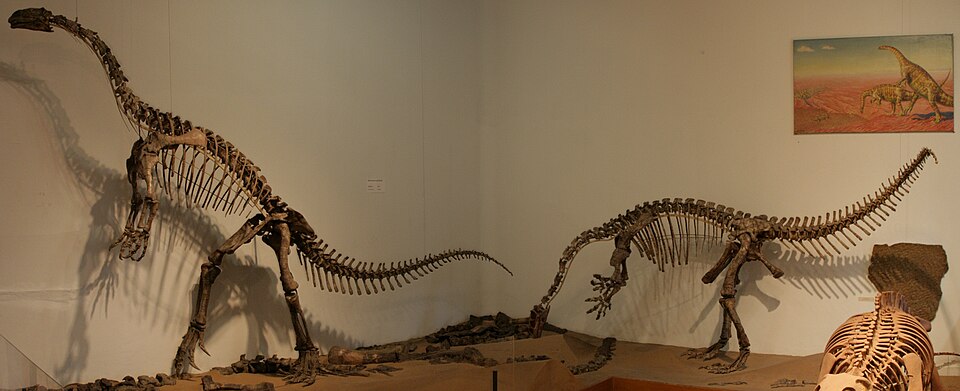

Plateosaurus engelhardti, from the Upper Triassic of central Europe, is the best-known non-sauropod sauropodomorph, represented by hundreds of specimens from bonebeds in Germany, Switzerland, and France. At five to ten meters in length and up to four tonnes in body mass, Plateosaurus was among the largest animals in its Late Triassic ecosystems. Biomechanical analyses of its forelimb indicate that it was an obligate biped, unable to pronate its hands sufficiently for habitual quadrupedal locomotion, despite its relatively large body size.5 Massospondylus carinatus, from the Early Jurassic of southern Africa, occupies a similar phylogenetic grade and provides exceptional ontogenetic data from embryonic to adult specimens, revealing that hatchlings had proportionally larger heads and shorter necks than adults, a pattern consistent with allometric growth toward the elongated-neck body plan of more derived forms.5, 15
The morphological disparity of non-sauropod sauropodomorphs shifted dramatically across the Triassic–Jurassic boundary. During the Norian, the radiation of plateosaurians filled a broad region of morphospace, but following the end-Triassic extinction approximately 201 million years ago, non-sauropod sauropodomorphs declined in diversity while true sauropods began their rapid radiation.12 By the Middle Jurassic, all non-sauropod sauropodomorph lineages had gone extinct, replaced entirely by the gravisaurian sauropods that would dominate terrestrial megaherbivore niches for the remaining 100 million years of the Mesozoic.12, 5
Phylogeny and major sauropod clades
The internal phylogeny of Sauropodomorpha has been the subject of extensive cladistic analysis since the 1990s, with broad consensus emerging on the major subdivisions of the group despite ongoing debate over the placement of several taxa.6, 19 At the base of the clade lie a series of successively more derived non-sauropod sauropodomorphs, from early forms like Saturnalia and Thecodontosaurus through the plateosaurian radiation to the more sauropod-like anchisaurians. The true Sauropoda, defined by a suite of characters including fully columnar limbs, an elongated cervical series, and obligate quadrupedality, arose by the Early Jurassic.6, 5
Within Sauropoda, the primary split divides the clade into two major lineages. Diplodocoidea, the peg-toothed sauropods, includes three families: Rebbachisauridae, Dicraeosauridae, and Diplodocidae. These taxa are united by cranial and vertebral synapomorphies including pencil-shaped teeth restricted to the front of the jaw, squared-off snout profiles adapted for ground-level browsing, and highly bifurcated neural spines in the cervical and dorsal vertebrae.6, 21 Macronaria, the broad-toothed sauropods, is the sister clade to Diplodocoidea and includes Camarasauridae, Brachiosauridae, and the enormous and species-rich Titanosauria. Macronarians are characterized by spatulate teeth, enlarged external nares positioned high on the skull, and, in titanosaurs, a distinctive procoelous caudal vertebral morphology and highly derived appendicular skeleton.6, 19
The position of Sauropodomorpha within Dinosauria has itself been debated. The traditional phylogenetic arrangement, supported by most analyses, places sauropodomorphs as the sister group to Theropoda within Saurischia. A 2017 hypothesis by Baron, Norman, and Barrett proposed an alternative topology in which theropods are instead allied with ornithischians (as Ornithoscelida), making sauropodomorphs the sole occupants of a restricted Saurischia. While this hypothesis remains contested, it has stimulated productive reanalysis of dinosaurian phylogeny.18
The evolution of gigantism
The defining feature of sauropodomorph evolution is the repeated and extreme increase in body size that culminated in the largest terrestrial animals ever to exist. Understanding how and why sauropods achieved body masses an order of magnitude greater than the largest terrestrial mammals requires examining a cascade of anatomical and physiological innovations that acted synergistically to remove the constraints that limit body size in other vertebrate lineages.4
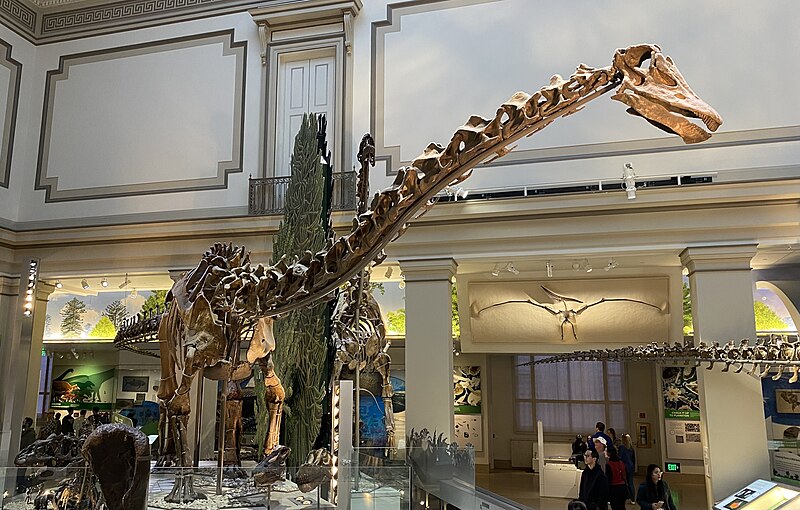

Skeletal pneumaticity is among the most critical of these innovations. Sauropods inherited an avian-style respiratory system featuring a series of air sacs that invaded the vertebral column, creating internal chambers (camerae and camellae) within the centra and neural arches of the presacral vertebrae. This pneumatization reduced the mass of the axial skeleton by 30 to 50 percent compared with solid bone of equivalent external dimensions, enabling the evolution of extremely elongated necks without a proportionate increase in the load borne by the cervical musculature and the forelimbs.8, 7 The air-sac system also improved respiratory efficiency, permitting unidirectional airflow through the lungs and enhancing oxygen extraction, features that supported the elevated metabolic rates necessary to sustain rapid growth in multi-tonne animals.4
Bone histology provides direct evidence that sauropods grew rapidly and continuously, a pattern more consistent with endothermic or near-endothermic metabolic rates than with the slow, cyclical growth typical of large ectothermic reptiles. Fibrolamellar bone, characterized by rapidly deposited woven-fibered matrix with dense primary vascularization, is the dominant tissue type in sauropod long bones, indicating growth rates comparable to those of large mammals and substantially exceeding those of crocodilians and turtles of equivalent size.10, 4 Sauropods also attained sexual maturity before reaching maximum body size, a growth strategy that allowed populations to maintain viable reproductive rates even with long overall growth periods.4
The sauropod reproductive strategy itself contributed to the feasibility of extreme body size. Unlike large mammals, which invest heavily in a small number of offspring, sauropods were oviparous and laid clutches of relatively small eggs. This reproductive mode eliminated the biomechanical constraints that a developing fetus of proportionate size would impose on the mother and allowed population recovery rates that could offset the high juvenile mortality inevitable for animals whose hatchlings weighed less than one ten-thousandth of an adult.4, 17
The sauropod neck: anatomy and function
The elongated neck is the most immediately recognizable feature of sauropod anatomy and the structure most directly implicated in the group's ecological success. Sauropod necks ranged from approximately 1.7 meters in the short-necked dicraeosaurid Brachytrachelopan to an estimated 15 meters in the mamenchisaurid Xinjiangtitan, with most large sauropods possessing necks in the 6 to 9 meter range.7 No other terrestrial vertebrate lineage has evolved necks of comparable absolute or relative length, and understanding the biomechanical prerequisites for this structure illuminates the suite of innovations that distinguish sauropods from all other herbivores.7
Taylor and Wedel identified a set of architectural features that collectively enabled extreme neck elongation. First, the small, lightweight skull of sauropods, which lacked the elaborate chewing apparatus of ornithischian dinosaurs or mammalian herbivores, minimized the load at the distal end of the cervical series. Sauropods processed food not in the mouth but in the gut, relying on gastrointestinal fermentation rather than oral mastication, which freed the skull from the mechanical demands imposed by heavy jaw musculature and batteries of grinding teeth.7, 15 Second, the pneumatized cervical vertebrae achieved structural strength through internal trabecular architecture and external laminae while remaining far lighter than solid bone of equivalent volume. Third, the large number of cervical vertebrae, reaching 19 in some taxa compared with the seven that constrain all living mammals, distributed the bending moment of the neck across many intervertebral joints, reducing the stress at any single point.7
The functional significance of the long neck has been debated, with hypotheses including high-browsing to access canopy vegetation, low-browsing with wide lateral sweeps to cover large feeding areas from a stationary body position, and a combination of both strategies depending on the taxon. Diplodocids, with their squared-off snouts, pencil-shaped teeth, and relatively horizontal neck posture, are interpreted as low-browsing specialists, while brachiosaurids, with their steeply inclined necks, elongated forelimbs, and dorsally positioned nostrils, appear to have been high-browsing specialists analogous to modern giraffes but on a vastly larger scale.7, 6
Diversity and biogeography
Sauropods achieved a near-global distribution by the Late Jurassic, when Pangaea was fragmenting into Laurasia and Gondwana but land connections still permitted intermittent faunal exchange. The Morrison Formation of western North America, the Tendaguru Beds of Tanzania, and coeval deposits in South America, Europe, and Asia have yielded some of the richest sauropod assemblages known, demonstrating that multiple sauropod lineages coexisted within single ecosystems, partitioned by body size, feeding height, and dietary specialization.5, 6
The Cretaceous Period witnessed a major faunal turnover within Sauropoda. Diplodocoids, which had dominated many Jurassic ecosystems alongside camarasaurids and basal macronarians, declined sharply during the Early Cretaceous and were largely extinct by the Cenomanian, with the exception of the rebbachisaurids, which persisted in Gondwanan ecosystems until approximately 90 million years ago.11, 21 Their ecological roles were filled by titanosaurs, which underwent a spectacular radiation during the Cretaceous and became the dominant sauropod clade on every continent, including Antarctica.9, 13
Titanosauria is the most species-rich sauropod clade, with over 100 named species spanning the Early Cretaceous to the terminal Maastrichtian. Titanosaurs ranged from dwarf island forms such as Magyarosaurus of Late Cretaceous Romania, estimated at less than one tonne, to the colossal Patagotitan mayorum from the early Late Cretaceous of Argentina, for which body mass estimates range from 44 to 69 tonnes depending on the method employed.9, 10 This size range, spanning nearly two orders of magnitude within a single clade, reflects the ecological versatility of the titanosaur body plan and the role of geographic isolation in driving both gigantism and insular dwarfism.10, 11
Estimated maximum body mass of selected sauropod genera9, 14, 11
Feeding ecology and craniodental evolution
The evolutionary history of sauropodomorph feeding is characterized by a progressive shift from generalized omnivory in the earliest members of the clade to increasingly specialized herbivory in sauropods, accompanied by profound changes in skull morphology, tooth shape, and jaw mechanics.15 Early sauropodomorphs such as Saturnalia and Panphagia possessed heterodont dentitions with recurved, serrated teeth anteriorly and broader, leaf-shaped teeth posteriorly, a configuration consistent with processing both plant material and animal prey.2, 3 By the time of the plateosaurian radiation in the Norian, most sauropodomorphs had transitioned to predominantly herbivorous diets, as evidenced by uniformly leaf-shaped teeth, expanded tooth rows, and reduced jaw adductor musculature that favored orthal jaw movement over the slicing and tearing motions of carnivores.15
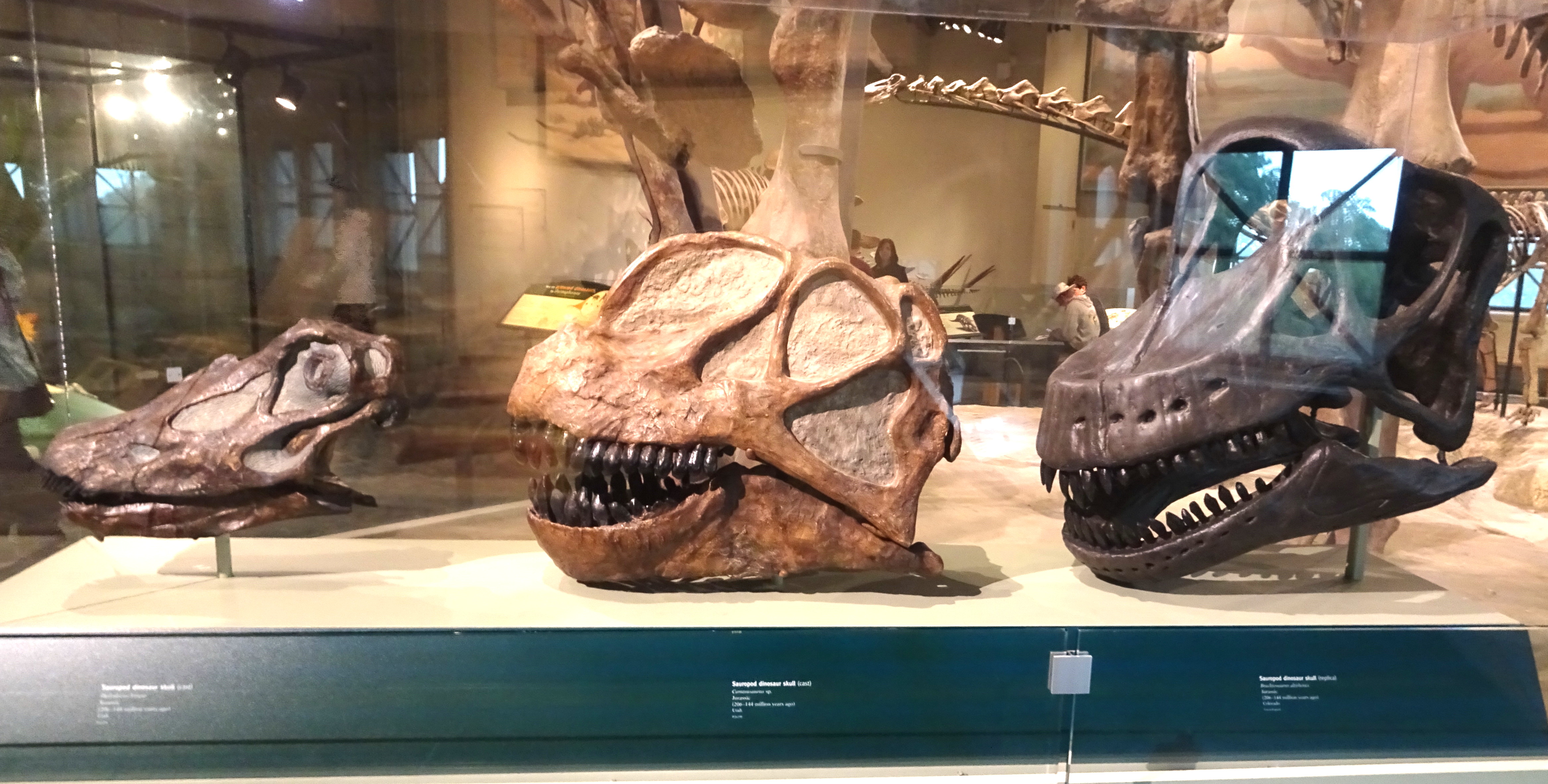

A major functional shift occurred at the base of Sauropoda, where cranial biomechanical analyses have identified a transition toward increased skull robustness, elevated bite forces, and the onset of static occlusion between upper and lower tooth rows. This change is associated with the adoption of a more efficient food-gathering strategy in which the jaws functioned primarily as a cropping apparatus rather than a processing tool, stripping vegetation that was then swallowed whole and processed in the gut.15 The two principal sauropod lineages subsequently diverged in their craniodental adaptations. Diplodocoids evolved narrow, squared-off snouts with pencil-shaped teeth restricted to the anterior jaw margin, a morphology suited to precision cropping of low-growing vegetation and perhaps bark stripping.6, 21 Macronarians retained broader, spatulate teeth distributed across a wider dental arcade, enabling less selective but higher-volume bulk feeding on a wider range of plant material.6, 15
The absence of sophisticated oral processing in sauropods is closely linked to their gigantic body size. Because sauropods relied on hindgut fermentation rather than mastication to extract nutrients from plant material, larger gut volumes, achieved through increased body size, directly improved digestive efficiency by extending retention time. This created a positive feedback loop in which larger body size permitted more efficient digestion, which in turn supported the energetic demands of even larger body size, a dynamic that has been termed an "evolutionary cascade" and is considered central to understanding sauropod gigantism.4
Reproduction and life history
The reproductive biology of sauropods has been illuminated by discoveries of nesting sites, eggs, and embryonic remains from multiple continents, particularly from titanosaur localities in Argentina, India, Spain, and Brazil.17, 20 Titanosaur eggs are spherical to subspherical, typically 12 to 20 centimeters in diameter, and are found in clutches of 15 to 40 eggs arranged in shallow depressions excavated in the substrate. The relatively small size of sauropod eggs relative to adult body mass confirms that sauropods, like other large dinosaurs, produced many small offspring rather than a few large ones, a reproductive strategy with important implications for population dynamics and growth rates.4, 17
Evidence from nesting sites in the Late Cretaceous of Brazil and India indicates that titanosaurs practiced colonial nesting, with dozens to hundreds of clutches deposited in close proximity within a single nesting horizon. The presence of multiple nesting levels at some sites suggests breeding-site fidelity, with populations returning to the same location across successive reproductive seasons, a behavior analogous to that observed in modern sea turtles and colonial seabirds.17 In some localities, nesting grounds are associated with geothermally active environments, raising the possibility that titanosaurs selected sites where elevated soil temperatures aided incubation, as observed in some modern megapode birds.17
A remarkable pathological specimen from the Late Cretaceous of India, preserving an egg-within-an-egg (ovum-in-ovo) condition, has provided unexpected insight into sauropod reproductive physiology. This pathology, previously known only in birds, indicates that titanosaurs possessed a segmented oviduct capable of sequential egg formation and laying, a feature that aligns sauropod reproductive anatomy more closely with that of modern birds than with that of crocodilians or turtles.20
Decline and extinction
Sauropods were among the last non-avian dinosaurs to survive, with diverse titanosaur faunas documented from Maastrichtian-age (72 to 66 million years ago) deposits on multiple continents, including South America, India, Madagascar, Europe, and North America.13, 9 In Gondwanan ecosystems, titanosaurs remained the dominant megaherbivores throughout the Late Cretaceous, with no indication of a pre-extinction decline in taxonomic diversity or ecological breadth in most regions.11 In Laurasia, however, the sauropod record is more complex: sauropods were rare or absent in many Late Cretaceous North American ecosystems, where ornithischian dinosaurs, particularly hadrosaurs and ceratopsians, dominated the large herbivore guild, though titanosaurs are known from the very latest Cretaceous of North America as immigrants from South America.13
The end-Cretaceous mass extinction, triggered by the Chicxulub asteroid impact approximately 66 million years ago, eliminated all non-avian dinosaurs, including the last sauropods. Unlike the end-Triassic extinction, which had facilitated the initial rise of sauropods by eliminating competing herbivore groups, the end-Cretaceous event was universally devastating to large-bodied terrestrial vertebrates, and no sauropod lineage survived into the Paleogene.1 The ecological niches vacated by sauropods were eventually filled, in part, by large herbivorous mammals during the Paleocene and Eocene, though no mammalian lineage has approached the body masses achieved by the largest titanosaurs, underscoring the uniqueness of the sauropodomorph experiment in extreme terrestrial gigantism.4, 11
References
A basal sauropodomorph (Dinosauria: Saurischia) from the Ischigualasto Formation (Triassic, Carnian) and the early evolution of Sauropodomorpha
Early evolution of sauropodomorphs: anatomy and phylogenetic relationships of a remarkably well-preserved dinosaur from the Upper Triassic of southern Brazil
Sauropodomorph evolution across the Triassic–Jurassic boundary: body size, locomotion, and their influence on morphological disparity
New information on the anatomy and relationships of Dreadnoughtus schrani, an exceptionally complete titanosaur
Dispersal and diversity in the earliest North American sauropodomorph dinosaurs, with a description of a new taxon
First ovum-in-ovo pathological titanosaurid egg throws light on the reproductive biology of sauropod dinosaurs
A specimen-level phylogenetic analysis and taxonomic revision of Diplodocidae (Dinosauria, Sauropoda)