Overview
- Trilobites were a supremely successful class of marine arthropods that persisted for nearly 300 million years across the entire Paleozoic era, diversifying into more than 20,000 described species occupying ecological niches from benthic detritivores to pelagic predators.
- Their calcite compound eyes, among the first sophisticated visual systems in the animal kingdom, used single-crystal lenses that eliminated spherical aberration — a solution so elegant it was not independently derived by human optics until the seventeenth century.
- Because trilobite species evolved rapidly and were geographically widespread, they serve as some of the most important index fossils in biostratigraphy, enabling geologists to correlate and date Paleozoic rock formations across continents with high temporal resolution.
Trilobites are an extinct class of marine arthropods that first appeared in the early Cambrian period, approximately 521 million years ago, and persisted until the end-Permian mass extinction roughly 252 million years ago — a reign spanning nearly 300 million years and encompassing the greater part of the Paleozoic era.1, 22 With more than 20,000 described species classified into ten orders and over 150 families, trilobites constitute one of the most diverse and species-rich groups in the entire fossil record.2, 3 Their name derives from the three longitudinal lobes — a central axial lobe flanked by two pleural lobes — that define their dorsal exoskeleton, though the body was also divided transversely into three tagmata: the cephalon (head), thorax, and pygidium (tail). Because they bore mineralized calcite exoskeletons that fossilized readily, because their species evolved rapidly and were distributed widely across Paleozoic seas, and because they occupied an extraordinary range of ecological niches, trilobites are among the most important fossils in the history of geology and palaeontology.1, 15
Body plan and anatomy
The trilobite body is enclosed in a dorsal exoskeleton composed of calcite (calcium carbonate), which gives these organisms their exceptional preservation potential. The exoskeleton is divided along the transverse axis into three tagmata. The cephalon, the anterior shield, houses the major sensory organs including the compound eyes, the antennae (known only from exceptionally preserved specimens), and the hypostome — a plate on the underside of the head that covered the mouth and varied in shape according to feeding mode.1, 10 The thorax consists of a series of articulated segments, each bearing a pair of biramous appendages with a walking leg and a feathery gill branch. The number of thoracic segments varies enormously across trilobite taxa, from as few as two in some agnostids to more than forty in certain early Cambrian forms.1, 16 The pygidium, the posterior shield, is formed by the fusion of several segments into a single plate. The relative proportions of these three tagmata vary dramatically among trilobite orders and provide a primary basis for higher-level classification.2
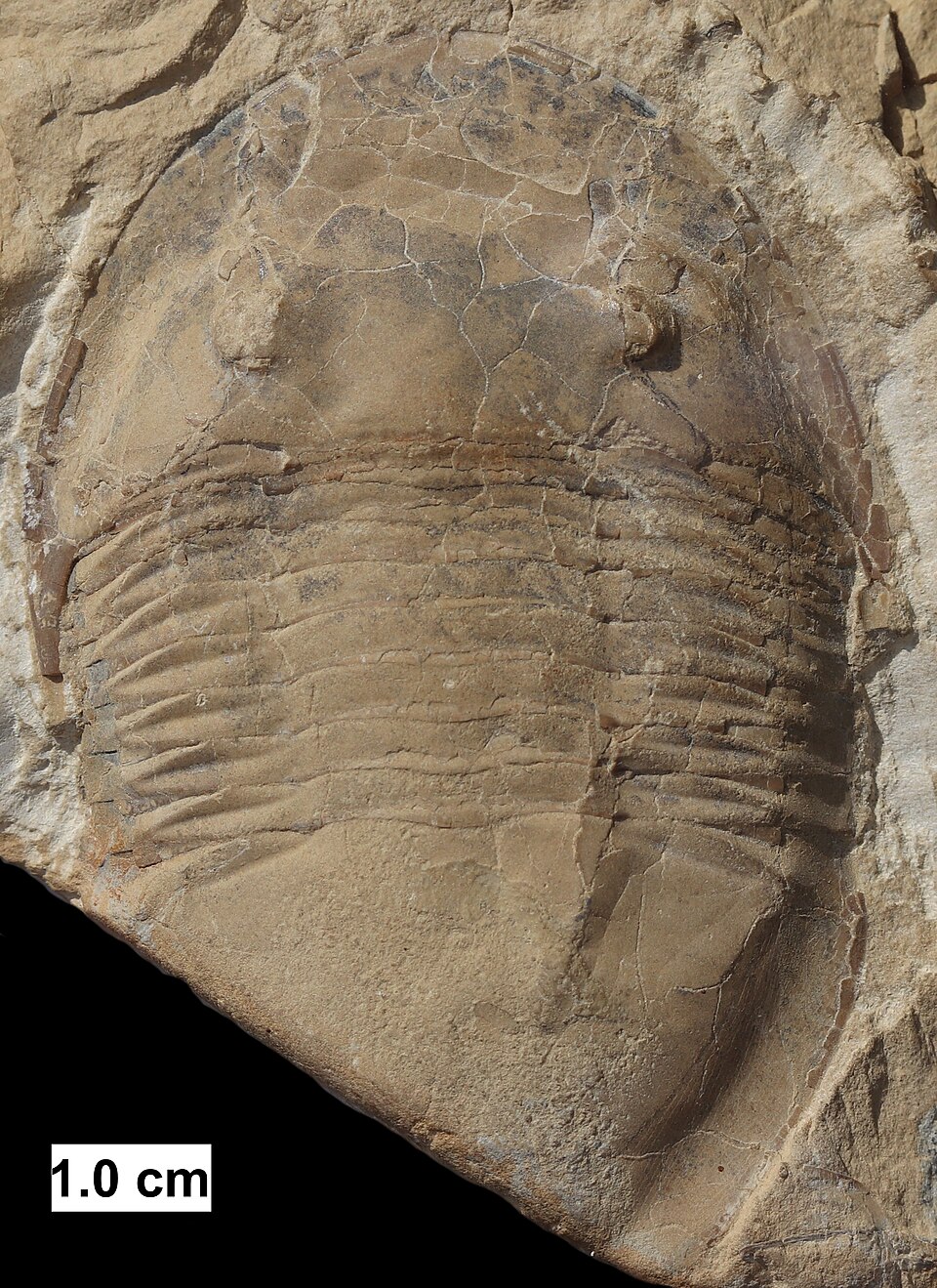

Longitudinally, the dorsal exoskeleton is divided into three lobes that give the class its name. The central axial lobe runs the length of the body and housed the digestive tract and other internal organs. The two lateral pleural lobes extend outward from the axis and protected the appendages beneath.1 The ventral anatomy is rarely preserved, but exceptional Lagerstatten such as the Burgess Shale, the Chengjiang biota, and Ordovician sites in Morocco have revealed the biramous limbs, antennae, and even traces of the digestive system. Each limb consisted of an inner walking branch (the endopodite) used for locomotion and an outer gill-bearing branch (the exopodite) used for respiration and, in some taxa, suspension feeding.1, 10
Trilobites grew through ecdysis, periodically moulting their exoskeletons as they increased in size. Their ontogeny proceeded through a series of well-defined stages — the protaspid (a tiny, unsegmented larval disc), the meraspid (in which thoracic segments were progressively released from the cephalon), and the holaspid (the adult form with a fixed number of thoracic segments).16 The detailed preservation of growth series in many trilobite lineages has made them one of the most thoroughly studied examples of arthropod ontogeny in the fossil record, yielding insights into developmental biology, heterochrony, and the evolution of segmentation.16
Compound eyes and the calcite lens
Trilobite eyes are among the oldest known sophisticated visual systems in the history of life. Most trilobite species possessed a pair of compound eyes on the dorsal surface of the cephalon, composed of individual visual units called ommatidia, each capped by a lens made of a single crystal of calcite.4 The use of a crystalline mineral as a lens material is unique among all known animals, living or extinct, and it conferred an optical advantage: by orienting the calcite crystal with its c-axis aligned along the optical axis of the lens, trilobites eliminated the double refraction (birefringence) that would otherwise have produced a blurred double image.4, 5
Two fundamentally different eye types are recognized.
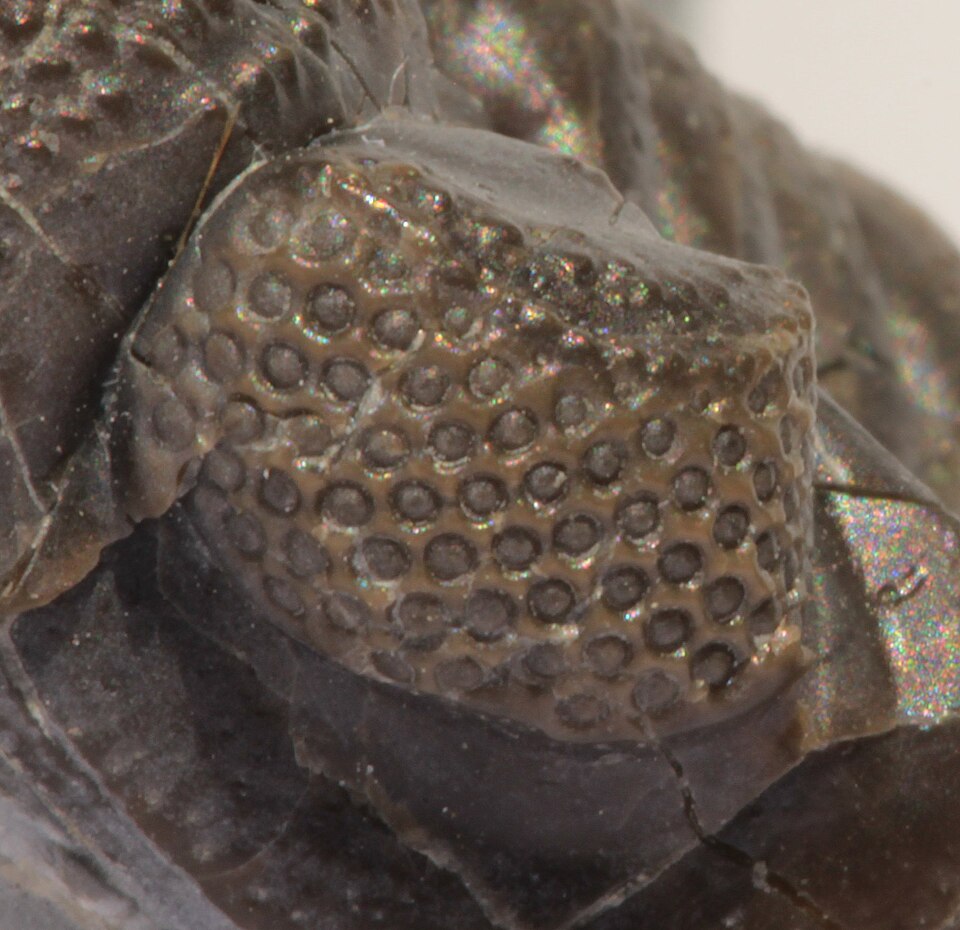

The holochroal eye, the more common and ancestral type, consisted of hundreds to thousands of tightly packed hexagonal lenses covered by a single continuous corneal membrane. This arrangement closely parallels the compound eyes of modern insects and crustaceans, and holochroal eyes are found in most trilobite orders throughout their history.1, 4 The schizochroal eye, unique to the suborder Phacopina within the order Phacopida, consisted of fewer but much larger lenses — typically 50 to 700 per eye — each individually separated from its neighbours by interlensar sclera and each possessing its own corneal covering.6 Detailed optical analysis of schizochroal lenses, particularly in the Devonian genus Dalmanites, revealed that each lens was a doublet — a combination of two elements of differing refractive indices that corrected for spherical aberration. Clarkson and Levi-Setti demonstrated that this correction followed principles described by Descartes and Huygens in the seventeenth century, making trilobites the earliest known organisms to have solved a problem in applied optics.4, 5
A minority of trilobites were blind, having secondarily lost their eyes. Blindness evolved independently in multiple lineages and is particularly common among deep-water and burrowing forms, such as many trinucleid trilobites and some agnostids, where the absence of light at depth rendered visual organs unnecessary.1, 10
Diversity and classification
Trilobites are classified in the class Trilobita within the phylum Arthropoda. Modern classifications, revised substantially by Adrain, recognize ten orders, though the precise boundaries and relationships among these groups remain subjects of active research.2, 3 The major orders span the full breadth of trilobite morphological diversity and temporal range.
The Redlichiida are among the most primitive trilobites, dominating early and middle Cambrian faunas. They are characterized by large, semicircular cephala, numerous thoracic segments, and relatively small pygidia, and they include some of the oldest known trilobite species.1, 22 The Ptychopariida, the most species-rich order, encompassed an enormous range of morphologies and persisted from the Cambrian to the late Ordovician, filling diverse benthic niches.2 The Phacopida, dominant from the Ordovician through the Devonian, included forms with large schizochroal eyes (the phacopines) and heavily ornamented exoskeletons, and this order contains many of the most familiar trilobite genera, including Phacops, Dalmanites, and Calymene.1, 6 The Lichida produced some of the most spectacularly spinose trilobites, while the Proetida were the last surviving order, persisting alone through the Carboniferous and Permian until the end-Permian extinction finally eliminated the class.19, 13
Other important orders include the Agnostida, tiny forms (typically under 1 centimetre) with only two or three thoracic segments whose affinities have been debated — some workers have argued they may not be trilobites at all but rather stem-group crustaceans. The Asaphida were diverse in the Ordovician, the Corynexochida flourished in the Cambrian, and the Harpetida are distinguished by their broad, flat cephalic brims that may have functioned in filter feeding.2, 10
Major trilobite orders and their temporal ranges2, 19
| Order | Temporal range | Approximate species count | Distinguishing features |
|---|---|---|---|
| Redlichiida | Early–Middle Cambrian | ~1,500 | Large cephalon, many thoracic segments, small pygidium |
| Ptychopariida | Cambrian–Late Ordovician | ~4,500 | Highly diverse morphology, most species-rich order |
| Phacopida | Ordovician–Devonian | ~3,000 | Schizochroal eyes (in phacopines), ornamented exoskeletons |
| Asaphida | Cambrian–Silurian | ~2,500 | Large, often smooth forms; isopygous body plan |
| Proetida | Ordovician–Permian | ~2,000 | Last surviving order; small, compact forms |
| Agnostida | Cambrian–Ordovician | ~1,200 | Tiny (<1 cm), 2–3 thoracic segments, often blind |
| Lichida | Ordovician–Devonian | ~800 | Elaborate spines, wide pygidia |
| Corynexochida | Cambrian–Ordovician | ~600 | Includes the large Cambrian form Olenoides |
| Harpetida | Cambrian–Devonian | ~300 | Broad, flat cephalic brim with pitted fringe |
Ecological diversity
Trilobites exploited a remarkably wide range of ecological niches during their long evolutionary history. The majority were benthic organisms inhabiting the seafloor, where they crawled along soft substrates feeding on organic detritus, microbial mats, and small invertebrates. The morphology of the hypostome — the ventral plate covering the mouth — provides important clues to feeding strategies. Trilobites with a firmly attached, or "conterminant," hypostome are interpreted as active predators or scavengers, while those with a loosely attached, or "natant," hypostome are inferred to have been deposit feeders or detritivores.10
Some trilobites became suspension feeders, using their gill-bearing exopodites to filter food particles from the water column. The harpetid trilobites, with their broad pitted cephalic fringes, are thought to have rested on the seafloor while channelling water beneath their cephala, and certain trinucleids may have employed a similar strategy.10, 1 Evidence for predatory behaviour includes the presence of bite marks and healed injuries on trilobite exoskeletons, which demonstrate that trilobites were both predators and prey. Babcock documented numerous examples of sublethal predation damage, including W-shaped bite marks consistent with attack by cephalopods or other large predators, concentrated on the right posterior side of the body in a pattern suggesting directed predation rather than random injury.12
A minority of trilobites adopted a pelagic lifestyle, swimming or drifting in the open water column rather than living on the seafloor. Fortey identified several convergent features in unrelated pelagic trilobite lineages: large eyes providing panoramic vision, thin and lightweight exoskeletons reducing body density, reduced or absent pygidia, and geographic distributions spanning multiple palaeocontinents — a pattern consistent with planktonic dispersal across ocean basins rather than benthic crawling along continental shelves.11 The early Ordovician genus Carolinites, with its enormous, dorsally positioned eyes and hydrodynamically streamlined body, is one of the most convincing examples of a pelagic trilobite.11
Other trilobites were burrowers that spent much of their lives within soft sediment. Many blind trilobite species, particularly those from deep-water environments, are interpreted as infaunal organisms that had no use for eyes in the perpetual darkness below the photic zone.10
Enrollment as a defensive strategy
Many trilobite species could roll their bodies into a ball, a behaviour called enrollment, in which the pygidium was tucked beneath the cephalon to enclose the soft ventral anatomy within a protective shell of mineralized exoskeleton. Enrollment is functionally analogous to the defensive rolling behaviour of modern pill bugs (isopods) and armadillos, and it represents one of the earliest documented examples of a defensive posture in the fossil record.9
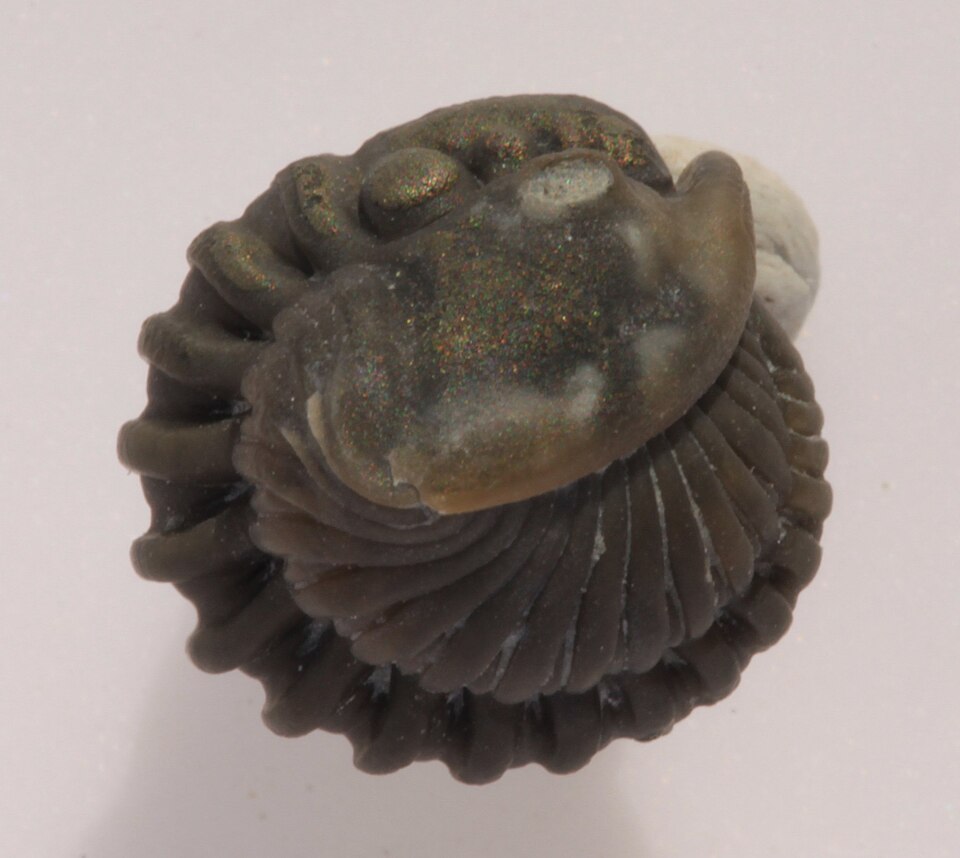

Two principal modes of enrollment are recognized. In sphaeroidal enrollment, the trilobite rolled into a tight, nearly spherical ball with the pygidium fitting precisely against the underside of the cephalon, often assisted by interlocking structures such as a vincular furrow on the cephalic doublure and corresponding notches on the pygidium. This configuration provided maximum protection for the soft ventral surface. In spiral enrollment, the body coiled loosely, with the pygidium tucked under the thorax but not reaching the cephalon, offering less complete coverage.9, 21
Biomechanical analyses have shown that sphaeroidal enrollment required specific anatomical adaptations: the thoracic segments needed sufficient flexibility to permit the necessary curvature, the pygidium had to match the cephalic doublure in size and shape, and the exoskeleton had to be strong enough to resist the crushing forces of a predator's attack.21 The frequency of enrolled trilobites in the fossil record increases notably from the Ordovician onward, a trend that correlates with the diversification of durophagous (shell-crushing) predators such as cephalopods and eurypterids. This pattern suggests an evolutionary arms race in which escalating predation pressure selected for increasingly effective defensive enrollment.12, 9
Biostratigraphic importance
Trilobites are among the most valuable index fossils for dating and correlating Paleozoic sedimentary rocks. An ideal index fossil must satisfy several criteria: it should be morphologically distinctive, easily identifiable, geographically widespread, and stratigraphically short-ranged — meaning each species existed for a brief interval of geological time before evolving into something recognizably different or going extinct. Trilobites fulfil all of these requirements to an exceptional degree.15
The rapid evolutionary turnover of trilobite species means that successive rock layers contain different species assemblages, allowing geologists to establish a relative chronology of strata based on their trilobite content. This principle was recognized as early as the nineteenth century, when trilobites played a central role in the subdivision of the Cambrian, Ordovician, and Silurian systems.15, 7 For the Cambrian period in particular, trilobite biostratigraphy remains the primary tool for intercontinental correlation. Palmer established a system of biomeres — stratigraphic intervals bounded by abrupt trilobite faunal turnovers — that defined the upper Cambrian of North America, and analogous trilobite-based zonation schemes have been developed for every major Cambrian palaeocontinent.7, 18
The biostratigraphic utility of trilobites diminishes somewhat after the Ordovician, as other fossil groups — graptolites for the Silurian, conodonts for the Devonian and later periods — became preferred index fossils for those intervals. Nevertheless, trilobites remain useful supplementary biostratigraphic markers throughout the Paleozoic, and their abundance in Cambrian rocks makes them indispensable for the subdivision and correlation of Earth's earliest period of complex animal life.15
Evolutionary history
The earliest trilobites appear in the fossil record in the early Cambrian, approximately 521 million years ago, already fully arthropod in body plan and already differentiated into several distinct groups, suggesting that a significant period of prior evolution occurred before the acquisition of a mineralized exoskeleton made them visible in the geological record.22 The Cambrian radiation of trilobites was explosive: by the middle Cambrian, trilobites had diversified into thousands of species across multiple orders and had spread to every major marine environment on every palaeocontinent.1, 8
Trilobites reached their peak generic diversity during the Great Ordovician Biodiversification Event, when global marine biodiversity roughly tripled. New trilobite orders emerged, including the Phacopida and Lichida, and the class as a whole explored novel morphological territory with elaborate spines, complex eye types, and specialized feeding structures.17, 20 However, the late Ordovician mass extinction, caused by a severe glaciation of Gondwana, struck trilobites hard, eliminating many families and several entire orders.19
Trilobites recovered partially during the Silurian and Devonian but never regained their former dominance. The late Devonian extinctions, particularly the Frasnian-Famennian crisis, further reduced trilobite diversity, eliminating the phacopids and most remaining orders.19, 20 By the beginning of the Carboniferous, only a single order survived: the Proetida. Proetid trilobites persisted through the Carboniferous and into the Permian, occupying restricted reef and shelf environments, but their diversity was a shadow of the class's former richness. When the end-Permian mass extinction struck approximately 252 million years ago — the most severe biotic crisis in Earth's history, which eliminated roughly 81 percent of all marine species — the last proetid trilobites disappeared, ending a lineage that had endured for nearly 300 million years.13, 14
Trilobite generic diversity through the Paleozoic19, 20
Decline and final extinction
The long decline of trilobites was not a single catastrophic event but a stepwise process spanning more than 200 million years, in which successive extinction pulses removed order after order until only the proetids remained. The late Ordovician extinction eliminated the ptychopariids and several smaller orders. The late Devonian crises removed the phacopids, lichids, and most remaining groups. Each of these events disproportionately affected trilobites relative to other marine invertebrates, suggesting that the class was particularly vulnerable to the environmental changes — ocean anoxia, cooling, sea-level fluctuation — that accompanied these crises.19, 20
The final extinction of trilobites occurred during the end-Permian mass extinction, approximately 251.9 million years ago, an event triggered by massive volcanism in the Siberian Traps that released enormous quantities of carbon dioxide and sulfur dioxide into the atmosphere, driving global warming, ocean acidification, and widespread marine anoxia.13, 14 By this time, trilobite diversity had been reduced to a handful of proetid genera occupying shallow-water carbonate environments — precisely the habitats most severely affected by ocean acidification and the collapse of reef ecosystems during the end-Permian crisis. The calcite exoskeleton that had served trilobites so well for hundreds of millions of years may have become a liability in acidified oceans, where the dissolution of calcium carbonate would have weakened their protective armour. The last trilobites vanished along with roughly 81 percent of all marine species, bringing to a close one of the most successful and enduring chapters in the history of animal life.13, 14
References
Cambrian trilobites: their distribution and bearing on chronostratigraphic subdivision
The Cambrian evolutionary 'explosion': decoupling cladogenesis from morphological disparity