Overview
- Religious belief correlates strongly with geography and birth culture — a person born in Saudi Arabia is overwhelmingly likely to be Muslim, a person born in Thailand Buddhist, and a person born in rural Mississippi Protestant Christian — suggesting that the primary determinant of religious affiliation is not independent rational inquiry or divine revelation but cultural transmission from parents and community.
- The argument from locality holds that this geographic clustering is more probable on the hypothesis that religious beliefs are products of cultural inheritance than on the hypothesis that any one religion represents a genuine revelation from God, because a God who desired all humans to know the truth would presumably not make access to that truth contingent on the accident of birthplace.
- Theistic responses include the claim that God accommodates revelation to local cultures, that geographic distribution is irrelevant to truth, and that the argument proves too much (moral and scientific beliefs also vary by culture) — critics reply that the analogy fails because science converges across cultures while religions diverge, and that the accommodation defense concedes the evidential force of the geographic pattern.
The argument from locality is the observation that religious belief correlates strongly with geographic and cultural origin, and the contention that this correlation constitutes evidence against the truth of any particular religion’s exclusive claims. A person born in Pakistan is overwhelmingly likely to be Muslim; a person born in Thailand is overwhelmingly likely to be Buddhist; a person born in India is overwhelmingly likely to be Hindu; a person born in the rural American South is overwhelmingly likely to be Protestant Christian. The Pew Research Center’s global surveys consistently confirm that religious affiliation tracks national and regional boundaries far more closely than it tracks any pattern that would suggest independent rational inquiry or universal divine revelation.12, 13
The argument holds that if any one religion were objectively true and its truth were accessible through revelation, reason, or experience, one would expect a distribution of belief that is at least partially independent of cultural inheritance. The actual distribution — in which the single strongest predictor of a person’s religion is the religion of that person’s parents and surrounding community — is far more consistent with the hypothesis that religious beliefs are culturally transmitted than with the hypothesis that they represent responses to a genuine divine reality that is equally available to all human beings.1, 5
The geographic pattern
The geographic clustering of religions is among the most robust sociological facts about human religious behavior. Christianity dominates in Europe, the Americas, sub-Saharan Africa, and Oceania. Islam dominates in the Middle East, North Africa, Central Asia, and much of Southeast Asia. Hinduism is concentrated almost entirely on the Indian subcontinent. Buddhism is concentrated in East and Southeast Asia. Judaism, Sikhism, Jainism, and other smaller traditions each cluster in specific geographic and ethnic communities. Pew’s 2012 global survey estimated that 84% of the world’s population identified with a religious group, and the geographic distribution of these identifications follows national and regional lines with striking fidelity.12
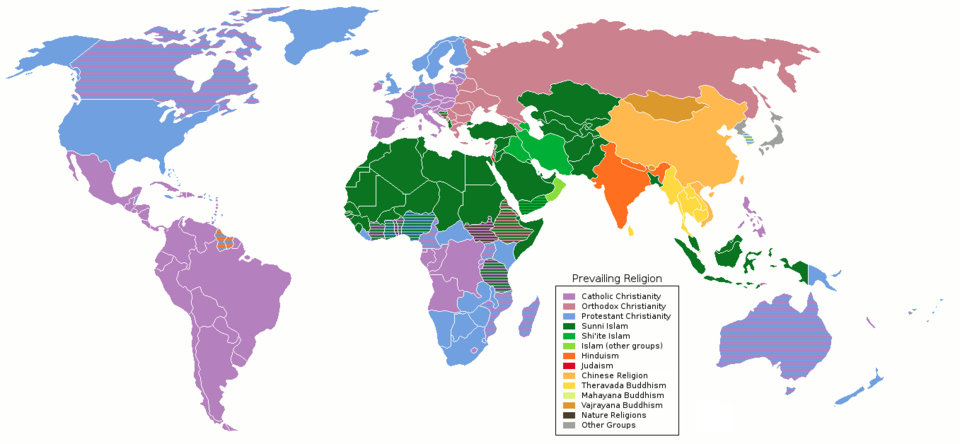

This pattern extends to denominational divisions within religions. Catholicism dominates in Southern Europe and Latin America; Protestantism dominates in Northern Europe and the Anglo-Saxon world; Eastern Orthodoxy dominates in Russia, Greece, and the Balkans. Within Islam, the Sunni–Shia divide follows geographic lines: Shia Islam predominates in Iran, Iraq, Bahrain, and Azerbaijan, while Sunni Islam predominates nearly everywhere else. These intra-religious divisions are no less geographically determined than the inter-religious ones, and they are equally well predicted by the religion of one’s parents and community.12, 13
The correlation between birthplace and belief is not absolute — conversion, migration, secularization, and missionary activity all produce deviations from perfect geographic clustering. But the deviations are modest relative to the overall pattern. Conversion rates between major world religions are low: the overwhelming majority of people die in the religion into which they were born or (in secularizing societies) leave religion altogether rather than converting to a different tradition. The global religious map, with its sharp boundaries running along national and cultural lines, is not the map one would expect if religious truth were self-evident or if a universal God were revealing himself equally to all peoples.1, 13
The argument formulated
The argument from locality can be formulated as a comparative likelihood argument in the same Bayesian framework used by Paul Draper and other contemporary philosophers of religion. Let G represent the geographic distribution of religious belief (the fact that religious affiliation is overwhelmingly determined by birthplace and culture). Let T represent theism (specifically, the kind of theism that claims a particular revelation is true and available to all). Let N represent naturalism (the hypothesis that religious beliefs are human cultural products with no supernatural origin). The argument claims that P(G|N) is much greater than P(G|T) — that is, the geographic pattern is far more expected on naturalism than on theism.1, 8
On naturalism, the geographic clustering of religion is exactly what one would predict. Cultural traits — languages, cuisines, artistic traditions, social customs — are transmitted vertically (from parents to children) and horizontally (within communities), and they cluster geographically as a result. If religion is a cultural trait like any other, its geographic distribution should mirror that of other cultural traits, which is precisely what is observed. The boundaries of religious communities follow the boundaries of linguistic, ethnic, and political communities, just as one would expect if religion is a product of the same cultural transmission processes that shape those other domains.8, 14
On theism — specifically, on the claim that God has revealed himself to humanity and desires that all people know the truth — the geographic pattern is surprising. If the Christian God exists and has provided sufficient revelation for all people to know the truth, why is Christianity concentrated in specific geographic regions and virtually absent from others (prior to colonial-era missionary activity)? If the Islamic God exists and the Quran is his final revelation, why was this revelation delivered in seventh-century Arabia and not simultaneously across the globe? The geographic confinement of each putative revelation to a specific time, place, and culture is difficult to reconcile with the claim that the revelation comes from a God who loves all people equally and desires the salvation of all.1, 9
Loftus and the outsider test for faith
The most systematic philosophical development of the argument from locality is John Loftus’s outsider test for faith (OTF), presented in Why I Became an Atheist (2008) and given a full-length treatment in The Outsider Test for Faith (2013). Loftus, a former student of William Lane Craig and a former Christian minister, argues that the geographic dependence of religious belief should lead every believer to adopt a stance of initial skepticism toward the religion in which they were raised, evaluating it with the same critical scrutiny they naturally apply to the religions of other cultures.1, 2
Loftus’s argument proceeds from what he calls the “religious diversity thesis” (RDT): the empirical fact that the religion a person adopts is overwhelmingly determined by when and where that person was born. From this, he derives the “religious dependency thesis” (RDpT): that the specific content of a person’s religious beliefs is causally dependent on cultural factors rather than on independent investigation. The OTF then argues that any belief-forming process that is so heavily influenced by cultural contingency should be subjected to the same skeptical scrutiny that one applies to the beliefs of outsiders — because the same process, operating on a person born in a different culture, would have produced a different and incompatible set of beliefs with equal subjective confidence.1
The force of the OTF comes from the asymmetry it exposes. A Christian in Alabama will readily grant that a Muslim in Saudi Arabia holds his beliefs largely because he was raised in a Muslim culture; the Christian will apply outsider skepticism to Islam without hesitation. The OTF asks the Christian to apply the same skepticism to his own beliefs — to recognize that he, too, holds his beliefs largely because he was raised in a Christian culture, and that if the accident of birth had placed him in Riyadh rather than Birmingham, he would almost certainly be a Muslim with equal sincerity and conviction. Loftus argues that intellectual honesty requires applying the same epistemic standards to one’s own inherited beliefs as one applies to the inherited beliefs of others.1, 2
Hick and the pluralist response
John Hick’s religious pluralism, developed most fully in An Interpretation of Religion (1989; 2nd ed. 2004), takes the geographic distribution of religion as a starting point but draws a different conclusion. Hick argued that the major world religions are diverse human responses to a single transcendent reality that he called “the Real.” The geographic clustering of religions does not show that religion is false; it shows that the Real is experienced differently in different cultural contexts, mediated by different conceptual schemes, mythological frameworks, and historical traditions. Christianity, Islam, Hinduism, and Buddhism are each authentic encounters with the same ultimate reality, filtered through different cultural lenses.5
Hick’s pluralism preserves the core insight of the argument from locality — that religious belief is culturally mediated — while resisting the atheistic conclusion. However, it comes at a significant cost to the truth claims of each individual religion. If all major religions are equally valid responses to the Real, then none of them is uniquely true in the way that orthodox Christianity, Islam, or Hinduism claims to be. Hick’s position requires abandoning the exclusive truth claims that are central to the self-understanding of most religious traditions: the Christian claim that Jesus is uniquely divine, the Islamic claim that the Quran is God’s final revelation, the Buddhist claim that the Noble Eightfold Path is the correct way to liberation. Most theologians within these traditions have rejected Hick’s pluralism as incompatible with their core doctrines.3, 5
From the perspective of the argument from locality, Hick’s pluralism concedes the argument’s central empirical premise (that religious belief is geographically determined) and responds by modifying the theological conclusion (no single religion has unique access to truth). This is a retreat from traditional theistic exclusivism, not a defense of it. The argument from locality thus succeeds in forcing a choice: either abandon exclusivist truth claims (Hick’s route) or provide an explanation for why a God who desires universal knowledge of the truth would confine his revelation to a single geographic and cultural context (the exclusivist’s burden).3, 11
Theistic responses
The most common exclusivist response is that God accommodates his revelation to specific cultures and then charges believers with spreading it to others through evangelism and missionary activity. On this view, the geographic concentration of Christianity in the first century is not evidence against its truth but merely a consequence of the fact that revelation must begin somewhere. God chose to reveal himself through a particular people (Israel) at a particular time, and the subsequent spread of Christianity through the Roman Empire, Europe, and eventually the world is evidence of the truth of that revelation, not evidence against it.10
Critics argue that this response raises more problems than it solves. If God desires the salvation of all people and possesses the power to reveal himself universally, the decision to begin with one small ethnic group in the ancient Near East and rely on human missionary activity for subsequent spread is difficult to justify. Billions of people lived and died before the Christian revelation; billions more lived and died in geographic and cultural isolation from it (the indigenous peoples of the Americas, Australia, the Pacific Islands, sub-Saharan Africa, and East Asia prior to European contact). If access to salvation depends on knowledge of a specific revelation, the geographic confinement of that revelation entails that the majority of human beings who have ever lived had no access to salvation through no fault of their own. Theodore Drange has argued that this consequence is incompatible with the goodness of God as traditionally conceived.9, 16
A second theistic response, often attributed to Plantinga, is that the geographic distribution of belief is irrelevant to truth. The fact that most people acquire their beliefs through cultural transmission rather than independent inquiry is a sociological observation, not an epistemological one. Many true beliefs are culturally transmitted — including scientific beliefs, mathematical beliefs, and moral beliefs — and the cultural origin of a belief does not undermine its warrant. Plantinga has argued that if God exists and has designed human cognitive faculties to produce true beliefs about him (the sensus divinitatis), then the mechanism of cultural transmission is simply one means by which God ensures that true beliefs are propagated.9
Critics have offered two replies. First, the analogy with science is misleading. Scientific beliefs converge across cultures: independently developed scientific traditions reach the same conclusions about the structure of matter, the age of the Earth, and the laws of physics. Religious beliefs diverge: independently developed religious traditions reach incompatible conclusions about the nature of God, the fate of the soul, and the requirements for salvation. The convergence of science across cultures is evidence that science tracks mind-independent reality; the divergence of religion across cultures is evidence that religion tracks culture-dependent assumptions.1, 16
Second, Plantinga’s sensus divinitatis defense is question-begging in the present context. If the question is whether there is a God who designed human cognitive faculties, one cannot assume the existence of such a God in order to explain the geographic distribution of belief. The defense works only if theism is already assumed; it cannot be used to respond to an argument that challenges theism. The argument from locality asks why, if God exists and desires universal belief, belief is so unevenly distributed. Answering that God designed cognitive faculties to produce belief presupposes the very conclusion in dispute.1, 11
Scope and significance
The argument from locality is not a deductive proof that no religion is true. It is possible, in principle, that one religion is true and that its geographic concentration is merely a contingent historical fact with no bearing on its truth. The argument is evidential and probabilistic: it claims that the geographic pattern of religious belief is more probable on the hypothesis that religions are human cultural products than on the hypothesis that any one religion represents a genuine divine revelation. The strength of the argument depends on how much weight one assigns to the geographic data relative to other considerations (arguments for God’s existence, personal religious experience, the internal coherence of a given theology).1, 11
The argument interacts closely with several other challenges to theism. The argument from inconsistent revelations observes that the world’s religions make mutually contradictory claims, so at most one can be fully true; the argument from locality adds that the distribution of these contradictory claims follows cultural rather than evidential lines. The cognitive science of religion identifies the psychological mechanisms (HADD, theory of mind, cultural learning biases) that drive cultural transmission of religious beliefs, providing a causal account of how the geographic pattern arises without any supernatural input. Together, these arguments form a cluster: religious beliefs are geographically distributed, they are mutually contradictory, and they can be fully explained by cultural and cognitive mechanisms that do not require divine action.1, 8, 14
The argument also has implications for the epistemology of disagreement. If reasonable, intelligent, sincere people in different cultures reach radically different religious conclusions, and if the primary explanation for these differences is cultural inheritance rather than differences in evidence or reasoning ability, then the rational response may be to reduce confidence in one’s own culturally inherited religious beliefs. This is the core of Loftus’s outsider test: the recognition that one’s own religious confidence is, to a significant degree, an artifact of birth rather than a product of evidence should prompt epistemic humility about the beliefs in question. Whether this humility should extend to full agnosticism or atheism, or merely to a less confident and more open-minded form of religious belief, remains a matter of debate.1, 4, 15