Overview
- Parsimony (Occam’s razor) is a principle of theory selection that favours simpler explanations over more complex ones, and its application to the theism-naturalism debate has generated sustained disagreement over whether God is a simple or complex postulate
- Richard Swinburne argues that theism is maximally parsimonious because it explains the entire universe by appeal to a single entity with properties at their limiting values (infinite power, knowledge, and freedom), whereas naturalism leaves dozens of laws and constants unexplained
- Critics including Graham Oppy, Elliott Sober, and Richard Dawkins counter that an omnipotent, omniscient mind is not a simple entity, that parsimony in science does not straightforwardly transfer to metaphysics, and that positing God to explain complexity merely relocates the problem
Parsimony — the principle that simpler explanations should be preferred over more complex ones, all else being equal — has been a central point of contention in the debate between theism and naturalism. Both sides claim the principle as an ally. Theists, most notably Richard Swinburne, argue that God is the simplest possible ultimate explanation of the universe: one entity, with properties at their natural limiting values, accounting for everything that exists.1 Atheists and agnostics counter that a disembodied mind with infinite attributes is not a simple postulate at all, and that naturalistic explanations invoking only physical laws and initial conditions are more parsimonious.3, 4 The dispute turns on what parsimony actually means, whether it tracks truth or merely convenience, and whether a principle forged in empirical science can be extended to metaphysics.

Ockham’s razor: historical and formal
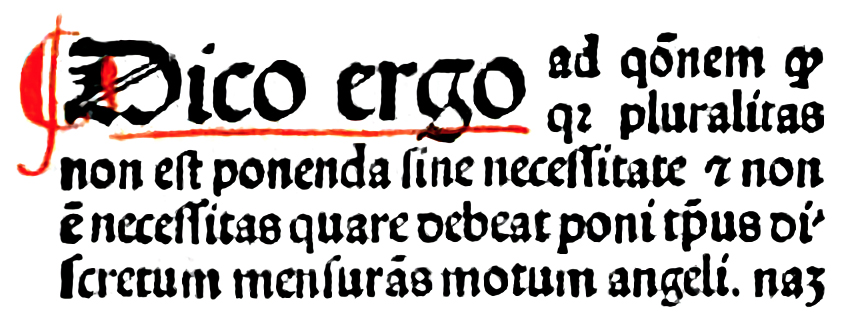
The principle of parsimony is commonly attributed to the fourteenth-century Franciscan friar William of Ockham, though the maxim "entities should not be multiplied beyond necessity" (entia non sunt multiplicanda praeter necessitatem) does not appear verbatim in his writings.12 What Ockham did argue, repeatedly, was that plurality should not be posited without necessity and that what can be explained by fewer principles is explained in vain by more. The label "Ockham’s razor" was attached to these ideas in later centuries as a convenient shorthand for a family of simplicity principles.5
The principle admits of several distinct formulations. Ontological parsimony (sometimes called quantitative parsimony) counsels against multiplying the number of entities in one’s ontology. Qualitative parsimony counsels against multiplying the number of kinds of entity. Ideological parsimony concerns the number of primitive predicates or concepts required by a theory. Parametric parsimony favours theories with fewer adjustable parameters.5, 7 These criteria do not always agree. A theory might be ontologically parsimonious (positing few entities) while being ideologically complex (requiring many primitive concepts to characterise those entities). The application of parsimony to the theism-naturalism debate depends critically on which version of the principle is in play.
In formal terms, parsimony can be given a Bayesian interpretation. On Bayes’ theorem, the posterior probability of a hypothesis H given evidence E is proportional to the product of its prior probability P(H) and its likelihood P(E|H). Simpler hypotheses are often assigned higher prior probabilities on the grounds that a simpler hypothesis makes more specific predictions, concentrating its probability mass over a narrower range of possible observations, and is therefore more falsifiable and more confirmable.15, 7 The question, then, is whether theism or naturalism deserves the higher prior on grounds of simplicity.
Ontological versus explanatory parsimony
A crucial distinction in the literature is between ontological parsimony — minimising the entities one postulates — and explanatory parsimony — minimising the number of unexplained brute facts in one’s account of reality.5, 1 These two criteria can pull in opposite directions when applied to the God question.
Ontological parsimony, in its most straightforward reading, appears to favour naturalism. The naturalist postulates only the physical universe and its governing laws; the theist postulates all of that plus an additional entity — God — that is not directly observed. On this reading, the razor shaves God away as an unnecessary addition to one’s ontology.8 J. L. Mackie made this point forcefully, arguing that since the physical universe is something both sides accept and God is something only the theist adds, the burden of justification falls entirely on the theist.8
Swinburne responds by shifting the emphasis from ontological to explanatory parsimony. What matters, he argues, is not merely the number of entities but the number of unexplained stopping points. Naturalism takes as brute facts the existence of the universe, the specific form of its laws, the specific values of its constants, and its initial conditions — a large collection of unexplained particulars. Theism explains all of these by appeal to a single being’s intentions, thereby reducing the total number of brute facts to one: the existence of God.1, 2 On this accounting, theism is the more parsimonious hypothesis because it does more explanatory work per postulate.
Swinburne’s case for theistic simplicity
Swinburne’s argument that theism is parsimonious has been the most sustained and philosophically developed version of this claim. Its core thesis is that God — understood as a being of infinite power, infinite knowledge, and perfect freedom — is a simpler postulate than any alternative ultimate explanation because the divine attributes are set at their natural limiting values rather than at arbitrary finite magnitudes.1, 2
The reasoning proceeds as follows. A hypothesis that postulates a being with power of degree 1047 must explain why that value rather than some other. A hypothesis that postulates unlimited power requires no such explanation, since infinity is a natural stopping point that involves no arbitrary selection among alternatives. The same logic applies to knowledge and freedom. Infinite values are like zero in a mathematical theory: they are simpler than any particular finite value because they are uniquely determined by the structure of the property in question.1 God, characterised by these three infinite attributes, is therefore the simplest possible person — and since personal explanation (explanation by intentions and agency) is a legitimate category alongside scientific explanation, positing one maximally simple person as the ultimate explanation of everything is the most parsimonious theory available.2, 13
Swinburne further argues that theism achieves this simplicity while simultaneously possessing enormous explanatory power. A single omnipotent, omniscient, perfectly good being has reason to create a universe with orderly laws (because order is good), with creatures capable of moral agency (because free will is good), and with the particular degree of complexity necessary for conscious life.1 No other single-entity hypothesis, Swinburne contends, can match this combination of simplicity and explanatory scope.
Oppy’s response: God is not a simple entity
Graham Oppy has provided the most thorough critical engagement with Swinburne’s simplicity claim. In Arguing About Gods and in his 2022 dialogue with Swinburne, Oppy challenges the thesis at several points.3, 10
First, Oppy disputes that infinite properties are simpler than finite ones. An omniscient being must know every true proposition — an infinite collection of truths about every particle, every event, every counterfactual. An omnipotent being must be capable of performing any logically possible action — an infinite range of causal powers. Far from being simple, these attributes involve a kind of maximal ontological richness. The brevity of the English sentence "God is omniscient" should not be confused with the simplicity of the state of affairs it describes.3
Second, Oppy argues that Swinburne’s comparison is unfairly structured. Naturalism does not merely postulate "a universe with 25 constants set to arbitrary values." A completed physics might reveal that the constants are not independent but derivable from a smaller set of principles, or even from a single principle. The history of science — from Maxwell’s unification of electricity and magnetism to the Standard Model’s unification of three fundamental forces — is a history of reducing the number of independent parameters, and there is no reason to assume this process has reached its limit.3, 10
Third, Oppy contends that naturalism needs no ultimate explanation at all. The demand that everything have an explanation — sometimes called the principle of sufficient reason — is itself a substantive metaphysical thesis that the naturalist is free to reject. If the universe and its laws are accepted as brute facts, no additional explanatory entity is needed, and parsimony favours the hypothesis with fewer total entities.3
Dawkins’ ultimate Boeing 747 argument
Richard Dawkins, in The God Delusion, presents what he calls "the ultimate Boeing 747 gambit" — a reference to Fred Hoyle’s argument that the probability of life arising by chance is comparable to a tornado assembling a Boeing 747 from parts in a junkyard. Dawkins turns the argument on its head: if complex organised things require explanation, and if God is a being complex enough to design a universe, then God requires at least as much explanation as the universe itself.4
The argument can be stated informally. Any entity capable of designing the fine-tuned constants of physics, the laws of nature, and the initial conditions of the universe must possess a staggering degree of organised complexity — the capacity to represent, evaluate, and choose among possible universes. Positing such an entity to explain the complexity of the universe does not reduce complexity but relocates it. The theist must then explain where God’s complexity came from, on pain of an infinite regress or an admission that some complex things are brute facts after all — which would undermine the original motivation for positing God.4, 14
Swinburne responds that Dawkins confuses the complexity of a physical system (composed of interacting parts) with the complexity of a hypothesis. God, as traditionally conceived, has no parts and no composition — divine simplicity is a standard thesis of classical theism going back to Thomas Aquinas.11 A non-physical mind with infinite attributes is not the kind of thing that requires assembly from components, and so the analogy with a Boeing 747 is misleading.1 Whether this response succeeds depends on whether one accepts that an unembodied mind of infinite capacity is genuinely simpler than a structured physical system — a point that remains deeply contested.10
Sober on parsimony in science versus metaphysics
The philosopher of science Elliott Sober has mounted a different kind of challenge to the use of parsimony in the theism debate. In Let’s Razor Ockham’s Razor and Ockham’s Razors: A User’s Manual, Sober argues that parsimony has no single, context-independent justification. In science, the preference for simpler hypotheses is justified locally — by specific background knowledge about the domain in question — rather than by a global metaphysical principle that simplicity tracks truth.6, 7
In phylogenetics, for example, the principle of parsimony (minimising the number of evolutionary changes) is justified by specific models of how evolution works, not by a brute assumption that simpler trees are more likely. In curve fitting, the preference for simpler equations is justified by the Akaike Information Criterion or similar model-selection tools grounded in information theory, not by a metaphysical commitment to simplicity.7 Sober concludes that parsimony is always domain-relative: it is justified when there is a specific reason to think that simpler hypotheses are more probable in that domain, and unjustified otherwise.
Applied to the theism debate, Sober’s analysis suggests that Swinburne cannot simply invoke the success of parsimony in physics or biology as evidence that parsimony applies to metaphysical hypotheses about ultimate reality. The contexts are too different. In science, simpler hypotheses are preferred because experience has shown that nature tends to operate by simple laws. There is no analogous track record for metaphysical hypotheses about the existence of God.6, 7 Gregory Dawes presses a similar point, arguing that personal explanations (explaining events by appeal to agents’ intentions) and scientific explanations (explaining events by appeal to laws and initial conditions) are different explanatory frameworks, and that simplicity criteria valid within one framework cannot be straightforwardly exported to the other.9
The Bayesian formulation
The parsimony debate can be given precise expression within the framework of Bayesian epistemology. On Bayes’ theorem, the posterior probability of theism given our total evidence E is:
P(Theism | E) = P(E | Theism) × P(Theism) / P(E)
Parsimony enters through the prior probability P(Theism). If theism is a simpler hypothesis, it should receive a higher prior; if naturalism is simpler, it should receive a higher prior. The debate about parsimony is, in Bayesian terms, a debate about how to assign prior probabilities to competing metaphysical hypotheses.15, 1
Swinburne argues that simpler hypotheses deserve higher priors because they are more "intrinsically probable" — they pick out a smaller, more natural region of the space of possible hypotheses. A hypothesis with fewer adjustable parameters makes more definite predictions and is therefore more tightly constrained by the evidence. This is analogous to the way in which simpler models in statistics are penalised less for their number of parameters, as formalised by the Bayesian Information Criterion.2, 13
Oppy responds that prior probability assignments in the theism debate are inevitably subjective and that no neutral, agreed-upon simplicity metric exists that would deliver a unique prior for theism. The very disagreement about what counts as simple — whether infinite properties are simpler than finite ones, whether unembodied minds are simpler than physical systems — means that the Bayesian framework, while useful for structuring the debate, cannot resolve it. The priors are where the philosophical action is, and parsimony alone cannot determine them.3, 10
Is parsimony truth-tracking or merely pragmatic?
Underlying the entire debate is a deeper epistemological question: does parsimony indicate truth, or is it merely a pragmatic criterion of theory choice — a preference for simpler theories because they are easier to work with, not because they are more likely to be correct?5
Realists about parsimony, including Swinburne, hold that simplicity is a genuine guide to truth. The track record of science — in which simpler theories have repeatedly been vindicated by later evidence — provides inductive support for the claim that simpler theories are more likely to be true. Without this assumption, Swinburne argues, inductive reasoning itself would be impossible, since any finite data set is compatible with infinitely many hypotheses of varying complexity.2, 13
Instrumentalists and pragmatists about parsimony deny that simplicity has any evidential force. Simpler theories are preferred because they are easier to test, easier to use, and easier to communicate — not because reality is biased toward simplicity. Bas van Fraassen, for instance, argues that the empirical adequacy of a theory is all that matters for its acceptance, and that parsimony is a pragmatic virtue on a par with elegance or computational tractability.5 If this view is correct, then the entire project of using parsimony to assign prior probabilities to theism or naturalism is misguided: parsimony would tell us which hypothesis is more convenient, not which is more likely to be true.
Sober occupies a middle position, arguing that parsimony is truth-tracking in specific scientific domains (where there are local reasons to think simpler models are more accurate) but not in metaphysics generally. This domain-relative view undercuts Swinburne’s attempt to extend the scientific track record of parsimony to the theism-naturalism debate while preserving the role of parsimony within science itself.6, 7
Contemporary assessment
The debate over parsimony and theism remains unresolved, and it is unlikely to be settled by parsimony considerations alone. The 2022 dialogue between Swinburne and Oppy — two of the most careful philosophers on opposite sides of the question — confirmed that the simplicity of theism is the central point of disagreement in their broader debate about God’s existence, and that no neutral algorithm exists for adjudicating it.10
Several conclusions, however, command broad agreement. First, the naive application of Ockham’s razor — "God is an extra entity, so cut him away" — is too crude. The razor’s instruction to avoid unnecessary entities raises the question of what counts as necessary, which is precisely what the theism debate is about.5, 7 Second, the question of whether theism is parsimonious cannot be separated from the question of which simplicity criterion is appropriate. On parametric simplicity, theism may have an advantage; on ontological parsimony in the entity-counting sense, naturalism may have the edge; on ideological simplicity, the verdict is disputed.1, 3, 5 Third, the extension of parsimony from empirical science to metaphysics is itself a substantive philosophical move that requires defence, not a default assumption that both sides share.6, 9
The argument from simplicity for theism remains a live option in natural theology, particularly within Swinburne’s Bayesian cumulative case. Its critics have not shown that it fails, but they have shown that its success depends on prior commitments about the nature of simplicity that are themselves open to rational disagreement. Parsimony, it turns out, is not the decisive tiebreaker that either side might wish it to be — it is one more contested premise in the larger argument about God.