Overview
- The process by which certain writings came to be regarded as authoritative scripture and collected into the Bible took place over centuries, with the boundaries of the Hebrew Bible largely settled by the late first or second century CE and the New Testament canon reaching its present form by the late fourth century CE.
- No single council or decree created the biblical canon; the process was gradual, involving widespread usage in worship and teaching, citation by authoritative figures, inclusion in manuscript codices, and eventual formal recognition by church councils that ratified what had already become common practice.
- The canons of different Christian traditions differ: the Protestant Old Testament contains 39 books matching the Hebrew Bible, the Roman Catholic canon includes 46 Old Testament books (with the deuterocanonical books), and the Ethiopian Orthodox canon contains 81 books, demonstrating that the question of which books belong in the Bible has never received a single universal answer.
The Bible did not arrive as a single volume. The collection of writings that Jews and Christians regard as scripture was assembled over centuries through a process that involved composition, copying, selection, debate, and eventual formal recognition. The Hebrew Bible reached a broadly stable form by the second century CE, though the precise boundaries remained contested in some Jewish communities. The New Testament canon reached its present twenty-seven-book form in the late fourth century, though individual books continued to be disputed in some churches for centuries after that. The Old Testament canons of the Roman Catholic, Eastern Orthodox, Ethiopian Orthodox, and Protestant traditions differ from one another to this day.1, 2
The word "canon" derives from the Greek kanon (κανών), meaning a reed used as a measuring rod, and by extension a rule or standard. Applied to scripture, it designates the list of books recognized as authoritative. No single council, decree, or individual created the canon. The process was organic: books gained authority through use in worship and teaching, through citation by respected figures, and through inclusion in manuscript collections. Formal lists and council decrees came later, ratifying what had already become widespread practice rather than imposing a new selection.1, 3

The Hebrew Bible canon
The Hebrew Bible (Tanakh) is divided into three sections: Torah (the five books of Moses), Nevi'im (Prophets), and Ketuvim (Writings). This threefold division is attested as early as the prologue to the book of Sirach (Ecclesiasticus), written around 132 BCE, which refers to "the Law and the Prophets and the other books of our ancestors." The division reflects a rough chronological order of canonical acceptance: the Torah achieved authoritative status first, followed by the Prophets, with the Writings reaching canonical recognition last.2, 3
The Torah (Genesis, Exodus, Leviticus, Numbers, Deuteronomy) was regarded as authoritative by the time of the post-exilic period. The book of Nehemiah describes a public reading of "the book of the law of Moses" in the mid-fifth century BCE (Nehemiah 8:1). The Samaritan community, which separated from Judean Judaism no later than the second century BCE, accepted only the Torah as scripture, indicating that the Torah's canonical status was established before the separation while the Prophets and Writings were not yet universally recognized.2, 6
The Prophets (Joshua, Judges, Samuel, Kings, Isaiah, Jeremiah, Ezekiel, and the Twelve Minor Prophets) were recognized as a collection by the second century BCE. The prologue to Sirach already treats "the Prophets" as a defined body of literature. The books of the Writings (Psalms, Proverbs, Job, Song of Songs, Ruth, Lamentations, Ecclesiastes, Esther, Daniel, Ezra-Nehemiah, Chronicles) took longer to achieve canonical status. The Mishnah, compiled around 200 CE, records debates about whether Song of Songs and Ecclesiastes "defile the hands" — a rabbinic idiom for canonical status — indicating that these books were still under discussion at that date (Yadayim 3:5).13
Jamnia and its limits
An older scholarly consensus held that the canon of the Hebrew Bible was formally closed at a council held at Jamnia (Yavneh) around 90 CE. This view, popularized by Heinrich Graetz in the nineteenth century, proposed that the rabbis at Jamnia voted on which books belonged in the canon and settled the disputed cases of Ecclesiastes, Song of Songs, and Esther.2, 3
This "Council of Jamnia" hypothesis has been substantially revised. Jack P. Lewis demonstrated in a 1964 article and subsequent work that the evidence from rabbinic sources does not support the idea of a formal council with canonical authority. The rabbinic discussions at Yavneh concerned the interpretation and status of specific books, but there is no evidence that a vote was taken or that binding decisions about the canon were issued. The discussions continued well beyond 90 CE: the Babylonian Talmud (compiled fifth to sixth century CE) still records disputes about the canonical status of Ezekiel, Proverbs, Ecclesiastes, Song of Songs, and Esther.2, 4
The earliest clear enumeration of the books of the Hebrew Bible appears in Josephus's Against Apion (c. 95 CE), which lists twenty-two books: five books of Moses, thirteen books of prophets covering the period from Moses to the reign of Artaxerxes, and four books of hymns and precepts. The number twenty-two (matching the letters of the Hebrew alphabet) was achieved by combining books that the later Jewish tradition counts separately (Ruth with Judges, Lamentations with Jeremiah). The content of Josephus's list corresponds to the thirty-nine books of the Protestant Old Testament, though the grouping and counting differ.10
The Septuagint and the deuterocanonical books
The Septuagint (LXX), the Greek translation of Jewish scriptures produced in Alexandria between the third and first centuries BCE, contains books not found in the Hebrew Bible as it was eventually defined by rabbinic Judaism. These additional works include Tobit, Judith, Wisdom of Solomon, Sirach (Ecclesiasticus), Baruch, the Letter of Jeremiah, 1 and 2 Maccabees, and additions to Esther and Daniel. The earliest complete manuscripts of the Septuagint — Codex Vaticanus (fourth century CE) and Codex Sinaiticus (fourth century CE) — contain some or all of these additional books alongside the books of the Hebrew canon.7, 15
The status of these books has been debated since antiquity. Jerome, translating the Bible into Latin in the late fourth and early fifth centuries, distinguished between the books found in the Hebrew canon (libri canonici) and those found only in the Greek tradition (libri ecclesiastici), regarding the latter as useful for edification but not for establishing doctrine. Augustine, by contrast, accepted the longer list of books as fully canonical. The Council of Carthage in 397 CE, following Augustine, listed the longer canon including the deuterocanonical books.1, 15
The Roman Catholic Church formally defined its Old Testament canon at the Council of Trent in 1546, affirming the deuterocanonical books as fully canonical in response to the Protestant Reformation's rejection of them. The decree Sacrosancta listed forty-six Old Testament books, including Tobit, Judith, Wisdom, Sirach, Baruch, and 1–2 Maccabees. Protestant traditions, following the precedent set by Martin Luther, accepted only the books found in the Hebrew canon as Old Testament scripture, though Luther included the deuterocanonical books in his Bible translation as an appendix labeled "Apocrypha — books which are not regarded as equal to the holy scriptures, but are useful and good to read."14, 15
The following table summarizes the Old Testament canons of the major Christian traditions:
Old Testament canons by tradition3, 15, 16
| Tradition | OT books | Deuterocanonical books included |
|---|---|---|
| Protestant | 39 | None |
| Roman Catholic | 46 | Tobit, Judith, Wisdom, Sirach, Baruch, 1–2 Maccabees, additions to Esther and Daniel |
| Eastern Orthodox | 49 | Catholic deuterocanonicals plus 1 Esdras, Prayer of Manasseh, Psalm 151, 3 Maccabees |
| Ethiopian Orthodox | 54 | Broader canon including Jubilees, 1 Enoch, and other works unique to the Ethiopian tradition |
The earliest period of the New Testament canon
The writings that became the New Testament were composed between approximately 50 CE (Paul's earliest letters) and the mid-second century CE (2 Peter, often regarded as the latest New Testament writing). In the earliest period, these documents circulated independently or in small collections. Paul's letters were written to specific congregations and initially traveled as individual documents. The Gospels were composed for particular communities and circulated separately before being collected together.1, 3
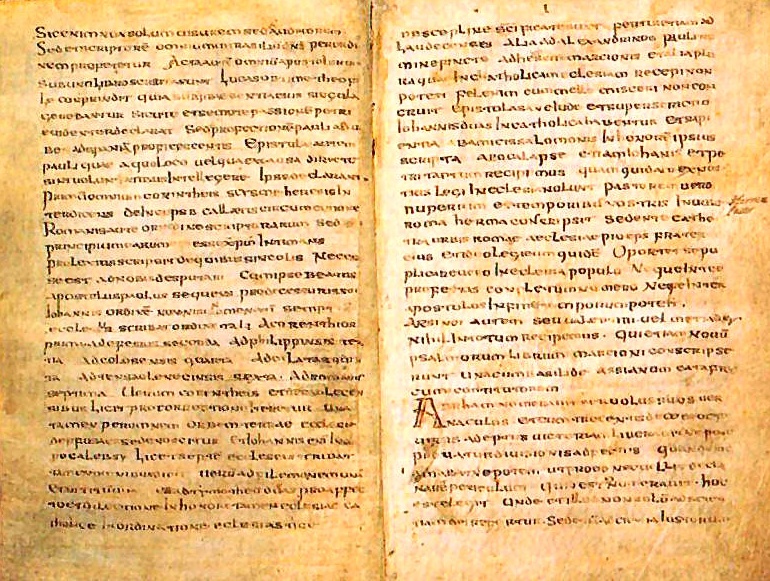
The earliest evidence of a collection of Paul's letters appears at the end of the first century or beginning of the second. The author of 2 Peter refers to "all [Paul's] letters" and places them alongside "the other scriptures" (2 Peter 3:15–16), indicating that by the time of this writing, Paul's letters were both collected and regarded as having scriptural authority. Papyrus 46 (P46), dated to approximately 200 CE, is the earliest surviving manuscript of a Pauline letter collection and contains ten of the thirteen letters attributed to Paul (omitting the Pastoral Epistles).1, 4
The four-Gospel collection also emerged early. By the mid-second century, Irenaeus of Lyon (c. 180 CE) argued that there must be four Gospels and only four, comparing them to the four winds and the four zones of the earth. Tatian, writing around the same period (c. 170 CE), produced the Diatessaron, a harmony that wove the four canonical Gospels into a single continuous narrative, indicating that these four (and these four only) were regarded as authoritative in his circles. The four-Gospel codex P45 (early third century) is the earliest surviving manuscript containing portions of all four Gospels together.1, 15
Disputed books
While the four Gospels, Paul's major letters, and Acts were widely accepted from an early date, other books remained disputed for centuries. Eusebius of Caesarea (c. 313–325 CE) classified the New Testament writings into three categories in his Ecclesiastical History: the "acknowledged" (homologoumena), the "disputed" (antilegomena), and the "spurious" or "rejected" (notha). His acknowledged books included the four Gospels, Acts, Paul's epistles, 1 John, 1 Peter, and "if it seem right, the Revelation of John." His disputed books included James, Jude, 2 Peter, 2 and 3 John. Among the rejected works he listed the Acts of Paul, the Shepherd of Hermas, the Apocalypse of Peter, the Epistle of Barnabas, the Didache, and "if it seem right, the Revelation of John" — placing Revelation in both the acknowledged and rejected categories, reflecting the division of opinion about it.8
The Epistle to the Hebrews illustrates the geographic variation in canonical acceptance. In the eastern churches (Alexandria, Antioch, Jerusalem), Hebrews was generally accepted as Pauline and canonical from an early date. In the western churches (Rome, North Africa, Gaul), Hebrews was known but not attributed to Paul and was excluded from some early canonical lists. The Muratorian Fragment, an early canonical list usually dated to the late second century (though some scholars place it in the fourth century), omits Hebrews entirely. Western acceptance of Hebrews as canonical developed gradually during the fourth century, influenced in part by eastern practice.1, 12
Revelation posed the opposite problem: it was widely accepted in the west but disputed in the east. Dionysius of Alexandria (third century) argued on stylistic grounds that Revelation could not have been written by the author of the Gospel of John, and eastern church lists frequently omit it. The Peshitta, the standard Syriac Bible, did not include Revelation until the sixth century. Even today, the lectionary of the Eastern Orthodox Church does not include readings from Revelation in its liturgical cycle.1, 15
Fourth-century canonical lists
The fourth century produced several canonical lists that approached or matched the present New Testament canon. The earliest list to contain exactly the twenty-seven books of the New Testament is Athanasius of Alexandria's Thirty-Ninth Festal Letter, written in 367 CE. Athanasius listed the four Gospels, Acts, the seven Catholic Epistles, Paul's fourteen epistles (including Hebrews, placed after 2 Thessalonians), and Revelation, declaring: "These are the fountains of salvation. ... Let no one add to them or take anything from them."9
The Council of Hippo (393 CE) and the Council of Carthage (397 CE) adopted canonical lists that matched Athanasius's twenty-seven books. These were regional councils of the North African church, not ecumenical councils, and their decrees did not have universal authority. They do, however, attest to the growing consensus in the western church by the end of the fourth century. The eastern churches reached a similar consensus more slowly, with some books (particularly Revelation) continuing to be disputed in certain regions.1, 2
The great parchment codices of the fourth and fifth centuries provide manuscript evidence for the state of the canon in this period. Codex Sinaiticus (fourth century) includes the twenty-seven New Testament books plus the Epistle of Barnabas and the Shepherd of Hermas. Codex Alexandrinus (fifth century) includes the twenty-seven books plus 1 and 2 Clement. These codices demonstrate that even in the fourth and fifth centuries, the boundaries of the New Testament collection were not universally fixed: scribes included works that later tradition excluded.7, 15
Criteria of canonicity
Ancient Christian writers articulated several criteria by which the authority of a book was judged, though these criteria were applied retrospectively to justify an existing consensus rather than prospectively to evaluate unknown books. The principal criteria were apostolic origin, orthodoxy, catholicity, and traditional usage.1, 5, 11
Apostolic origin required that a book be written by an apostle (Matthew, John, Paul, Peter) or by a close associate of an apostle (Mark as Peter's interpreter, Luke as Paul's companion). This criterion was applied flexibly: Hebrews was accepted as canonical in part because it was attributed to Paul, even though many ancient authorities doubted Pauline authorship. The Shepherd of Hermas, despite its popularity, was excluded in part because its author was identified as a second-century Roman Christian with no apostolic connection.1, 3
Orthodoxy required that the content of a book be consistent with the "rule of faith" — the body of teaching received from the apostles. This criterion was invoked to exclude Gnostic gospels and other works whose theological content diverged from what the developing church regarded as apostolic teaching. The phenomenon of pseudepigraphy — writing in the name of an earlier authority — further complicated the application of the apostolic criterion. Catholicity required that a book be widely accepted across multiple churches, not just in a single region or community. Traditional usage emphasized long-standing practice: books that had been read in churches for generations carried a presumption of authority that newer or lesser-known works did not.1, 11
Books that were not included
The process of canon formation involved not only the acceptance of certain books but the exclusion of others. Dozens of gospels, acts, epistles, and apocalypses circulated in the early Christian centuries that were ultimately not included in the New Testament. Some were excluded because they were judged to be late compositions without apostolic connection. Others were excluded because their theological content was deemed incompatible with the developing orthodoxy. Still others, such as the Didache and 1 Clement, were respected and widely used but never achieved canonical status.1, 2
The Gospel of Thomas, a collection of 114 sayings attributed to Jesus, was known in antiquity but not included in any canonical list. A complete Coptic text was discovered at Nag Hammadi in 1945. The Gospel of Peter, known from a fragment discovered in 1886, narrates the passion and resurrection with details not found in the canonical Gospels, including a description of the resurrection itself (which the canonical Gospels do not narrate). The Protevangelium of James, a second-century infancy gospel, provides the source for many traditions about Mary (including her perpetual virginity and presentation in the temple) that entered Christian tradition despite the work's non-canonical status.2, 4
The Acts of Paul and Thecla, the Apocalypse of Peter, the Epistle of Barnabas, and the Shepherd of Hermas were all included in some early canonical lists or manuscript codices. Their exclusion from the final canon was not the result of a single decision but of a gradual process by which usage and opinion converged. The Shepherd of Hermas was included in Codex Sinaiticus (fourth century) and cited as scripture by Irenaeus and Clement of Alexandria, yet it was excluded from the lists of Athanasius, Hippo, and Carthage. The Apocalypse of Peter was included in the Muratorian Fragment but with the note that "some of us will not have it read in the church."7, 12
Continuing variation
The canons of different Christian traditions have never been fully identical. The Ethiopian Orthodox Church recognizes a broader canon than any other major Christian tradition, including 81 books in its Mashafa Berhan (Book of Light). Its Old Testament includes Jubilees and 1 Enoch, both of which are also attested among the Dead Sea Scrolls. Its New Testament includes the Sinodos (church order texts), the Book of the Covenant, and Clement, works found in no other Christian canon.3, 16
The Syriac churches used the Diatessaron rather than the four separate Gospels until the fifth century, when Theodoret of Cyrrhus and Rabbula of Edessa replaced it with the four-Gospel text. The Peshitta, the standard Syriac Bible, originally contained only twenty-two New Testament books, omitting 2 Peter, 2 and 3 John, Jude, and Revelation. These five books were added to the Syriac canon only gradually, and the Harklean version (616 CE) was the first Syriac New Testament to include all twenty-seven books.1, 15
The Protestant Reformation reopened questions about the Old Testament canon. Luther placed the deuterocanonical books in an appendix and expressed reservations about James (calling it "an epistle of straw"), Hebrews, Jude, and Revelation, though he did not remove them from the New Testament. The Church of England's Thirty-Nine Articles (1563) stated that the deuterocanonical books should be "read for example of life and instruction of manners" but not used "to establish any doctrine." The Westminster Confession (1647) declared that "the books commonly called Apocrypha, not being of divine inspiration, are no part of the Canon of the Scripture."2, 14
The history of canon formation demonstrates that the Bible as a defined collection is itself a product of historical processes. Different communities at different times drew the boundaries of scripture in different places, and the canons that exist today represent the outcomes of centuries of usage, debate, and formal decision-making rather than a single moment of determination.2, 3