Overview
- None of the four canonical Gospels names its author within the text; all four narrate entirely in the third person, and the titles associating them with Matthew, Mark, Luke, and John were added by later copyists, first appearing in manuscripts from the late second century onward.
- Over 90 percent of the Gospel of Mark's content reappears in the Gospel of Matthew, often in identical Greek wording and in the same sequence, a pattern of verbatim literary dependence incompatible with two independent eyewitness accounts of the same events.
- Internal evidence — including narration of private scenes where no disciple was present, geographic descriptions at odds with the landscape of Galilee and Judea, and the systematic literary copying visible across the Synoptic Gospels — points to authors writing at a remove from the events described, drawing on earlier written sources rather than personal memory.
The four canonical Gospels — Matthew, Mark, Luke, and John — are the primary sources for the life and teachings of Jesus of Nazareth within the Christian New Testament. Each carries a title attributing it to a specific author: "The Gospel According to Matthew," "The Gospel According to Mark," and so on. These titles, however, are not part of the original compositions. None of the four Gospels names its author within the text itself. All four narrate in the third person. The titles first appear in manuscript copies dating to the late second and early third centuries, and the earliest external testimony associating specific names with these texts comes from church writers of the same period.8, 10
The question of who wrote the Gospels is not merely a matter of curiosity. Authorship bears directly on the nature of these texts as historical sources. If the Gospels were composed by eyewitnesses to the events they describe — the apostle Matthew, the companion of Peter (Mark), the companion of Paul (Luke), and the apostle John — they represent direct testimony. If they were composed by later writers drawing on earlier written sources, oral traditions, and theological agendas, they represent something different: curated literary works shaped by the communities that produced them. The internal evidence of the Gospels themselves, and the patterns of literary dependence among them, bear directly on this question.4, 11
The Gospels as anonymous texts
Each of the four Gospels begins without identifying its author by name. The Gospel of Mark opens with the line: "The beginning of the good news of Jesus Christ, the Son of God" (Mark 1:1). No author is named. No claim of personal witness is made. The narrative proceeds entirely in the third person, describing what Jesus did and said without any first-person statement such as "I saw" or "I was there."
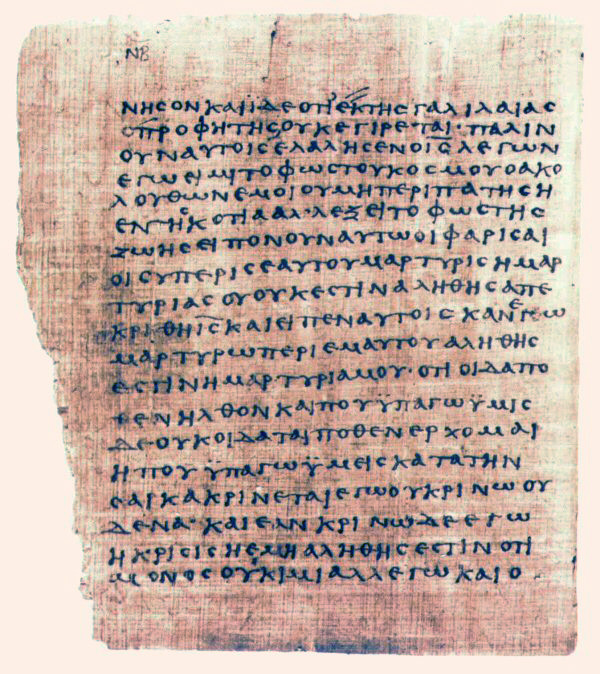

The Gospel of Matthew similarly opens with a genealogy — "An account of the genealogy of Jesus the Messiah, the son of David, the son of Abraham" (Matthew 1:1, NRSV) — and moves into a third-person narrative of Jesus' birth, ministry, death, and resurrection. At no point does the author identify himself. The passage often cited as relevant to the question of Matthean authorship is Matthew 9:9:
Matthew 9:9, NRSVAs Jesus was walking along, he saw a man called Matthew sitting at the tax booth; and he said to him, "Follow me." And he got up and followed him.
The text refers to "a man called Matthew" in the third person. It does not say "he saw me" or "I got up and followed him." The author describes the scene as an outside observer would, not as a participant recounting his own experience.11
The Gospel of Luke is the only one of the four that includes a prologue addressing its compositional method, and this prologue explicitly identifies the author as someone who was not an eyewitness:11
Luke 1:1–4, NRSVSince many have undertaken to set down an orderly account of the events that have been fulfilled among us, just as they were handed on to us by those who from the beginning were eyewitnesses and servants of the word, I too decided, after investigating everything carefully from the very first, to write an orderly account for you, most excellent Theophilus, so that you may know the truth concerning the things about which you have been instructed.
The author of Luke distinguishes between "those who from the beginning were eyewitnesses" and himself. The eyewitnesses "handed on" their accounts; the author then "investigated everything carefully" and composed his own "orderly account." This is a description of a second-generation writer working from received sources, not a participant writing from memory. The author does not name himself.11
The Gospel of John concludes with a passage that appears to identify a source:9
John 21:24, NRSVThis is the disciple who is testifying to these things and has written these things, and we know that his testimony is true.
This verse refers to "the disciple" in the third person and uses the first-person plural "we know" — distinguishing between the disciple whose testimony underlies the text and the "we" who vouch for it. The verse does not name the disciple. An earlier passage, John 19:35, similarly references an unnamed witness: "He who saw this has testified so that you also may believe. His testimony is true, and he knows that he tells the truth" (NRSV) (John 19:35). The third-person framing — "he who saw this," "his testimony" — positions the author as someone other than the witness being cited.
Literary dependence among the Synoptic Gospels
The Gospels of Matthew, Mark, and Luke share so much material in common — often in identical wording, identical sequence, and identical grammatical constructions — that they can be laid side by side and read together, a practice that gives them their collective name: the Synoptic Gospels (from the Greek synoptikos, "seen together"). The extent of this overlap is quantifiable. Of Mark's 661 verses, approximately 600 appear in Matthew, often with only minor alterations, and approximately 350 appear in Luke.3, 4 Over 90 percent of Mark's content is reproduced in Matthew. This is not a matter of two witnesses independently recounting the same events and arriving at similar descriptions. The overlap extends to parenthetical comments by the narrator, to Greek particles and connective words that carry no narrative content, and to the specific sequence in which unrelated episodes are arranged.
The following table presents a selection of parallel passages from Mark and Matthew, shown in the original Greek word order translated into English, to illustrate the degree of verbatim correspondence.3, 12
Parallel passages in Mark and Matthew3, 12
| Passage | Mark | Matthew |
|---|---|---|
| Healing of the paralytic | "He said to the paralytic, 'I say to you, stand up, take your mat and go to your home.'" (Mark 2:10–11, NRSV) | "He then said to the paralytic, 'Stand up, take your bed and go to your home.'" (Matthew 9:6, NRSV) |
| Plucking grain on the sabbath | "The sabbath was made for humankind, and not humankind for the sabbath; so the Son of Man is lord even of the sabbath." (Mark 2:27–28, NRSV) | "For the Son of Man is lord of the sabbath." (Matthew 12:8, NRSV) |
| Parable of the sower | "Other seed fell into good soil and brought forth grain, growing up and increasing and yielding thirty and sixty and a hundredfold." (Mark 4:8, NRSV) | "Other seeds fell on good soil and brought forth grain, some a hundredfold, some sixty, some thirty." (Matthew 13:8, NRSV) |
| Stilling the storm | "'Who then is this, that even the wind and the sea obey him?'" (Mark 4:41, NRSV) | "'What sort of man is this, that even the winds and the sea obey him?'" (Matthew 8:27, NRSV) |
| Confession at Caesarea Philippi | "'But who do you say that I am?' Peter answered him, 'You are the Messiah.'" (Mark 8:29, NRSV) | "'But who do you say that I am?' Simon Peter answered, 'You are the Messiah, the Son of the living God.'" (Matthew 16:15–16, NRSV) |
| The greatest commandment | "'The first is, "Hear, O Israel: the Lord our God, the Lord is one; you shall love the Lord your God with all your heart..."'" (Mark 12:29–30, NRSV) | "'You shall love the Lord your God with all your heart, and with all your soul, and with all your mind.'" (Matthew 22:37, NRSV) |
| Prediction of the temple's destruction | "'Do you see these great buildings? Not one stone will be left here upon another; all will be thrown down.'" (Mark 13:2, NRSV) | "'You see all these, do you not? Truly I tell you, not one stone will be left here upon another; all will be thrown down.'" (Matthew 24:2, NRSV) |
The pattern visible in this table extends across hundreds of passages. Where the wording is not identical, the differences are typically the kind of minor editorial adjustment a copyist or redactor would make when working from a written source: abbreviation, clarification, stylistic improvement, or theological expansion. Matthew's version of Peter's confession, for instance, adds "the Son of the living God" to Mark's simpler "You are the Messiah." Matthew's version of the grain-plucking episode omits Mark's saying about the sabbath being made for humankind and retains only the concluding christological claim. These are editorial patterns — one writer working from another's text, condensing here, expanding there — not the independent variations one would expect from two separate witnesses recalling the same event from memory.4
The Synoptic Problem and Markan priority
The Synoptic Problem is the term for the literary puzzle posed by the extensive overlap among Matthew, Mark, and Luke. If these three Gospels were composed independently by separate authors, the degree of verbatim agreement in Greek wording, narrative sequence, and editorial parenthetical remarks is difficult to explain. The dominant explanation for this pattern posits that Mark was written first and that the authors of Matthew and Luke each used Mark as a written source, copying from it, rearranging it, and supplementing it with additional material.4, 5
The case for Markan priority rests on several interlocking observations. First, nearly all of Mark's content appears in Matthew, in Luke, or in both. If Matthew were the original and Mark the abbreviation, it would be necessary to explain why Mark omitted the Sermon on the Mount, the Lord's Prayer, the Beatitudes, the birth narrative, the resurrection appearances, and virtually all of the material that distinguishes Matthew from Mark. A writer abbreviating Matthew would have removed the most distinctive and memorable material while retaining the narrative framework — an implausible editorial strategy.4
Second, where Matthew and Luke diverge from each other, each tends to follow Mark's order independently. Where one departs from Mark's sequence, the other stays with it. Matthew and Luke rarely agree in order against Mark, which is precisely what one would expect if both are independently following Mark's sequence but occasionally rearranging material for their own purposes.5
Third, Matthew and Luke frequently improve Mark's rougher Greek style. Mark's Gospel contains grammatical constructions that are less polished than those found in the parallel passages of Matthew and Luke. Where Mark uses a historical present tense ("he says"), Matthew and Luke tend to substitute a past tense ("he said"). Where Mark's syntax is awkward, Matthew and Luke smooth it. This pattern of stylistic improvement is consistent with later writers revising an earlier source, not with an earlier writer degrading the polished prose of a later one.4, 5
Fourth, Mark occasionally preserves details that appear to be theologically difficult for the later Gospel writers. In Mark 6:5, Jesus "could do no deed of power" in his hometown. Matthew's parallel (Matthew 13:58) changes this to "he did not do many deeds of power there" — altering inability to choice. In Mark 10:18, when addressed as "Good Teacher," Jesus responds: "Why do you call me good? No one is good but God alone." Matthew's version (Matthew 19:17) rewrites the exchange: "Why do you ask me about what is good?" These alterations suggest writers modifying a source that contained material they found theologically problematic, not a later writer introducing difficulties into an earlier, smoother text.4, 11
Implications of literary copying for eyewitness authorship
The pattern of literary dependence visible among the Synoptic Gospels has direct implications for the question of eyewitness authorship. If the author of the Gospel of Matthew were the apostle Matthew — a personal companion of Jesus who witnessed the events firsthand — the extensive copying from Mark requires explanation. Mark, according to the later church tradition that assigned names to the Gospels, was not himself a disciple of Jesus but rather a companion of Peter who recorded Peter's reminiscences.2 The traditional attribution thus presents a situation in which an eyewitness (Matthew) relied on a secondhand account (Mark) for the structure, wording, and sequence of over 90 percent of the material they share.
The nature of the copying deepens the difficulty. The author of Matthew does not merely draw on the same traditions as Mark; he reproduces Mark's specific Greek phrasing, Mark's parenthetical narrator comments, and Mark's editorial transitions. When the author of Matthew describes the calling of the tax collector in Matthew 9:9, he follows Mark's narrative structure from Mark 2:14 almost exactly, changing only the name from "Levi son of Alphaeus" (Mark's version) to "Matthew." If the author were the tax collector himself, recounting his own call, the dependence on a prior written account of that call — written by someone who was not present — is a distinctive compositional choice. An author narrating his own experience would not ordinarily need to copy another writer's description of it, adjust the name, and leave the rest of the account unchanged (Matthew 9:9).4, 11
The same point applies to Luke. The author of Luke explicitly states in his prologue that he is not an eyewitness but a compiler of received traditions (Luke 1:1–4). His text confirms this: approximately 35 percent of Luke's content derives from Mark, rewritten and rearranged, with additional material from other sources.3
Internal evidence: narration, knowledge, and geography
Beyond the pattern of literary copying, the Gospels contain internal features that bear on the question of authorship.11
Third-person narration throughout. All four Gospels narrate entirely in the third person. The author of Matthew describes the calling of Matthew as an outside observer (Matthew 9:9). The Gospel of John refers to "the disciple whom Jesus loved" in the third person (John 13:23, 19:26, 20:2, 21:7, 21:20). Even if this figure is the source behind the Gospel, the author writes about him as "he," not "I." The consistent third-person stance throughout all four Gospels is the narrative posture of a writer describing someone else's experiences, not recording one's own (Matthew 9:9; John 21:24).11
Knowledge of scenes where no disciple was present. The Gospels narrate events at which, according to their own accounts, no disciple was present to observe. The most striking example is the scene in Gethsemane. Mark 14:32–42 describes Jesus withdrawing from his disciples to pray alone:
Mark 14:33–37, NRSVHe took with him Peter and James and John, and began to be distressed and agitated. And he said to them, "I am deeply grieved, even to death; remain here, and keep awake." And going a little farther, he threw himself on the ground and prayed that, if it were possible, the hour might pass from him. He said, "Abba, Father, for you all things are possible; remove this cup from me; yet, not what I want, but what you want." He came and found them sleeping; and he said to Peter, "Simon, are you asleep? Could you not keep awake one hour?"
The text states that Jesus went "a little farther" away from the disciples and that when he returned, he "found them sleeping." The narrative reports the content of Jesus' private prayer — specific words spoken while the only potential witnesses were asleep. Matthew's parallel (Matthew 26:36–46) reproduces this scene with minor alterations, following Mark's account (Matthew 26:36–46).
Other scenes narrated without any disciple present include the private conversation between Pilate and Jesus during the trial (Mark 15:2–5, John 18:33–38), the deliberations of the Sanhedrin (Mark 14:55–65), and the temptation of Jesus in the wilderness, where Jesus is described as alone for forty days (Mark 1:12–13, Matthew 4:1–11, Luke 4:1–13). These narratives describe events that, by the Gospels' own framing, had no disciple witnesses to report them.11
Geographic descriptions. The Gospel of Mark contains geographic references that do not correspond to the physical landscape of the regions described. Mark 5:1 places the exorcism of the Gerasene demoniac in "the country of the Gerasenes," on the eastern shore of the Sea of Galilee (Mark 5:1–20). The city of Gerasa (modern Jerash, Jordan) lies approximately 50 kilometres southeast of the Sea of Galilee — far too distant for the narrative detail of the pigs running down a steep bank into the sea (Mark 5:13). Matthew's parallel changes the location to "the country of the Gadarenes" (Matthew 8:28), and Gadara (modern Umm Qais) is closer to the lake but still approximately 10 kilometres away, without direct access to the shore. Some later manuscripts of Mark substitute "Gergesenes," a variant that Origen of Alexandria proposed in the third century, suggesting that even early readers recognized the geographic difficulty.10
Mark 7:31 describes a journey "from the region of Tyre" going "by way of Sidon towards the Sea of Galilee, in the region of the Decapolis" (NRSV) (Mark 7:31). Sidon lies north of Tyre, while the Sea of Galilee lies to the south and east. Travelling from Tyre to the Sea of Galilee by way of Sidon is a significant detour in the wrong direction, comparable to travelling from New York to Philadelphia by way of Boston. The route described does not correspond to any practical itinerary between these locations.
When and how the names were attached
The earliest surviving external testimony attributing the Gospels to specific authors comes from the late second century. Papias of Hierapolis, writing around 110–130 CE, is quoted by the fourth-century historian Eusebius as having made statements about Mark and Matthew.2 Regarding Mark, Papias wrote:
Eusebius, Ecclesiastical History 3.39.152Mark, having become the interpreter of Peter, wrote down accurately, though not in order, whatsoever he remembered of the things said or done by Christ. For he neither heard the Lord nor followed him, but afterward, as I said, followed Peter, who adapted his teaching to the needs of his hearers, but with no intention of giving a connected account of the Lord's discourses.
Regarding Matthew, Papias stated: "So then Matthew compiled the oracles (ta logia) in the Hebrew language, and each one interpreted them as he could."2 The reference to composition "in the Hebrew language" does not match the Gospel of Matthew as it exists in the manuscript tradition, which is written in Greek and shows no signs of being a translation from Hebrew or Aramaic. The Gospel of Matthew is composed in fluent Greek, incorporates Greek literary conventions, and draws directly on the Greek text of the Gospel of Mark. If Papias is describing the canonical Gospel of Matthew, his description does not match the text. If he is describing a different work entirely, the connection between his statement and the canonical Gospel is uncertain.4, 11
Irenaeus of Lyon, writing around 180 CE in Against Heresies, provides the first surviving testimony that links all four Gospels to the names they now bear:1
Irenaeus, Against Heresies 3.1.11Matthew also issued a written Gospel among the Hebrews in their own dialect, while Peter and Paul were preaching at Rome, and laying the foundations of the Church. After their departure, Mark, the disciple and interpreter of Peter, did also hand down to us in writing what had been preached by Peter. Luke also, the companion of Paul, recorded in a book the Gospel preached by him. Afterwards, John, the disciple of the Lord, who also had leaned upon his breast, did himself publish a Gospel during his residence at Ephesus in Asia.
Irenaeus is writing approximately 90 to 150 years after the Gospels were composed. His testimony about Matthew repeats the claim of Hebrew composition, which does not correspond to the Greek text of the canonical Gospel. His testimony is also shaped by a theological agenda: Irenaeus is arguing against Marcion and other groups who accepted fewer than four Gospels. He needs exactly four authoritative Gospels, each linked to an apostle or an apostolic companion, to support his theological framework. His account is a defense of the fourfold Gospel, not a disinterested historical report.1, 11
Other early attributions include the Muratorian Fragment (late second century), which describes the composition of Luke and John but not Mark or Matthew in the surviving text,15 and Tertullian's Against Marcion (c. 207 CE), which names all four Gospel authors in the context of polemical argument.14 The Anti-Marcionite Prologues, once thought to date to the second century, are now generally placed later.13
Gospel titles in the manuscript tradition
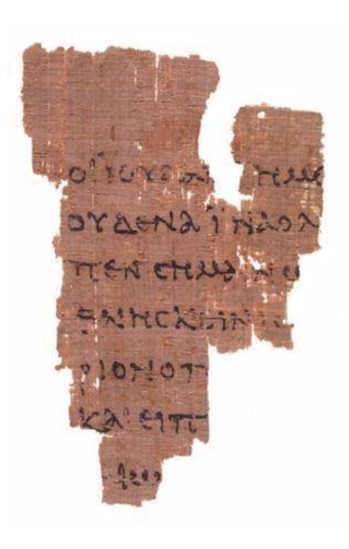

The physical manuscripts of the Gospels provide evidence for when the author attributions became part of the transmitted text. The earliest substantial New Testament manuscripts are papyri from the second and third centuries. Papyrus 75 (P75), dated to approximately 175–225 CE and containing portions of Luke and John, includes the title "Gospel According to Luke" (euangelion kata Loukan) at the end of the Lukan text and "Gospel According to John" at the beginning of the Johannine text.7 This is among the earliest manuscript evidence for Gospel titles.
The form of the titles is itself significant. The Greek phrasing euangelion kata followed by a name — "Gospel according to" — uses the preposition kata, which indicates the message "as told by" or "in the version of" a named individual. This formulation differs from the possessive construction one would expect if the author had titled his own work. An author writing his own account might title it "My account of the good news" or "The Gospel of Matthew"; the kata formulation is the language of attribution by a third party, distinguishing one version of the gospel message from another.8
Martin Hengel argued that the titles were added early, perhaps as soon as the Gospels began circulating together in collections, because a practical need existed to distinguish them. A church receiving multiple Gospel texts on separate scrolls would need some means of identifying which was which.8 Whether the titles were added in the early second century or later in that century, they represent a scribal convention — an external attribution applied to texts that did not originally identify their authors.
The major fourth-century codices — Codex Sinaiticus and Codex Vaticanus — include the titles in a standardized form, indicating that by the time these comprehensive manuscripts were produced, the attributions had become a fixed part of the scribal tradition.6, 10 The uniformity of the titles across manuscripts from different regions suggests that the attributions were standardized relatively early in the transmission process, though this does not establish that they were original to the texts.
Textual transmission and copying patterns
The literary relationship among the Synoptic Gospels is visible not only in the content of the texts but in the mechanics of how one writer copied from another. These copying patterns reveal the compositional process behind the Gospels and provide evidence for the nature of their authorship.3, 4
When the author of Matthew incorporates material from Mark, he does so with characteristic editorial tendencies that remain consistent across the Gospel. He abbreviates Mark's narratives, often reducing the amount of descriptive detail while preserving the essential structure. Mark's account of the Gerasene demoniac, for example, spans 20 verses (Mark 5:1–20), while Matthew's parallel covers 7 verses (Matthew 8:28–34), with the number of demoniacs changed from one to two (Mark 5:1–20; Matthew 8:28). Mark's account of Jairus' daughter and the woman with the hemorrhage (Mark 5:21–43) occupies 23 verses; Matthew's version (Matthew 9:18–26) occupies 9 verses. The compression is systematic: Matthew retains the narrative core and the words of Jesus while cutting ambient detail.3
This pattern of systematic abbreviation is the behavior of a writer working from a written source, not of an eyewitness recounting events from personal recollection. An eyewitness might add details that another account lacks or remember the sequence differently, but the consistent pattern of cutting narrative detail while preserving exact wording of speeches — across dozens of separate episodes — indicates a literary, editorial process.4
The author of Luke treats Mark's source material differently but with equal evidence of deliberate editorial work. Luke tends to improve Mark's Greek style, replace Semitic expressions with more idiomatic Greek, and rearrange the order of some episodes to suit his own narrative structure. Luke omits a large section of Mark (Mark 6:45–8:26, sometimes called "Luke's Great Omission") and inserts two large blocks of non-Markan material: the "Lesser Interpolation" (Luke 6:20–8:3) and the "Greater Interpolation" or "Travel Narrative" (Luke 9:51–18:14). These insertions break Mark's sequence, and when Luke returns to following Mark after each insertion, he picks up precisely where he left off — a pattern consistent with a writer working from a written text that he can set aside and return to, not with a writer recalling events from memory.4, 5
The Gospel of John and the question of the beloved disciple
The Gospel of John presents a distinct set of authorship questions. Unlike the Synoptic Gospels, John does not closely follow Mark's narrative framework. Approximately 90 percent of John's content has no parallel in the Synoptic Gospels. The chronology differs: John places the cleansing of the temple at the beginning of Jesus' ministry (John 2:13–22) rather than at the end (Mark 11:15–19). John narrates three Passover celebrations during Jesus' ministry, implying a ministry lasting at least two to three years, while the Synoptic Gospels mention only one Passover and could be read as describing a ministry of approximately one year. The theological language, the literary style, and the content of Jesus' speeches in John differ substantially from those in the Synoptics.11
The Gospel introduces a figure called "the disciple whom Jesus loved" who appears at the Last Supper (John 13:23), at the crucifixion (John 19:26), at the empty tomb (John 20:2–8), and at the Sea of Tiberias appearance (John 21:7, 21:20–23). This figure is never named within the text. The concluding verse, John 21:24, states: "This is the disciple who is testifying to these things and has written these things, and we know that his testimony is true" (NRSV) (John 21:24).
Several features of this verse are relevant to the authorship question. The statement "has written these things" (ho grapsas tauta) attributes the writing to the beloved disciple, but the addition "and we know that his testimony is true" introduces a separate group — "we" — who are vouching for the disciple's truthfulness. The "we" cannot be the same person as the disciple, because they speak about him in the third person. This verse appears to be an editorial addition by someone other than the primary author, a community or later editor certifying the authority of the tradition behind the Gospel (John 21:24).9, 11
John 21 itself is widely regarded as an appendix to the Gospel. The preceding chapter, John 20, ends with what reads as a concluding statement: "Now Jesus did many other signs in the presence of his disciples, which are not written in this book. But these are written so that you may come to believe that Jesus is the Messiah, the Son of God, and that through believing you may have life in his name" (John 20:30–31, NRSV). This is a literary conclusion. Chapter 21, with its additional resurrection appearance and its editorial note about the beloved disciple, is appended after the Gospel has already ended, suggesting that it was added by a later hand.11
Dating and compositional context
The dating of the Gospels is relevant to the authorship question because the later the composition, the less likely it is that an eyewitness to events of the late 20s or early 30s CE was still alive to write the account. The Gospels themselves provide internal chronological markers. Mark 13 contains a speech attributed to Jesus predicting the destruction of the Jerusalem temple: "Do you see these great buildings? Not one stone will be left here upon another; all will be thrown down" (Mark 13:2, NRSV). The temple was destroyed by Roman forces in 70 CE. Whether this passage records a genuine prediction or reflects knowledge of the destruction after the fact, it provides a chronological reference point. The text of Mark 13 appears to describe the events of the Jewish-Roman war (66–73 CE) in language that becomes progressively more specific, including references to the "desolating sacrilege" set up in the temple (Mark 13:14) — language that corresponds to events of 70 CE.11
Luke's version of this discourse makes the reference to the destruction more explicit: "When you see Jerusalem surrounded by armies, then know that its desolation has come near" (Luke 21:20, NRSV). Luke replaces Mark's allusive "desolating sacrilege" with a concrete military description — "Jerusalem surrounded by armies" — that reads as a description of the Roman siege rather than a cryptic prediction. This suggests that the author of Luke was writing with knowledge of the fall of Jerusalem (Luke 1:1–4).11
If Mark was composed around 70 CE, and Matthew and Luke both used Mark as a source and show awareness of the destruction of Jerusalem, their dates of composition fall after 70 CE — commonly estimated in the range of 80–90 CE for Matthew and 80–90 CE for Luke. The Gospel of John is generally placed later still, around 90–100 CE, based on its advanced theological development, its apparent awareness of the expulsion of Christians from synagogues (John 9:22, 12:42, 16:2), and its literary independence from the Synoptic tradition.10, 11
These estimated dates of composition place the Gospels approximately 40 to 70 years after the events they describe. The original disciples, if they were contemporaries of Jesus in the late 20s CE, would have been elderly or deceased by the time the Gospels reached their final written form. Peter and Paul, according to early church tradition, died in the mid-60s CE. The author of Luke, writing after Mark and after the destruction of Jerusalem, explicitly identifies himself as a non-eyewitness compiling earlier sources. The interval between event and composition, combined with the internal evidence of literary dependence and the Gospels' own silence about their authors, situates these texts as products of early Christian communities rather than as the memoirs of individual participants.10, 11
The evidence in summary
The four canonical Gospels do not name their authors within the text. All four narrate in the third person. The author of Luke explicitly identifies himself as a second-generation compiler, not an eyewitness. The author of John, or a later editor, refers to the "beloved disciple" in the third person and vouches for his testimony using the first-person plural "we," distinguishing the author from the source (Luke 1:1–4; John 21:24).
Over 90 percent of the Gospel of Mark's content is reproduced in the Gospel of Matthew, often in identical Greek wording and identical sequence. This pattern of verbatim literary dependence extends to parenthetical narrator comments, editorial transitions, and the ordering of unrelated episodes. The author of Matthew treats Mark as a written source, abbreviating narratives, improving Greek style, and modifying theologically difficult passages. The author of Luke follows the same procedure with Mark's text, inserting large blocks of new material and then returning to exactly the point in Mark where he left off. These are the compositional patterns of writers working from written documents, not of witnesses independently recounting shared experiences.3, 4, 5
The Gospels narrate private scenes at which no disciple was present to witness — Jesus' solitary prayer in Gethsemane while the disciples slept, the temptation in the wilderness, private exchanges between Jesus and Pilate. The Gospel of Mark contains geographic descriptions that do not correspond to the physical landscape of Galilee and Judea. The names now attached to the Gospels first appear in the external testimony of church writers in the late second century, approximately 90 to 150 years after the texts were composed, and in manuscript titles using the third-party attribution formula kata ("according to") rather than a possessive authorial claim.1, 2, 8
The evidence — the texts' own silence, the pattern of literary copying, the narration of unwitnessed events, the geographic errors, and the late external attributions — is presented here from the Gospels themselves and from the manuscript tradition that transmitted them. The texts and the physical evidence are the primary sources; the reader can evaluate what they indicate about how these four works were composed and by whom.10, 11