Overview
- The biblical texts contain hundreds of claims about people, places, and events in the ancient world, and external evidence from archaeology, epigraphy, and contemporary ancient sources confirms some of these claims, fails to confirm others, and in certain cases presents information that sits in tension with the biblical account.
- Inscriptions such as the Merneptah Stele (c. 1208 BCE), the Mesha Stele (c. 840 BCE), the Kurkh Monolith (c. 853 BCE), and the Tel Dan Stele (c. 840 BCE) independently attest to the existence of Israel, its kings, and its neighbors as described in the biblical text, while the archaeological record at sites such as Jericho, Ai, and the cities attributed to Solomon presents a more complex picture than the biblical narratives alone suggest.
- This hub surveys the landscape of biblical historical claims and the external evidence that bears on them, introducing detailed examinations of the Exodus, the conquest of Canaan, the united monarchy, the nativity accounts, the census of Quirinius, and apostle martyrdom traditions.
The biblical texts make claims about real places, real peoples, and real events in the ancient Near East and the Greco-Roman world. Some of these claims can be checked against evidence that exists outside the Bible itself: inscriptions carved by foreign kings, destruction layers preserved in archaeological sites, administrative documents on papyrus, and accounts written by non-biblical authors such as Josephus and Tacitus.12 This article surveys the landscape of that external evidence — what it confirms, what it complicates, and where it remains silent — as an introduction to the detailed examinations found in the articles below.
The method is straightforward. The biblical text makes a claim: that Israel was enslaved in Egypt, that Joshua conquered Jericho, that Solomon built at Megiddo, that a census brought Joseph and Mary to Bethlehem. The external record is then examined for evidence that bears on that claim. Where the external evidence aligns with the biblical account, the alignment is presented. Where the external evidence sits in tension with the biblical account, both are quoted. Where the external record is silent, the silence is noted. The reader sees both the biblical text and the external evidence and evaluates the relationship between them.12
The scope of the question
The Hebrew Bible narrates a continuous history from the creation of the world through the Babylonian exile and the return to Judah — a span of thousands of years as the text reckons it. The New Testament adds accounts of events in first-century Roman Palestine and the eastern Mediterranean. Not all of these claims are equally testable. Events set in deep antiquity (the patriarchal narratives of Genesis, the sojourn in Egypt) predate the earliest external written sources that mention Israel and are difficult to evaluate against an archaeological record that was not designed to preserve them.12 Events set in the period of the Divided Monarchy (ninth through sixth centuries BCE), by contrast, occur in an era when Assyrian, Babylonian, and Egyptian kings produced detailed annals that frequently mention Israel, Judah, and their rulers by name.6, 15
The distribution of external evidence is therefore uneven. For some biblical periods, the external record is rich and overlapping. For others, it is thin or altogether absent. An absence of external evidence does not establish that an event did not occur — absence of evidence is not evidence of absence, particularly in the ancient world where the survival of records is accidental and fragmentary. But the presence of external evidence, where it exists, provides an independent check on what the biblical text reports, and the results of that check vary from passage to passage and period to period.12
The earliest external references to Israel
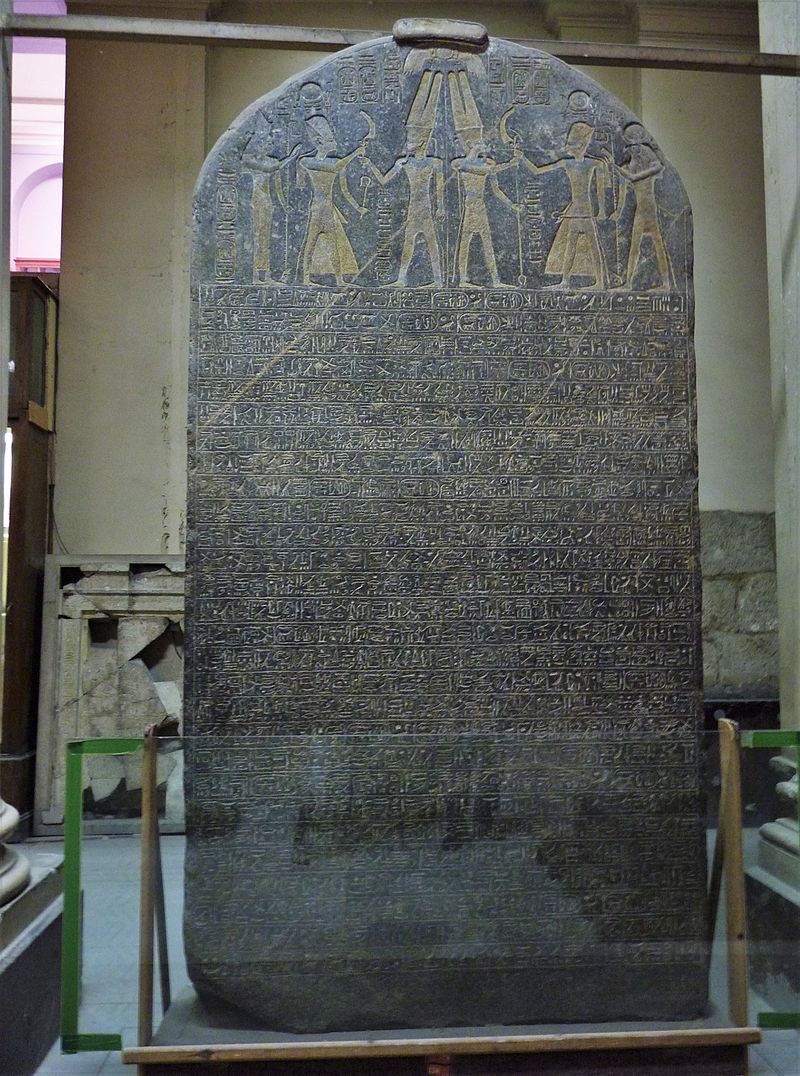

The earliest known reference to Israel outside the Bible appears on the Merneptah Stele, a granite slab erected by the Egyptian pharaoh Merneptah around 1208 BCE to commemorate his military campaigns. The stele was discovered by Flinders Petrie at Thebes in 1896 and is now housed in the Egyptian Museum in Cairo.1 The inscription is primarily an account of Merneptah's victory over Libyan and Sea Peoples forces, but its final lines describe a prior campaign in Canaan:
"Canaan has been plundered into every sort of woe; Ashkelon has been overcome; Gezer has been captured; Yanoam is made non-existent; Israel is laid waste and his seed is not."
The hieroglyphic determinative applied to "Israel" in this inscription differs from those applied to the city-names Ashkelon, Gezer, and Yanoam. Where those names carry the determinative for a foreign city or land, "Israel" carries the determinative for a people or ethnic group — a seated man and woman above three plural strokes.2 This indicates that the Egyptians understood Israel not as a place but as a people, a socioethnic entity present in Canaan at the end of the thirteenth century BCE.
The Merneptah Stele establishes that an entity called Israel existed in Canaan by approximately 1208 BCE. It does not describe who these people were, where they came from, or how they were organized. The biblical narratives place the Exodus and conquest before this date, but the stele itself says nothing about an exodus from Egypt or a military conquest of Canaan. It records only that an entity called Israel was present in the region and that Merneptah claimed to have defeated it.1, 2
The divided monarchy and the epigraphic record
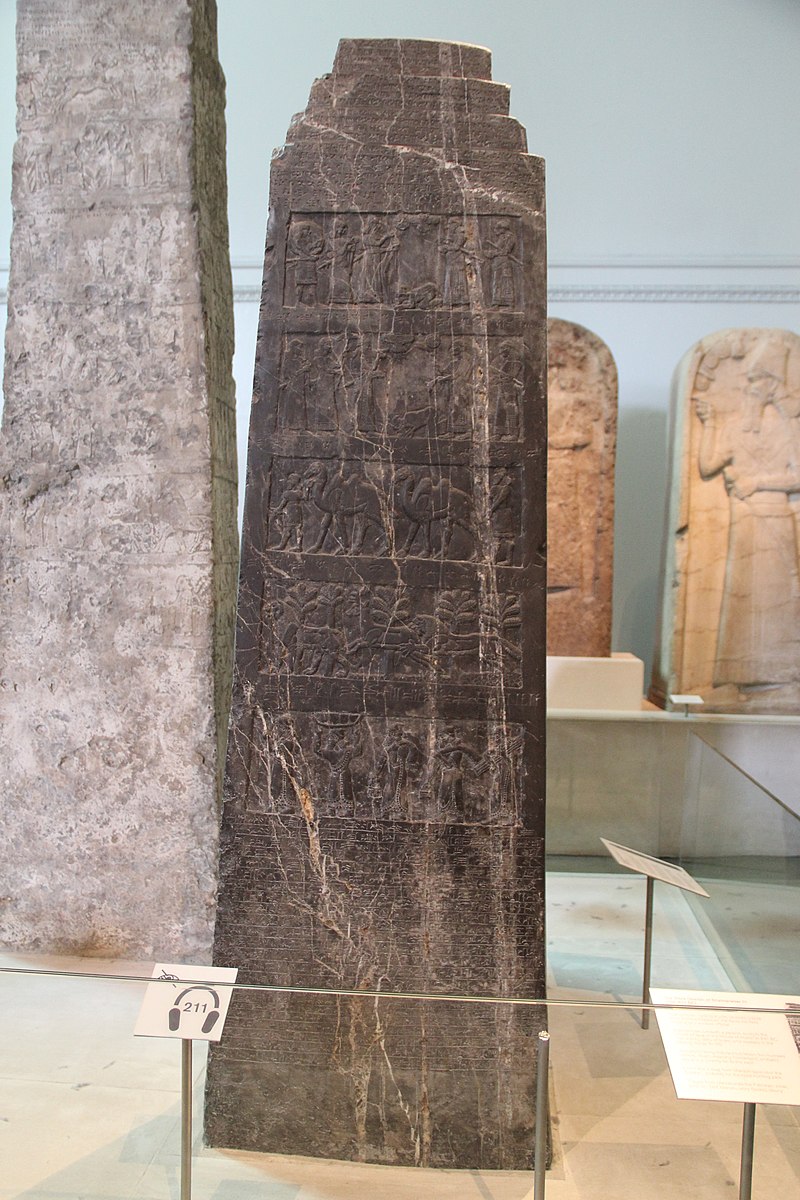

The period of the Divided Monarchy — after the biblical kingdom splits into northern Israel and southern Judah — is by far the best attested biblical era in the external record. Multiple inscriptions from Assyrian, Moabite, and Aramean kings mention Israelite and Judahite rulers by name, and several of these inscriptions describe the same events narrated in the Books of Kings and Chronicles.6, 12
The Kurkh Monolith, an Assyrian stele erected by Shalmaneser III and discovered at Kurkh (modern Turkey) in 1861, records the Battle of Qarqar in 853 BCE. Among the coalition of kings who opposed Shalmaneser, the inscription lists "Ahab the Israelite" (*A-ha-ab-bu Sir-'i-la-a-a*) as contributing 2,000 chariots and 10,000 soldiers — one of the largest contingents in the coalition.6 The Books of Kings describe Ahab as king of Israel and depict him as a powerful ruler, though they do not mention the Battle of Qarqar. The Kurkh Monolith provides independent attestation that Ahab existed, ruled Israel, and commanded significant military resources.
The Mesha Stele (also called the Moabite Stone), discovered at Dhiban in Jordan in 1868 and dated to approximately 840 BCE, is a royal inscription of King Mesha of Moab. The stele is now in the Louvre in Paris.3 Mesha describes his revolt against Israelite domination and names "Omri, king of Israel" as the ruler who had subjugated Moab. The inscription states:
"Omri was king of Israel, and he oppressed Moab many days, for Chemosh was angry with his land. And his son succeeded him, and he too said, 'I will oppress Moab.'"
The Books of Kings describe Omri as king of Israel and founder of a dynasty (1 Kings 16:21–28). The Mesha Stele confirms the existence of Omri and the Israelite domination of Moab, while also providing a Moabite perspective on events that the Bible narrates from the Israelite side. The stele also contains the earliest certain extrabiblical reference to the Israelite God YHWH (Yahweh).3
The Tel Dan Stele, discovered by Avraham Biran at Tel Dan in northern Israel in 1993 (with additional fragments found in 1994), is an Aramaic inscription dated to approximately 840 BCE, likely erected by Hazael, king of Aram-Damascus.4, 5 The inscription describes military victories over the kings of Israel and the "House of David" (bytdwd). The reading of bytdwd as "House of David" — a dynastic designation for the kingdom of Judah — has been accepted by most epigraphers who have examined the inscription, though alternative readings have been proposed.4 If the standard reading is correct, the Tel Dan Stele provides the earliest known reference to David as the founder of a royal dynasty, and it independently attests the existence of both the Israelite and Judahite kingdoms in the ninth century BCE.
External inscriptions mentioning biblical figures3, 4, 6, 15
| Inscription | Date | Biblical figure(s) named | Current location |
|---|---|---|---|
| Kurkh Monolith | c. 853 BCE | Ahab (king of Israel) | British Museum |
| Mesha Stele | c. 840 BCE | Omri (king of Israel) | Louvre, Paris |
| Tel Dan Stele | c. 840 BCE | "House of David" (Judahite dynasty) | Israel Museum, Jerusalem |
| Black Obelisk of Shalmaneser III | c. 825 BCE | Jehu (king of Israel) | British Museum |
| Sennacherib Prism (Taylor Prism) | c. 689 BCE | Hezekiah (king of Judah) | British Museum |
| Pilate Stone | c. 26–36 CE | Pontius Pilate (prefect of Judea) | Israel Museum, Jerusalem |
Sennacherib and Hezekiah: a case of convergence
One of the clearest cases of convergence between the biblical text and an external source involves the Assyrian king Sennacherib's campaign against Judah in 701 BCE. The account in 2 Kings 18–19 describes Sennacherib invading Judah, capturing its fortified cities, and besieging Jerusalem during the reign of King Hezekiah (2 Kings 18–19). The biblical text states that Hezekiah paid tribute to Sennacherib:
"Hezekiah king of Judah sent to the king of Assyria at Lachish, saying, 'I have done wrong; withdraw from me; whatever you impose on me I will bear.' The king of Assyria required of Hezekiah king of Judah three hundred talents of silver and thirty talents of gold."2 Kings 18:14, NRSV
The Taylor Prism, a hexagonal clay cylinder inscribed with the annals of Sennacherib and dated to approximately 691 BCE, describes the same campaign from the Assyrian perspective.15 Sennacherib's account states:
"As for Hezekiah the Judahite, who did not submit to my yoke: forty-six of his strong, walled cities, as well as the small towns in their area, which were without number ... I besieged and took them ... Himself, like a caged bird, I shut up in Jerusalem, his royal city ... Hezekiah himself ... did send me later to Nineveh, my lordly city, together with thirty talents of gold, eight hundred talents of silver ..."
Both sources agree that Sennacherib invaded Judah, that he captured fortified cities, that Hezekiah was confined to Jerusalem, and that Hezekiah paid tribute including gold and silver. The silver amounts differ — 300 talents in 2 Kings versus 800 talents in Sennacherib's account. The biblical account attributes the Assyrian withdrawal to divine intervention: "That very night the angel of the LORD set out and struck down one hundred eighty-five thousand in the camp of the Assyrians" (2 Kings 19:35, NRSV) (2 Kings 18–19). Sennacherib's inscription does not mention such an event and does not claim to have captured Jerusalem, an omission that stands out in a text otherwise devoted to cataloging conquests. The two sources overlap on the main events but diverge on the details and the explanation for the outcome.15
The exodus and the sojourn in Egypt
The Book of Exodus describes the Israelites as an enslaved population in Egypt who were delivered through divine intervention and led into the wilderness under Moses. The narrative includes specific details: the Israelites built the store cities of Pithom and Rameses (Exodus 1:11), they made bricks with straw (Exodus 5:6–19), and their departure was preceded by a series of plagues and the death of Egypt's firstborn (Exodus 1:8–14).
No Egyptian text has been found that describes the events of the Exodus as the Bible narrates them — no record of a mass departure of slaves, no account of plagues, no mention of Moses. This silence extends across all categories of Egyptian documentation: royal annals, administrative papyri, and private correspondence.13 The absence is not conclusive. Egyptian records were not comprehensive, and defeats or embarrassments were routinely omitted from royal inscriptions, which served propagandistic rather than historiographic purposes.
What the Egyptian record does contain is evidence that Semitic-speaking peoples lived and worked in Egypt, sometimes under compulsion. Papyrus Brooklyn 35.1446, an administrative document from the late Middle Kingdom (c. 1740 BCE), contains a list of ninety-five household servants, approximately forty-five of whom bear Semitic (Northwest Semitic) names.14 Egyptian tomb paintings from the New Kingdom period depict Asiatic workers making bricks. The toponym "Rameses" in the Exodus account corresponds to Pi-Ramesses, the delta capital built by Ramesses II in the thirteenth century BCE.13 These details are consistent with the general setting of the Exodus narrative — Semitic peoples did live in the eastern Nile Delta, they did perform forced labor, and the place-names in the text correspond to known Egyptian sites. Whether this general consistency extends to the specific events described in Exodus is a question that the available evidence does not resolve.
A more detailed examination of the Exodus question — including the route of the wilderness wandering, the number of people involved, and the archaeological evidence from the Sinai Peninsula — is presented in The Exodus.13
The conquest of Canaan
The Book of Joshua describes a rapid, comprehensive military conquest of Canaan by the Israelites under Joshua's command. The narrative includes the destruction of Jericho (Joshua 6), the burning of Ai (Joshua 8), and the destruction of Hazor (Joshua 11:10–13). Joshua 11:23 summarizes: "So Joshua took the whole land, according to all that the LORD had spoken to Moses" (NRSV) (Joshua 6:1–21).
The Book of Judges, which follows Joshua in the biblical canon, presents a different picture. Judges 1 catalogs the cities that each tribe failed to conquer:
"Manasseh did not drive out the inhabitants of Beth-shean and its villages, or Taanach and its villages, or the inhabitants of Dor and its villages, or the inhabitants of Ibleam and its villages, or the inhabitants of Megiddo and its villages; but the Canaanites continued to live in that land."Judges 1:27, NRSV
The text of Judges presents the settlement as incomplete and gradual rather than total and swift (Judges 1:1–36).
The archaeological evidence at the sites named in Joshua has been examined extensively. At Jericho (Tell es-Sultan), Kathleen Kenyon's excavations in the 1950s found that the massive Bronze Age destruction layer — including collapsed walls and burned buildings — dates to the end of the Middle Bronze Age, approximately 1550 BCE, several centuries before the period typically assigned to the Israelite conquest (c. 1200 BCE).7 Kenyon found no significant fortification walls dating to the Late Bronze Age and concluded that the site was largely unoccupied during the thirteenth century BCE. At Ai (et-Tell), excavations have revealed that the site was unoccupied from approximately 2400 BCE to 1200 BCE, meaning there was no city at the location for the Israelites to destroy during the proposed conquest period.8 At Hazor, by contrast, a massive destruction layer dating to the thirteenth century BCE has been found, consistent with the account in Joshua 11.8
The archaeological record thus presents a mixed picture. Some sites show destruction consistent with the biblical timeline. Others show no destruction at the relevant period or were unoccupied entirely. The site-by-site analysis is presented in The conquest of Canaan.7, 8
The united monarchy
The Books of Samuel and Kings describe David and Solomon as rulers of a united Israelite kingdom centered in Jerusalem, with Solomon building the Temple and constructing monumental architecture at Megiddo, Hazor, and Gezer (1 Kings 9:15–19). First Kings states:
"This is the account of the forced labor that King Solomon conscripted to build the house of the LORD and his own house, the Millo and the wall of Jerusalem, Hazor, Megiddo, Gezer."1 Kings 9:15, NRSV
The archaeological evidence for the united monarchy is the subject of significant debate. At Megiddo, Hazor, and Gezer, archaeologists have uncovered monumental six-chambered gate structures. The dating of these gates is disputed. Some archaeologists date them to the tenth century BCE and associate them with Solomon's building program as described in 1 Kings 9:15.19 Others, applying a revised ("low") chronology, date these structures to the ninth century BCE and attribute them to the Omride dynasty of the northern kingdom of Israel, which would place them a century after Solomon and remove them as evidence for the biblical account of a Solomonic building program.8, 18
The Tel Dan Stele's reference to the "House of David" (if the standard reading is accepted) establishes that a dynasty tracing itself to David existed by the mid-ninth century BCE — within approximately a century of David's presumed reign.4, 5 This does not confirm the biblical account of the scope of David's kingdom or Solomon's wealth, but it independently attests that David was regarded as the founder of the Judahite royal line. The question of what kind of polity David and Solomon ruled — a large territorial state, a modest highland chiefdom, or something in between — remains a question that the current archaeological evidence has not definitively resolved.8, 19
The full archaeological and textual evidence is examined in The united monarchy.
The nativity accounts and the census of Quirinius
The New Testament contains two accounts of the birth of Jesus, one in the Gospel of Matthew and one in the Gospel of Luke. These accounts share certain elements — both place the birth in Bethlehem during the time of Herod — but differ in their narrative details and in the mechanisms by which Joseph and Mary arrive in Bethlehem (Matthew 2:1–18; Luke 2:1–5).9
The Gospel of Matthew states that Jesus was born in Bethlehem "in the time of King Herod" and describes the visit of the Magi, Herod's order to kill children in Bethlehem, and the family's flight to Egypt (Matthew 2:1–18). The Gospel of Luke states that Jesus was born in Bethlehem because of a census ordered by Augustus "while Quirinius was governor of Syria," which required Joseph to travel to Bethlehem for registration (Luke 2:1–5).
The dating of these accounts presents a difficulty. Herod the Great died in 4 BCE, according to Josephus's Antiquities (17.6.4–17.8.1).9 The census under Quirinius is independently attested by Josephus (Antiquities 18.1.1), who places it in 6 CE, when Quirinius became legate of Syria and Judea was reorganized as a Roman province following the deposition of Herod's son Archelaus.9 If both Josephus's dates are accepted, the census of Quirinius occurred approximately ten years after the death of Herod. Matthew places the birth before Herod's death. Luke places it during the census under Quirinius. These two temporal markers point to dates approximately a decade apart.
The question of whether Luke's reference to Quirinius can be reconciled with Matthew's reference to Herod, and the historical evidence for Roman census practices in the eastern provinces, is examined in The census of Quirinius.9 The broader comparison of the two nativity narratives — including the genealogies, the geographic movements, and the post-birth events — is presented in The nativity accounts.
New Testament figures in the external record
Several figures named in the New Testament are independently attested in non-biblical sources. Pontius Pilate, identified in all four Gospels as the Roman official who ordered the crucifixion of Jesus, is named in a limestone inscription discovered at Caesarea Maritima in 1961 by a team led by Antonio Frova. The partially damaged inscription reads:
[...]S TIBERIEUM
[...PONTI]US PILATUS
[...PRAEF]ECTUS IUDA[EA]E
[...FECIT D]E[DICAVIT]
The inscription identifies Pilate as praefectus Iudaeae — prefect of Judea — and records that he dedicated a Tiberieum (a building honoring the emperor Tiberius) at Caesarea.11 The Pilate Stone is now in the Israel Museum in Jerusalem. In addition to this inscription, Pilate is mentioned by Josephus (Antiquities 18.3.1–2) and Tacitus (Annals 15.44), the latter of whom describes the execution of "Christus" under Pilate during the reign of Tiberius.10
Josephus also mentions James, identified as "the brother of Jesus who was called Christ," in Antiquities 20.9.1, in the context of James's execution by the high priest Ananus in 62 CE.17 This passage provides an external reference to both James and Jesus as historical figures in first-century Jerusalem, though the scope and authenticity of Josephus's references to Jesus (particularly the longer passage in Antiquities 18.3.3, known as the Testimonium Flavianum) remain the subject of extensive textual analysis.
The question of what can be established about the deaths of the apostles from the available sources — including the New Testament, Josephus, Tacitus, and later apocryphal and patristic texts — is examined in Apostle martyrdom.16 Acts 12:1–2
The spectrum of evidence
The external evidence bearing on biblical historical claims does not fall into a single category. Some biblical claims are confirmed by independent sources. The existence of Israel as a people in Canaan by the late thirteenth century BCE is confirmed by the Merneptah Stele.1 The existence of Israelite kings such as Ahab and Omri is confirmed by Assyrian and Moabite inscriptions.3, 6 The existence of Pontius Pilate as prefect of Judea is confirmed by the Caesarea inscription and by Josephus and Tacitus.10, 11 Sennacherib's campaign against Hezekiah is described both in 2 Kings and in the Taylor Prism, with substantial overlap in the main events.15 2 Kings 18–19
Other biblical claims are not confirmed by the external record and, in some cases, sit in tension with it. No Egyptian text records the events of the Exodus.13 The archaeological evidence at Jericho and Ai does not support the conquest narrative as told in Joshua for the period typically assigned to it.7, 8 The temporal markers in the nativity accounts of Matthew and Luke point to dates approximately a decade apart when compared against Josephus's chronology.9 The scope of Solomon's kingdom as described in 1 Kings remains debated in light of the archaeological evidence from the tenth century BCE.8, 19
The following data visualization summarizes the state of external evidence across the major biblical periods covered by the child articles in this series.
External attestation by biblical period8, 13, 19
Method and limitations
Several methodological principles govern the articles in this series. First, the biblical text is treated as a primary source — an ancient document that makes claims about the past — rather than as either a guaranteed historical record or a work of pure fiction. The text says what it says, and the external evidence says what it says. The relationship between the two is presented, not adjudicated.12
Second, the external evidence is cited from its primary publications: excavation reports, epigraphic editions, and critical translations of ancient texts. The articles cite specific inscriptions by their standard designations (Merneptah Stele, Taylor Prism, Tel Dan Stele), specific archaeological sites by their modern and ancient names, and specific ancient authors by work and passage number. Where the interpretation of an inscription or a stratigraphy is contested, the competing readings or dates are presented side by side.4, 8
Third, these articles distinguish between three different kinds of claims: (1) what the biblical text states, (2) what the external evidence shows, and (3) what relationship exists between the two. The first is a textual fact. The second is an empirical observation. The third is an inference that the reader is invited to evaluate. The articles present the first two and leave the third to the reader.12
The limitations of the external evidence must also be acknowledged. The ancient Near Eastern record is fragmentary. Vast quantities of texts, inscriptions, and material culture have been lost to time, looting, and the vicissitudes of preservation. The archaeological record is biased toward durable materials (stone, fired pottery, carbonized grain) and against perishable ones (wood, textiles, papyrus). Many sites mentioned in the Bible have not been excavated, or have been excavated only partially. The absence of external confirmation for a biblical event does not establish that the event did not occur; it establishes only that confirmation has not been found.12, 19
Articles in this series
This hub article introduces the broad landscape of biblical historical claims and external evidence. The following articles examine specific cases in detail, presenting the full biblical text alongside the relevant archaeological, epigraphic, and literary evidence:
The Exodus examines the biblical account of Israelite slavery and departure from Egypt alongside the Egyptian textual and archaeological record, including evidence for Semitic populations in the Nile Delta, the question of the route through Sinai, and the absence of direct Egyptian attestation of the events described in the Book of Exodus.13 Exodus 1:8–14
The conquest of Canaan compares the rapid, total conquest described in Joshua with the gradual, incomplete settlement described in Judges, and examines the destruction layer evidence (or lack thereof) at Jericho, Ai, Hazor, and other sites named in the biblical narrative.7 Joshua 6:1–21 Judges 1:1–36
The united monarchy examines the textual depiction of David and Solomon's kingdom in the Books of Samuel and Kings alongside the archaeological evidence from tenth-century Jerusalem, Megiddo, Hazor, and Gezer, including the chronological debate over the dating of monumental structures at those sites.8, 19 1 Kings 9:15–19
The nativity accounts places the birth narratives of Matthew and Luke side by side, comparing their genealogies, geographic movements, and narrative details, and examining the points at which the two accounts converge and diverge.9 Luke 2:1–5 Matthew 2:1–18
The census of Quirinius examines Luke 2:1–5 alongside Josephus's account of the census in 6 CE, the historical evidence for Roman census practices in the eastern provinces, and the chronological question posed by the ten-year gap between Herod's death and Quirinius's governorship.9 Luke 2:1–5
Apostle martyrdom surveys what the New Testament, Josephus, and later sources (including the apocryphal Acts and patristic writings) report about the deaths of the apostles, distinguishing between well-attested events and later traditions that developed decades to centuries after the alleged events.16, 17 Acts 12:1–2
References
The Bible Unearthed: Archaeology's New Vision of Ancient Israel and the Origin of Its Sacred Texts
The Fate of the Apostles: Examining the Martyrdom Accounts of the Closest Followers of Jesus