Overview
- The four Gospels present the discovery of Jesus' empty tomb with different participants, different figures at the tomb, different messages, and different sequences of events — Matthew names Mary Magdalene and 'the other Mary,' Mark adds Salome, Luke names at least five women, and John names only Mary Magdalene
- The post-resurrection appearances differ in location and sequence: Matthew and Mark place them in Galilee, Luke confines all appearances to Jerusalem and its vicinity on a single day, and John includes appearances in both Jerusalem and Galilee across multiple occasions
- The Gospel of Mark originally ended at 16:8 with the women fleeing the tomb in fear and telling no one — the longer ending (16:9–20) is absent from the earliest Greek manuscripts and was added by a later hand
The resurrection of Jesus is the central claim of the New Testament. All four canonical Gospels narrate the discovery of an empty tomb on the morning after the Sabbath, and all four report post-resurrection appearances in which the risen Jesus is seen and recognized by his followers. Yet when the four accounts are placed side by side, they present the events with different participants, different sequences, different locations, and different details at nearly every point. The Gospel of Matthew names two women at the tomb and reports an earthquake and a descending angel. The Gospel of Mark names three women and describes a young man sitting inside the tomb. The Gospel of Luke names at least five women and reports two men in dazzling clothes. The Gospel of John names only Mary Magdalene and describes two angels seated inside the tomb (Matthew 28:1–20; Mark 16:1–8; Luke 24:1–53; John 20:1–31).
The differences extend beyond the discovery scene. Matthew and Mark direct the disciples to Galilee for the first appearance. Luke confines all post-resurrection events to Jerusalem and its vicinity and places the ascension on the same day as the resurrection. John includes appearances in both Jerusalem and Galilee across multiple days. Paul's account in 1 Corinthians 15, the earliest written record, names a sequence of appearances that matches none of the Gospel lists. This article places all five accounts side by side, quoting each at length, and presents the elements of each narrative in parallel (Matthew 28:1–20; Luke 24:1–53; John 20:1–31; John 21:1–25; 1 Corinthians 15:3–8).
Who went to the tomb
Each Gospel identifies the women who went to the tomb on Sunday morning, and no two lists are identical.7 The Gospel of Matthew reports:
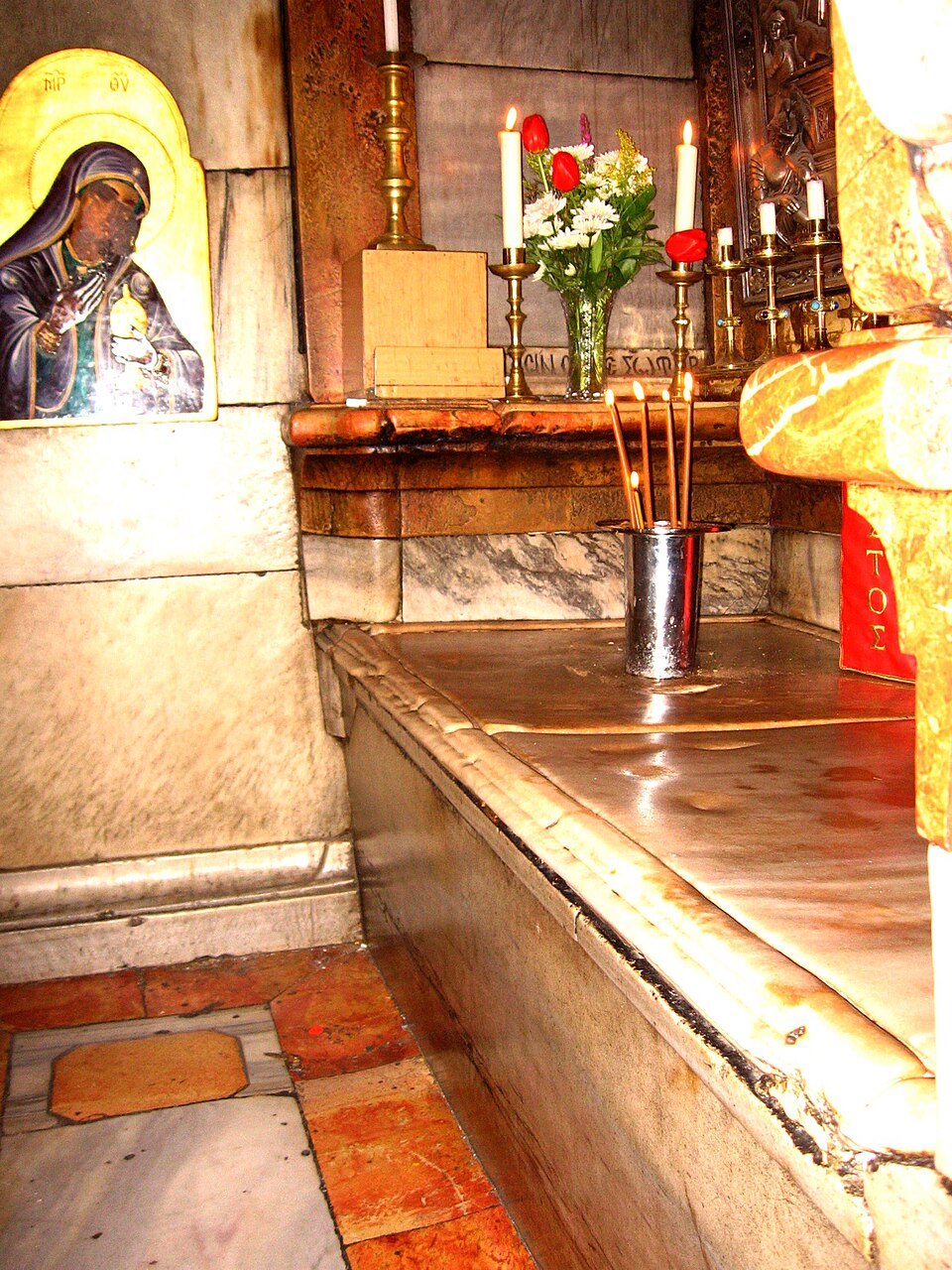

Matthew 28:1, NRSV"After the sabbath, as the first day of the week was dawning, Mary Magdalene and the other Mary went to see the tomb."
Matthew names two women: Mary Magdalene and "the other Mary," whom Matthew 27:56 identifies as the mother of James and Joseph. No purpose for the visit is stated in Matthew's account — the women come "to see the tomb," not to anoint the body (Matthew 28:1–20).
The Gospel of Mark provides a different list and a different purpose:
Mark 16:1–2, NRSV"When the sabbath was over, Mary Magdalene, and Mary the mother of James, and Salome bought spices, so that they might go and anoint him. And very early on the first day of the week, when the sun had risen, they went to the tomb."
Mark names three women — the same two as Matthew plus Salome — and states they came to anoint Jesus' body with spices. Mark also specifies the time as "very early" after sunrise (Mark 16:1–8).
The Gospel of Luke expands the group further:
Luke 24:1, NRSV"But on the first day of the week, at early dawn, they came to the tomb, taking the spices that they had prepared."
Luke does not name the women until after they have reported to the apostles. At that point, Luke identifies them: "Now it was Mary Magdalene, Joanna, Mary the mother of James, and the other women with them who told this to the apostles" (Luke 24:10, NRSV). Luke's list includes at least five women — Mary Magdalene, Joanna (a name appearing in no other Gospel's resurrection account), Mary the mother of James, and unnamed additional women. Like Mark, Luke states they brought spices, though Luke specifies these were prepared before the Sabbath rather than purchased after it (Luke 24:1–53).
The Gospel of John narrows the group to a single named individual:
John 20:1, NRSV"Early on the first day of the week, while it was still dark, Mary Magdalene came to the tomb and saw that the stone had been removed from the tomb."
John names only Mary Magdalene, though the first-person plural in her subsequent report — "we do not know where they have laid him" (John 20:2, NRSV) — may indicate that the author assumed the presence of other women even while naming only one. No purpose for the visit is stated in John's account. John also specifies a different time from Mark: Mary arrives "while it was still dark," whereas Mark reports the visit occurred "when the sun had risen" (John 20:1–31).
What they found at the tomb
The four Gospels describe different scenes at the tomb itself — a different number and type of figures, different positions, different actions, and different words spoken.7
In Matthew's account, the discovery is preceded by an earthquake and the dramatic descent of an angel (Matthew 28:2–4):
Matthew 28:2–4, NRSV"And suddenly there was a great earthquake; for an angel of the Lord, descending from heaven, came and rolled back the stone and sat on it. His appearance was like lightning, and his clothing white as snow. For fear of him the guards shook and became like dead men."
Matthew alone among the Gospels includes a guard at the tomb, placed there at the request of the chief priests and Pharisees (Matthew 27:62–66). The angel is described sitting on the rolled-back stone outside the tomb. The angel addresses the women: "Do not be afraid; I know that you are looking for Jesus who was crucified. He is not here; for he has been raised, as he said. Come, see the place where he lay. Then go quickly and tell his disciples, 'He has been raised from the dead, and indeed he is going ahead of you to Galilee; there you will see him'" (Matthew 28:5–7, NRSV) (Matthew 28:1–20).
Mark's account contains no earthquake, no guards, and no angel descending from heaven. Instead, the women find the stone already rolled away and encounter a figure inside the tomb (Mark 16:4–7):
Mark 16:4–7, NRSV"When they looked up, they saw that the stone, which was very large, had already been rolled back. As they entered the tomb, they saw a young man, dressed in a white robe, sitting on the right side; and they were alarmed. But he said to them, 'Do not be alarmed; you are looking for Jesus of Nazareth, who was crucified. He has been raised; he is not here. Look, there is the place they laid him. But go, tell his disciples and Peter that he is going ahead of you to Galilee; there you will see him, just as he told you.'"
Mark describes a single "young man" (neaniskon in Greek), not an angel. He sits inside the tomb on the right side, not outside on the stone as in Matthew. His message is similar to Matthew's but includes the specific mention of Peter by name — "tell his disciples and Peter" — a detail absent from the other Gospels. Mark 14:28 records Jesus saying during the Last Supper, "But after I am raised up, I will go before you to Galilee" (NRSV), and the young man's instruction in 16:7 directly references this earlier statement: "just as he told you" (Mark 16:1–8; Mark 14:28; Mark 16:7).
Luke describes two figures rather than one (Luke 24:2–8):
Luke 24:2–8, NRSV"They found the stone rolled away from the tomb, but when they went in, they did not find the body. While they were perplexed about this, suddenly two men in dazzling clothes stood beside them. The women were terrified and bowed their faces to the ground, but the men said to them, 'Why do you look for the living among the dead? He is not here, but has risen. Remember how he told you, while he was still in Galilee, that the Son of Man must be handed over to sinners, and be crucified, and on the third day rise again.' Then they remembered his words."
Luke's "two men in dazzling clothes" stand beside the women rather than sitting. Their message omits any instruction to go to Galilee. Instead, they tell the women to remember what Jesus said "while he was still in Galilee" — a formulation that treats Galilee as a place of past events, not a destination for future appearances. This aligns with Luke's broader narrative, which places all post-resurrection appearances in or near Jerusalem (Luke 24:1–53).
John's account unfolds differently from all three Synoptic Gospels. Mary Magdalene arrives, sees the stone removed, and runs to tell Peter and the Beloved Disciple before encountering anyone at the tomb. The two disciples then race to the tomb:
John 20:6–7, NRSV"Then Simon Peter came, following him, and went into the tomb. He saw the linen wrappings lying there, and the cloth that had been on Jesus' head, not lying with the linen wrappings but rolled up in a place by itself."
Only after the disciples depart does Mary Magdalene look into the tomb and see two angels:
John 20:11–12, NRSV"But Mary stood weeping outside the tomb. As she wept, she bent over to look into the tomb; and she saw two angels in white, sitting where the body of Jesus had been lying, one at the head and the other at the feet."
John's angels are described as sitting — one at the head and one at the feet of where the body had lain. They ask Mary a question ("Woman, why are you weeping?") but do not deliver the proclamation of resurrection found in the Synoptic accounts. Instead, Mary turns and encounters Jesus himself, whom she initially mistakes for the gardener (John 20:1–31).
Immediate reactions and responses
The accounts diverge sharply in their descriptions of what the women did after the tomb encounter.7
Matthew reports that the women obeyed the angel's instruction immediately and with a mix of emotions (Matthew 28:8–10):
Matthew 28:8–10, NRSV"So they left the tomb quickly with fear and great joy, and ran to tell his disciples. Suddenly Jesus met them and said, 'Greetings!' And they came to him, took hold of his feet, and worshiped him. Then Jesus said to them, 'Do not be afraid; go and tell my brothers to go to Galilee; there they will see me.'"
In Matthew, the women leave in fear and joy, encounter Jesus on the road, physically grasp his feet, and receive a second instruction to send the disciples to Galilee (Matthew 28:1–20).
Mark's original ending presents the opposite response (Mark 16:8):
Mark 16:8, NRSV"So they went out and fled from the tomb, for terror and amazement had seized them; and they said nothing to anyone, for they were afraid."
In Mark, the women flee in terror and tell no one. The Greek text ends with the conjunction gar (γάρ, "for") — an abrupt termination that has generated extensive discussion about whether this was the intended ending or whether the original conclusion was lost. In the original text of Mark, no post-resurrection appearance of Jesus is narrated and no one is told about the empty tomb (Mark 16:1–8).5
Luke reports that the women did tell the apostles, but that their testimony was rejected (Luke 24:8–12):
Luke 24:8–12, NRSV"Then they remembered his words, and returning from the tomb, they told all this to the eleven and to all the rest. . . . But these words seemed to them an idle tale, and they did not believe them. But Peter got up and ran to the tomb; stooping and looking in, he saw the linen cloths by themselves; then he went home, amazed at what had happened."
Luke's account adds Peter's solo visit to the tomb after receiving the women's report — a visit in which he sees the linen cloths but encounters no angels and receives no message. This differs from John's account, in which Peter visits the tomb with the Beloved Disciple before Mary Magdalene encounters the angels (Luke 24:1–53; John 20:1–31).
In John, Mary Magdalene's first action is to run to Peter and the Beloved Disciple with a message that does not mention angels or resurrection: "They have taken the Lord out of the tomb, and we do not know where they have laid him" (John 20:2, NRSV). It is only after the disciples' visit and departure that Mary sees the angels and then encounters the risen Jesus. Jesus instructs her: "Do not hold on to me, because I have not yet ascended to the Father. But go to my brothers and say to them, 'I am ascending to my Father and your Father, to my God and your God'" (John 20:17, NRSV). Mary then announces to the disciples, "I have seen the Lord" (John 20:18, NRSV) (John 20:1–31).
Post-resurrection appearances
The Gospels and Paul's letter to the Corinthians record different lists of post-resurrection appearances in different locations and different sequences. No two accounts present the same order of events.7
Matthew records only two appearances. The first is to the women on the road from the tomb (Matthew 28:9–10). The second is to the eleven disciples on a mountain in Galilee (Matthew 28:16–20):
Matthew 28:16–17, NRSV"Now the eleven disciples went to Galilee, to the mountain to which Jesus had directed them. When they saw him, they worshiped him; but some doubted."
Matthew notes that even at this climactic appearance, "some doubted" (hoi de edistasan, οἱ δὲ ἐδίστασαν). Matthew records no appearances in Jerusalem to the disciples, and the Galilee mountain scene is the final episode of the Gospel (Matthew 28:1–20).
Mark's original text (ending at 16:8) records no post-resurrection appearances at all. The longer ending (Mark 16:9–20), discussed in detail below, summarizes several appearances: first to Mary Magdalene, then to two disciples walking in the country, and finally to the eleven at a meal (Mark 16:1–8; Mark 16:9–20).
Luke records three appearances, all occurring on the day of resurrection and all in the vicinity of Jerusalem. The first is the encounter on the road to Emmaus, in which two disciples (one named Cleopas) walk with Jesus for an extended period without recognizing him:
Luke 24:13–16, NRSV"Now on that same day two of them were going to a village called Emmaus, about seven miles from Jerusalem, and talking with each other about all these things that had happened. While they were talking and discussing, Jesus himself came near and went with them, but their eyes were kept from recognizing him."
The two recognize Jesus only when he breaks bread at their table, at which point "he vanished from their sight" (Luke 24:31, NRSV). They return to Jerusalem and find the eleven gathered, who report that "the Lord has risen indeed, and he has appeared to Simon!" (Luke 24:34, NRSV) — an appearance to Peter that is mentioned but not narrated (Luke 24:1–53).
The second narrated appearance in Luke is to the gathered disciples in Jerusalem. Jesus appears suddenly, shows his hands and feet, and eats a piece of broiled fish to demonstrate physical reality (Luke 24:36–43). He then delivers final instructions and leads them to Bethany, where "he withdrew from them and was carried up into heaven" (Luke 24:51, NRSV). Luke's Gospel presents all of these events — the Emmaus road, the Jerusalem appearance, the ascension at Bethany — as occurring on a single day (Luke 24:1–53; Luke 24:50–53).
The same author's second work, the Acts of the Apostles, revises this timeline. Acts 1:3 states that Jesus "presented himself alive to them by many convincing proofs, appearing to them during forty days and speaking about the kingdom of God" (NRSV). The ascension in Acts takes place from the Mount of Olives after this forty-day period (Acts 1:1–11). Luke 24 places the ascension on Easter Sunday. Acts 1 places it forty days later.
John records four post-resurrection appearances across multiple days and two different geographical regions. The first is to Mary Magdalene at the tomb (John 20:14–18). The second is to the disciples (without Thomas) on the evening of resurrection day in Jerusalem, behind locked doors:
John 20:19–20, NRSV"When it was evening on that day, the first day of the week, and the doors of the house where the disciples had met were locked for fear of the Jews, Jesus came and stood among them and said, 'Peace be with you.' After he said this, he showed them his hands and his side."
The third appearance occurs eight days later, again in Jerusalem, this time with Thomas present. Thomas declares, "My Lord and my God!" (John 20:28, NRSV). The fourth appearance, narrated in John 21, takes place at the Sea of Tiberias (Sea of Galilee), where seven disciples are fishing and the risen Jesus appears on the shore, directs them to a large catch of fish, and shares a meal with them (John 20:1–31; John 21:1–25).
Paul's account in 1 Corinthians 15
The earliest written account of the resurrection appearances is found not in any Gospel but in Paul's first letter to the Corinthians, composed in approximately 53–54 CE — at least fifteen to twenty years before the earliest Gospel (Mark, typically dated to approximately 66–70 CE). Paul writes:
1 Corinthians 15:3–8, NRSV"For I handed on to you as of first importance what I in turn had received: that Christ died for our sins in accordance with the scriptures, and that he was buried, and that he was raised on the third day in accordance with the scriptures, and that he appeared to Cephas, then to the twelve. Then he appeared to more than five hundred brothers and sisters at one time, most of whom are still alive, though some have died. Then he appeared to James, then to all the apostles. Last of all, as to one untimely born, he appeared also to me."
Paul's list of appearances does not match any Gospel. He names the first appearance as being to Cephas (Peter) alone, then to "the twelve," then to more than five hundred at once, then to James, then to "all the apostles," and finally to Paul himself. Several features of this list are absent from the Gospel accounts: no Gospel narrates an appearance to five hundred people at once, and no Gospel narrates a separate appearance to James (the brother of Jesus). Conversely, Paul does not mention any women — neither Mary Magdalene nor any of the women who, in all four Gospels, are the first witnesses at the tomb (1 Corinthians 15:3–8).
Paul's language about the resurrection body differs from the physical, flesh-and-bone demonstrations described in Luke and John. Paul writes of the resurrected body: "It is sown a physical body, it is raised a spiritual body" (sōma pneumatikon, σῶμα πνευματικόν; 1 Corinthians 15:44). He includes his own encounter with the risen Christ in the same list as the other appearances, using the same verb (ōphthē, ὤφθη, "he appeared" or "he was seen") for all of them, though Paul's own encounter, described elsewhere in his letters and in Acts, was a visionary experience rather than a physical meeting with a flesh-and-bone figure (1 Corinthians 15:3–8; 1 Corinthians 15:44).
Comparison of accounts
The following table presents the key elements of each resurrection account side by side. Each column reproduces what that particular text states. Empty cells indicate that the text does not address the element.
Resurrection accounts compared across all five sources
| Element | Matthew 28 | Mark 16:1–8 | Luke 24 | John 20–21 | 1 Cor 15:3–8 |
|---|---|---|---|---|---|
| Women at tomb | Mary Magdalene, “the other Mary” | Mary Magdalene, Mary mother of James, Salome | Mary Magdalene, Joanna, Mary mother of James, other women | Mary Magdalene (alone named) | No women mentioned |
| Time of visit | “As the first day of the week was dawning” | “Very early… when the sun had risen” | “At early dawn” | “While it was still dark” | — |
| Purpose of visit | “To see the tomb” | To anoint the body with spices | Bringing prepared spices | Not stated | — |
| Stone | Angel rolls it back (women witness this) | Already rolled back when women arrive | Already rolled back when women arrive | Already removed when Mary arrives | — |
| Guard at tomb | Yes (posted by chief priests) | No | No | No | — |
| Earthquake | Yes | No | No | No | — |
| Figures at tomb | One angel, outside on the stone | One young man in white, inside on the right | Two men in dazzling clothes, standing beside them | Two angels in white, sitting inside (head and feet) | — |
| Message at tomb | “He has been raised… he is going ahead of you to Galilee” | “He has been raised… he is going ahead of you to Galilee” | “He is not here, but has risen. Remember how he told you, while he was still in Galilee” | “Woman, why are you weeping?” (no resurrection proclamation from angels) | — |
| Women’s response | Left with fear and great joy; ran to tell disciples | Fled in terror; “said nothing to anyone, for they were afraid” | Returned and told the eleven; apostles did not believe them | Mary ran to Peter and Beloved Disciple before seeing angels | — |
| Peter visits tomb | No | No | Yes (alone; sees linen cloths) | Yes (with Beloved Disciple; sees linen wrappings) | — |
| First appearance | To the women on the road from the tomb | None (in original ending) | To two disciples on Emmaus road | To Mary Magdalene at the tomb | To Cephas (Peter) |
| Appearance to disciples | Eleven on a mountain in Galilee | None (in original ending) | Gathered group in Jerusalem (same day) | Disciples in locked room, Jerusalem (evening of same day); again eight days later with Thomas | “The twelve”; then 500+; then James; then “all the apostles” |
| Location of appearances | Galilee | — | Jerusalem and Emmaus only | Jerusalem and Sea of Galilee | Not specified |
| Physical demonstration | Women grasp his feet | — | Shows hands and feet; eats broiled fish | Shows hands and side; Thomas invited to touch wounds | “Spiritual body” (sōma pneumatikon) |
| Ascension | Not narrated | Not narrated (in original ending) | Same day, at Bethany (Luke 24:50–51); 40 days later from Mount of Olives (Acts 1:3, 9–12) | Not narrated as a separate event | — |
Galilee versus Jerusalem
One of the most prominent differences among the resurrection accounts is the geographical setting of the post-resurrection appearances. Matthew and Mark point the disciples toward Galilee. Luke confines all events to Jerusalem and its immediate vicinity. John includes both locations.
In Matthew, the angel at the tomb instructs the women: "Go quickly and tell his disciples, 'He has been raised from the dead, and indeed he is going ahead of you to Galilee; there you will see him'" (Matthew 28:7, NRSV). Jesus repeats this instruction when he meets the women on the road: "Go and tell my brothers to go to Galilee; there they will see me" (Matthew 28:10, NRSV). The Gospel's only appearance to the eleven disciples takes place on a mountain in Galilee, fulfilling this instruction (Matthew 28:1–20).
Mark contains the same directive. The young man in the tomb tells the women: "But go, tell his disciples and Peter that he is going ahead of you to Galilee; there you will see him, just as he told you" (Mark 16:7, NRSV). This instruction references Jesus' own prediction at the Last Supper: "But after I am raised up, I will go before you to Galilee" (Mark 14:28, NRSV). However, because Mark's original text ends at 16:8 with the women telling no one, the promise of a Galilee appearance is never fulfilled within the text as it survives (Mark 16:1–8; Mark 14:28; Mark 16:7).
Luke's account contains no instruction to go to Galilee. The two men at the tomb instead say: "Remember how he told you, while he was still in Galilee, that the Son of Man must be handed over to sinners, and be crucified, and on the third day rise again" (Luke 24:6–7, NRSV). The phrasing "while he was still in Galilee" treats Galilee as a place the narrative has left behind. All of Luke's post-resurrection appearances — the Emmaus road encounter, the appearance to the gathered disciples, the ascension at Bethany — occur in or near Jerusalem on the day of resurrection (Luke 24:1–53).
Luke's narrative leaves no temporal gap in which a trip to Galilee could occur. The Emmaus road encounter takes place on "that same day" (Luke 24:13). The two disciples return to Jerusalem "that same hour" (Luke 24:33). Jesus appears to the group, eats fish, delivers instructions, and leads them to Bethany, where the ascension occurs. Luke 24 presents a continuous narrative from dawn to ascension within a single day. A round trip to Galilee (approximately 60–70 miles from Jerusalem) is not possible within this timeline (Luke 24:1–53; Luke 24:50–53).
John combines both geographic traditions. The appearances in John 20 take place in Jerusalem — to Mary Magdalene at the tomb, to the disciples without Thomas on the evening of resurrection day, and to the disciples with Thomas eight days later. The appearance in John 21 takes place at the Sea of Tiberias (Galilee), though the chapter does not specify how much time has elapsed between the Jerusalem appearances and the Galilee appearance (John 20:1–31; John 21:1–25).
Mark's original ending at 16:8
The Gospel of Mark presents a distinctive problem in the textual tradition. In the two oldest complete Greek manuscripts of the New Testament — Codex Sinaiticus (4th century CE) and Codex Vaticanus (4th century CE) — the Gospel of Mark ends at 16:8 with the words "for they were afraid" (ephobounto gar, ἐφοβοῦντο γάρ).1, 2
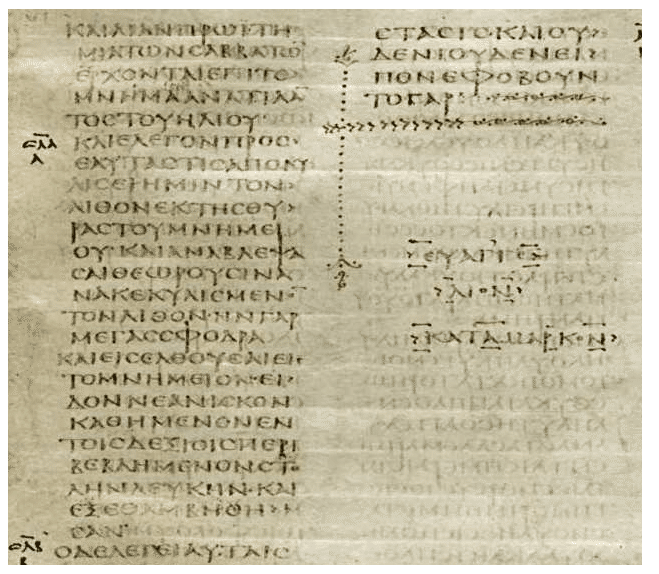

The full text of Mark's ending in these manuscripts reads:
Mark 16:8, NRSV"So they went out and fled from the tomb, for terror and amazement had seized them; and they said nothing to anyone, for they were afraid."
This ending means that in the earliest recoverable text of Mark, no post-resurrection appearance of Jesus is narrated. The women discover the empty tomb, hear the young man's announcement, and flee without telling anyone. The promise that the disciples will see Jesus in Galilee (Mark 16:7) remains unfulfilled within the text (Mark 16:1–8).5
The verses known as the "Longer Ending" of Mark (16:9–20) appear in later manuscripts beginning in the 5th century and in some early translations. This passage summarizes appearances to Mary Magdalene (16:9), two disciples in the country (16:12), and the eleven at a meal (16:14–18), followed by a brief ascension (16:19). The vocabulary, style, and content of these verses differ from the rest of Mark. The passage uses words and constructions that do not appear elsewhere in Mark's Gospel, and it appears to draw on and summarize material from Luke and John rather than presenting an independent narrative (Mark 16:9–20).3, 6
The critical apparatus of the Nestle-Aland 28th edition of the Greek New Testament marks 16:9–20 as a later addition, enclosed in double brackets to indicate that the passage is not part of the original text.8 Additional manuscript evidence supports this assessment. Eusebius of Caesarea (early 4th century) and Jerome (late 4th century) both reported that the longer ending was absent from almost all Greek manuscripts known to them. A shorter alternative ending, consisting of a single sentence, appears in some manuscripts either alone or alongside the longer ending. At least one manuscript (Codex Washingtonianus, 4th/5th century) contains the longer ending with an interpolation between verses 14 and 15 known as the "Freer Logion," suggesting the passage was still being expanded even after its initial addition.3, 4
Whether Mark intended to end at 16:8 or whether the original ending was lost remains a question that the manuscript evidence alone cannot resolve. What the manuscripts establish is that the longer ending was not part of the text as it circulated in the earliest centuries, and that the version of Mark preserved in the oldest surviving Greek codices contains no resurrection appearances.1, 2, 5, 10
The guard at the tomb
The Gospel of Matthew alone among the canonical texts reports that the Jewish authorities placed a guard at Jesus' tomb. The passage appears in Matthew 27:62–66:
Matthew 27:62–66, NRSV"The next day, that is, after the day of Preparation, the chief priests and the Pharisees gathered before Pilate and said, 'Sir, we remember what that impostor said while he was still alive, "After three days I will rise again." Therefore command the tomb to be made secure until the third day; otherwise his disciples may go and steal him away, and tell the people, "He has been raised from the dead," and the last deception would be worse than the first.' Pilate said to them, 'You have a guard of soldiers. Go, make it as secure as you can.' So they went with the guard and made the tomb secure by sealing the stone."
Matthew continues the guard narrative in the resurrection account. The guards witness the earthquake and the angel's descent and "became like dead men" (Matthew 28:4, NRSV). After the women depart, some of the guards go to the chief priests and report what has happened. The chief priests pay the soldiers to say that the disciples stole the body while they were sleeping: "So they took the money and did as they were directed. And this story is still told among the Jews to this day" (Matthew 28:15, NRSV) (Matthew 28:1–20).
This narrative appears in no other Gospel. Mark, Luke, and John make no mention of a guard posted at the tomb, a sealed stone, a bribe paid to soldiers, or a story circulating among Jewish communities about a stolen body. Matthew's account addresses a specific objection — that the disciples took the body — and attributes the origin of that objection to a deliberate fabrication by the chief priests. The passage is directed at an audience for whom the "stolen body" explanation was a known counter-narrative (Matthew 28:1–20; Matthew 27:62–66).
The nature of the risen body
The accounts present the risen Jesus differently with respect to physicality. Luke and John emphasize the material, bodily nature of the resurrection. Paul describes the resurrected body in terms that emphasize transformation rather than resuscitation.7
In Luke, when the risen Jesus appears to the gathered disciples, they are "startled and terrified, and thought that they were seeing a ghost" (Luke 24:37, NRSV). Jesus responds:
Luke 24:38–43, NRSV"'Why are you frightened, and why do doubts arise in your hearts? Look at my hands and my feet; see that it is I myself. Touch me and see; for a ghost does not have flesh and bones as you see that I have.' And when he had said this, he showed them his hands and his feet. While in their joy they were disbelieving and still wondering, he said to them, 'Have you anything here to eat?' They gave him a piece of broiled fish, and he took it and ate in their presence."
Luke's Jesus explicitly states he has "flesh and bones," invites physical touch, and eats food — all demonstrations intended to establish that the appearance is not a vision or a ghostly apparition (Luke 24:1–53).
John similarly emphasizes physicality. Jesus shows the disciples "his hands and his side" (John 20:20, NRSV). When Thomas is absent and expresses doubt, Jesus appears again and says: "Put your finger here and see my hands. Reach out your hand and put it in my side. Do not doubt but believe" (John 20:27, NRSV). In John 21, the risen Jesus prepares a charcoal fire and cooks breakfast for the disciples, handling bread and fish (John 20:1–31; John 21:1–25).
At the same time, both Luke and John describe the risen Jesus as possessing abilities that go beyond ordinary physicality. In Luke, Jesus appears suddenly to the Emmaus disciples and later "vanished from their sight" (Luke 24:31, NRSV). In John, Jesus appears in a room whose "doors were locked" (John 20:19, NRSV), apparently passing through physical barriers. The risen body in these accounts is simultaneously tangible and capable of actions that a normal human body cannot perform (Luke 24:1–53; John 20:1–31).
Paul's description operates in a different register. Writing to the Corinthians about what the resurrected body will be, Paul states: "It is sown a physical body (sōma psychikon, σῶμα ψυχικόν), it is raised a spiritual body (sōma pneumatikon, σῶμα πνευματικόν). If there is a physical body, there is also a spiritual body" (1 Corinthians 15:44). Paul further states: "flesh and blood cannot inherit the kingdom of God, nor does the perishable inherit the imperishable" (1 Corinthians 15:50, NRSV). Paul's formulation — a "spiritual body" that is not "flesh and blood" — stands in tension with Luke's description of a risen Jesus who explicitly insists he has "flesh and bones" and eats physical food (1 Corinthians 15:3–8; 1 Corinthians 15:44).
Paul places his own encounter with the risen Christ in the same list as the appearances to Peter, James, and the twelve, using the same Greek verb (ōphthē) for all of them. The nature of Paul's encounter — described in his letters as revelatory rather than a physical meeting with a walking, eating figure — raises the question of whether Paul understood the earlier appearances in the same visionary terms in which he described his own, or whether he distinguished between them. The text does not resolve this question explicitly (1 Corinthians 15:3–8).7
Timing and the chronological sequence
When the post-resurrection events are arranged chronologically according to each source, the resulting timelines do not align. Luke's Gospel compresses all events — appearances, final instructions, and ascension — into a single day. Acts, written by the same author, distributes them across forty days. Matthew and John provide no explicit duration. Paul provides no narrative timeline at all.
Luke 24 opens at dawn on Sunday (24:1) and proceeds without any temporal break to the ascension at Bethany (24:50–51). The Emmaus road encounter occurs on "that same day" (24:13). The two disciples return to Jerusalem "that same hour" (24:33). Jesus appears to the group, eats, teaches, and leads them out to Bethany, all in continuous narrative with no indication that days or weeks have passed (Luke 24:1–53; Luke 24:50–53).
Acts 1:3 revises this: "After his suffering he presented himself alive to them by many convincing proofs, appearing to them during forty days and speaking about the kingdom of God" (NRSV). The ascension in Acts takes place from the Mount of Olives at the end of this forty-day period (Acts 1:9–12). Luke's two volumes, written by the same author and addressed to the same recipient (Theophilus), present the duration between resurrection and ascension as one day in the Gospel and forty days in Acts (Acts 1:1–11; Luke 24:50–53).
John 20 marks specific intervals. Mary Magdalene visits the tomb on the first day of the week (20:1). Jesus appears to the disciples that evening (20:19). He appears again "a week later" (20:26). John 21 records a subsequent appearance in Galilee, though the interval between John 20:26 and John 21:1 is not specified. John presents a multi-week timeline that is not compatible with Luke 24's single-day framework but is also not fully aligned with Acts' forty-day structure (John 20:1–31; John 21:1–25).
Matthew provides no chronological markers beyond the morning of the resurrection and the subsequent appearance in Galilee. The Gospel does not specify how much time elapsed between the women's discovery and the mountain appearance, nor does it narrate an ascension (Matthew 28:1–20).
Paul's list in 1 Corinthians 15 is sequential ("then . . . then . . . then . . . last of all") but provides no dates, durations, or locations. The interval between the appearance to Peter and the appearance to Paul himself spans years, since Paul's conversion occurred some time after the events surrounding Jesus' death. Paul treats all the appearances, including his own, as belonging to the same category of event (1 Corinthians 15:3–8).
The texts together
Read individually, each account presents a coherent narrative of the resurrection. Read together, the five accounts present five versions of the same events with different participants, different sequences, different locations, different figures, and different theological emphases. Matthew's account includes an earthquake, a guard, and an angel who rolls the stone; Mark has none of these elements but includes Salome among the women and ends with terrified silence. Luke restricts events to Jerusalem and emphasizes the physical reality of the risen body; John includes both Jerusalem and Galilee and introduces the Beloved Disciple and Thomas as central figures. Paul omits the empty tomb entirely and presents a list of appearances that corresponds to none of the Gospel sequences (Matthew 28:1–20; Mark 16:1–8; Luke 24:1–53; John 20:1–31; 1 Corinthians 15:3–8).
The differences are not limited to incidental details. They involve the number and identity of witnesses, the nature and location of the appearances, the duration of the post-resurrection period, and the character of the risen body itself. The comparison table above documents these differences element by element. The texts speak for themselves (Matthew 28:1–20; Mark 16:1–8; Luke 24:1–53; John 20:1–31; John 21:1–25; 1 Corinthians 15:3–8).7, 9