Overview
- Textual criticism is the scholarly discipline that compares manuscripts, versions, and quotations to reconstruct the earliest recoverable wording of biblical texts, working from approximately 5,800 Greek New Testament manuscripts, 10,000 Latin manuscripts, and thousands of manuscripts in other languages, no two of which are identical in every detail.
- The discipline employs two major methodological traditions: the genealogical method pioneered by Karl Lachmann and refined by B. F. Westcott and F. J. A. Hort, which groups manuscripts into families and evaluates readings based on their transmission history, and the eclectic method used in modern critical editions, which weighs both external evidence (manuscript age, quality, and geographic distribution) and internal evidence (scribal habits, authorial style, and difficulty of readings).
- Textual criticism of the Hebrew Bible relies on a smaller manuscript base anchored by the Masoretic Text, the Dead Sea Scrolls, the Septuagint, and the Samaritan Pentateuch, and the discovery of the Qumran scrolls in 1947 revealed that multiple text forms circulated simultaneously in the Second Temple period, complicating any assumption that a single original text can always be recovered.
Textual criticism is the discipline that seeks to establish the earliest recoverable wording of texts that survive in multiple manuscript copies. For the Bible, this work draws on thousands of handwritten manuscripts, ancient translations, and quotations in early Christian and Jewish writings. No two manuscripts of any biblical book are identical in every detail; the differences range from spelling variations and word-order changes to the addition or omission of entire passages. The task of textual criticism is to compare these witnesses systematically, evaluate the variants, and reconstruct what the author most likely wrote — or, where that is not recoverable, to identify the earliest attested form of the text.1, 8
The discipline has developed different methods and traditions for the Old and New Testaments, reflecting the different character of their manuscript evidence. The New Testament is preserved in a vastly larger number of manuscripts than any other ancient work, while the Hebrew Bible's textual history was shaped by centuries of careful scribal transmission and by the transformative discovery of the Dead Sea Scrolls in 1947.1, 7
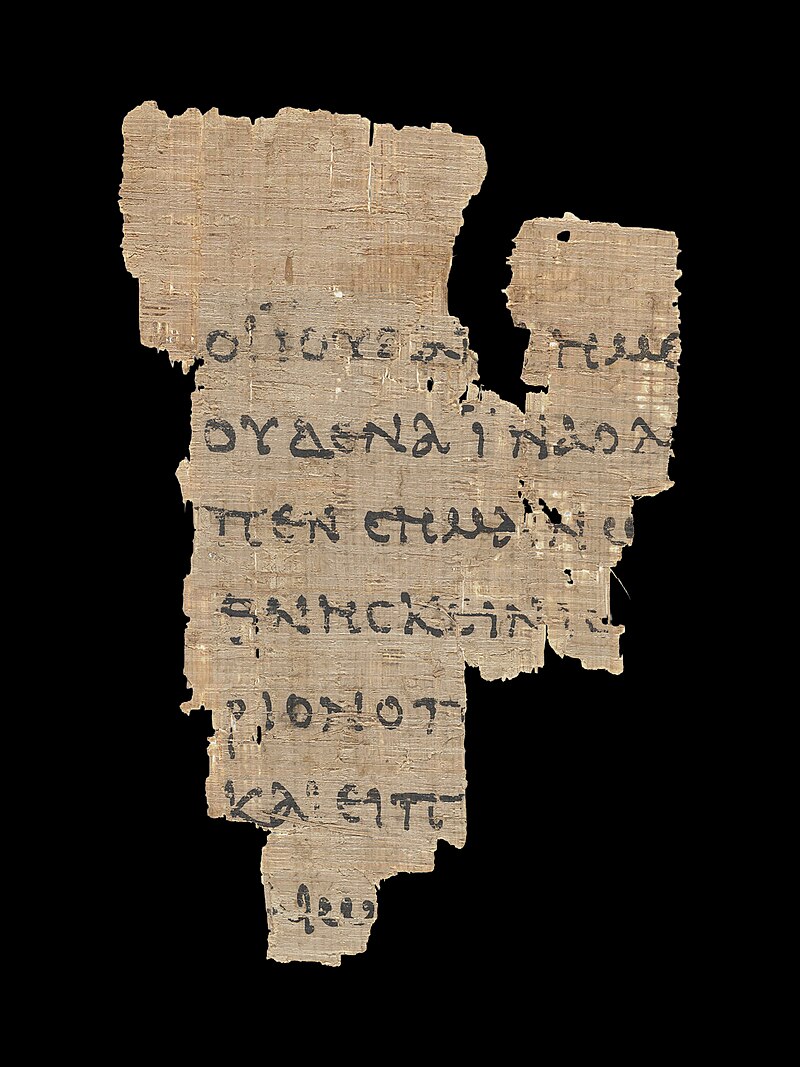
_recto_John_18,_31-33.jpg)
Manuscript evidence for the New Testament
The Greek New Testament is attested by approximately 5,800 Greek manuscripts, ranging from small fragments containing a few verses to complete codices of the entire New Testament. These are classified by writing material and format: papyri (designated with a "P" followed by a number, such as P52 or P75), majuscules or uncials (written in capital letters on parchment, designated by a number preceded by "0" or by a letter), minuscules (in cursive script, designated by plain numbers), and lectionaries (passages arranged for liturgical reading). In addition, the New Testament survives in approximately 10,000 Latin manuscripts, as well as manuscripts in Syriac, Coptic, Armenian, Georgian, Ethiopic, Gothic, and Old Church Slavonic. Early church writers from the second century onward quoted the New Testament extensively, providing an additional line of evidence for the text's wording at specific dates and locations.1, 6
The earliest surviving New Testament manuscript is P52, a fragment of the Gospel of John (18:31–33, 37–38) written on papyrus and dated paleographically to approximately 125–175 CE. The oldest substantial manuscripts of large portions of the New Testament are the Chester Beatty Papyri (P45, P46, P47), dating to the early third century, and P75, a codex of Luke and John from approximately the same period. The two most important complete or near-complete manuscripts are Codex Sinaiticus (designated by the Hebrew letter aleph or the number 01), a fourth-century parchment codex now divided among the British Library, Leipzig University Library, the National Library of Russia, and St. Catherine's Monastery, and Codex Vaticanus (B or 03), a fourth-century codex held in the Vatican Library. These two manuscripts were central to the development of the modern critical text.1, 15
Manuscript evidence for the Hebrew Bible
The textual evidence for the Hebrew Bible differs fundamentally from that of the New Testament. The dominant manuscript tradition is the Masoretic Text (MT), a consonantal text with an elaborate system of vowel pointing, accentuation, and marginal notes (masorah) developed by scribes known as the Masoretes between the sixth and tenth centuries CE. The oldest complete manuscript of the Masoretic Text is the Leningrad Codex (Codex Leningradensis, L), dated to 1008/1009 CE, which serves as the base text for the standard critical edition, Biblia Hebraica Stuttgartensia (BHS) and its successor Biblia Hebraica Quinta (BHQ). The Aleppo Codex, slightly older (c. 930 CE) and considered more authoritative by some scholars, is partially damaged, missing most of the Pentateuch.7, 8, 13
Before the discovery of the Dead Sea Scrolls, the oldest known Hebrew Bible manuscripts dated to approximately the ninth and tenth centuries CE, leaving a gap of more than a millennium between the composition of most biblical books and the earliest surviving copies. The scrolls discovered near Qumran between 1947 and 1956 pushed this evidence back by roughly a thousand years. Approximately 230 of the roughly 981 scrolls recovered are biblical manuscripts, including fragments of every book of the Hebrew Bible except Esther. These manuscripts, dating from the third century BCE to the first century CE, revealed that multiple text forms circulated simultaneously during the Second Temple period. Some Qumran manuscripts closely match the proto-Masoretic text; others align with the Septuagint's Hebrew Vorlage or the Samaritan Pentateuch; still others represent text forms not known from any other source.11, 12
The Septuagint (LXX), the Greek translation of the Hebrew Bible begun in the third century BCE in Alexandria, provides indirect evidence for the Hebrew text that the translators had before them. In some books — particularly Jeremiah, where the LXX is about one-eighth shorter than the MT — the Septuagint appears to reflect a different and possibly earlier Hebrew edition. The Samaritan Pentateuch, an independent textual tradition preserved by the Samaritan community, offers a third major witness for the first five books.7, 8
History of the discipline
Textual criticism of the Bible has roots in antiquity. Origen of Alexandria (c. 185–254 CE) compiled the Hexapla, a six-column presentation of the Old Testament in Hebrew, Greek transliteration, and four Greek versions (Aquila, Symmachus, the Septuagint, and Theodotion), marking differences between the Hebrew and Greek with critical signs. Jerome (c. 347–420 CE) compared Hebrew, Greek, and Old Latin texts when producing the Vulgate. In the Renaissance, Erasmus of Rotterdam produced the first published Greek New Testament in 1516, drawing on a handful of late minuscule manuscripts and back-translating portions of Revelation from the Latin Vulgate where he lacked Greek copies.1
The modern discipline took shape in the nineteenth century. Karl Lachmann (1793–1851) was the first to produce a Greek New Testament (1831) based entirely on ancient manuscript evidence rather than on the textus receptus, the printed Greek text that had dominated since the sixteenth century. Constantin von Tischendorf (1815–1874) discovered Codex Sinaiticus at St. Catherine's Monastery and produced critical editions that drew on the oldest available manuscripts. The decisive methodological advance came with Westcott and Hort's 1881 edition of The New Testament in the Original Greek, which classified manuscripts into four text-types (Neutral, Alexandrian, Western, and Syrian) and argued that the Neutral text, represented primarily by Codex Vaticanus and Codex Sinaiticus, stood closest to the original. Their principle that the Syrian (later called Byzantine) text was a later conflation of earlier text-types became foundational for all subsequent critical editions.1, 3
For the Hebrew Bible, modern text-critical method developed more slowly. The Masoretic Text held a position of near-exclusive authority until the Qumran discoveries forced a reassessment. The Hebrew University Bible Project (HUBP), begun in 1956, and the Biblia Hebraica Quinta (BHQ), currently in production, incorporate evidence from the scrolls alongside the traditional witnesses.7, 8
Methods and principles
Textual critics evaluate variant readings using two categories of evidence: external and internal. External evidence concerns the manuscripts themselves — their age, the text-type they belong to, their geographic distribution, and the quality of their scribal work. Internal evidence concerns the readings — which variant best explains how the others arose, which fits the author's style and vocabulary, and which is more likely to have been altered by a scribe. The fundamental principle is lectio difficilior potior (the more difficult reading is to be preferred), since scribes were more likely to simplify a difficult text than to make a simple text more difficult. A related principle, lectio brevior potior (the shorter reading is to be preferred), reflects the general scribal tendency toward expansion, though this rule has been challenged by the observation that accidental omission (parablepsis) was also common.1, 2
Two broad methodological approaches are currently practiced. Reasoned eclecticism, the method underlying the standard Nestle-Aland and United Bible Societies editions, weighs both external and internal evidence for each variant, giving no single manuscript or criterion automatic priority. Thoroughgoing eclecticism, practiced by a minority of scholars, prioritizes internal evidence almost exclusively, evaluating each variant primarily on the basis of scribal habits and authorial style rather than manuscript pedigree. A third approach, the Coherence-Based Genealogical Method (CBGM), developed by Gerd Mink at the Institute for New Testament Textual Research in Münster, uses computer analysis to trace the genealogical relationships among all extant witnesses for each variant, producing a more refined stemmatic analysis than was possible with earlier methods. The CBGM has been applied to the Catholic Epistles in the Editio Critica Maior and is being extended to other New Testament books.6, 14, 16
Types of textual variation
Variations among manuscripts arise from both unintentional and intentional causes. Unintentional errors include errors of sight (confusing similar letters, skipping from one similar word to another in a phenomenon called homoioteleuton or parablepsis), errors of hearing (when a scribe copied from dictation and confused homophones), and errors of memory (substituting a synonym, harmonizing a passage with a parallel text from memory). These mechanical errors account for the majority of textual variants and are often easily identified and corrected.1, 4
Intentional changes are more significant for understanding the text's transmission. Scribes corrected perceived grammatical errors, harmonized parallel passages (particularly in the Synoptic Gospels, where a scribe might alter Mark's wording to match Matthew's more polished version), clarified ambiguous pronouns, added explanatory glosses, and occasionally modified passages for theological reasons. Ehrman has documented cases where christological controversies of the second and third centuries influenced scribal alterations to New Testament passages bearing on the nature of Christ, the virgin birth, and the relationship between the Father and the Son.4, 5
The vast majority of textual variants — estimated at 300,000 to 400,000 among New Testament manuscripts alone — involve spelling differences, word-order changes, the presence or absence of the definite article, and other variations that do not affect the meaning of the text. A smaller number involve substantive differences in wording. A still smaller number affect the meaning of the passage in question.1, 4
Significant textual problems
Several New Testament textual problems have received extensive scholarly attention. The ending of the Gospel of Mark is the most prominent: the two oldest Greek manuscripts (Codex Sinaiticus and Codex Vaticanus) end at Mark 16:8 with the women fleeing the empty tomb in fear, while later manuscripts include a longer ending (16:9–20) narrating resurrection appearances. An additional "shorter ending" appears in some manuscripts. The longer ending is absent from early Syriac, Armenian, and Georgian manuscripts and was noted as missing from accurate copies by Eusebius and Jerome. The UBS Greek New Testament and the Nestle-Aland edition print the longer ending in double brackets, indicating that it is regarded as a later addition.1, 2
The pericope adulterae (John 7:53–8:11), the account of a woman caught in adultery, is absent from the oldest and best Greek manuscripts (P66, P75, Sinaiticus, Vaticanus) and appears in different locations in various manuscripts — after John 7:36, after John 7:44, after John 21:25, and even after Luke 21:38. Its vocabulary and style differ from the rest of John's Gospel. The passage is printed in double brackets in modern critical editions.1, 2
The Comma Johanneum (1 John 5:7b–8a), which reads "in heaven, the Father, the Word, and the Holy Ghost: and these three are one. And there are three that bear witness in earth," is absent from all Greek manuscripts before the sixteenth century, from all early Latin manuscripts before the fifth or sixth century, and from all early versions and patristic writers. It was included in later editions of the Vulgate and in Erasmus's third edition of the Greek New Testament (1522) under pressure from critics, and from there entered the King James Version. It is absent from all modern critical editions.1, 2
Text-types and manuscript families
New Testament manuscripts have been grouped into text-types based on shared patterns of readings. The classification, though debated in its details, provides a framework for evaluating the relative worth of different textual traditions. The Alexandrian text-type, attested by Codex Vaticanus, Codex Sinaiticus, P75, and other early Egyptian manuscripts, is generally regarded as preserving the earliest recoverable form of the text. Its readings tend to be shorter and more difficult than those of other text-types. The Western text-type, attested primarily by Codex Bezae (D) and Old Latin manuscripts, is characterized by a paraphrastic tendency — additions, substitutions, and rearrangements that appear to reflect free handling of the text. The Byzantine text-type, represented by the vast majority of surviving manuscripts (the Koine text), shows signs of smoothing, harmonization, and conflation, and is generally regarded as later and less reliable for recovering the earliest text, though individual Byzantine readings may preserve early variants.1, 3, 16
For the Hebrew Bible, the concept of text-types was developed by Frank Moore Cross, who proposed a theory of local texts: an Egyptian text (reflected in the Septuagint's Vorlage), a Palestinian text (reflected in the Samaritan Pentateuch and some Qumran manuscripts), and a Babylonian text (ancestral to the Masoretic Text). This tripartite model has been modified by subsequent research, particularly by Emanuel Tov, who argues that many Qumran manuscripts do not fit neatly into any of these groups and should be classified as independent or non-aligned texts.8, 12
Critical editions
The results of textual criticism are published in critical editions that present a reconstructed text with an apparatus noting variant readings. For the New Testament, the two standard critical editions are the Nestle-Aland Novum Testamentum Graece, now in its twenty-eighth edition (NA28, 2012), and the United Bible Societies Greek New Testament, now in its fifth edition (UBS5, 2014). Both editions share the same text but differ in their critical apparatus: NA28 records a comprehensive selection of variants for scholarly analysis, while UBS5 selects a smaller number of variants particularly relevant for translators and assigns each a confidence rating from A (virtually certain) to D (highly uncertain). The Editio Critica Maior (ECM), an ongoing project of the Institute for New Testament Textual Research, presents a full accounting of all known variant readings and has so far published volumes on the Catholic Epistles and Acts.6, 16
For the Hebrew Bible, the standard critical edition is the Biblia Hebraica Stuttgartensia (BHS, 1977), based on the Leningrad Codex, with a critical apparatus noting significant variants from other Masoretic manuscripts, the Dead Sea Scrolls, the Septuagint, the Samaritan Pentateuch, the Targums, the Vulgate, and the Peshitta. Its successor, the Biblia Hebraica Quinta (BHQ), currently being published fascicle by fascicle, provides a more detailed apparatus and commentary on textual decisions.7, 8
Old Testament textual plurality
The Dead Sea Scrolls revealed a picture of textual plurality that was not previously appreciated. Before the Qumran discoveries, the Masoretic Text was often treated as effectively equivalent to the original, with deviations in the Septuagint or Samaritan Pentateuch attributed to translation technique or sectarian alteration. The scrolls showed that the situation was more complex. In some books, such as Isaiah, the Qumran manuscripts (particularly the Great Isaiah Scroll, 1QIsa-a) closely match the proto-Masoretic text with only minor variations. In other books, the Qumran evidence supports readings otherwise known only from the Septuagint. The most striking case is Jeremiah: 4QJer-b preserves a Hebrew text corresponding to the shorter Septuagint version, demonstrating that the LXX's shorter Jeremiah was not a Greek abridgment but reflected a genuinely different Hebrew edition.8, 9, 11
Tov has classified the Qumran biblical manuscripts into five groups: proto-Masoretic (about 40% of the biblical scrolls), pre-Samaritan (about 5%), texts close to the presumed Hebrew Vorlage of the Septuagint (about 5%), non-aligned texts that do not fit any of these categories (about 35%), and texts written in the Qumran scribal practice (about 15%), characterized by distinctive orthographic conventions. This distribution demonstrates that the Masoretic Text was one tradition among several during the Second Temple period, albeit the one that ultimately prevailed.8, 9
Comparison of major witnesses
Major textual witnesses for the Bible1, 7, 8
| Witness | Date | Contents | Significance |
|---|---|---|---|
| Dead Sea Scrolls | 3rd c. BCE – 1st c. CE | All HB books except Esther | Oldest Hebrew Bible manuscripts; reveal textual plurality |
| Septuagint (LXX) | 3rd c. BCE onward | Greek translation of HB + additional books | Indirect witness to pre-Masoretic Hebrew text forms |
| Samaritan Pentateuch | Tradition from 4th c. BCE; manuscripts medieval | Torah only | Independent textual tradition; ~6,000 variants from MT |
| P52 | c. 125–175 CE | John 18:31–33, 37–38 | Earliest NT manuscript fragment |
| P75 | c. 175–225 CE | Luke 3–John 15 | Close agreement with Codex Vaticanus; key Alexandrian witness |
| Codex Vaticanus (B) | c. 325–350 CE | Nearly complete Bible | Foundation of modern critical text of NT |
| Codex Sinaiticus (ℵ) | c. 330–360 CE | Complete NT + most of OT | Oldest complete NT; ends Mark at 16:8 |
| Aleppo Codex | c. 930 CE | HB (partially damaged) | Most authoritative Masoretic manuscript |
| Leningrad Codex (L) | 1008/1009 CE | Complete HB | Base text of BHS and BHQ critical editions |
Current state and ongoing debates
Contemporary textual criticism continues to refine its methods and grapple with fundamental questions. For the New Testament, the Coherence-Based Genealogical Method represents the most significant methodological innovation in recent decades, using computational analysis to trace relationships among variants across the entire manuscript tradition rather than classifying manuscripts into fixed text-types. The ongoing publication of the Editio Critica Maior is producing the most comprehensive critical apparatus ever assembled for any ancient text. At the same time, some scholars have questioned whether the goal of recovering a single "original text" is always achievable or even meaningful, arguing that some New Testament writings may have circulated in multiple authorial editions from the beginning.10, 16
For the Hebrew Bible, the Qumran evidence has permanently altered the discipline's assumptions. The recognition that multiple text forms coexisted in the Second Temple period has led to a more pluralistic understanding of the text's history. Tov has argued that the concept of an "original text" of the Hebrew Bible is problematic for many books, since the evidence suggests that some books underwent successive editions — the most obvious case being Jeremiah — and that what the Masoretic Text preserves is one endpoint of a complex editorial process rather than the starting point. The question of whether textual criticism should aim to recover a single original or to document the history of the text's development remains an active area of methodological debate.8, 9, 11
The digital age has opened new possibilities for the discipline. High-resolution digital images of manuscripts are increasingly available online, enabling scholars worldwide to examine witnesses that were previously accessible only through travel to distant libraries. Projects such as the New Testament Virtual Manuscript Room (NTVMR) and the digital Codex Sinaiticus project have democratized access to primary evidence. Computational phylogenetics, borrowed from evolutionary biology, has been applied to manuscript relationships, and machine learning techniques are being explored for tasks such as handwriting identification and dating.15, 16
References
The Text of the New Testament: Its Transmission, Corruption, and Restoration (4th ed.)
The Orthodox Corruption of Scripture: The Effect of Early Christological Controversies on the Text of the New Testament (2nd ed.)
The Text of the New Testament in Contemporary Research: Essays on the Status Quaestionis (2nd ed.)