Overview
- The Book of Exodus describes the Israelites as an enslaved population in Egypt who departed under Moses after a series of divine plagues, but no Egyptian text has been found that records a mass departure of slaves, a sequence of plagues, or a figure named Moses.
- Egyptian administrative documents confirm that Semitic-speaking peoples lived and labored in the Nile Delta under compulsion, that brick-making with straw quotas was standard practice, and that the place-names Pithom and Rameses correspond to known Egyptian sites, establishing that the general setting of the Exodus narrative is historically plausible even though the specific events remain unattested.
- The Merneptah Stele (c. 1208 BCE) establishes that an entity called Israel existed in Canaan by the late thirteenth century BCE, providing a firm terminus ante quem for any historical exodus, while the dating of the event itself remains disputed between a fifteenth-century reading of 1 Kings 6:1 and a thirteenth-century identification with the reign of Ramesses II.
The Book of Exodus describes the foundational event of Israelite identity: the enslavement of the Israelites in Egypt, their deliverance through divine intervention under the leadership of Moses, their passage through the sea, and their forty years of wandering in the Sinai wilderness before reaching the promised land of Canaan. The narrative provides specific details — the names of store-cities, the practice of brick-making with straw, the series of ten plagues, and the route of departure through the wilderness — that invite comparison with the Egyptian textual and archaeological record. This article examines the biblical account alongside the external evidence, presenting what the Egyptian sources confirm, what they complicate, and where they remain silent.
The Exodus holds a unique position among biblical historical claims because it is simultaneously the most important event in the Hebrew Bible's self-understanding and one of the most difficult to evaluate against external evidence. No Egyptian document has been found that describes the events as the Bible narrates them. At the same time, the Egyptian record contains details — Semitic names among laborers in the Nile Delta, brick-making quotas, the use of the term Apiru for foreign workers — that are consistent with the general setting of the narrative. The question is what conclusions the available evidence permits.1, 2
The biblical account
The narrative begins in Exodus 1 with a new pharaoh "who did not know Joseph" subjecting the Israelites to forced labor. The text specifies that the Israelites "built supply cities, Pithom and Rameses, for Pharaoh" (Exodus 1:11, NRSV). When the population continued to grow, the pharaoh ordered the killing of newborn Hebrew males. Moses, saved as an infant and raised in the Egyptian court, eventually fled to Midian after killing an Egyptian overseer. God commissioned him at the burning bush to return to Egypt and demand the release of the Israelites (Exodus 3:1–12).
When the pharaoh refused, God sent ten plagues upon Egypt, culminating in the death of every Egyptian firstborn (Exodus 7–12). The Israelites departed in haste, and Exodus 12:37 states that "about six hundred thousand men on foot, besides children" left from Rameses for Succoth. The pharaoh pursued with his army, and the Israelites crossed through a body of water variously identified as the "Sea of Reeds" (Hebrew: yam suph), which then closed upon the Egyptian forces (Exodus 14). The Israelites then spent forty years in the wilderness, received the covenant and law at Mount Sinai, and eventually arrived at the border of Canaan (Exodus 19–20; Deuteronomy 34).
The narrative is rich in specific detail: place-names (Pithom, Rameses, Succoth, Etham, Pi-hahiroth, Migdol, Baal-zephon), administrative practices (brick-making with and without straw, labor quotas), and geographic features (the wilderness of Shur, Marah, Elim, the wilderness of Sin, Rephidim, Mount Sinai, Kadesh-barnea). These details provide potential points of contact with the Egyptian record, though they also raise questions about dating, geography, and scale that scholars have debated for more than a century.
The Egyptian textual record
Although no Egyptian text describes the events of the Exodus as the Bible narrates them, several Egyptian administrative documents attest to conditions consistent with the general setting of the Exodus narrative — specifically, the presence of Semitic-speaking peoples in the eastern Nile Delta, their use as forced laborers, and the administrative practices described in the biblical text.
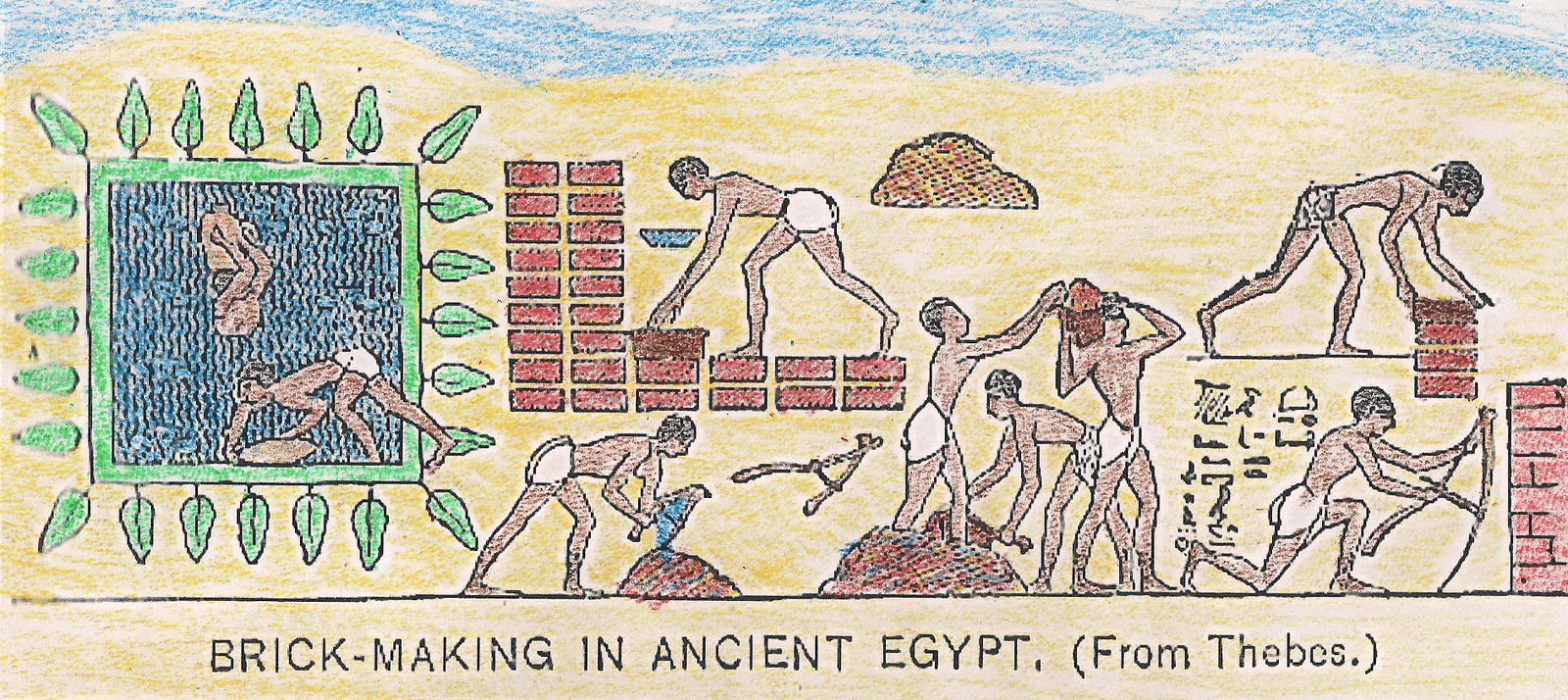

Papyrus Brooklyn 35.1446, published by William C. Hayes in 1955, is an administrative document from the late Middle Kingdom (c. 1740 BCE) now housed in the Brooklyn Museum. The verso of the papyrus contains a list of approximately seventy-nine household servants, of whom approximately forty-five bear Northwest Semitic names — names linguistically related to Hebrew, Amorite, and other Semitic languages of the second millennium BCE.5 The names include forms such as Menahem, Issachar, and Shiphrah — the last of which is identical to the name of one of the Hebrew midwives in Exodus 1:15. The papyrus demonstrates that a significant Semitic population was present in Egypt as servants or slaves during the Middle Kingdom period, centuries before the conventional dating of the Exodus itself.1, 5
Papyrus Anastasi III and IV, New Kingdom administrative texts from the reign of Merneptah (c. 1213–1203 BCE), contain references to brick-making and labor quotas that parallel the account in Exodus 5:6–19. Papyrus Anastasi III (3.1–2) records: "Likewise, people are making bricks ... they are making their quota of bricks daily." Papyrus Anastasi IV (12.5–6) mentions the lack of both laborers and straw for brick production, echoing the biblical account in which the pharaoh commands: "You shall no longer give the people straw to make bricks, as before; let them go and gather straw for themselves" (Exodus 5:7, NRSV).6, 17 Kitchen has demonstrated in detail that the brick-making practices described in Exodus — including the use of straw as a binding agent, the imposition of daily quotas, and the organizational structure of taskmasters and foremen — are fully consistent with what is known from Egyptian administrative texts of the New Kingdom period.6
Leiden Papyrus 348, dated to the reign of Ramesses II (c. 1279–1213 BCE), records an order to "distribute grain rations to the soldiers and to the Apiru who transport stones for the great pylon of Ramesses." The Apiru (Egyptian 'pr.w) were a social class of foreign laborers, displaced persons, and semi-free workers attested in texts throughout the ancient Near East during the second millennium BCE. Whether the Apiru can be identified with the biblical Hebrews ('ibrim) remains debated — the terms may be etymologically related, or the similarity may be coincidental — but the document confirms that foreign laborers designated by a term phonetically similar to "Hebrew" were employed in construction projects under Ramesses II.1, 2
The place-name "Rameses" in Exodus 1:11 corresponds to Pi-Ramesses (Egyptian: "House of Ramesses"), the great delta capital built by Ramesses II at the modern site of Qantir in the eastern Nile Delta. Excavations by Manfred Bietak at nearby Tell el-Dab'a (ancient Avaris) and by Edgar Pusch at Qantir have confirmed the identification and revealed a massive royal city with palatial structures, military installations, bronze-working facilities, and stables dating to the Ramesside period.14 The city was one of the largest in the ancient world during the thirteenth century BCE, covering an area of approximately thirty square kilometres. The biblical reference to "Rameses" as a place where the Israelites performed labor is thus consistent with a thirteenth-century setting, since the city did not exist before the reign of Ramesses II.1, 14
The question of numbers
Exodus 12:37 states that "about six hundred thousand men on foot, besides children" departed from Egypt. If women and children are included, the total population implied would be approximately two to three million people — a figure that has posed difficulties for interpreters ancient and modern. A population of that size would have formed a marching column stretching hundreds of kilometres, would have required enormous quantities of food and water daily, and would have constituted a significant fraction of the entire estimated population of Egypt in the Late Bronze Age, which modern demographic studies place at roughly three to five million.3, 11
The logistical implications have led scholars to examine the Hebrew word 'eleph (אֶלֶף), which in the received text is translated as "thousand." In other biblical contexts, however, the same word can mean "clan," "military unit," or "contingent" — a much smaller group, possibly numbering a dozen or fewer fighting men. Colin Humphreys, a physicist at Cambridge, published a mathematical analysis in Vetus Testamentum arguing that if 'eleph in the census lists of Numbers 1 and Numbers 26 is read as "troop" or "contingent" rather than "thousand," the resulting figures are internally consistent and yield a total military force of approximately 5,550 men — implying a total population of roughly 20,000 to 40,000 people.11
This reinterpretation has not achieved consensus. Critics note that the census totals in Numbers appear to have been calculated by the biblical author using 'eleph as "thousand" — the arithmetic works out to 603,550 only if the word means "thousand" — which suggests the biblical writer intended the larger number even if the underlying tradition originally used the word differently.8 Kitchen has argued that the large numbers may reflect a later editorial convention applied to an earlier, smaller-scale tradition, but acknowledges that the text as it stands presents the larger figure.8 The question of the Exodus population remains unresolved, with proposals ranging from the literal two to three million of the received text, through the tens of thousands suggested by the 'eleph-as-clan reading, to minimalist proposals that any historical kernel involved only a small group of refugees whose story was later magnified into a national epic.3, 4
The route through Sinai
The biblical text describes a route from Rameses through Succoth, Etham, Pi-hahiroth, the crossing of the sea, and then through various wilderness stations to Mount Sinai, Kadesh-barnea, and eventually the plains of Moab opposite Canaan. Three principal routes through the Sinai Peninsula have been proposed by scholars.
The northern route follows the Mediterranean coast along the Way of Horus, the ancient Egyptian military road connecting the eastern Delta to Gaza. This route is well attested archaeologically, with a chain of Egyptian fortresses identified through excavations and satellite imaging. The biblical text, however, appears to exclude this route explicitly: "When Pharaoh let the people go, God did not lead them by way of the land of the Philistines, although that was nearer; for God thought, 'If the people face war, they may change their minds and return to Egypt'" (Exodus 13:17, NRSV).13
The southern route, the traditional identification since at least the fourth century CE, leads through the southern Sinai to Jebel Musa (the traditional Mount Sinai) in the granite massif of the southern peninsula. The monastery of St. Catherine, founded in the sixth century, marks this identification. Hoffmeier has argued that certain place-names in the itinerary, particularly Migdol and Baal-zephon, can be located in the northern Sinai or the region of the Bitter Lakes, and that the sea crossing occurred at one of the bodies of water along the line of the modern Suez Canal rather than at the Gulf of Suez or the Gulf of Aqaba.13
The central route passes through the interior of the peninsula, and some scholars have proposed identifications of Mount Sinai in the central Sinai or in northwest Arabia (Midian), based on the volcanic imagery in the Sinai theophany (Exodus 19:16–18) and the association of Moses with Midian. None of these route proposals has achieved scholarly consensus, in part because the place-names in the biblical itinerary cannot be securely identified with modern locations.13
The identification of Kadesh-barnea with Ein el-Qudeirat in the northeastern Sinai is widely accepted. The site possesses the largest spring in the northern Sinai, consistent with the biblical description of Kadesh as a place where the Israelites encamped for an extended period (Numbers 20:1; Deuteronomy 1:46). Excavations by Rudolph Cohen between 1976 and 1982 revealed three superimposed fortresses at the site, but the earliest dates to the tenth century BCE — several centuries after the conventional dating of the Exodus. No remains from the Late Bronze Age (the period to which either a fifteenth- or thirteenth-century Exodus would belong) were found at the site.12 The absence of Late Bronze Age occupation at Kadesh-barnea is frequently cited as evidence against the historicity of the wilderness wandering narrative, though defenders of the tradition note that semi-nomadic populations leave minimal archaeological traces and that the arid conditions of the Sinai are not conducive to the preservation of ephemeral campsites.1, 13
The absence of direct Egyptian attestation
The most frequently noted feature of the external evidence is the absence of any Egyptian text that describes the events of the Exodus as the Bible narrates them. No Egyptian inscription, papyrus, or ostracon mentions Moses, a series of plagues, the death of firstborn children, a mass departure of slaves, or the destruction of a pharaoh's army in a body of water. This silence extends across all categories of surviving Egyptian documentation: royal monumental inscriptions, temple records, administrative papyri, and private letters.2, 3
The significance of this silence is itself debated. Several factors complicate a straightforward argument from silence. First, Egyptian royal inscriptions were propagandistic in purpose, designed to glorify the pharaoh and demonstrate divine favour. Military defeats, national humiliations, and internal crises were routinely omitted from official records. The Egyptians did not record the expulsion of the Hyksos from the perspective of the expelled, and Ramesses II's own account of the Battle of Kadesh (c. 1274 BCE) presented what was at best a strategic draw as a triumphant Egyptian victory.2, 8 A catastrophic loss of a labour force and a military disaster at the sea would fall precisely into the category of events that Egyptian scribes would have had every reason not to record.
Second, the survival of Egyptian records is itself accidental and fragmentary. The vast majority of papyrus documents from ancient Egypt have been lost to decay, fire, and the reuse of writing material. Administrative documents from the eastern Delta, where the Exodus narrative is set, are especially poorly preserved because the damp conditions of the Delta are far less favourable to papyrus preservation than the arid conditions of Upper Egypt, from which the bulk of surviving Egyptian papyri derive.1
Third, as Redford has noted, the absence of a specific mention of an Israelite exodus does not mean the Egyptians were unaware of population movements in the eastern Delta. Egyptian texts do record instances of groups departing Egypt — including a passage in Papyrus Anastasi V (19.2–20.6) that describes Egyptian border officials pursuing two runaway servants who fled "through the fortifications ... of Tjeku" (biblical Succoth) toward the Sinai.2, 10 The scenario of a group of Semitic workers fleeing from the Delta toward the Sinai is attested in Egyptian sources, even if no text links such a flight to the Israelites specifically.
The argument from silence thus cuts both ways. The absence of Egyptian attestation does not confirm the Exodus narrative, but neither does it disprove it. The question is whether the silence is expected given Egyptian recording practices and the conditions of preservation, or whether it constitutes positive evidence against the historicity of the event. Scholars who regard the Exodus as largely ahistorical, such as Finkelstein and Redford, emphasise the silence as one element in a cumulative case.2, 3 Scholars who regard the tradition as preserving a historical kernel, such as Hoffmeier and Kitchen, argue that the silence is precisely what one would expect given Egyptian conventions and the vagaries of preservation.1, 8
The Merneptah Stele
The earliest known reference to Israel outside the Bible appears on the Merneptah Stele, a granite slab erected by the Egyptian pharaoh Merneptah around 1208 BCE to commemorate his military campaigns in Libya and Canaan. The stele was discovered by Flinders Petrie at Thebes in 1896 and is now in the Egyptian Museum in Cairo.9 The final lines of the inscription describe a campaign in Canaan:
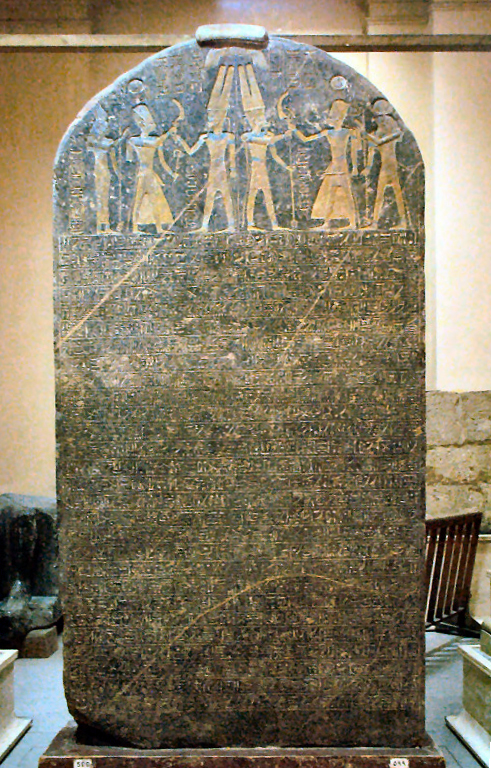

"Canaan has been plundered into every sort of woe; Ashkelon has been overcome; Gezer has been captured; Yanoam is made non-existent; Israel is laid waste and his seed is not."
The hieroglyphic determinative applied to "Israel" differs from those applied to the city-names Ashkelon, Gezer, and Yanoam. Where those names carry the determinative for a foreign city or land, "Israel" carries the determinative for a people or ethnic group — a seated man and woman above three plural strokes.7 This indicates that the Egyptian scribes understood Israel not as a place but as a socioethnic entity present in Canaan at the end of the thirteenth century BCE. As discussed in the parent article on historical claims and evidence, the stele establishes that Israel existed in Canaan by approximately 1208 BCE but says nothing about where this people came from or how they arrived there.
For the Exodus question, the Merneptah Stele provides a firm terminus ante quem: any historical exodus from Egypt must have occurred before 1208 BCE, because by that date Israel was already established in Canaan as a recognisable entity. This constraint is compatible with both the fifteenth-century and thirteenth-century dating proposals discussed below, but it rules out any dating of the Exodus to after the reign of Merneptah.7, 8
The dating question
Two principal dates for the Exodus have been proposed, each based on different ways of reading the biblical and Egyptian evidence.
The fifteenth-century date (sometimes called the "early date") derives primarily from 1 Kings 6:1, which states that Solomon began building the Temple "in the four hundred eightieth year after the Israelites came out of the land of Egypt, in the fourth year of Solomon's reign over Israel." If Solomon's fourth year is placed at approximately 966 BCE (a date derived from Assyrian synchronisms with the later kings of Israel and Judah), then 480 years before that yields a date of approximately 1446 BCE for the Exodus, during the reign of Thutmose III of the Eighteenth Dynasty. Proponents of the early date, including John Bimson, have argued that the destructions at certain Canaanite sites match a fifteenth-century conquest better than a thirteenth-century one.18
The thirteenth-century date (sometimes called the "late date") is based on the reference to the store-city "Rameses" in Exodus 1:11, which corresponds to Pi-Ramesses, the delta capital that did not exist before the reign of Ramesses II (c. 1279–1213 BCE). Proponents of this date argue that the 480 years in 1 Kings 6:1 should be understood not as a precise chronological figure but as a conventional or symbolic number — twelve generations of forty years each — and that the actual interval between the Exodus and Solomon was shorter, placing the Exodus in the first half of the thirteenth century BCE.1, 16 This dating places the Exodus during the reign of Ramesses II and the entry into Canaan in the late thirteenth century, consistent with the appearance of Israel on the Merneptah Stele by 1208 BCE and with the proliferation of small agricultural settlements in the central hill country of Canaan during Iron Age I (c. 1200–1000 BCE) that Finkelstein has identified as the earliest Israelite villages.3, 15
Neither date is without difficulties. The fifteenth-century date requires the 480 years to be taken literally while also accounting for the absence of significant destruction layers at Jericho, Ai, and other conquest sites during the fifteenth century BCE. The thirteenth-century date requires the 480 years to be treated as approximate or symbolic, and it must account for the relatively short interval between the Exodus and the Merneptah Stele if the Israelites spent forty years in the wilderness. A minority of scholars have proposed other dates — including a date in the sixteenth century BCE associated with the expulsion of the Hyksos, or a much later date in the Persian period for the composition of the narrative itself — but the fifteenth- and thirteenth-century proposals remain the dominant positions in the debate.8, 16
Timeline of key dates and evidence bearing on the Exodus7, 8, 14
The state of the evidence
The evidence bearing on the Exodus falls into several categories, each with distinct implications. The Egyptian administrative record confirms that Semitic-speaking peoples lived in the eastern Nile Delta, performed forced labor including brick-making, and in some cases fled toward the Sinai — conditions consistent with the general setting of the Exodus narrative.1, 5, 6 The place-names in the biblical account (Rameses, Pithom, Succoth) correspond to known Egyptian sites, and the administrative practices described (quotas, straw in brick-making, taskmasters) match what is known from Egyptian sources.6, 14 The Merneptah Stele confirms that Israel existed as a recognisable entity in Canaan by 1208 BCE, providing a fixed chronological anchor.7
Against this, no Egyptian text records the specific events of the Exodus — no plagues, no mass departure, no Moses, no destruction of an army at the sea. The archaeological survey of the Sinai Peninsula has not produced evidence of a large population moving through the region during the Late Bronze Age, and the site most commonly identified with Kadesh-barnea shows no occupation before the tenth century BCE.3, 12 The numbers given in the biblical text, if taken literally, imply a population far larger than the region could have supported and far larger than would be consistent with the available archaeological evidence for early Israel in Canaan.4, 11
The scholarly landscape reflects this ambiguity. Maximalists such as Kitchen argue that the Egyptian evidence is broadly consistent with the Exodus tradition and that the silence of the Egyptian record is expected given Egyptian recording practices.8 Minimalists such as Finkelstein and Redford argue that the absence of archaeological and textual evidence, combined with the legendary character of the narrative, points to the Exodus as a foundation myth developed centuries after the events it purports to describe.2, 3 Between these poles, scholars such as Dever have proposed that a small group of Semitic workers may have left Egypt and that their experience was subsequently adopted and magnified into a national origin story by the larger population of early Israelites, most of whom were indigenous Canaanites who had never been in Egypt.4
What the evidence does not permit is a definitive resolution. The Exodus narrative is set in a historical context that is archaeologically and textually attested — Semitic peoples did live in the Delta, they did perform forced labour, they did sometimes flee — but the specific events described in the Book of Exodus remain beyond the reach of the currently available evidence. The external record neither confirms the Exodus as the Bible describes it nor rules out the possibility that a historical event underlies the tradition. It establishes the plausibility of the setting while leaving the historicity of the narrative itself an open question.
References
The Bible Unearthed: Archaeology's New Vision of Ancient Israel and the Origin of Its Sacred Texts
A Papyrus of the Late Middle Kingdom in the Brooklyn Museum (Papyrus Brooklyn 35.1446)
The Number of People in the Exodus from Egypt: Decoding Mathematically the Very Large Numbers in Numbers I and XXVI
Ancient Israel in Sinai: The Evidence for the Authenticity of the Wilderness Tradition