Overview
- Human sky-watching predates writing by tens of thousands of years: notched bones from the Upper Paleolithic may record lunar cycles, and megalithic monuments across Europe were deliberately aligned to solstice and equinox events as early as 3200 BCE, demonstrating that systematic celestial observation is among the oldest intellectual activities in the archaeological record.
- Mesopotamian astronomers from roughly 1800 BCE onward maintained the most rigorous observational tradition of the ancient world, cataloging planets, predicting eclipses through the Saros cycle, and developing the sexagesimal number system whose 360-degree circle and 60-minute hour persist to the present day.
- Greek astronomers of the third and second centuries BCE achieved remarkable theoretical breakthroughs—Aristarchus proposed a heliocentric solar system, Eratosthenes measured the Earth's circumference to within a few percent of the modern value, and Hipparchus discovered the precession of the equinoxes—laying the foundations from which Ptolemy and later Copernicus would build.
The sky was humanity's first shared text. Long before writing systems existed to record harvests or debts, people across the world had learned to read the regularities of the heavens—the monthly cycle of the moon, the annual wandering of the sun along the horizon at dawn, the heliacal risings of particular stars that announced the seasons. Ancient astronomy was not a single tradition but a convergence of independent observations made by cultures separated by thousands of kilometers, each arriving at similar conclusions through the insistence of the same sky. What unites these traditions is not shared ancestry but shared necessity: agriculture, navigation, ritual, and timekeeping all demanded accurate celestial knowledge, and the intellectual effort devoted to acquiring that knowledge across the prehistoric and ancient world was extraordinary.18, 19
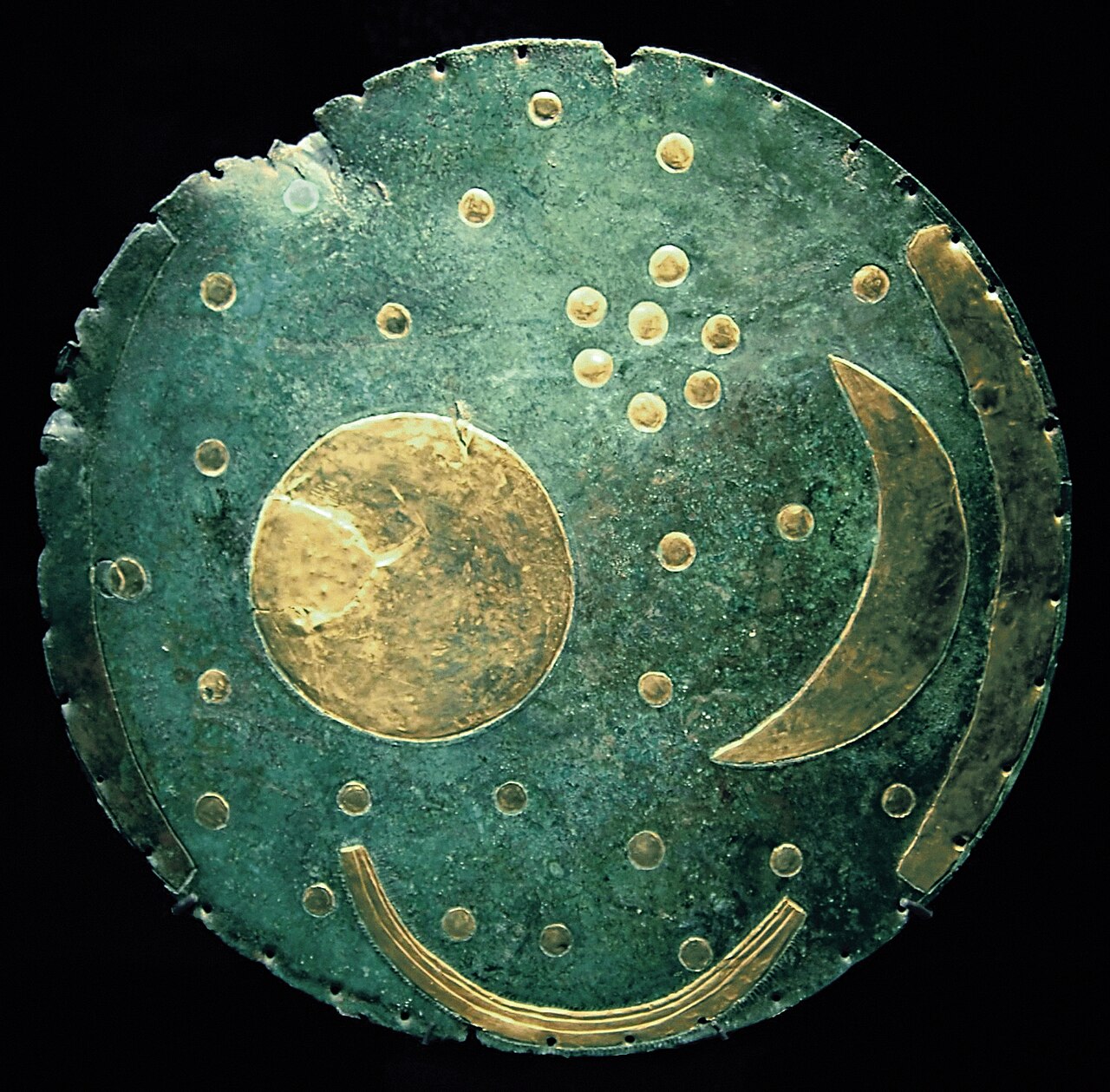

Paleolithic sky awareness
The earliest possible evidence for deliberate sky observation dates to the Upper Paleolithic, tens of thousands of years before any literate civilization. In the 1960s, the American archaeologist Alexander Marshack examined notched bones and antler fragments from European Paleolithic sites under low-angle illumination and proposed that the sequences of marks were lunar tallies rather than random decorations or hunting records.1 The most discussed example is the Ishango bone from the Democratic Republic of Congo, dated to approximately 20,000 years ago, which bears three columns of notches whose groupings Marshack and others interpreted as tracking the waxing and waning of the moon over two months. A similarly analyzed bone from the Blanchard rock shelter in the Dordogne, France, dated to roughly 32,000 years ago, shows 69 marks in a serpentine pattern whose cumulative count matches two and a quarter lunar months.1
Marshack's notation hypothesis remains contested. Critics point out that without written confirmation from the makers, any pattern in repeated marks is susceptible to over-interpretation, and that the groupings could reflect counting systems unrelated to lunar cycles. Nevertheless, the hypothesis is consistent with what we know about modern hunter-gatherer relationships with the sky: many ethnographically documented foraging societies maintain detailed lunar and stellar calendars entirely within oral tradition, using them to coordinate seasonal movements, predict resource availability, and structure ceremonial life.19 Whether or not specific Paleolithic bones record the moon, the cognitive prerequisites for sustained sky observation—memory, pattern recognition, the linking of celestial and terrestrial cycles—were almost certainly present in anatomically modern humans by 50,000 years ago.
Megalithic astronomy
The most visually dramatic evidence for prehistoric astronomical knowledge comes from the megalithic monuments of western Europe, built between roughly 4500 and 1500 BCE. These structures demonstrate that Neolithic and Bronze Age communities in Britain, Ireland, and France possessed not only detailed knowledge of solar and lunar cycles but the organizational capacity and geometric skill to encode that knowledge in permanent stone architecture aligned to arc-minute precision.2
Stonehenge on Salisbury Plain in England is the most extensively studied of these sites. Its construction proceeded through multiple phases over roughly two millennia, with the final bluestone and sarsen arrangements dating to approximately 2500 BCE. The monument's principal axis is oriented so that the sun rises directly over the Heel Stone and illuminates the central altar stone at the summer solstice, while the same axis points toward the winter solstice sunset. Whether this alignment served a calendrical, ritual, or funerary function—or some combination of all three—remains debated, but the precision of the orientation rules out coincidence.2 The site also encodes lunar alignments: the positions of specific stones and the gaps between them track the 18.6-year cycle of lunar standstills, suggesting that Neolithic astronomers had followed the moon's movement over multiple generations and translated that knowledge into the monument's design.
Newgrange in the Boyne Valley of Ireland, constructed around 3200 BCE and therefore predating Stonehenge by several centuries, contains one of the most elegant solar alignments in the archaeological record. Above the entrance to the passage tomb is a small aperture called the roofbox, engineered so that for approximately five days around the winter solstice, the rising sun sends a narrow beam of light through the opening and down the 19-meter passage to illuminate the rear chamber for seventeen minutes.3 The precision required to design this feature—knowing exactly where the midwinter sun would rise, calculating the angle of the passage, constructing the roofbox at the correct height—implies sustained observation of the winter solstice sunrise over many years and considerable geometric sophistication. Michael J. O'Kelly, who excavated Newgrange in the 1960s, described witnessing the first scientifically documented solstice illumination in 1967 as one of the most memorable moments of his career.
The Callanish standing stones on the Isle of Lewis in Scotland, erected around 2900 BCE, align to the most southerly moonrise of the 18.6-year lunar cycle, an event during which the moon appears to skim along the tops of the surrounding hills before setting in a dramatic display visible only from within the stone circle. At Carnac in Brittany, France, over three thousand standing stones arranged in parallel rows extending for kilometers appear to track solar and lunar rising and setting points across a range of azimuths, though the precise astronomical intentions of the Carnac builders remain under investigation.19 Taken together, the megalithic monuments of Atlantic Europe represent a coherent intellectual tradition in which the regulation of time through celestial observation was considered important enough to justify enormous collective labor.
Mesopotamian astronomy
The most systematic astronomical tradition of the ancient world developed in Mesopotamia, where the flat alluvial plains of the Tigris-Euphrates valley offered unobstructed horizons and where a writing system capable of recording observations in permanent form had existed since roughly 3200 BCE. By approximately 1800 BCE, Babylonian scribes were keeping regular records of celestial phenomena on clay tablets, and by the first millennium BCE they had developed predictive mathematical astronomy of considerable sophistication.4, 6
The foundational text of Babylonian observational astronomy is the MUL.APIN, a compendium compiled around 1000 BCE but drawing on observations that extended back to at least 1400 BCE. The text catalogs the rising and setting dates of stars and constellations, the paths of the moon and five visible planets across the sky, and the intervals between celestial events.5 It identifies 66 stars and constellations organized into three "paths" across the sky—the Path of Anu, the Path of Enlil, and the Path of Ea—which correspond roughly to the celestial equator, northern sky, and southern sky. The MUL.APIN also records the lengths of daylight throughout the year and provides a scheme for intercalating lunar months into the solar year to keep the calendar synchronized with the seasons.5
Babylonian astronomers made their most consequential practical discovery in the realm of eclipse prediction. By the seventh century BCE, court astronomers in Nineveh were using the Saros cycle—a period of approximately 18 years and 11 days after which the relative geometry of the sun, moon, and Earth repeats closely enough to reproduce eclipse conditions—to predict lunar and solar eclipses well in advance.4 This discovery did not arise from any theoretical understanding of why eclipses occurred; Babylonian astronomers did not know that the Earth was spherical or that it orbited the sun. It arose instead from the meticulous accumulation of observational records over centuries, from which the underlying periodicity eventually became apparent. The eclipse prediction tablets from the library of Ashurbanipal at Nineveh represent one of the great achievements of ancient science: reliable forecasting of rare celestial events based purely on statistical pattern recognition from empirical data.12
Mesopotamian astronomy also bequeathed to the modern world its most pervasive numerical legacy. The sexagesimal number system—base 60—that Sumerian mathematicians developed for administrative accounting was adopted by Babylonian astronomers to measure celestial angles and time intervals.6 The division of the circle into 360 degrees, each degree into 60 arc-minutes, and each arc-minute into 60 arc-seconds; the division of the hour into 60 minutes and each minute into 60 seconds: all of these persist unchanged in modern usage, transmitted through Greek and Arabic astronomy from their Babylonian origin. The Babylonian zodiac, dividing the ecliptic into twelve 30-degree signs, was adopted by Greek astronomers around the fifth century BCE and became the framework within which Hipparchus and Ptolemy constructed their planetary models.
Egyptian astronomy
Egyptian astronomical practice had a character distinct from the Mesopotamian tradition, oriented less toward planetary prediction and more toward timekeeping, calendar regulation, and the spatial orientation of sacred architecture.7, 8 The most distinctive Egyptian contribution to observational astronomy was the system of decans: 36 groups of stars whose heliacal risings (first appearances just before sunrise after a period of invisibility) occurred at roughly ten-day intervals throughout the year. Each decan was assigned to rule one ten-day week, and the succession of their heliacal risings provided a practical sidereal clock for the hours of the night, allowing priests and officials to determine the time after dark with considerable precision.7 Decan lists first appear on the interior lids of Middle Kingdom coffins around 2100 BCE, where they served as astronomical maps to guide the deceased through the hours of the underworld.
The Egyptian civil calendar was regulated by the heliacal rising of Sirius, the brightest star in the sky, which Egyptians knew as Sopdet (identified with the goddess Isis in later periods). After approximately 70 days of invisibility below the horizon, Sirius reappears just before sunrise in late July, an event that coincided with the annual inundation of the Nile and the beginning of the agricultural year. The Egyptian civil calendar of 365 days was constructed to begin with this rising, and the Sothic cycle—the period of approximately 1,460 years required for the heliacal rising of Sirius to drift through a full civil year and return to the same civil date—provides modern scholars with one of the most important chronological anchors for the absolute dating of ancient Egyptian history.8
The alignment of Egyptian sacred architecture to celestial phenomena was systematic and deliberate. The Great Pyramid of Khufu at Giza, constructed around 2560 BCE, is oriented to true north with a precision of less than one-tenth of a degree, an achievement requiring either careful observation of circumpolar star rotation or bisection of the shadow cast by a gnomon over the course of a day.8 The pyramid's shafts pointing from the burial chambers toward specific northern and southern stars—including Orion's belt and the circumpolar star Thuban, then the closest star to the celestial pole—suggest that celestial orientation played a role in the theology of royal afterlife. Temples throughout Egypt were similarly aligned to solstice sunrises or to the rising points of significant stars, embedding celestial knowledge into the sacred landscape.
Maya astronomy
The Maya civilization of Mesoamerica developed one of the most precise astronomical traditions in the ancient world, combining careful naked-eye observation with sophisticated mathematical modeling to achieve predictions of Venus and eclipse events that rival the accuracy of contemporary European astronomy a millennium later.9, 10 Unlike Mesopotamian astronomy, which developed largely as a service to royal astrology, Maya astronomy was embedded in a theology in which celestial cycles directly governed earthly time and the activities of gods and kings.
The Dresden Codex, one of only four surviving pre-Columbian Maya books, contains the most important astronomical document from the ancient Americas. Its Venus tables, compiled over centuries of observation and covering the synodic cycle of Venus (the period of approximately 584 days from one morning star appearance to the next), allowed Maya astronomers to predict Venus risings and settings with an accumulated error of only two hours over 481 years.10 The tables achieve this precision through a correction scheme that periodically adjusts the base date to compensate for the small discrepancy between the idealized 584-day cycle and the true mean synodic period of 583.92 days. The Dresden Codex also contains eclipse tables organized around the 177- and 148-day intervals between eclipse seasons, enabling predictions of when dangerous eclipse conditions would occur. These tables show that Maya astronomers had independently discovered the same underlying periodicities that Babylonian astronomers were using half a world away.
The Long Count calendar, which the Maya used to situate historical events within a vast cosmological timeline, counted individual days from a fixed creation date (corresponding to 3114 BCE in the Gregorian calendar) in units extending from single days up to periods of over 5,000 years. This system, capable of unambiguously placing any date within a span of millions of years, served as the framework within which the Maya recorded astronomical observations and correlated them with dynastic history. The monumental inscriptions of the Classic period (250–900 CE) are saturated with astronomical references, linking royal births, accessions, and battles to the rising of Venus, the occurrence of eclipses, and the completion of major calendar cycles in ways that modern epigraphy has only recently begun to decode fully.9
Chinese astronomy
In ancient China, astronomy was a state function from its earliest documented phases. The emperor ruled by the Mandate of Heaven, and unusual celestial events—eclipses, comets, novae, planetary conjunctions—were interpreted as communications from heaven regarding the legitimacy of imperial rule. The astronomical bureau, one of the oldest continuous scientific institutions in world history, was charged with monitoring the sky and interpreting its messages, making the accurate recording of celestial phenomena a matter of political urgency.11, 12
The Shang dynasty oracle bones, dating to approximately 1250–1046 BCE, contain some of the earliest written astronomical records anywhere in the world. Among the divination records inscribed on turtle plastrons and cattle scapulae are references to solar and lunar eclipses, new star appearances, and planetary observations.12 The phrase "a great new star appeared" recurs in the oracle bone corpus, and at least two of these records have been tentatively matched to nova or supernova events. Chinese records of the supernova of 1054 CE, which produced the Crab Nebula, are among the most detailed in the historical record. The astronomer Yang Weide recorded the appearance of a "guest star" in the constellation Tianguan (near Taurus) that was bright enough to be visible in daylight for 23 days and remained visible at night for nearly two years, providing modern astrophysicists with a precise date for the explosion whose expanding remnant is still observed today.11
Chinese astronomers also maintained the world's longest continuous series of sunspot observations, recorded solar and lunar eclipse dates going back to the third millennium BCE (though with increasing reliability from the Han dynasty onward), and compiled star catalogs of the northern sky that tracked thousands of stars in equatorial coordinates. The Chinese equatorial system, which measured star positions in terms of their distance from the celestial equator and from a reference point along that equator, was an independent invention that paralleled the Greek ecliptic system and would later influence the design of equatorially mounted telescopes.19
Polynesian star navigation
The navigational astronomy of Polynesia represents a tradition as intellectually sophisticated as any in the ancient world, and one that solved a practical problem—crossing thousands of kilometers of open ocean to locate islands separated by vast empty distances—that no other civilization faced on the same scale. Polynesian navigators did not build observatories or write astronomical treatises. Their knowledge was encoded in chant, oral formula, and embodied practice, transmitted through apprenticeship across generations.13
The core instrument of Polynesian navigation was the star compass: a mental model of the sky divided into approximately 32 houses, each associated with the rising or setting point of a specific star. A navigator steering toward a known destination followed a sequence of star houses, shifting from one star to the next as the first rose too high to serve as a bearing. The 220 or so stars whose rising and setting points were memorized as navigational waypoints included stars from every declination between roughly 27 degrees north and 27 degrees south, providing coverage of the entire Polynesian triangle from Hawaii to New Zealand to Easter Island.13 When stars were obscured by cloud, navigators used the swell patterns of the ocean, the color of the water, the flight directions of land-seeking birds, the character of cloud formations over islands, and the smell of vegetation to maintain their course. This multi-sensory integration of environmental information with astronomical knowledge allowed Polynesian voyagers to locate islands a hundred kilometers wide at distances of three thousand kilometers with a reliability that European navigators did not achieve until the development of the marine chronometer in the eighteenth century.
Greek astronomy and the theoretical transition
Greek astronomy of the classical and Hellenistic periods represents a conceptual transformation rather than simply an accumulation of better observations. Where Babylonian astronomy was fundamentally empirical and predictive—finding numerical patterns in observed data and extrapolating them forward—Greek astronomers from the fifth century BCE onward asked a different kind of question: what physical model of the cosmos would generate the observed motions as geometrical consequences? This shift from pattern recognition to physical modeling is the defining intellectual event in the history of ancient astronomy.14, 18
Aristarchus of Samos, working in the third century BCE, proposed the most audacious cosmological model of antiquity: that the sun, not the Earth, stood at the center of the universe, and that the Earth orbited the sun while rotating daily on its axis. His heliocentric hypothesis, known primarily through Archimedes' description in the Sand Reckoner and a surviving treatise on the sizes and distances of the sun and moon, was geometrically sophisticated and in its essentials correct.15 Aristarchus estimated from the geometry of lunar eclipses that the sun was approximately 18 to 20 times farther from Earth than the moon (the true ratio is about 390), and from this concluded that the sun was enormously larger than the Earth. He argued that it made more sense physically for the smaller body to orbit the larger, and constructed a heliocentric model in which Earth and the other planets orbit the sun. His contemporaries largely rejected the model, citing the absence of observable stellar parallax (a parallax that exists but was far too small for ancient instruments to detect, requiring the vast distances Aristarchus himself implied) and philosophical objections rooted in Aristotelian physics. Heliocentrism would not be revived as a serious scientific proposal until Copernicus in 1543.
Eratosthenes of Cyrene, who served as chief librarian at Alexandria around 240 BCE, performed one of the most elegant measurements in ancient science. He knew that on the summer solstice at noon, the sun was directly overhead at Syene (modern Aswan) in southern Egypt, casting no shadow in deep wells. At the same moment in Alexandria, approximately 800 kilometers to the north, the sun cast a shadow indicating an angle of about one-fiftieth of a full circle (roughly 7.2 degrees) from the vertical.14 Assuming the Earth was spherical and the sun sufficiently distant that its rays arrived essentially parallel, Eratosthenes concluded that the circumference of the Earth was 50 times the distance between Alexandria and Syene, yielding a figure of approximately 250,000 stades. The conversion to modern units is complicated by uncertainty about the length of the stade he used, but estimates place his result between 39,375 and 46,620 kilometers; the actual polar circumference is 40,008 kilometers. By any measure it was a triumph of applied geometry, requiring not sophisticated instruments but only careful observation, reasonable assumptions, and the insight that two simultaneous shadow measurements at different latitudes encode the curvature of the Earth.
Hipparchus of Nicaea, working at Rhodes in the second century BCE, made two discoveries that would define positional astronomy for the next 1,500 years. First, by comparing his observations of star positions with those recorded by Babylonian and earlier Greek astronomers, he identified a systematic drift in the positions of the equinoxes relative to the fixed stars—approximately 45 to 46 arc-seconds per year in his estimate (the modern value is 50.27 arc-seconds).16 This precession of the equinoxes, caused by the slow wobble of the Earth's rotational axis over a 26,000-year cycle, is one of the most subtle motions in observational astronomy, and Hipparchus's detection of it from records spanning only a century and a half testifies to extraordinary care in both observation and calculation. Second, Hipparchus compiled the first comprehensive star catalog in the Western tradition, recording the positions and brightnesses of approximately 850 stars in ecliptic coordinates, organized into his magnitude scale of first through sixth magnitude—a classification system still in use today in modified form.16
The theoretical tradition initiated by these Hellenistic astronomers was synthesized and extended by Claudius Ptolemy of Alexandria in the second century CE. His Almagest, drawing heavily on Hipparchus's data and Babylonian records, presented a complete mathematical model of the cosmos in which the Earth stood at the center and all celestial bodies moved in combinations of circular motions called deferents and epicycles.18 The Ptolemaic system, though physically incorrect, was an extraordinary piece of applied mathematics: using only circles and the geometric device of the equant point, it predicted planetary positions accurate to within a degree or two for centuries into the future. It remained the dominant model of the cosmos in both the Islamic world and medieval Europe until the heliocentric revolution of the sixteenth century completed the transition that Aristarchus had attempted eighteen hundred years earlier.
From observation to theory
The history of ancient astronomy is, at its broadest scale, the history of a transition from practical sky-watching to theoretical cosmology. The earliest sky watchers—whether Paleolithic hunters tracking the moon or Neolithic monument builders encoding the solstice in stone—sought celestial knowledge because it regulated the rhythms of survival: the seasons for planting and harvest, the tides for fishing and navigation, the propitious times for ceremony and war. Babylonian and Chinese astronomers added the discipline of systematic record-keeping, discovering through the accumulation of data that the sky's motions were periodic and therefore predictable. Egyptian astronomers encoded celestial knowledge into architecture and timekeeping practice, making the sky a permanent presence in sacred space. Maya and Polynesian astronomers refined observation and navigational application to levels of practical precision that remain astonishing on their own terms.17, 19
What the Greeks added was the question of mechanism: not just when the sun would rise but why it moved as it did, not just how to predict an eclipse but what physical arrangement of bodies made eclipses possible. This shift toward physical model-building, combined with the Greek inheritance of Babylonian numerical data and Egyptian geometrical methods, produced in the space of roughly three centuries—from Aristarchus to Hipparchus to Ptolemy—a theoretical astronomy powerful enough to serve as the framework of all subsequent positional astronomy in the Western and Islamic worlds. The telescope, when it arrived in 1609, would transform the observational base. But the conceptual tools—spherical geometry, the celestial coordinate systems, the practice of modeling motion with mathematical functions fitted to observational data—had been forged in antiquity, on the same sky that Paleolithic notch-cutters had watched by firelight forty thousand years before.
References
- The Roots of Civilization: The Cognitive Beginnings of Man's First Art, Symbol and Notation — Marshack, A. · Moyer Bell, 1991
- Stonehenge: A History in Photographs — Cleal, R. M. J., Walker, K. E. & Montague, R. · English Heritage, 1995
- Newgrange: Archaeology, Art and Legend — O’Kelly, M. J. · Thames & Hudson, 1982
- Astral Sciences in Mesopotamia — Hunger, H. & Pingree, D. · Brill, 1999
- MUL.APIN: An Astronomical Compendium in Cuneiform — Hunger, H. & Pingree, D. · Archiv für Orientforschung Beiheft 24, 1989
- The Exact Sciences in Antiquity (2nd edition) — Neugebauer, O. · Brown University Press, 1957
- Egyptian Astronomy, Astrology, and Calendrical Reckoning — Parker, R. A. · Dictionary of Scientific Biography, Vol. 15, Scribner, 1978
- The Oxford Encyclopedia of Ancient Egypt — Redford, D. B. (ed.) · Oxford University Press, 2001
- Star Gods of the Maya: Astronomy in Art, Folklore, and Calendars — Milbrath, S. · University of Texas Press, 1999
- The Dresden Codex: A New Edition of the Maya Eclipse and Venus Tables — Bricker, V. R. & Bricker, H. M. · American Philosophical Society, 2011
- Chinese Astronomical Records and the Crab Nebula Supernova of 1054 AD — Clark, D. H. & Stephenson, F. R. · The Historical Supernovae, Pergamon Press, 1977
- Historical Eclipses and Earth’s Rotation — Stephenson, F. R. · Cambridge University Press, 1997
- We, the Navigators: The Ancient Art of Landfinding in the Pacific (2nd edition) — Lewis, D. · University of Hawaii Press, 1994
- A History of Greek Mathematics, Vol. I — Heath, T. L. · Oxford University Press, 1921
- Aristarchus of Samos: The Ancient Copernicus — Heath, T. L. · Oxford University Press, 1913
- Hipparchus’ Commentaries on the Phaenomena of Aratus and Eudoxus — Toomer, G. J. · Hipparchus: A Historical Survey, Springer, 1988
- Archaic and Classical Greece: A Selection of Ancient Sources in Translation — Cartledge, P. & Spawforth, A. · Cambridge University Press, 1989
- Calendars in Antiquity: Empires, States, and Societies — Stern, S. · Oxford University Press, 2012
- The Cambridge Concise History of Astronomy — Hoskin, M. (ed.) · Cambridge University Press, 1999
- Astronomy Before the Telescope — Walker, C. (ed.) · British Museum Press, 1996
References
The Roots of Civilization: The Cognitive Beginnings of Man's First Art, Symbol and Notation