Overview
- The Byzantine Empire — the eastern continuation of the Roman Empire — endured for over a millennium from the founding of Constantinople in 330 CE to its fall to the Ottoman Turks in 1453, making it one of the longest-lived political entities in human history. At its greatest extent under Justinian I in the sixth century, it controlled the eastern Mediterranean, North Africa, and parts of Italy and Spain.
- Byzantium served as the institutional and intellectual custodian of Greco-Roman civilization during the medieval period, preserving classical Greek texts in philosophy, science, law, and literature that would otherwise have been lost, while simultaneously developing a distinctive Christian civilization centred on Orthodox theology, elaborate court ceremonial, and monumental architecture exemplified by the Hagia Sophia.
- The empire's influence extended far beyond its borders through the Christianisation of the Slavic peoples, the transmission of Roman law (codified in Justinian's Corpus Juris Civilis), the development of Orthodox Christianity as a major branch of the faith, and the dispersal of Greek learning to both the Islamic world and Renaissance Europe.
The Byzantine Empire is the conventional name for the eastern continuation of the Roman Empire, which persisted from the founding of Constantinople as the imperial capital in 330 CE until its conquest by the Ottoman Turks in 1453. The Byzantines did not call themselves "Byzantines" — they identified as Romans (Rhomaioi) and regarded their state as the unbroken continuation of the Roman Empire. The term "Byzantine" is a modern scholarly convention, derived from Byzantion, the Greek colony on the Bosporus that Constantine the Great refounded and renamed Constantinople in 330 CE.1, 2 Over its eleven centuries of existence, the empire survived Persian invasions, Arab conquests, Slavic migrations, Norman attacks, the Crusades, and recurrent civil wars, adapting its institutions, military organisation, and cultural identity to meet each successive crisis while preserving a continuous tradition of Roman law, Greek learning, and Orthodox Christian theology.3

Constantinople and the eastern turn
The foundation of Constantinople in 330 CE marked the decisive eastward shift of Roman imperial gravity. Constantine selected the site of Byzantion — a small Greek city commanding the Bosporus strait between Europe and Asia — for its strategic advantages: a deep natural harbour (the Golden Horn), a defensible peninsula flanked by water on three sides, and a position at the crossroads of trade routes linking the Mediterranean, the Black Sea, and overland routes to Asia. Constantine populated his new capital with classical works of art brought from across the empire, built a hippodrome for chariot racing, erected churches, and established a senate, creating a "New Rome" that would eventually surpass the old in population, wealth, and political importance.16, 1
Constantinople grew rapidly throughout the fourth and fifth centuries to become the largest city in Europe and the Mediterranean, with a population that may have reached 500,000 by the time of Justinian I in the sixth century. The Theodosian Walls, a triple line of fortifications constructed under Theodosius II in the early fifth century, proved virtually impregnable for a thousand years, repelling attacks by Huns, Avars, Persians, Arabs, Bulgars, and Rus' raiders. The city's location and defences gave the eastern empire a resilience that the western empire, with its exposed Rhine and Danube frontiers and its vulnerable capital at Ravenna, could not match.16, 3
The age of Justinian
The reign of Justinian I (527–565 CE) represents both the apogee and the turning point of Byzantine imperial ambition. Justinian sought to restore the territorial extent of the old Roman Empire, launching military campaigns under his general Belisarius that reconquered North Africa from the Vandals (533–534), Italy from the Ostrogoths (535–554, though resistance continued for years), and southeastern Spain from the Visigoths. These campaigns temporarily reunified much of the Mediterranean under Roman rule but came at an enormous cost in blood and treasure, and the reconquered territories proved difficult to hold against subsequent Lombard, Slavic, and Arab invasions.4, 6
Justinian's most enduring achievement was the codification of Roman law in the Corpus Juris Civilis (Body of Civil Law), compiled between 529 and 534 under the direction of the jurist Tribonian. The Corpus consisted of four parts: the Codex Justinianus (a compilation of imperial constitutions), the Digest (an anthology of juristic writings), the Institutes (a textbook for law students), and the Novellae (new laws issued by Justinian himself). This codification preserved and systematised a millennium of Roman legal thought and became the foundation of civil law traditions across continental Europe, influencing legal systems from medieval Italy to modern France, Germany, and Latin America.8
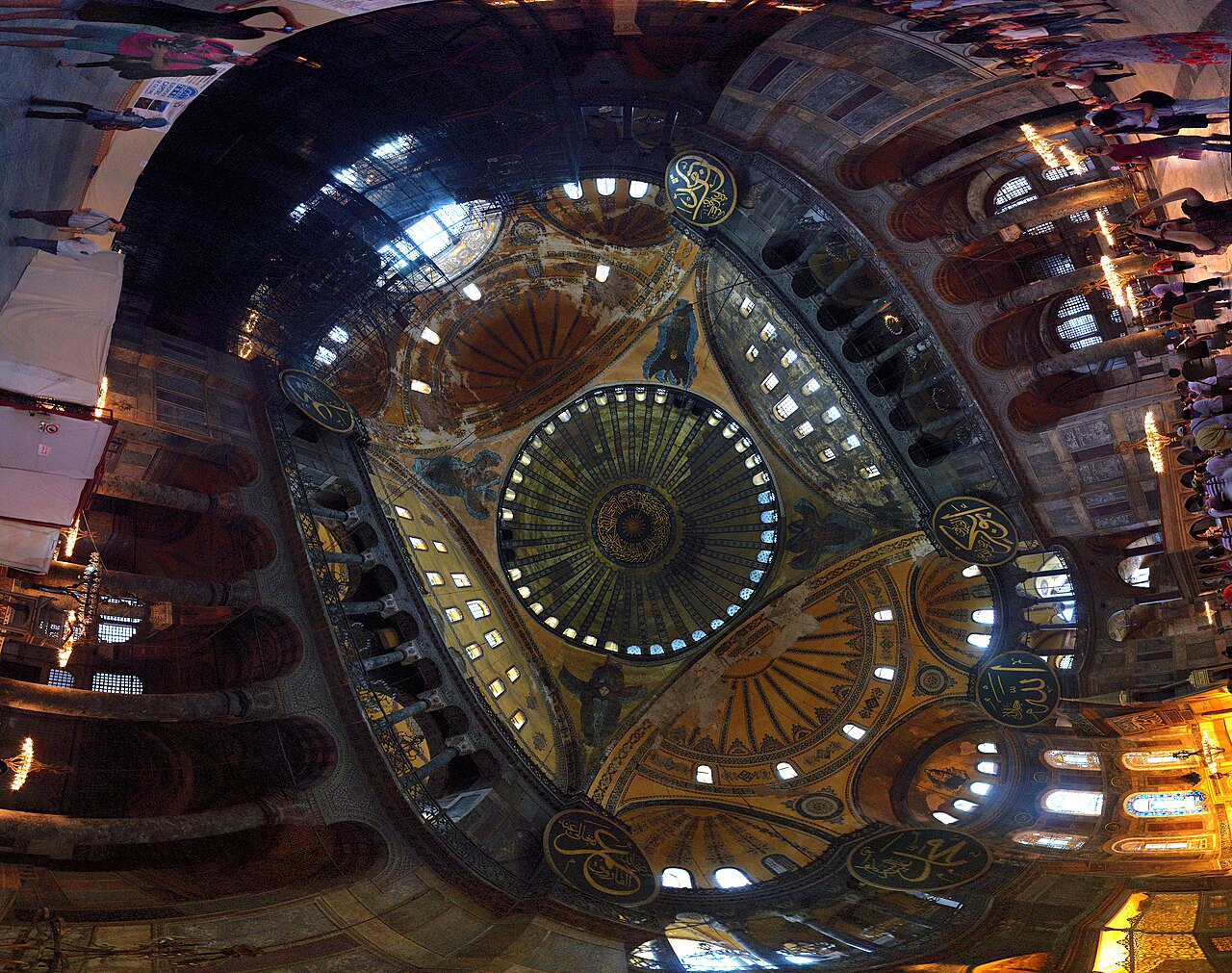
The architectural monument of Justinian's reign is the Hagia Sophia (Church of the Holy Wisdom), constructed in Constantinople between 532 and 537 by the mathematicians Anthemius of Tralles and Isidore of Miletus. Its central dome, rising 55.6 metres above the floor and spanning 31 metres, was the largest in the world for nearly a thousand years and represented a revolution in structural engineering. The dome rests on pendentives — curved triangular sections of masonry that transfer the weight of a circular dome to a square base — a technique that the Hagia Sophia perfected and that became a defining feature of Byzantine and later Ottoman architecture.7 Justinian's reign was also shadowed by catastrophe: the Justinianic plague, which struck Constantinople in 541–542 and recurred in waves for two centuries, killed an estimated 25 to 50 million people across the Mediterranean world and permanently reduced the empire's population and fiscal capacity.5
Survival and adaptation
The centuries following Justinian saw the empire contract dramatically under the combined pressures of the Arab conquests, Slavic and Avar incursions, and Lombard expansion in Italy. The Arab armies, energised by the new religion of Islam, conquered Syria, Palestine, Egypt, and North Africa between the 630s and the early eighth century, stripping the empire of its richest provinces and reducing it to Anatolia, the Aegean, and a few coastal footholds in Italy and the Balkans. Constantinople itself survived two major Arab sieges (674–678 and 717–718), the second repelled in part by the deployment of "Greek fire," a petroleum-based incendiary weapon whose exact composition remains unknown.1, 3
The empire responded to these losses with a fundamental reorganisation of its military and administrative structures. The old Roman provinces were replaced by themata (themes) — military-administrative districts in which a general (strategos) commanded both the army and the civil government. Soldiers were settled on state-owned land in exchange for military service, creating a peasant militia that reduced the empire's dependence on expensive professional armies and mercenaries. This thematic system, fully developed by the eighth century, provided the institutional framework for the empire's survival and eventual recovery.1, 14
The Iconoclast controversy (726–843), a bitter dispute over the use of religious images (icons) in Christian worship, dominated Byzantine political and religious life for over a century. The iconoclast emperors, beginning with Leo III, prohibited the veneration of icons, destroying religious images and persecuting monks and others who defended their use. The iconodule (icon-venerating) party ultimately triumphed in 843, a date celebrated in the Orthodox Church as the "Triumph of Orthodoxy." The controversy deepened the cultural and theological divide between the Latin West, which had largely supported icons, and the Greek East, contributing to the eventual schism between Roman Catholicism and Eastern Orthodoxy in 1054.2, 3
Cultural preservation and transmission
The Byzantine Empire played an indispensable role in the preservation and transmission of ancient Greek learning. While the Latin West lost direct access to most Greek philosophical, scientific, and literary texts during the early medieval period, Byzantine scholars continued to copy, study, and comment on the works of Plato, Aristotle, Euclid, Ptolemy, Galen, Homer, Sophocles, Thucydides, and dozens of other classical authors. The imperial library in Constantinople, the university refounded by Constantine IX in 1045, and the monastic libraries of Mount Athos and elsewhere served as repositories for manuscripts that, had they been lost, would have left irreparable gaps in the Western intellectual tradition.15, 2
This preservation was not merely passive. Byzantine intellectuals actively engaged with the classical tradition, producing commentaries, epitomes, encyclopedias, and original works in philosophy, theology, history, and the sciences. The ninth-century patriarch Photios compiled the Bibliotheca, a summary and critique of 279 works that he had read, many of which survive only through his descriptions. The emperor Constantine VII Porphyrogennetos (913–959) commissioned vast encyclopedic compilations of historical, agricultural, diplomatic, and ceremonial knowledge. The mathematician and philosopher Leo the Mathematician revived the study of classical science in ninth-century Constantinople.15, 3
Byzantine learning flowed outward in two critical directions. To the east, Greek philosophical and scientific texts were translated into Syriac and Arabic during the Islamic Golden Age, a process that owed much to bilingual Christian scholars in the Byzantine-Arab borderlands and in Baghdad itself. Dimitri Gutas has demonstrated that the Graeco-Arabic translation movement of the eighth through tenth centuries drew directly on Byzantine manuscript traditions, transmitting the works of Aristotle, Galen, Ptolemy, and others into the Arabic intellectual world, where they were elaborated and eventually retransmitted to the Latin West.13 To the west, the fall of Constantinople in 1453 and the preceding decades of Byzantine decline scattered Greek scholars across Italy, where they brought manuscripts and teaching that contributed to the Renaissance recovery of classical learning. Scholars such as Manuel Chrysoloras, Bessarion, and George Gemistos Plethon were instrumental in reintroducing Greek philosophy and literature to Western Europe.15, 10
Orthodox Christianity and the Byzantine Commonwealth
Religion and politics were inextricable in the Byzantine world. The emperor was regarded as God's vice-regent on earth, responsible for both the temporal and spiritual welfare of his subjects. The relationship between emperor and patriarch — sometimes described as a "symphony" of church and state — was in practice a complex negotiation of authority in which emperors convened church councils, appointed patriarchs, and intervened in theological disputes, while patriarchs claimed the right to admonish and even excommunicate emperors who strayed from orthodoxy.2, 11
Byzantine missionaries extended Orthodox Christianity far beyond the empire's borders. The most consequential mission was that of Saints Cyril and Methodius, ninth-century brothers from Thessalonica who evangelised the Slavic peoples of Central and Eastern Europe. Cyril created the Glagolitic alphabet (later adapted into the Cyrillic alphabet) to translate the Bible and liturgy into Slavonic, establishing the linguistic and cultural foundation for the Orthodox Christian civilisations of Bulgaria, Serbia, and Russia. Dimitri Obolensky described the resulting cultural sphere as the "Byzantine Commonwealth" — a community of peoples united not by political subjection to Constantinople but by shared Orthodox faith, Slavonic liturgy, Byzantine art and architecture, and the legal and literary traditions transmitted from the empire.11
The Silk Road and maritime trade routes brought Constantinople into contact with civilisations from China to Scandinavia. The city was the western terminus of transcontinental trade networks, and its markets offered goods from across the known world: Chinese silk, Indian spices, Russian furs, African ivory, and the products of its own highly skilled artisans. The Byzantine nomisma (gold solidus) served as the standard currency of international trade for centuries, a testament to the empire's fiscal stability and commercial prestige.14, 1
Decline and fall
The empire's terminal decline began with the catastrophic defeat at the Battle of Manzikert in 1071, when the Seljuk Turks under Alp Arslan destroyed the Byzantine field army and captured Emperor Romanos IV Diogenes. The loss of central Anatolia — the empire's primary source of soldiers and agricultural revenue — to Turkish settlement was a blow from which Byzantium never fully recovered. The empire's appeal to the West for military assistance contributed to the launching of the First Crusade in 1095, but the relationship between Byzantium and the Crusader states was marked by mutual suspicion and periodic hostility.9, 1
The Fourth Crusade (1202–1204) dealt the empire a wound that proved mortal. The Crusaders, diverted from their original objective of Egypt by Venetian commercial interests and Byzantine dynastic politics, attacked and sacked Constantinople in April 1204, subjecting the city to three days of looting and destruction unprecedented in its history. The Byzantine Empire was partitioned into a collection of Latin and Greek successor states, and although a Byzantine rump state based at Nicaea recaptured Constantinople in 1261 under Michael VIII Palaiologos, the restored empire was a diminished entity controlling little more than the capital, parts of the Peloponnese, and a few Aegean islands.9, 10
The final two centuries of Byzantine history were dominated by the advance of the Ottoman Turks, who progressively absorbed the empire's remaining territories in Anatolia and the Balkans. Constantinople fell to Sultan Mehmed II on 29 May 1453, after a siege of nearly two months. The last Byzantine emperor, Constantine XI Palaiologos, died fighting on the walls of his capital. The fall of Constantinople sent shockwaves across Christendom and is conventionally used to mark the end of the Middle Ages, though the empire's political, cultural, and religious legacies continued to shape the Ottoman Empire, the Russian tsarate (which claimed to be the "Third Rome"), and the modern nations of southeastern Europe.10, 11
References
Greek Thought, Arabic Culture: The Graeco-Arabic Translation Movement in Baghdad and Early ‘Abbāsid Society