Overview
- The Great Pyramids of Giza were built during the Fourth Dynasty of the Old Kingdom (c. 2589–2504 BCE) through an extraordinary mobilisation of labour, logistics, and engineering, with the Great Pyramid of Khufu alone containing approximately 2.3 million limestone blocks averaging 2.5 tonnes each.
- Archaeological excavations since the 1990s have revealed a purpose-built workers' settlement south of the pyramids, housing an estimated 20,000–30,000 labourers who were well fed, received medical care, and were organised into rotating crews drawn from across Egypt rather than enslaved populations.
- Construction methods likely combined internal and external ramp systems with copper tools, wooden sledges, and precise surveying techniques, though the exact engineering solutions remain debated and no single ramp theory fully accounts for all phases of construction.
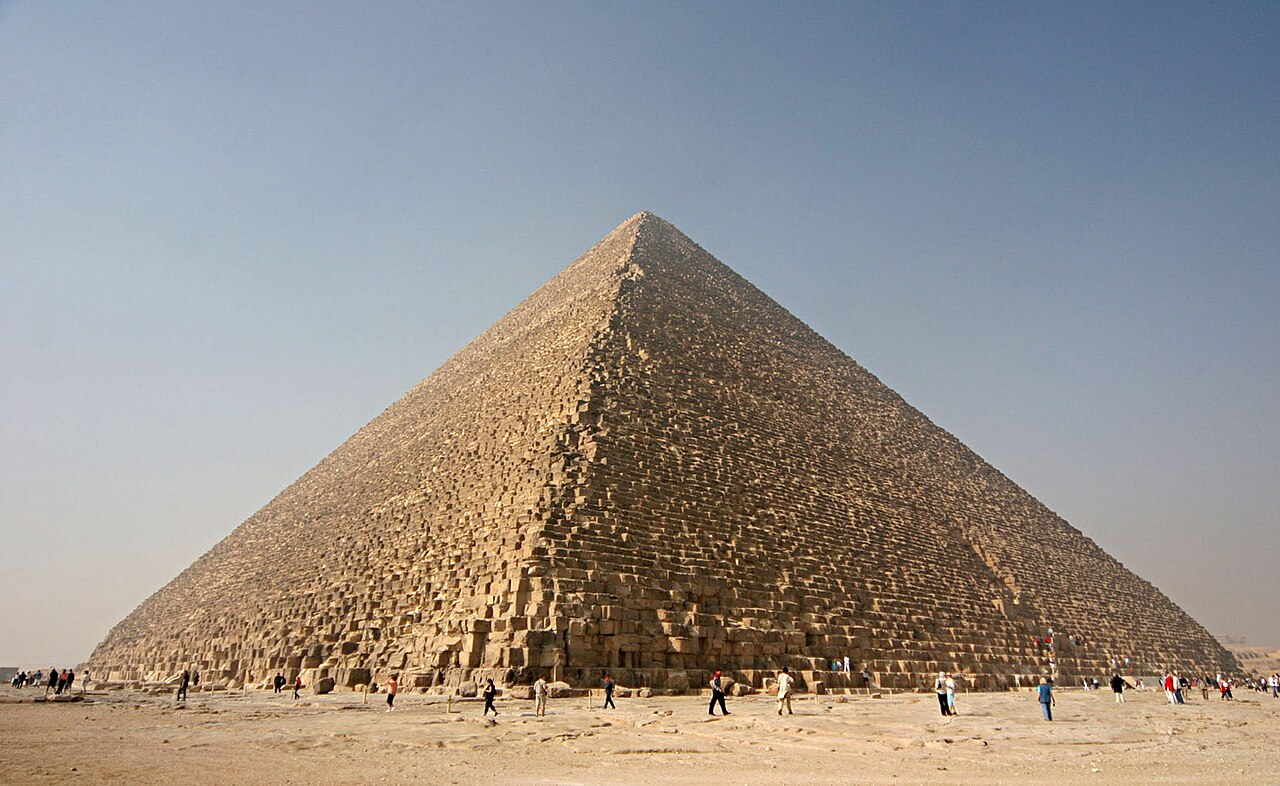
The pyramids of Giza, constructed during the Fourth Dynasty of ancient Egypt's Old Kingdom (c. 2589–2504 BCE), represent one of the most ambitious construction programmes in human history. The three principal pyramids—those of Khufu (Cheops), Khafre (Chephren), and Menkaure (Mycerinus)—together with their associated mortuary temples, causeways, satellite pyramids, and the Great Sphinx, form a monumental funerary complex on the Giza Plateau west of modern Cairo.1, 14 The Great Pyramid of Khufu, the oldest and largest of the three, originally stood approximately 146.6 metres tall and contained an estimated 2.3 million limestone blocks with an average weight of roughly 2.5 tonnes each, making it the tallest human-made structure in the world for more than 3,800 years.1, 4 The question of how these monuments were built—the organisation of labour, the logistics of material supply, the engineering solutions for raising millions of tonnes of stone—has generated centuries of speculation and remains one of the most actively investigated problems in Egyptology.

Chronology and planning
The Giza pyramids were built across three successive reigns. Khufu's Great Pyramid, the first and largest, was constructed over an estimated twenty years beginning around 2589 BCE. Khafre's pyramid, slightly smaller but built on higher ground to appear taller, followed during his reign (c. 2558–2532 BCE), and Menkaure's considerably smaller pyramid was completed around 2504 BCE.1, 14 Radiocarbon dating of organic material embedded in the mortar has broadly confirmed these chronological estimates, though with margins of uncertainty of approximately one to two centuries attributable to the Old Kingdom radiocarbon plateau.10
The precision of the Great Pyramid's construction reveals meticulous planning. The base is a near-perfect square, with sides measuring approximately 230.4 metres and a maximum deviation between the longest and shortest sides of only 4.4 centimetres. The base is levelled to within 2.1 centimetres across its entire area, and the sides are oriented to the cardinal directions with an average deviation of less than four minutes of arc.1, 4 This precision implies sophisticated surveying techniques, likely involving stellar observations for orientation and water-levelling for the platform, though the exact methods remain a subject of ongoing investigation.4, 9
Quarrying and transport
The bulk of the limestone used in the Great Pyramid was quarried from formations immediately south and west of the pyramid itself, minimising transport distances for the majority of the building material. The fine white Tura limestone used for the outer casing was quarried from the Mokattam Hills on the east bank of the Nile, approximately 15 kilometres away, and transported across the river by barge. Granite for the King's Chamber, its relieving chambers, and certain structural elements was sourced from Aswan, nearly 900 kilometres to the south.1, 4
The most significant primary source evidence for Old Kingdom stone transport is the diary of Merer, discovered at the Red Sea harbour site of Wadi al-Jarf by Pierre Tallet in 2013. This papyrus logbook, dating to the final years of Khufu's reign, records the day-by-day activities of a team of approximately 200 workers who transported Tura limestone blocks by boat from the eastern quarries to the Giza construction site via a system of canals connecting the Nile to a purpose-built harbour near the pyramid complex.5, 7, 13 The diary documents a round-trip cycle of approximately ten days, with blocks loaded onto boats at the Tura quarry, transported downstream and through canals to the harbour at Giza, and unloaded for delivery to the construction site. This logistical evidence indicates a sophisticated, centrally coordinated supply chain operating at industrial scale.7
The labour force
The long-standing popular image of pyramid construction by enslaved masses has been definitively overturned by archaeological evidence accumulated since the 1990s. Excavations directed by Mark Lehner and Zahi Hawass south of the Giza Plateau have revealed a purpose-built workers' settlement, known as the "Lost City of the Pyramids," that housed the labour force responsible for pyramid construction.2, 6 The settlement included barracks-style dormitories capable of accommodating up to 2,000 workers at a time, bakeries producing thousands of loaves daily, breweries, fish-processing facilities, a copper workshop for tool manufacture and repair, and a medical facility where skeletal evidence shows that workers received treatment for injuries including set broken bones.2, 3
Faunal remains from the workers' settlement indicate a diet rich in cattle, sheep, and goat meat, suggesting that the labourers were well provisioned by the state rather than subsisting on minimal rations. Lehner estimates the total workforce at Giza at approximately 20,000 to 30,000 workers, organised into competing crews of roughly 2,000 men, subdivided into named gangs of 1,000 and further into units of 200.2, 3 Graffiti found on pyramid blocks record the names of these crews—such as "Friends of Khufu" and "Drunkards of Menkaure"—suggesting corporate identity and competitive spirit among the work teams.1, 6 The current scholarly consensus holds that the core labour force consisted of a permanent cadre of skilled stonecutters and builders supplemented by rotating contingents of conscripted agricultural workers serving corvée obligations during the Nile flood season, when farming was impossible.6, 3
Ramp theories and construction methods
The central engineering problem of pyramid construction is how blocks weighing an average of 2.5 tonnes—and granite beams weighing up to 80 tonnes in the case of the King's Chamber relieving slabs—were raised to heights exceeding 140 metres. No definitive ancient account of the method survives, and the question has generated a substantial literature of competing hypotheses.4, 9
The most widely discussed approach involves ramp systems of various configurations. A straight ramp extending from ground level to the pyramid's summit would have required an enormous structure, potentially larger than the pyramid itself at the angle needed for hauling, making it logistically implausible for the upper portions of the construction.4, 11 A wraparound ramp spiralling up the exterior faces of the pyramid addresses the length problem but would have obscured the corners during construction, preventing the surveyors from checking alignment. Archaeological evidence of an inclined ramp remnant at Giza, documented by Robert Moores, suggests that at least the lower courses were constructed using external ramps.11 The French architect Jean-Pierre Houdin proposed an internal ramp theory, in which an external ramp served for the lower third of the pyramid and an internal helical ramp, spiralling upward within the body of the structure, was used for the upper two-thirds. A microgravimetry survey and muon tomography scanning of the Great Pyramid have identified anomalous voids consistent with but not conclusive proof of an internal passage or ramp structure.8, 12
In practice, the builders likely employed a combination of techniques adapted to different phases of construction, with external ramps for the massive lower courses, some form of ramp reconfiguration for the middle sections, and specialised hoisting mechanisms for the uppermost levels where only a small number of relatively light capping stones needed to be placed. Wooden sledges, lubricated with water to reduce friction on sand or prepared trackways, were the primary means of horizontal transport, as depicted in the well-known tomb painting of Djehutihotep at el-Bersheh.4, 1 Copper chisels, dolerite pounders, and wooden wedges expanded with water constituted the primary quarrying toolkit, and the precision of the finished stonework testifies to the extraordinary skill of the Fourth Dynasty masons.4
Purpose and legacy
The pyramids were royal tombs, designed to house the body of the deceased pharaoh and to facilitate his transformation into an eternal being in the afterlife. The internal chambers of the Great Pyramid—the subterranean chamber, the so-called Queen's Chamber, the Grand Gallery, and the King's Chamber with its granite sarcophagus—formed a carefully designed mortuary complex, while the Pyramid Texts inscribed in later Fifth and Sixth Dynasty pyramids at Saqqara preserve the ritual spells intended to ensure the king's resurrection and ascent to join the circumpolar stars.15, 14 The associated mortuary temples, causeways, and satellite pyramids (including queens' pyramids) formed an integrated funerary landscape linking the living world of the Nile Valley to the western desert realm of the dead.1
The Giza pyramids also served as instruments of state formation, projects whose construction mobilised labour, resources, and administrative capacity from across Egypt, binding the provinces to the central authority of the pharaoh through cycles of corvée service, provisioning, and shared participation in a monumental undertaking.1, 9 In this interpretation, the pyramid was not merely a tomb but a mechanism of social integration, and its construction was as politically significant as the finished monument. The logistical evidence from the Merer papyri confirms the scale of this administrative achievement: the coordinated movement of stone, food, fuel, tools, and workers across hundreds of kilometres required a bureaucratic infrastructure of remarkable sophistication for a society operating in the mid-third millennium BCE.5, 7
Modern investigation continues to reveal new dimensions of the Giza complex. The ScanPyramids project's detection in 2017 of a previously unknown large void above the Grand Gallery using cosmic-ray muon tomography demonstrates that the Great Pyramid has not yet yielded all its secrets, and that non-invasive technologies are opening avenues of inquiry that would have been unimaginable to earlier generations of Egyptologists.12
References
Evidence at Giza for the Use of an Inclined Ramp during Construction of the Great Pyramid