Overview
- The Han dynasty (206 BCE–220 CE) was the second imperial dynasty of China and is generally regarded as the formative period of Chinese imperial civilization, consolidating the centralized bureaucratic state inherited from the Qin while moderating its harshness through Confucian ideology.
- Under Emperor Wu (r. 141–87 BCE) the Han pushed Chinese power deep into Central Asia, established state monopolies on salt and iron to finance war against the Xiongnu confederacy, founded the imperial academy (taixue), and dispatched the envoy Zhang Qian on the missions that opened the overland Silk Road.
- The dynasty was interrupted between 9 and 23 CE by Wang Mang's short-lived Xin regime, restored as the Eastern Han under Emperor Guangwu, and finally collapsed in 220 CE after the Yellow Turban rebellion of 184 CE, decades of court factionalism, and the rise of regional warlords led by Cao Cao.
The Han dynasty (206 BCE–220 CE) was the second imperial dynasty of China and the polity that, more than any other, established the institutional, intellectual, and cultural template of imperial Chinese civilization. Founded by the commoner rebel Liu Bang in the wake of the rapid collapse of the Qin, the Han preserved the centralized bureaucratic structures bequeathed by its predecessor — the commandery-county system, codified law, standardized weights and currency — while replacing the harsh Legalist temper of Qin governance with a synthesis of administrative pragmatism and Confucian moral ideology that would define Chinese statecraft until the early twentieth century.1, 2 Under Emperor Wu (r. 141–87 BCE) the dynasty extended its reach across the Tarim Basin into Central Asia, made Confucianism the official state doctrine, and despatched the envoy Zhang Qian on the missions that opened the overland trade routes later known as the Silk Road.2, 5, 6
Conventionally divided into a Western (or Former) Han based at Chang'an and an Eastern (or Later) Han based at Luoyang — separated by the brief Xin interregnum of the usurper Wang Mang (9–23 CE) — the dynasty endured for more than four centuries and at its first census in 2 CE registered roughly 57.7 million inhabitants in over twelve million households.21, 24 Han civilization produced the historiographical tradition of Sima Qian and Ban Gu, the iron and salt monopolies debated in the Discourses on Salt and Iron, the seismograph of Zhang Heng, the systematized papermaking attributed to Cai Lun in 105 CE, and the Mawangdui tombs that preserve the most vivid surviving picture of early imperial elite life.3, 9, 12, 18, 22 Its end, marked by the Yellow Turban rebellion of 184 CE and the rise of regional warlords culminating in the abdication of Emperor Xian in 220 CE, dissolved imperial unity for nearly four centuries but left behind a model of centralized bureaucratic empire that every later Chinese dynasty consciously sought to emulate.13, 17, 25
Founding of the Han
The Han dynasty was the unintended product of the violent collapse of the first Chinese empire. The Qin, which had unified the warring states in 221 BCE under the First Emperor Qin Shi Huang, exhausted its population through forced labour on monumental construction projects, military campaigns against the Xiongnu and the Yue, and the rigid enforcement of its Legalist legal code. Within four years of the First Emperor's death in 210 BCE, rebellions had broken out across the former Warring States territories, and by 206 BCE Qin authority had effectively disintegrated.2, 15 The two principal contenders to inherit the empire were Xiang Yu, the aristocratic general of the resurgent state of Chu, and Liu Bang, a low-ranking Qin official from Pei County who had taken refuge among bandits when his prisoner-labour convoy escaped his custody and who had subsequently raised a peasant army of his own.3, 16
Liu Bang was the first commoner in Chinese history to found an imperial dynasty, a fact that the historian Sima Qian, writing within a century of the events, presented as evidence both of Liu Bang's strategic shrewdness and of the operation of the Mandate of Heaven, which the Zhou had used to legitimize their conquest of the Shang and which the Han now invoked to legitimize their replacement of the Qin.3, 2 After accepting the surrender of the last Qin ruler at the capital Xianyang in 206 BCE, Liu Bang was appointed by Xiang Yu to the marginal western fief of Hanzhong, from which the dynasty would later take its name. The ensuing four-year struggle between Liu Bang and Xiang Yu, known as the Chu-Han Contention, ended at the battle of Gaixia in 202 BCE, where Xiang Yu's forces were encircled and destroyed and Xiang Yu himself committed suicide on the bank of the Wu River.3, 16
Liu Bang assumed the title of emperor in 202 BCE, taking the temple name Gaozu ("High Progenitor"), and established his capital at Chang'an, near the site of the former Qin capital in the Wei River valley of modern Shaanxi province. His earliest political problem was the management of the regional kings — allies and former rivals to whom he had been compelled to grant semi-autonomous fiefs in order to secure their support during the war — and most of his short reign was occupied with eliminating these kings one by one and replacing them with members of the Liu imperial clan.1, 2 By the time of his death in 195 BCE, the Han had consolidated direct imperial control over the central commanderies of the realm and reduced the surviving regional kingdoms to a manageable network of Liu cadet branches.2
Early Western Han consolidation
The first six decades of the Western Han, spanning the reigns of Gaozu, Empress Lü, Emperor Wen (r. 180–157 BCE), and Emperor Jing (r. 157–141 BCE), are conventionally described as a period of recovery and retrenchment. The early Han court explicitly rejected the punitive temper of Qin governance: the harshest Qin laws were repealed, mass conscription for monumental construction projects was abandoned, taxes on agricultural produce were reduced from the Qin level of two-thirds to a token rate of one-fifteenth or even one-thirtieth of the harvest, and the corvée demands made on commoners were relaxed.2, 23 The intellectual mood of the early Han court was correspondingly cautious. Senior advisors such as Cao Shen and the household teachers of the imperial princes recommended a syncretic philosophy known as Huang-Lao — named for the legendary Yellow Emperor (Huang Di) and the supposed Daoist sage Laozi — which counselled minimal state action, light taxation, and the cultivation of social and economic recovery rather than further imperial expansion.1, 2
The most dangerous challenge to early Han stability came not from the steppe but from the regional kingdoms within the empire. In 154 BCE, seven of the kingdoms ruled by Liu cadet branches, led by the king of Wu in the wealthy lower Yangtze region, rose in revolt against Emperor Jing's attempts to reduce their territories and curb their semi-autonomous powers. The Revolt of the Seven Kingdoms was suppressed within three months by the imperial general Zhou Yafu, after which the surviving kingdoms were progressively shorn of their administrative independence and reduced to nominal appanages whose fiscal and military affairs were managed by officials appointed from the centre.1, 2 By the accession of Emperor Wu in 141 BCE, the Han imperial bureaucracy had effectively absorbed the regional kingdoms and assumed direct control of the entire territory between the Wei River basin and the eastern coast.2, 11
External relations during this same period were dominated by the steppe confederacy of the Xiongnu, which had been unified under the chanyu Modu around 209 BCE and which posed a sustained military threat along the Han northern frontier. After Liu Bang himself was nearly captured by Xiongnu cavalry at the battle of Pingcheng in 200 BCE, the early Han adopted a policy known as heqin ("peace and kinship"), under which Han princesses were sent in marriage to successive chanyus and the Han court paid annual tribute in silk, grain, and luxury goods in exchange for nominal Xiongnu restraint along the border.5, 24 The heqin system was humiliating to the Han court but cheaper than war, and it remained the basis of Han steppe policy for sixty years until the accession of Emperor Wu, whose reign would convert the Han from a defensive into an aggressively expansionist empire.5, 2
Emperor Wu and imperial expansion
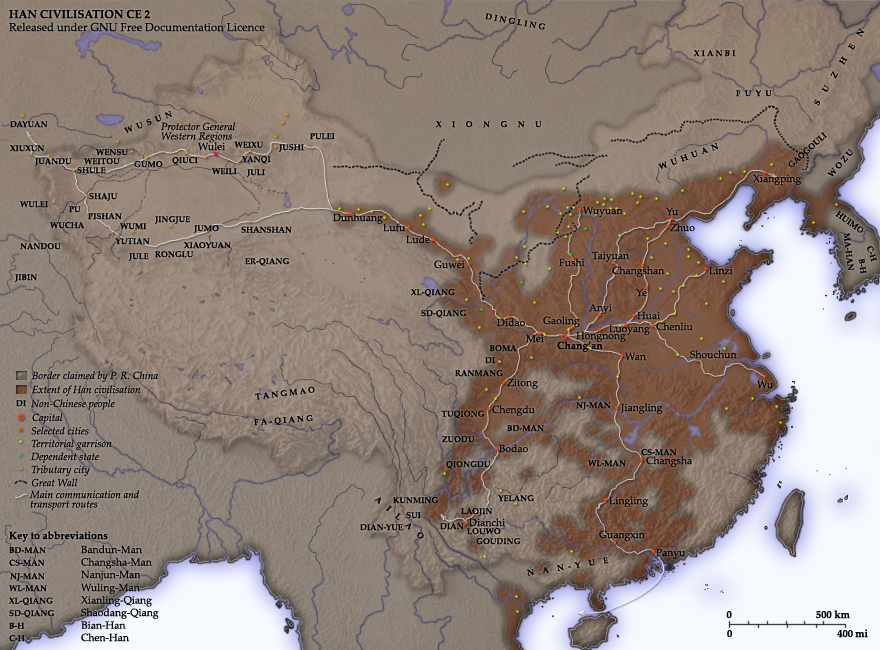
Emperor Wu (Han Wudi, r. 141–87 BCE) was the longest-reigning emperor of the Western Han and the ruler under whom the dynasty achieved its greatest territorial extent, fiscal centralization, and ideological consolidation. Coming to the throne at the age of fifteen, Wu inherited a treasury that had been replenished by sixty years of low taxation and political stability, and he proceeded to spend it on a programme of military expansion that pushed Han power into Central Asia, the Korean peninsula, the southwest, and northern Vietnam.1, 2, 24 The strategic centrepiece of Wu's reign was the long war against the Xiongnu confederacy. Beginning in 133 BCE, Wu abandoned the conciliatory heqin policy and launched a series of major cavalry campaigns under the generals Wei Qing and his nephew Huo Qubing that drove the Xiongnu out of the Ordos loop, secured the Gansu Corridor, and established Han garrisons in the oasis cities of the Tarim Basin.5, 2

To finance these campaigns, Wu's government implemented a sweeping programme of fiscal centralization. State monopolies were imposed on the production and sale of salt and iron, traditionally the most lucrative private industries in the empire. A new agency, the Equable Marketing Bureau, bought up commodities in regions where they were cheap and sold them where they were dear, generating revenue and stabilizing prices. A property tax was imposed on merchants, and private coinage was suppressed in favour of a standardized state-issued bronze cash known as the wuzhu.2, 9 These measures generated the resources required for sustained warfare but also concentrated unprecedented economic power in the hands of the central state, a concentration that would become the subject of bitter ideological dispute after Wu's death.9
Wu's southern and eastern campaigns extended Han authority into territories that had never before been administered by a Chinese imperial state. In 111 BCE, Han armies destroyed the kingdom of Nanyue in what is now Guangdong, Guangxi, and northern Vietnam, dividing it into nine commanderies. Two years later, the kingdom of Dian in modern Yunnan was reduced to tributary status. In 108 BCE, a Han expeditionary force conquered the kingdom of Wiman Choson in northern Korea and established four commanderies on the peninsula, the longest-lasting of which, Lelang, would remain in Han hands for more than four centuries.1, 24 By the end of Wu's reign in 87 BCE, the Han empire stretched from the Korean peninsula in the east to the Pamirs in the west and from the Mongolian steppe in the north to central Vietnam in the south, an expanse of territory that would not be matched again by any Chinese state until the Tang.2, 20
Zhang Qian and the opening of the Silk Road
The diplomatic dimension of Han Central Asian policy is inseparable from the figure of Zhang Qian (d. 113 BCE), a palace gentleman of the imperial guard whom Emperor Wu despatched in 138 BCE on a mission to find and ally with the Yuezhi, a nomadic people whom the Xiongnu had driven out of the Gansu region a generation earlier. Wu's strategic hope was that the Yuezhi, embittered by their displacement, might be persuaded to attack the Xiongnu from the west while Han armies attacked them from the east.5, 7 Zhang Qian's expedition did not achieve its diplomatic aim, but its incidental consequences would prove transformative. Within months of departing Chang'an he was captured by Xiongnu patrols and held in honourable captivity for roughly a decade, during which time he married a Xiongnu wife and had a son. He eventually escaped, continued westward through the Ferghana Valley to Sogdiana, and reached the Yuezhi, who had by then settled in Bactria and showed no interest in returning to the eastern steppe.6, 7
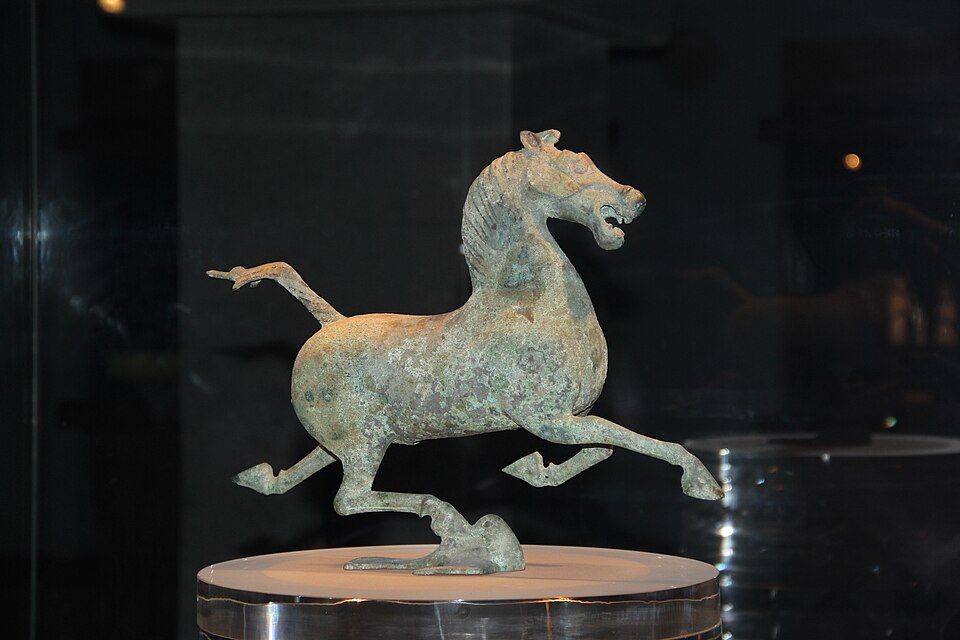
Zhang Qian returned to Chang'an in 126 BCE, having travelled an estimated 18,000 li (roughly 7,500 kilometres) in twelve years; of the hundred men with whom he had set out, only he and one companion survived. His report, preserved in chapter 123 of Sima Qian's Shiji and elaborated in chapter 61 of Ban Gu's Hanshu, was the first systematic Chinese account of the polities and products of Central Asia and contained the earliest descriptions in Chinese sources of Ferghana, Sogdiana, Bactria, Parthia, and the regions further west.3, 4, 7 He described the celebrated "blood-sweating" horses of Ferghana, vastly larger and more powerful than the steppe ponies of the Xiongnu, and brought back samples of grapes and alfalfa, both of which were soon being cultivated in the Wei River valley.5, 6
The strategic and commercial implications of Zhang Qian's mission were rapidly absorbed by the Han court. Beginning in the late 120s BCE the Han pursued a sustained military and diplomatic effort to wrest control of the Gansu Corridor from the Xiongnu, establishing the four commanderies of Wuwei, Zhangye, Jiuquan, and Dunhuang along the route. By 60 BCE the Han had created a Protectorate of the Western Regions overseeing the oasis city-states of the Tarim Basin from a headquarters at modern Luntai, and a regular network of caravan routes had developed linking Chang'an to the Hellenistic and Iranian successor states of Central Asia and, ultimately, to the Mediterranean world.5, 6, 24 The term "Silk Road" was a nineteenth-century coinage by the German geographer Ferdinand von Richthofen, but the network it described was a direct outgrowth of Han military and diplomatic activity in the late second and first centuries BCE.6
Confucian state ideology and the bureaucracy
The intellectual transformation of the Han state was as consequential as its territorial expansion. Under Emperor Wu the loose syncretic Huang-Lao philosophy of the early Han was displaced by a state-sponsored Confucianism reinterpreted through the cosmological theories of yin and yang and the Five Phases. The principal architect of this synthesis was the scholar Dong Zhongshu (c. 179–104 BCE), who argued in a series of memorials presented to Wu around 134 BCE that Heaven (tian) responded directly to the moral conduct of the ruler, manifesting its approval through harvests and stable weather and its disapproval through earthquakes, floods, and astronomical anomalies.8, 2 Dong's memorials urged the emperor to dismiss officials trained in non-Confucian schools, to recruit and train officials in the Confucian classics, and to establish an imperial academy where promising young men could be prepared for state service.8
Wu adopted Dong's recommendations. In 136 BCE he established Erudites (boshi) of the Five Confucian Classics — the Book of Changes, Book of Documents, Book of Odes, Book of Rites, and Spring and Autumn Annals — at the imperial court, and in 124 BCE he founded the imperial academy (taixue) at the capital, initially with fifty students who were to be trained in the classics and then dispatched to administrative posts in the provinces. By the end of the Western Han the taixue enrolled around three thousand students, and by the late Eastern Han its enrolment had grown to over thirty thousand.1, 2, 11 Recruitment of officials below this level was conducted through a system of recommendation known as chaju, in which provincial governors and commandery administrators were required to nominate annually a fixed number of candidates judged to be "filially pious and incorrupt" (xiaolian) for appointment to junior posts in the imperial administration. From 132 CE these recommended candidates were also required to pass written examinations on the classics, an institutional innovation that anticipated the great civil service examination system of the later imperial dynasties.11, 24
The Han bureaucracy that emerged from these reforms was the largest and most systematized administrative apparatus the world had yet seen. The empire was divided into roughly one hundred commanderies and over thirteen hundred counties, each staffed by salaried officials whose careers were managed by a central personnel ministry, with about 130,000 officials in total at the end of the Western Han.11, 21 Officials were ranked on a scale of grades measured in nominal grain stipends, ranging from the chancellor at 10,000 shi down to minor county clerks at one or two hundred shi. Routine administrative work — tax collection, population registration, conscription, the maintenance of roads and granaries, the adjudication of legal disputes — was conducted through a vast paper (or rather, wood and bamboo slip) bureaucracy whose surviving administrative documents from frontier garrisons and tomb deposits give an unusually detailed picture of the daily operation of an early imperial state.11, 14
Iron, salt, and the political economy of empire
The state monopolies on salt and iron imposed by Emperor Wu in 119 BCE became the most contentious economic policies of the Han period. Salt was an essential commodity required for human and animal consumption and for food preservation, and its production from coastal evaporation pans and inland brine springs had long been a source of private fortunes. Iron was the indispensable raw material for agricultural tools, weapons, and household implements, and Han iron foundries had achieved a scale and technical sophistication unmatched anywhere else in the ancient world, including the production of cast iron at temperatures above 1,200°C and the use of large bellows powered by water-driven trip hammers.14, 2 By taking these industries into state hands, Wu's government secured a steady fiscal stream to finance its frontier wars but also displaced a class of wealthy private producers and disrupted established patterns of regional commerce.9, 23
After Wu's death in 87 BCE the regent Huo Guang convened, on behalf of the young Emperor Zhao, a court conference in 81 BCE to debate the future of these monopolies. The proceedings of this conference were later edited and elaborated by the Confucian scholar Huan Kuan into a sixty-chapter dialogue entitled Yantielun (Discourses on Salt and Iron), which is one of the most important surviving sources for early imperial Chinese economic thought.9 The Discourses stage a debate between the imperial counsellors who defended the monopolies as essential to fiscal solvency and frontier defence, and the "worthy and learned" (xianliang wenxue) Confucian scholars who argued that the monopolies were oppressive, that they corrupted the moral relationship between ruler and subject, and that the state ought not to "compete with the people for profit" (yu min zheng li).9
The immediate practical outcome of the conference was modest: the salt and iron monopolies were retained, although the monopoly on liquor was abolished. The longer consequences of the debate were ideological. The Discourses on Salt and Iron established a vocabulary in which Confucian moral arguments could be brought to bear on questions of imperial economic policy, and it framed the question of state versus private control of commerce as a central problem of Chinese statecraft for the next two thousand years. When the Eastern Han was eventually restored after the Wang Mang interregnum, it largely retreated from the most aggressive features of Wu's economic centralization, and many of the monopolies were either abolished or quietly devolved to local control.9, 10
Society, technology, and material culture
Han society was overwhelmingly agrarian. The 2 CE census recorded about 57.7 million people in the empire, distributed across roughly 12.4 million households, with population concentrated in the loess agricultural heartland of the middle Yellow River valley and along the lower reaches of the Yangtze and Huai rivers.21, 23 Han farmers grew foxtail and broomcorn millet in the north and rice in the south, supplemented by wheat, barley, and beans, and by the late Western Han the use of cast iron ploughshares, the seed drill (louche), and intensive multi-cropping had raised agricultural productivity to levels that supported an urban population in the imperial capitals of perhaps half a million inhabitants and a network of provincial cities of between ten and one hundred thousand each.23, 14
.jpg)
The technological achievements of the Han period are extensively documented in archaeological finds, in encyclopedic texts such as the Shiji and Hanshu, and in the dedicated treatises of Eastern Han polymaths. The Han iron industry produced cast and wrought iron for ploughshares, sickles, axes, knives, swords, and the components of the powerful Chinese crossbow whose bronze trigger mechanism was the most precisely machined metal device of the ancient world.14, 2 The court astronomer and polymath Zhang Heng (78–139 CE), who served Emperor Shun of the Eastern Han, constructed a water-powered armillary sphere driven by clepsydra, calculated the value of pi to a high degree of accuracy, and in 132 CE invented the houfeng didong yi, an instrument now usually translated as "seismograph" that detected distant earthquakes by means of an internal pendulum that released a small bronze ball into the open mouth of one of eight bronze toads arranged around the base.22, 14
The most familiar Han technological achievement is the systematized production of paper. Coarse paper made from hemp fibres existed in China at least as early as the second century BCE — fragments recovered from a tomb at Fangmatan in Gansu province have been radiocarbon-dated to between 179 and 141 BCE — but the decisive innovation was traditionally attributed by Eastern Han sources to the eunuch official Cai Lun, who in 105 CE presented to Emperor He a refined process using mulberry bark, hemp waste, old rags, and worn fishnets pulped in water and dried into thin sheets.12, 14 Cai Lun's process produced a writing surface cheaper than silk and lighter than the wooden and bamboo slips that had been the dominant medium of Han bureaucratic record-keeping, and although paper would not entirely displace bamboo slips in administrative use until the third century CE, it became the foundation for the eventual transformation of Chinese literate culture.12
Han elite material culture is most vividly preserved at the Mawangdui tombs near Changsha in Hunan province, excavated in 1972–74. The three tombs belonged to the marquis Li Cang, the chancellor of the early Western Han kingdom of Changsha, his wife Lady Dai (Xin Zhui), and a male relative believed to be their son. Lady Dai's body was found in a state of preservation unmatched in ancient archaeology — her skin elastic, her joints flexible, her internal organs intact — thanks to the airtight sealing of her nested lacquer coffins within layers of charcoal and white clay. The tombs yielded over a thousand grave goods including silk garments, lacquer vessels, ritual figurines, manuscripts on silk and bamboo (among them previously unknown versions of the Daodejing and an early medical text), and the celebrated T-shaped silk funeral banner depicting Lady Dai's ascent through the realms of the dead and the cosmic levels of Han religious imagination.18, 14
Wang Mang and the Xin interregnum
The Western Han came to an end not through external conquest but through a court coup. Wang Mang (45 BCE–23 CE) was the nephew of the Empress Dowager Wang Zhengjun, the consort of Emperor Yuan, and a member of the Wang clan that had dominated the Han imperial court since the late first century BCE. After serving in a series of senior offices and cultivating a reputation for Confucian frugality and learning, Wang Mang acted as regent for the infant Emperor Ping and then for the still younger Liu Ying, before in 9 CE deposing the latter and proclaiming himself emperor of a new dynasty, the Xin ("New").10, 16
Wang Mang justified his usurpation by appeal to the Confucian classics and to a series of staged omens that purported to demonstrate the transfer of the Mandate of Heaven from the Han to himself. His programme of reforms was equally rooted in his reading of the classics, and was intended to restore what he understood as the institutions of the legendary Western Zhou. He attempted to nationalize all agricultural land and redistribute it as inalienable family plots; he abolished the buying and selling of slaves; he reintroduced state monopolies on iron, salt, liquor, coinage, and several other commodities; and he replaced the standardized wuzhu coinage with a baroque system of twenty-eight different denominations made of gold, silver, tortoise shell, cowrie, and bronze.10, 24 The currency reform proved disastrous: ordinary people could not distinguish the new coins from forgeries, the monetary economy collapsed into barter, and the land redistribution programme had to be abandoned within three years in the face of resistance from the great landowning families on whose cooperation the regime depended.10
What ultimately destroyed the Xin was a confluence of administrative failure and natural catastrophe. Around 11 CE the Yellow River, whose dykes had been chronically neglected, broke its course and reoccupied an old channel further south, drowning hundreds of thousands of inhabitants and displacing millions more. The ensuing famine and dislocation produced a generation of dispossessed peasant rebels in the regions of modern Shandong and the lower Han River valley, organized into bands known as the Red Eyebrows (after their habit of dyeing their brows red to distinguish themselves from government soldiers) and the Lülin ("Greenwood") rebels.10 The military forces of the Xin proved unable to suppress them, and in 23 CE a coalition that included members of the deposed Han imperial clan defeated the Xin armies decisively at the battle of Kunyang. Later that year a militia entered Chang'an, sacked the imperial palace, and killed Wang Mang in the throne room.10, 16
The Eastern Han restoration
The Han dynasty was restored by Liu Xiu, a distant descendant of Emperor Jing of the Western Han and a junior member of the imperial Liu clan from the Nanyang region of modern Henan province. Liu Xiu emerged from the chaotic post-Xin civil war as the most effective of several Liu claimants to the throne, defeating both his rivals among the imperial clan and the surviving Red Eyebrow rebel armies. He proclaimed himself emperor in 25 CE, taking the temple name Guangwu ("Resplendent Martial"), and by 36 CE had reunified the empire under Han rule.1, 2, 24
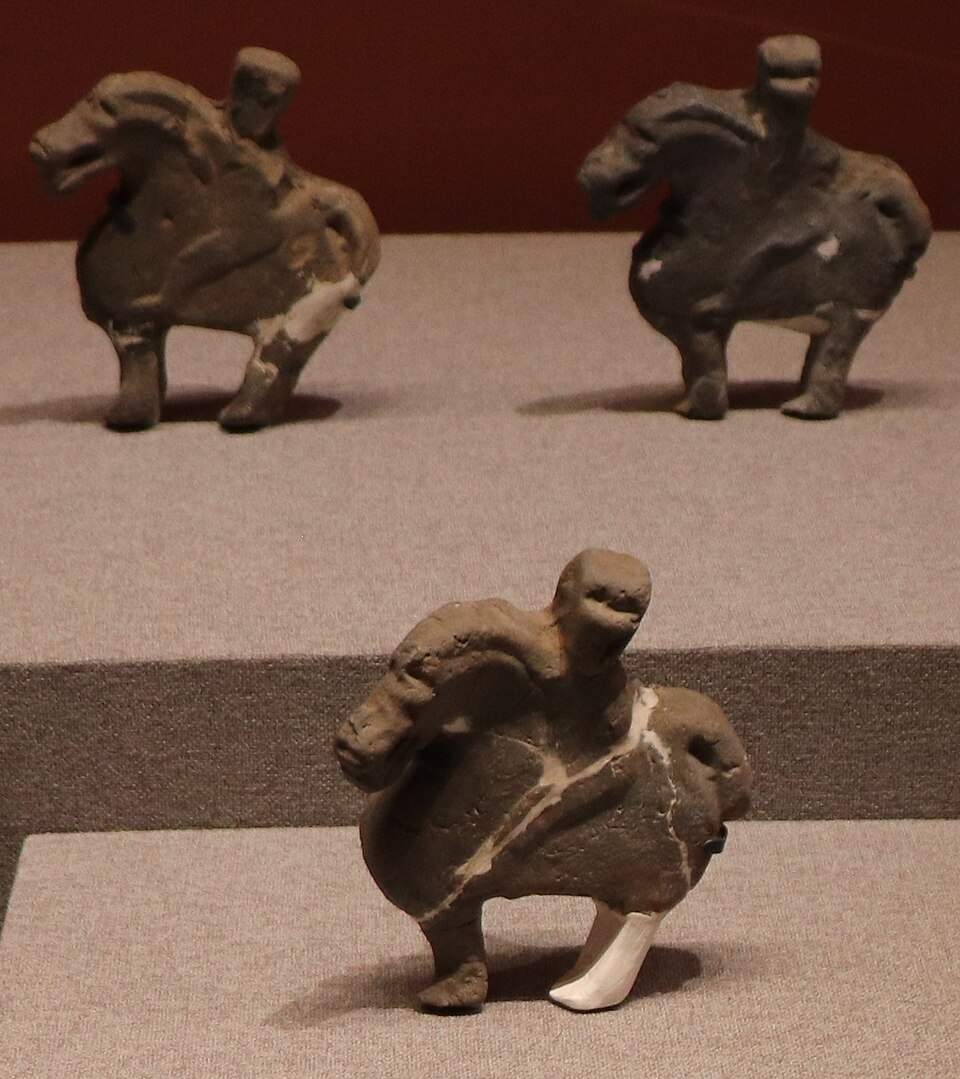

Guangwu relocated the imperial capital from the war-devastated Chang'an to Luoyang, about 335 kilometres to the east in the central Yellow River valley, a move that gave the second half of the dynasty its conventional name of Eastern (or Later) Han. The Eastern Han retained the basic institutional framework of its Western predecessor — the commandery and county administration, the Confucian state ideology, the imperial academy, the system of recommendation for official appointment — but it was a more cautious and economically devolved state than the empire of Emperor Wu. Many of the Western Han monopolies were quietly abandoned or transferred to local administrators, the standing army was reduced, and the great landowning families that had survived the Wang Mang catastrophe were left in increasingly secure possession of their estates.2, 10
The early Eastern Han nevertheless saw significant achievements. The general Ban Chao (32–102 CE), brother of the historian Ban Gu, spent more than three decades campaigning in Central Asia and at one point reasserted Han control over the Tarim Basin oasis states from a headquarters at Kucha; in 97 CE he despatched his lieutenant Gan Ying on a westward embassy that reached the Persian Gulf, the furthest west any Chinese envoy is known to have travelled in antiquity.5, 6 The technologies of papermaking and porcelain production reached new levels of refinement, the seismograph and water-powered armillary sphere of Zhang Heng were constructed at the Eastern Han court, and the first Buddhist communities in China were established at Luoyang during the first century CE, beginning a process of religious transmission that would transform Chinese culture in the centuries after the dynasty's collapse.14, 17, 22
Historiography: Sima Qian and Ban Gu
The Han period produced the two foundational works of the Chinese historiographical tradition. The first was the Shiji (Records of the Grand Historian), composed by Sima Qian (c. 145–c. 86 BCE), the court astronomer and grand historian of Emperor Wu. Sima Qian inherited the project of writing a comprehensive history of the world as known to the Chinese from his father, Sima Tan, and devoted the remainder of his life to its completion after the elder Sima's death in 110 BCE.3, 16 His work suffered an extraordinary interruption: in 99 BCE, after defending the disgraced general Li Ling against Emperor Wu's anger over Li Ling's surrender to the Xiongnu, Sima Qian was condemned to castration. Rather than commit suicide, as honour was thought to require, he chose to undergo the punishment in order to complete the Shiji, an act he justified in a long autobiographical letter to his friend Ren An that survives among the most powerful documents of early Chinese self-reflection.3
The Shiji as completed runs to 130 chapters and approximately 526,000 characters, organized into five sections: twelve "basic annals" of rulers, ten chronological tables, eight treatises on subjects such as ritual, music, the calendar, astronomy, and economics, thirty "hereditary houses" of feudal lineages, and seventy biographical chapters of individual statesmen, generals, philosophers, assassins, merchants, and foreigners. Its scope extends from the legendary Yellow Emperor down to Sima Qian's own day, and its method — combining annalistic chronology with thematic treatises and individual biography — established the structural template that every subsequent Chinese dynastic history would follow.3, 24 Sima Qian's willingness to interview surviving witnesses, to visit historical sites, and to incorporate documentary sources from regional archives also broke decisively with the courtly chronicle tradition that had preceded him.3
The second great Han historiographical project was the Hanshu (Book of Han), the first dynastic history to confine itself to a single dynasty. It was begun by Ban Biao as a continuation of the Shiji, taken over and substantially recast after Ban Biao's death in 54 CE by his son Ban Gu (32–92 CE), and completed after Ban Gu's own death in prison by his sister Ban Zhao (c. 45–c. 116 CE) and the scholar Ma Xu around 111 CE. The Hanshu covers the Western Han down to the fall of Wang Mang in 23 CE in 100 chapters and over 800,000 characters, and is organized into the same annal-table-treatise-biography format as the Shiji, with the omission of Sima Qian's "hereditary houses" section.4, 24 Ban Gu's treatment is more bureaucratically thorough than Sima Qian's and his treatises on topics such as administrative geography, the bibliography of the imperial library, and Han law are essential sources for the institutional history of the Western Han.4, 11
Decline, the Yellow Turbans, and the fall of the Han
The political pathologies that destroyed the Eastern Han were already apparent by the middle of the second century CE. Successive emperors came to the throne as children — Emperor Shang acceded at one hundred days old, Emperor Chong at one year, Emperor Zhi at seven, Emperor Huan at fourteen — and were governed in turn by the consort families of their mothers and grandmothers and by the eunuchs of the inner palace, who together monopolized access to the throne and frustrated successive attempts at reform from within the senior bureaucracy.1, 25 The "Disasters of Partisan Prohibitions" (danggu zhi huo) of 166 and 169 CE saw hundreds of senior Confucian officials proscribed, imprisoned, or executed at the instigation of the eunuch faction, and the moral authority of the imperial bureaucracy never recovered.25, 24
The decisive shock to the Eastern Han came from outside the court altogether. In 184 CE the brothers Zhang Jue, Zhang Bao, and Zhang Liang, leaders of a millenarian Daoist healing sect known as the Way of Great Peace (Taiping Dao), launched a coordinated rising across eight provinces of the empire that came to be known as the Yellow Turban Rebellion from the yellow scarves worn by its adherents. Zhang Jue had spent more than a decade preaching that the "Blue Heaven" of the Han was about to be replaced by a "Yellow Heaven" of universal peace and equality, that the present world order was corrupt and would soon be swept away, and that those who trusted in his charms and incantations would be cured of their afflictions and admitted into the new era.13, 24 At its height the movement claimed several hundred thousand adherents, and although the main rising was suppressed within months by the imperial generals Huangfu Song, Zhu Jun, and Lu Zhi, its organizational structures persisted and provincial outbreaks continued for more than two decades.13
The political consequence of the rebellion was the fatal devolution of military authority to provincial governors and warlords. To suppress the Yellow Turbans the central government had granted regional commanders unprecedented latitude to raise private armies and to draw on local resources, and these armies proved difficult to demobilize once the immediate emergency had passed. By the 190s the empire had effectively fragmented into rival military spheres, and the imperial court at Luoyang had become a prize fought over by successive warlords. The most successful of these was Cao Cao (155–220 CE), who in 196 CE took custody of the figurehead Emperor Xian and ruled north China through the formal apparatus of the Han state for the next twenty-four years. Cao Cao was checked at the battle of Red Cliffs in 208 CE by an alliance of his southern rivals Sun Quan and Liu Bei, and the empire stabilized into the three regional regimes of Wei, Shu, and Wu.25, 17 When Cao Cao died in 220 CE his son Cao Pi formally accepted the abdication of Emperor Xian and proclaimed himself emperor of the new dynasty of Wei, ending the Han dynasty after four hundred and twenty-six years and inaugurating the period of disunion known as the Three Kingdoms.17, 25
Chronological overview
Reigns and major events of the Han dynasty1, 2, 10, 16, 24
| Period | Dates | Key developments |
|---|---|---|
| Founding (Gaozu) | 206–195 BCE | Liu Bang defeats Xiang Yu at Gaixia (202 BCE), establishes capital at Chang'an, eliminates non-Liu regional kings |
| Empress Lü and early Wen | 195–157 BCE | Huang-Lao governance, low taxation, agricultural recovery, heqin tribute to the Xiongnu |
| Emperor Jing | 157–141 BCE | Suppression of the Revolt of the Seven Kingdoms (154 BCE), centralization of regional fiefs |
| Emperor Wu | 141–87 BCE | Wars with the Xiongnu, Zhang Qian's missions (138–126 BCE), salt and iron monopolies (119 BCE), Confucianism as state doctrine (136 BCE), taixue founded (124 BCE) |
| Emperor Zhao and Xuan | 87–49 BCE | Salt and iron debate (81 BCE); submission of the Xiongnu chanyu Huhanye (51 BCE); Protectorate of the Western Regions (60 BCE) |
| Late Western Han | 49 BCE–9 CE | Rise of the Wang consort clan; Han census of 2 CE registers ~57.7 million people in 12.4 million households |
| Xin dynasty (Wang Mang) | 9–23 CE | Land nationalization, currency reform, Yellow River course change, Red Eyebrow and Lülin rebellions; Wang Mang killed at Chang'an |
| Eastern Han founding (Guangwu) | 25–57 CE | Liu Xiu reunifies the empire, capital relocated to Luoyang, Western monopolies devolved |
| High Eastern Han | 57–125 CE | Ban Chao's Central Asian campaigns; Cai Lun's papermaking process (105 CE); Ban Gu and Ban Zhao complete the Hanshu (c. 111 CE) |
| Late Eastern Han | 125–184 CE | Child emperors, eunuch and consort-clan factionalism, Disasters of Partisan Prohibitions (166, 169 CE), Zhang Heng's seismograph (132 CE) |
| Yellow Turban era | 184–220 CE | Yellow Turban rebellion (184 CE), warlord period, Cao Cao's domination of the north, Battle of Red Cliffs (208 CE) |
| Fall of the Han | 220 CE | Abdication of Emperor Xian; Cao Pi proclaims the Wei dynasty; beginning of the Three Kingdoms period |
The Han legacy
The Han dynasty left a deeper imprint on the institutions, vocabulary, and self-conception of Chinese civilization than any other ancient polity. The Chinese majority ethnic group still calls itself the Hanren ("Han people") and the Chinese language is known as Hanyu ("Han speech"), terms that originated as labels for the inhabitants and language of the Han empire. The Han model of centralized bureaucratic government — an emperor at the apex of a salaried civil service recruited through merit-based criteria, organized into commanderies and counties, regulated by a codified law, and legitimized by Confucian moral ideology — was adopted by every subsequent Chinese dynasty and exported with modifications to Korea, Japan, and Vietnam.2, 17, 20
Han intellectual achievements were equally durable. Sima Qian's annalistic-biographical structure became the framework for the twenty-four official dynastic histories that constitute the canonical record of Chinese imperial history down to the seventeenth century, and the Shiji and Hanshu are still read in the original by students of classical Chinese.3, 4 The Confucian classics edited and commented upon by Han scholars formed the basis of the civil service examinations that recruited Chinese officials until the system's abolition in 1905, almost two thousand years after Dong Zhongshu first urged Emperor Wu to make Confucianism the official ideology of the imperial state.8, 11 Han technological innovations in agriculture, iron production, and papermaking spread across Eurasia along the trade routes that the dynasty itself had opened, transforming the material conditions of literate culture wherever they reached.6, 12
Perhaps most consequentially, the Han period fixed in Chinese political memory the idea that the natural and proper condition of the country was unification under a single imperial state. The four centuries of disunion that followed the Han collapse never produced a stable rival ideology of regional sovereignty; on the contrary, every successor regime down to the reunification of China under the Sui in 589 CE measured itself against the Han precedent and claimed to be working toward its restoration.17, 20 When that reunification finally arrived, it was understood by contemporaries and by later historians not as the founding of a new order but as the recovery of the imperial unity that the Han had bequeathed and that the long centuries of division had merely interrupted.17, 2
References
Courtier and Commoner in Ancient China: Selections from the History of the Former Han by Pan Ku
Trade and Expansion in Han China: A Study in the Structure of Sino-Barbarian Economic Relations
Discourses on Salt and Iron: A Debate on State Control of Commerce and Industry in Ancient China