Overview
- The Indus Valley script is an undeciphered system of symbols used by the Harappan civilization from approximately 2600 to 1900 BCE, attested on more than 4,000 inscribed objects including steatite seals, pottery, copper tablets, and ivory rods, with a corpus of roughly 400–450 distinct signs.
- Statistical analyses of sign frequency, positional distribution, and combinatorial patterns have demonstrated that the script exhibits a degree of internal structure consistent with a linguistic writing system, though a vocal minority of scholars have argued that it represents non-linguistic symbolic notation.
- Decipherment has been blocked by the brevity of inscriptions (averaging fewer than five signs), the absence of any bilingual text, and fundamental uncertainty about the language family underlying the script, with Dravidian, Indo-Aryan, and language-isolate hypotheses all lacking conclusive support.
The Indus Valley script, also known as the Harappan script, is an undeciphered system of symbols associated with the Indus Valley civilization, the Bronze Age urban society that flourished across a vast region of South Asia from approximately 2600 to 1900 BCE. The script is attested on more than 4,000 inscribed objects recovered from sites across the Harappan world, including Mohenjo-daro, Harappa, Dholavira, Lothal, and Kalibangan, with the corpus consisting primarily of short inscriptions on steatite seals, seal impressions, pottery, copper tablets, and ivory or bone rods.1, 9 Despite more than a century of study, the script has resisted all attempts at decipherment, making it one of the last major undeciphered writing systems of the ancient world and one of the most contentious problems in the study of early writing.

The corpus and its characteristics
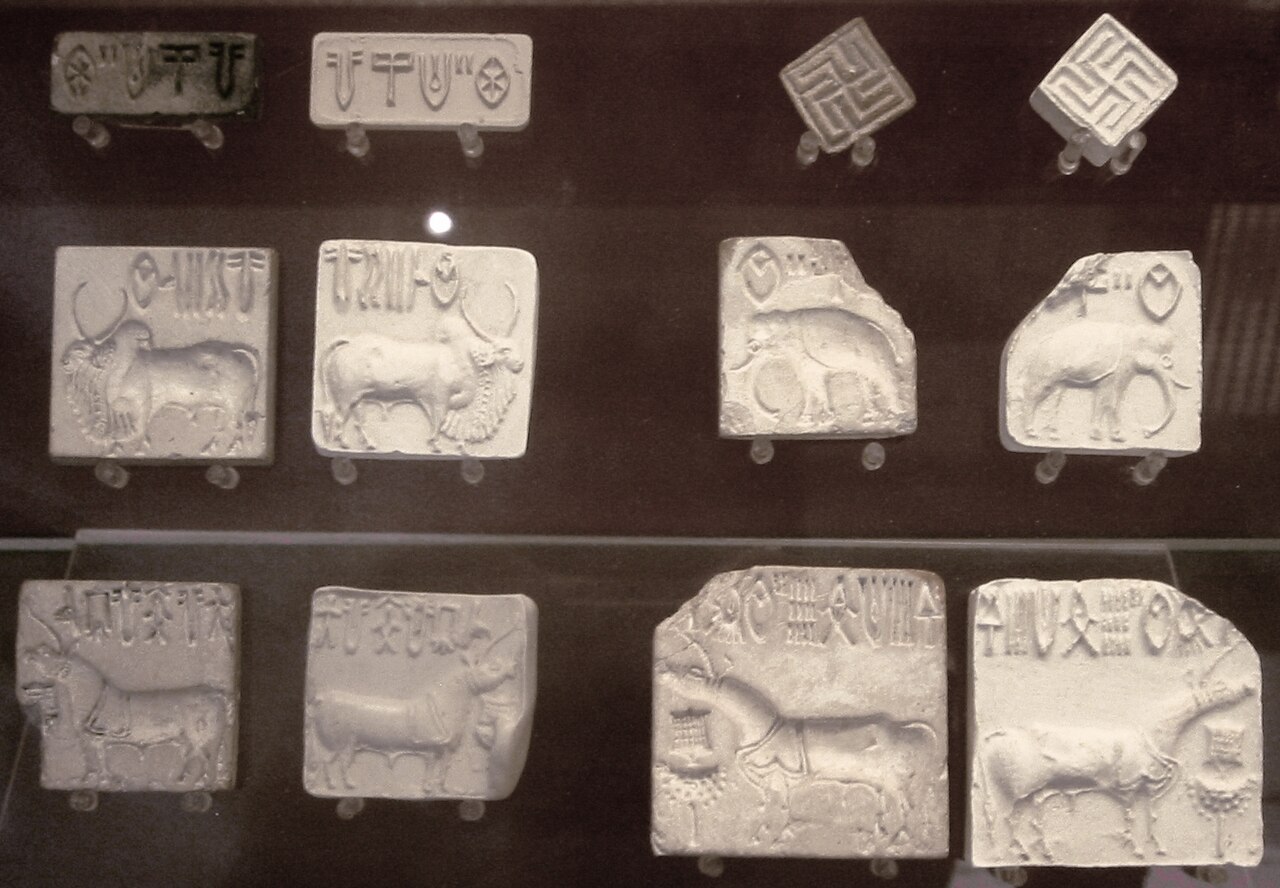
The standard catalogue of the Indus script, compiled by Iravatham Mahadevan in 1977, identified approximately 3,700 inscribed objects bearing roughly 400 to 450 distinct signs, though subsequent discoveries have expanded the corpus.1 The signs include a mixture of geometric shapes, anthropomorphic and zoomorphic figures, plant-like forms, and abstract symbols. Many signs appear to be composites formed by combining basic elements, and some scholars have identified potential ligatures in which two or more signs are merged into a single glyph.6, 1 The number of distinct signs—too many for an alphabet (typically 20–40 signs) but too few for a purely logographic system like Chinese (which uses thousands)—has led most specialists to conclude that if the script represents a writing system, it is likely logosyllabic, combining word signs with phonetic elements, comparable in principle to Sumerian cuneiform or Egyptian hieroglyphs.6, 13
The most striking feature of the corpus is the extreme brevity of the inscriptions. The average inscription length is fewer than five signs, and the longest known text contains only 26 signs arranged in three lines on a surface of a single object.1, 10 This brevity has been both the greatest obstacle to decipherment and a central point of contention in debates over the script's nature. No lengthy texts, literary compositions, or bilingual inscriptions have been found, and the overwhelming dominance of seals and seal impressions in the corpus suggests that the primary surviving context of the script's use was administrative—marking ownership, certifying goods, or identifying individuals within the trade networks of the Harappan world.7, 14
Statistical analyses and the linguistic debate
Beginning in the 2000s, computational approaches brought new methods to bear on the question of whether the Indus signs encode a linguistic system. Rajesh Rao and colleagues applied information-theoretic measures, including conditional entropy (the degree to which the identity of a sign is predicted by the preceding sign), to the Indus corpus and compared the results with known linguistic scripts (Sumerian, Old Tamil, Sanskrit) and non-linguistic symbol systems (DNA sequences, Fortran code, heraldic blazons). They found that the conditional entropy of the Indus script fell within the range characteristic of linguistic systems and was significantly different from non-linguistic sequences, a result they interpreted as evidence that the script encodes language.2, 4
This conclusion was challenged by Steve Farmer, Richard Sproat, and Michael Witzel, who had argued in a widely cited 2004 paper that the Indus signs do not constitute a writing system at all but rather a non-linguistic symbol system comparable to medieval European heraldry or Vinča symbols.3 Their argument rested on the brevity of the inscriptions, the absence of longer texts despite extensive excavation, and the lack of evidence for the kinds of administrative record-keeping that accompanied writing in Mesopotamia and Egypt. Sproat subsequently argued that conditional entropy measures alone cannot reliably distinguish linguistic from non-linguistic systems, demonstrating that certain non-linguistic sequences can produce entropy values within the linguistic range depending on how the comparison is structured.12
The debate remains unresolved, though the majority of Indus script specialists continue to regard the signs as a form of writing. Rao and colleagues responded to the critique by applying Markov chain models and additional statistical tests, finding that the combinatorial structure of the Indus signs exhibits patterns—including positional preferences, sign clustering, and syntactic regularities—that are more consistent with linguistic encoding than with the known behaviour of non-linguistic symbol systems.4, 11 The fundamental difficulty, however, is that statistical methods can characterise the structure of the sign system but cannot identify the language it might encode.
Decipherment attempts and the language question
Numerous decipherment attempts have been proposed since the script's discovery in the 1870s, but none has achieved scholarly consensus. The most sustained and methodologically rigorous effort has been that of Asko Parpola, who has argued since the 1960s that the script encodes an early Dravidian language, ancestral to the modern Dravidian family that includes Tamil, Telugu, Kannada, and Malayalam.5, 6 Parpola's approach relies on a rebus principle—the idea that a pictographic sign representing an object whose name in proto-Dravidian sounds like another word can be read for that homophonous word—and he has proposed readings for several common signs, including the "fish" sign as a Dravidian word for "star" (based on the homophony of min "fish" and min "star" in several Dravidian languages).6, 8
Alternative hypotheses have proposed that the script encodes an early Indo-Aryan language, a language isolate unrelated to any surviving family, or a Munda (Austroasiatic) language. The Indo-Aryan hypothesis faces the difficulty that the mainstream chronology places the arrival of Indo-Aryan speakers in South Asia after the decline of the Mature Harappan phase, though proponents of an indigenous origin for Indo-Aryan dispute this timeline.13, 8 The language-isolate hypothesis, while unfalsifiable, is considered plausible given the deep antiquity of the civilization and the likelihood that pre-Harappan South Asia was far more linguistically diverse than it is today.13
The prospects for decipherment are constrained by the nature of the surviving evidence. The brevity of the inscriptions means that there is insufficient text to apply the frequency-based cryptanalytic methods that proved decisive in the decipherment of Linear B and Egyptian hieroglyphs. The absence of a bilingual text—the equivalent of the Rosetta Stone—eliminates the most direct avenue to identifying the language. And the uncertainty about the underlying language family means that proposed phonetic readings cannot be independently verified against a known linguistic structure.6, 10
Seals and their archaeological context
The primary vehicle of the Indus script is the stamp seal, typically a square or rectangular piece of steatite measuring two to five centimetres on a side, carved in intaglio with a line of script above a figural motif and fitted with a perforated boss on the reverse for handling or suspension. The figural motifs most commonly depict a humped bull (zebu), an "unicorn" (a bull-like animal shown in profile with a single visible horn), elephants, rhinoceroses, water buffalo, and, in a famous minority of cases, a seated figure in a cross-legged posture that has been speculatively identified as a "proto-Shiva" or yogic figure.7, 14
The seals are widely understood to have functioned within the Harappan administrative and commercial system, serving as markers of identity, authority, or ownership in the context of long-distance trade. Seal impressions on clay tags found at Harappa, Mohenjo-daro, and Lothal indicate that goods were sealed for transport, and Indus-type seals and seal impressions have been recovered at Mesopotamian sites including Ur, Kish, and Tell Asmar, confirming direct contact between the two civilizations.7, 14 At Dholavira in Gujarat, a large signboard bearing ten Indus signs, each approximately 37 centimetres tall, was discovered above the north gate of the citadel—the only known example of a monumental inscription in the Harappan world, and evidence that the script could serve a public communicative function beyond the small-scale administrative contexts of the seals.13
Prospects and significance
The Indus script remains one of the great unsolved problems of ancient studies. Future progress may depend on the discovery of longer texts, a bilingual inscription, or new computational methods capable of extracting linguistic structure from extremely short sequences. The ongoing application of machine learning and neural network models to the corpus holds some promise, though the limited size of the dataset constrains the effectiveness of data-driven approaches.11 Archaeological work at major Harappan sites continues, and the possibility that longer texts were inscribed on perishable materials such as palm leaves, bark, or cloth—none of which would survive in the South Asian climate—remains a plausible explanation for the apparent absence of extended written records.10, 13
Whether the Indus signs are ultimately deciphered as a full writing system or reinterpreted as a more limited form of symbolic notation, their study illuminates the diverse trajectories by which human societies developed systems of visual communication. The Harappan case stands in instructive contrast to Mesopotamia and Egypt, where writing evolved from administrative tokens and pictographic inventories into fully expressive scripts over the course of centuries, and it reminds scholars that the relationship between social complexity and literacy was neither automatic nor uniform in the ancient world.6, 13