Overview
- The Mycenaean civilization (c. 1700-1100 BCE) was the first advanced civilization on the Greek mainland, building heavily fortified palatial centers at Mycenae, Tiryns, Pylos, and Thebes that administered regional economies through a bureaucratic system documented in Linear B, the earliest known form of written Greek.
- Mycenaean society was organized around a palace-centered redistributive economy overseen by a ruler called the wanax, with specialized craft production, extensive Mediterranean trade networks reaching Egypt and the Levant, and a warrior culture evidenced by elaborate weapons, chariot technology, and the full bronze body armor discovered at Dendra.
- The Mycenaean palatial system collapsed between approximately 1200 and 1100 BCE as part of the wider Bronze Age Collapse, resulting in the loss of writing, the end of monumental architecture, and a prolonged period of reduced population and material culture in Greece before the emergence of the Iron Age city-states.
The Mycenaean civilization was the dominant culture of the Greek mainland during the Late Bronze Age, flourishing from approximately 1700 to 1100 BCE across the Peloponnese, central Greece, and parts of the Aegean islands.1, 3 Named after the site of Mycenae in the northeastern Peloponnese, which Heinrich Schliemann excavated in 1876, this civilization developed heavily fortified palatial centers, a centralized redistributive economy, and a bureaucratic administrative system recorded in Linear B — the earliest attested script for the Greek language.4, 7 The Mycenaeans were contemporaries and eventual successors of the Minoan civilization on Crete, and they participated in the international diplomatic and commercial networks that linked the eastern Mediterranean powers during the Late Bronze Age, exchanging goods and correspondence with New Kingdom Egypt, the Hittite Empire, and the city-states of the Levant.2, 13
The collapse of Mycenaean palatial civilization between approximately 1200 and 1100 BCE was one of the defining events of the Bronze Age Collapse, resulting in the disappearance of centralized administration, the loss of literacy, and a prolonged period of reduced material culture that preceded the emergence of the classical Greek world.6, 11

Discovery and chronology
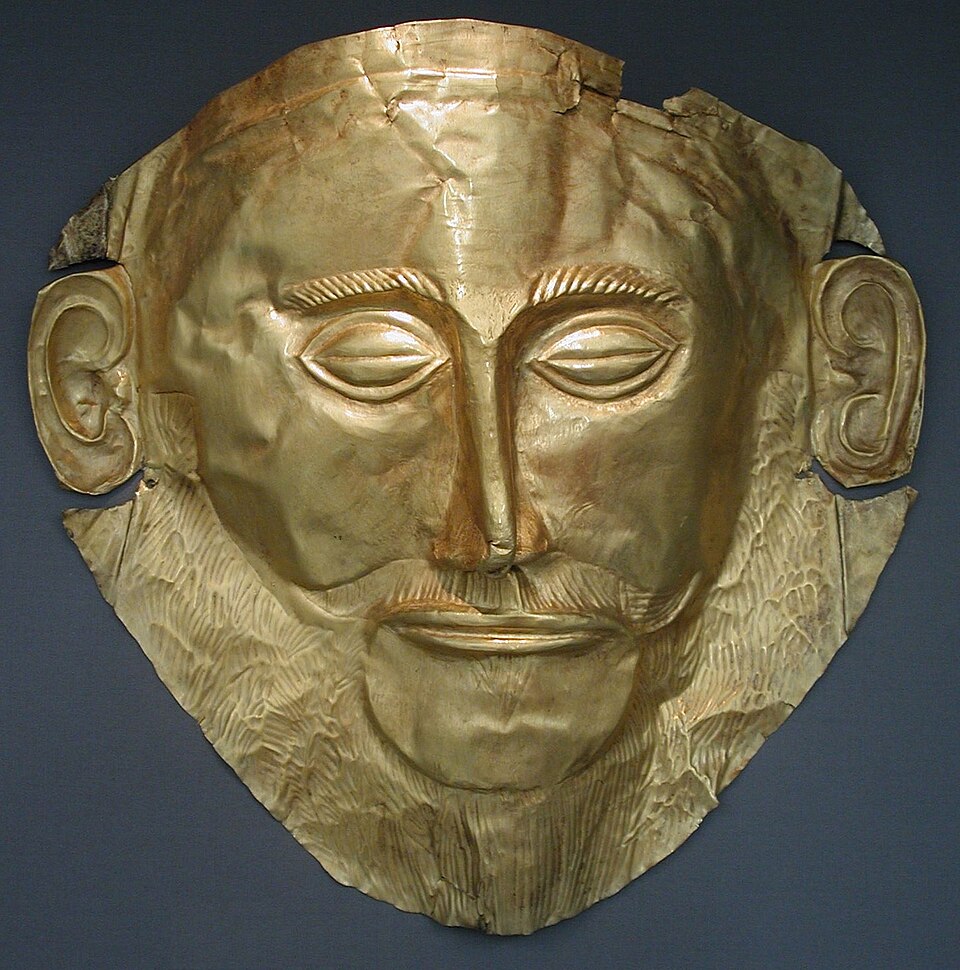
The rediscovery of Mycenaean civilization began with Heinrich Schliemann, a German businessman turned archaeologist who, inspired by the Homeric epics, excavated at Mycenae in 1876. Within Grave Circle A, just inside the citadel's Lion Gate, Schliemann uncovered six shaft graves containing a spectacular array of gold artifacts, including five gold death masks, bronze weapons inlaid with gold and silver, rock crystal and amber ornaments, and the remains of nineteen individuals.7, 3 One death mask, which Schliemann reportedly described in a telegram as the face of Agamemnon, has since been dated to approximately 1550 BCE — several centuries before any plausible date for the Trojan War — but its discovery electrified public interest in pre-classical Greece and established Mycenae as a site of extraordinary wealth and power.7

Subsequent excavations at other sites — Tiryns, Pylos, Thebes, Orchomenos, Iolkos, Athens, and Midea — revealed that Mycenaean culture was not confined to a single center but represented a widespread civilization with shared architectural, artistic, and administrative conventions across the Greek mainland.1, 2 The chronological framework for Mycenaean civilization is based on pottery sequences, calibrated by synchronisms with Egyptian chronology and radiocarbon dating. Scholars divide the period into the Late Helladic I (LH I, c. 1700–1600 BCE), Late Helladic II (LH II, c. 1600–1400 BCE), and Late Helladic III (LH III, c. 1400–1100 BCE), with LH III further subdivided into phases IIIA, IIIB, and IIIC that track the apex, decline, and aftermath of the palatial system.3, 1
Ancient DNA analysis has clarified the population history of the Mycenaeans. A 2017 study published in Nature demonstrated that Mycenaeans derived approximately three-quarters of their ancestry from Neolithic Anatolian farming populations who had colonized the Aegean during the seventh millennium BCE, with additional contributions from populations related to the Caucasus and Iran.5 Crucially, Mycenaeans differed from Minoans in carrying a significant component of ancestry ultimately traceable to steppe-related populations of eastern Europe and Siberia, likely introduced through migrations during the third millennium BCE that brought Indo-European languages — including the ancestor of Greek — to the Aegean.5, 16 Modern Greeks show strongest genetic continuity with the Mycenaean population, with some additional later admixture.5
Palatial centers and fortification
The most distinctive architectural achievement of Mycenaean civilization was the fortified palatial center, built on elevated, defensible positions and surrounded by massive walls constructed in a technique known as Cyclopean masonry — so called because later Greeks believed that only the mythological Cyclopes could have moved the enormous limestone blocks, some weighing over 20 tonnes, that form these walls.14, 7 The contrast with the unfortified palaces of Minoan Crete is stark, and it points to a society organized around the expectation of military conflict.3
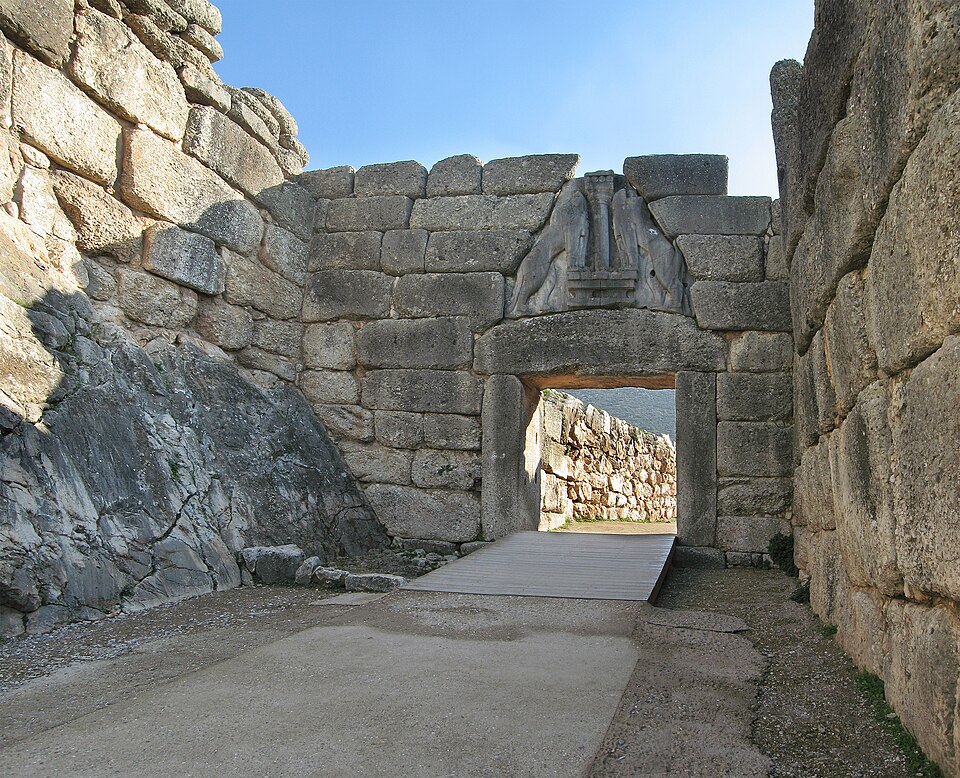
The citadel of Mycenae is the best-known example. Its main entrance, the Lion Gate (c. 1250 BCE), features a massive triangular relief of two lions flanking a column — the earliest piece of monumental sculpture in Europe. The citadel walls enclose an area of approximately 30,000 square meters, within which the palace complex, Grave Circle A, a granary, houses, and cult areas were situated.14, 7 At Tiryns, some 15 kilometres south of Mycenae, the Cyclopean walls are even more massive, reaching thicknesses of 8 metres and incorporating corbelled galleries within the wall fabric that may have served as storage or shelter.14
The organizational heart of each Mycenaean palace was the megaron, a large rectangular hall with a central circular hearth surrounded by four columns supporting the roof, with a throne positioned along one wall. This architectural form, distinct from the central-court layout of Minoan palaces, would persist in Greek sacred and domestic architecture for centuries.14, 1 The megaron at Pylos, the best-preserved example, was elaborately decorated with painted frescoes depicting griffins, lions, and scenes of feasting and combat.7
Major Mycenaean palatial centers1, 2, 14
| Site | Region | Key features | Destruction date |
|---|---|---|---|
| Mycenae | Argolid | Lion Gate, Grave Circles A & B, Treasury of Atreus | c. 1190–1130 BCE |
| Tiryns | Argolid | Massive Cyclopean walls, corbelled galleries | c. 1200–1150 BCE |
| Pylos | Messenia | Best-preserved megaron, largest Linear B archive on mainland | c. 1180 BCE |
| Thebes | Boeotia | Kadmeion palace, Orientalizing imports | c. 1200 BCE |
| Orchomenos | Boeotia | Treasury of Minyas tholos tomb | c. 1200 BCE |
| Athens | Attica | Acropolis fortification, possible megaron | Survived into LH IIIC |
| Midea | Argolid | Cyclopean citadel, Dendra panoply nearby | c. 1200 BCE |
Burial practices and the shaft graves
Mycenaean burial customs underwent significant transformation over the course of the civilization and provide some of the most vivid evidence for social hierarchy and cultural change. The earliest elite burials are the shaft graves of Grave Circles B (c. 1650–1550 BCE) and A (c. 1600–1500 BCE) at Mycenae, deep rectangular pits cut into bedrock and roofed with timber and stone slabs, in which the dead were interred with remarkable concentrations of wealth.9, 7
Grave Circle A, the richer of the two, contained approximately 14 kilograms of gold objects, including the five death masks, gold diadems, inlaid daggers with scenes of lion hunts and marine motifs executed in gold, silver, and niello, and hundreds of pieces of jewelry.7, 3 The sheer quantity of precious metal in these graves, dating to a period before the full florescence of Mycenaean palatial power, indicates that an exceptionally wealthy warrior elite had already established itself in the Argolid by the sixteenth century BCE. The weapons deposited with the dead — long swords, daggers, spearheads, and arrowheads — emphasize the military character of this elite.9
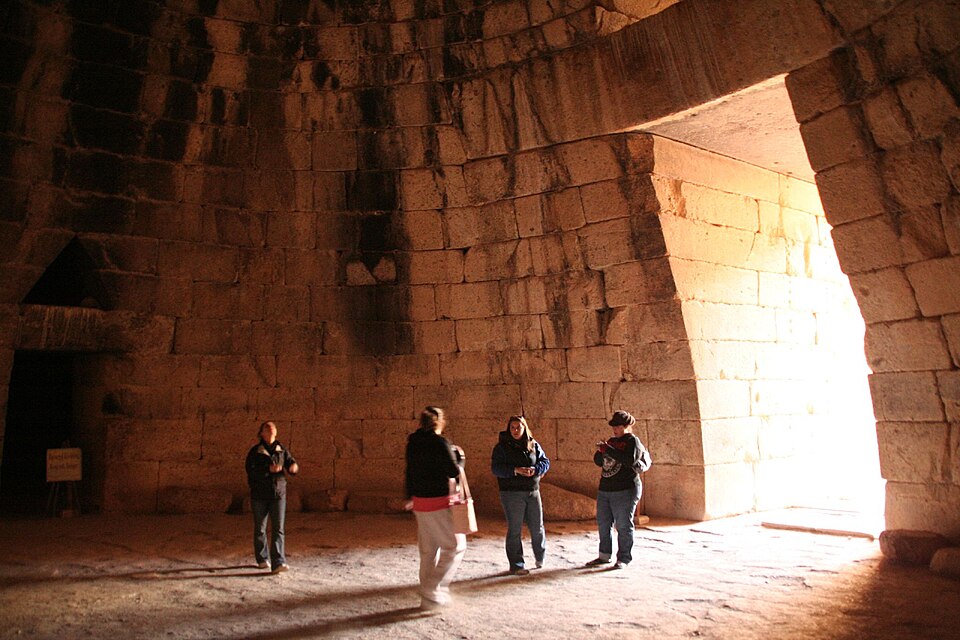
Beginning around 1500 BCE, the shaft grave tradition gave way to the tholos tomb, a beehive-shaped chamber constructed of carefully corbelled stone courses, covered by an earthen mound, and accessed through a long entrance passage called a dromos. The largest and most technically accomplished tholos tomb is the Treasury of Atreus at Mycenae (c. 1350–1250 BCE), whose main chamber has an internal height of approximately 13.5 metres and a diameter of 14.5 metres — the largest unsupported domed space in the world until the construction of the Roman Pantheon nearly 1,500 years later.14, 7 The construction of such tombs required enormous labor investment, suggesting that the rulers who commissioned them commanded substantial resources and workforce.3

Non-elite Mycenaeans were typically buried in simpler chamber tombs cut into hillsides, used by family groups over multiple generations. These tombs, found in large cemeteries at sites across the Mycenaean world, contained more modest grave goods — pottery vessels, simple jewelry, and occasionally bronze tools or weapons — but their widespread distribution provides evidence for the broad social structure of Mycenaean communities beyond the palatial elite.1, 3
Linear B and administration
The decipherment of Linear B by the architect Michael Ventris in 1952, with subsequent philological confirmation by John Chadwick, was one of the great intellectual achievements of twentieth-century scholarship. Ventris demonstrated that the script recorded an early form of Greek, predating the Homeric epics by more than five centuries and proving that Greek speakers had been present in the Aegean since at least the fifteenth century BCE.4, 15
Linear B was adapted from the Minoan Linear A script, retaining many of the same sign forms but repurposing them to represent the syllables of Greek. The script uses approximately 87 syllabic signs, each representing a consonant-vowel combination, along with over 100 ideograms representing commodities such as wheat, barley, olive oil, wine, wool, bronze, gold, chariots, horses, and various types of vessels.4, 15 Major archives of Linear B tablets have been recovered from Knossos (approximately 3,400 tablets), Pylos (approximately 1,100 tablets), Thebes, Mycenae, and Tiryns, with smaller collections from several other sites.15
The content of the Linear B tablets is overwhelmingly administrative: inventories of agricultural produce, livestock censuses, allocations of rations to workers, records of textile production, lists of military equipment including chariots and armor, and records of religious offerings to deities and sanctuaries.4, 1 No literary, legal, or historical texts have been found, and the tablets themselves were unbaked clay documents intended only for short-term record-keeping within a single administrative year. They survive only because they were accidentally fired when the palaces in which they were stored were destroyed by conflagration.4
The administrative vocabulary preserved in the tablets reveals a hierarchical political structure. At the apex was the wanax (later Greek anax, "lord" or "king"), the supreme authority of the palatial state. Below the wanax was the lawagetas (literally "leader of the people"), a figure of uncertain function who may have held military responsibilities. Regional administrators called ko-re-te and po-ro-ko-re-te governed outlying districts, while a council of elders (ke-ro-si-ja, later Greek gerousia) and a community assembly (da-mo, later Greek demos) exercised some role in land tenure and local governance.4, 8
Economy and trade
The Mycenaean economy was a centralized, redistributive system in which the palace collected agricultural produce, raw materials, and labor from the surrounding territory and allocated resources to support specialized craftspeople, military personnel, religious institutions, and the palace household.8, 1 Linear B tablets from Pylos document this system in detail, recording the collection of flax and wool, the assignment of female textile workers to palace workshops, the distribution of bronze to smiths for weapons production, and the allocation of rations of grain and figs to palace dependents.4, 11
Agriculture was the economic foundation: wheat, barley, olives, grapes, and figs were the principal crops, supplemented by herding of sheep, goats, cattle, and pigs. The Pylos tablets record herds totaling over 100,000 sheep managed by the palace, and the textile industry that processed their wool was one of the largest organized sectors of the economy.4, 7 Olive oil and wine were produced in quantities that exceeded local consumption and served as important export commodities. Distinctive Mycenaean stirrup jars, a vessel form designed specifically for transporting liquid commodities, have been found across the eastern Mediterranean from Egypt to Italy, testifying to the geographic reach of Mycenaean commercial activity.11, 2
The Mycenaeans participated actively in the international trade networks that connected the Late Bronze Age Mediterranean. The Uluburun shipwreck (c. 1300 BCE), discovered off the southern coast of Turkey, carried Mycenaean pottery alongside Cypriot copper ingots, tin from Central Asia, Egyptian glass and ebony, and Canaanite resin — a physical record of the multi-directional exchange system in which Mycenaean goods circulated.6, 2 The Amarna Letters, the diplomatic correspondence of the fourteenth-century Egyptian court, refer to the land of Tanaja, likely a reference to the Mycenaean world, indicating that the Mycenaeans were recognized as significant actors in the international system of the period.13
Mycenaean exports found across the Mediterranean2, 11
Warfare and military technology
Mycenaean civilization was permeated by a warrior ethos evident in every aspect of its material culture, from the weapons-laden shaft graves of the sixteenth century to the fortified citadels and military records of the thirteenth century.7, 9 The Linear B tablets from Pylos include detailed inventories of military equipment: chariots with their component parts (wheels, frames, and yokes), bronze body armor, helmets, swords, spears, and arrowheads, all recorded with the meticulous accounting characteristic of the palatial administration.4
The most extraordinary piece of Mycenaean military equipment is the Dendra panoply, a complete suit of bronze body armor discovered in a chamber tomb at Dendra near Midea in 1960, dating to approximately 1450–1400 BCE. The panoply consists of fifteen separate pieces of beaten bronze sheet: front and back torso plates, three overlapping bands protecting the lower body, large shoulder guards, and a high collar protecting the neck. The entire assembly was held together with leather thongs to allow some degree of movement, creating a tubular suit that encased the warrior from neck to knees.7, 2 A 2024 experimental study in which modern soldiers performed simulated combat exercises wearing a reconstruction of the panoply demonstrated that the armor, though heavy at approximately 18 kilograms, did not significantly impair combat effectiveness during extended physical activity, supporting the argument that such armor was functional battlefield equipment rather than ceremonial regalia.2
The boar's tusk helmet, described in detail by Homer in the Iliad and attested in numerous Mycenaean artistic representations, was another distinctive piece of Mycenaean military equipment. Constructed from curved segments of wild boar tusks sewn onto a leather or felt cap in alternating rows, these helmets required the tusks of approximately 40 to 70 boars and were therefore expensive prestige items. Fragments of boar's tusk helmets have been found across the Mycenaean world, and a complete example was recovered from the Dendra tomb alongside the bronze panoply.7, 3
The chariot was central to Mycenaean military organization. Linear B tablets from Knossos and Pylos record large inventories of chariots and their components, and chariot scenes appear frequently in Mycenaean art, including frescoes, painted pottery, and carved gems.4, 7 Whether the chariot served primarily as a fighting platform, as it did in Near Eastern armies, or primarily as transport to and from the battlefield, as may have been more practical on the rugged Greek terrain, remains debated. The existence of the Dendra panoply suggests that at least some warriors fought dismounted, as the armor's weight and restricted mobility would have been difficult to manage on a moving chariot.3, 2
Religion and cult practice
Mycenaean religion represents the earliest documented stage of Greek religious tradition, and the Linear B tablets have revealed that many of the deities worshipped in the classical period were already venerated in the Bronze Age.12, 4 The tablets from Pylos and Knossos record offerings to di-we (Zeus), po-se-da-o (Poseidon), a-re (Ares), e-ma-a2 (Hermes), a-ta-na po-ti-ni-ja (Athena Potnia), a-te-mi-to (Artemis), and di-wo-nu-so (Dionysus), among others.4, 12 The presence of Dionysus in the Mycenaean pantheon was particularly significant, as it disproved the long-held scholarly assumption that his cult was a later import to Greece from Thrace or Asia Minor.12
The title po-ti-ni-ja (Potnia, "mistress" or "lady"), used both independently and as an epithet of named deities, occurs with particular frequency in the tablets and appears to designate a goddess of great importance in the Mycenaean religious hierarchy. At Pylos, the major cult center was located at a site recorded as pa-ki-ja-ne, where the Potnia had a significant shrine with dedicated land holdings, cult personnel, and religious dependents (do-e-ro and do-e-ra, literally "male and female slaves" of the deity).12, 4
The tablets record the types and quantities of offerings made to deities and sanctuaries: olive oil, honey, wine, grain, wool, cloth, gold vessels, and animals for sacrifice. The Pylos tablets document a series of offerings made in what appears to be a period of crisis, with special rituals performed at multiple sanctuaries simultaneously, possibly reflecting the anxious final months before the palace's destruction.4, 12
Archaeological evidence for Mycenaean cult practice includes shrine rooms within palaces (such as the cult center at Mycenae, which contained terracotta figurines, a painted plaster altar, and frescoes of goddesses), open-air peak sanctuaries, and cult deposits at natural features such as caves and springs.12, 1 Terracotta figurines in distinctive standardized types — phi-figurines (arms raised in a circular gesture), psi-figurines (arms raised in a Y-shape), and tau-figurines (arms extended horizontally) — are found throughout the Mycenaean world and appear to have served as votive offerings in both domestic and sanctified contexts.7, 12
Art and material culture
Mycenaean art drew heavily on Minoan artistic traditions while developing distinctive characteristics that reflected the more militaristic and hierarchical nature of mainland society.7, 3 Wall painting was practiced at all major palatial centers, with frescoes depicting processions of women, chariot scenes, warfare and hunting, heraldic compositions, and nature motifs rendered in a style that combined Minoan naturalism with a greater emphasis on formal composition and narrative content. The megaron frescoes at Pylos, which include scenes of a banquet, a lyre player, and warriors in combat, are among the finest surviving examples.7, 2
Mycenaean pottery is among the most widely distributed artifacts of the Late Bronze Age Mediterranean. The characteristic forms include the stirrup jar (used for oil and wine transport), the kylix (a stemmed drinking cup), and various types of kraters (mixing vessels). Mycenaean pottery decoration evolved from Minoan-influenced naturalistic motifs in the LH I–II periods to increasingly stylized and abstract patterns in LH III, including octopuses, birds, bulls, chariots, and warriors rendered in dark paint on a light buff background.3, 2 The so-called Warrior Vase from Mycenae (c. 1200 BCE), depicting a line of soldiers marching with shields, spears, and distinctive horned helmets, is one of the most iconic images from the end of the Mycenaean period.7
Metalwork reached extraordinary levels of sophistication. The inlaid daggers from the shaft graves at Mycenae are masterpieces of Bronze Age metallurgy, with scenes of lion hunts and marine creatures executed in gold, silver, electrum, and niello (a black metallic alloy) inlaid into the bronze blades using a technique that required exceptional skill in both metalworking and pictorial composition.7, 9 Gold signet rings, carved with elaborate scenes of ritual, combat, and mythology, served both as personal seals for administrative purposes and as markers of elite status.3 The gold cups from Vapheio, near Sparta, depicting the capture of wild bulls in scenes of extraordinary naturalistic vigor, are widely considered among the finest examples of Bronze Age metalwork in the Aegean.7
Expansion and international relations
The expansion of Mycenaean influence across the Aegean and eastern Mediterranean is one of the defining features of the Late Bronze Age. Around 1450 BCE, Mycenaean Greeks established control over Knossos on Crete, as evidenced by the appearance of Linear B tablets, Mycenaean-style pottery, and warrior burials at the site.1, 15 This takeover, whether achieved through military conquest or gradual infiltration, gave the Mycenaeans access to the well-established Minoan trade networks and administrative expertise, and Knossos continued to function as a major palatial center under Mycenaean control until its final destruction around 1375–1350 BCE.1
Mycenaean commercial and cultural influence extended well beyond the Aegean. Mycenaean pottery is found in significant quantities at sites in Cyprus, the Levantine coast (particularly Ugarit), Egypt, and Anatolia, and in smaller quantities in the central Mediterranean (southern Italy, Sicily, and Sardinia).11, 2 At Miletus (ancient Milawanda) on the western coast of Anatolia, archaeological evidence suggests a permanent Mycenaean settlement, and Hittite texts from Hattusa refer to the kingdom of Ahhiyawa — a name that may correspond to the Homeric Achaioi (Achaeans) — as a power whose influence extended to the Anatolian coast and occasionally came into conflict with Hittite interests.10, 6
The Amarna Letters, the diplomatic archive of the Egyptian court at Akhetaten (Tell el-Amarna), contain references to Tanaja (possibly the Danaans, another Homeric name for the Greeks), and Mycenaean pottery and objects have been found in Egyptian contexts from the Nile Delta to Thebes.13, 2 Whether the Mycenaeans maintained formal diplomatic relations with Egypt on the level of the great-power correspondence documented in the Amarna Letters remains uncertain, but their material culture clearly circulated through the same international exchange networks that connected the major Bronze Age civilizations.13
The extent to which Mycenaean political organization was centralized or fragmented remains one of the most debated questions in Aegean prehistory. The Hittite references to Ahhiyawa imply a single recognized authority, and the Homeric tradition of Agamemnon as "king of kings" commanding a coalition of Greek rulers may preserve some memory of a leading Mycenaean power — most likely Mycenae itself, given its architectural grandeur and central position in the Argolid.10, 8 However, the Linear B evidence reveals multiple independent palatial states, each with its own wanax and administrative apparatus, suggesting a political landscape more akin to a system of peer polities than a unified empire.8, 1
Collapse and aftermath
Between approximately 1200 and 1100 BCE, every major Mycenaean palatial center was destroyed or abandoned, bringing to an end the most complex civilization the Greek mainland had yet produced.6, 1 The Palace of Nestor at Pylos was destroyed by fire around 1180 BCE in what appears to have been a sudden and violent event; the Linear B tablets preserved in the conflagration include records of coastal watch stations and unusual military mobilizations that suggest the administration was aware of an approaching threat in its final days.4, 6 Mycenae, Tiryns, Thebes, and other centers show evidence of destruction and partial rebuilding during the LH IIIB2 to LH IIIC transition (c. 1200–1150 BCE), indicating that the collapse was not a single catastrophic event but a protracted process extending over several decades.11, 6
The causes of the Mycenaean collapse are inseparable from the broader question of the Bronze Age Collapse that devastated civilizations across the eastern Mediterranean. Current scholarship favors a systems-collapse model in which multiple interacting stressors — including severe drought documented in paleoclimate records, disruption of the international trade networks on which the palace economies depended, possible seismic damage, attacks by external aggressors (including the enigmatic Sea Peoples recorded in Egyptian texts), and internal social upheaval — combined to overwhelm a tightly interconnected system that could not absorb simultaneous shocks.6, 11
The consequences of the collapse were devastating. Writing in Linear B ceased entirely, and Greece would remain illiterate for approximately four centuries until the adoption of the Phoenician alphabet around the eighth century BCE.3, 6 Monumental architecture disappeared. Long-distance trade contracted sharply, with the circulation of prestige goods and imported materials declining precipitously during the LH IIIC period and its aftermath.11 Population estimates based on settlement surveys suggest declines of 75 percent or more in some regions, particularly in the Argolid and Messenia, the former heartlands of palatial power.6, 3
The post-palatial period (LH IIIC, c. 1200–1050 BCE) was not entirely devoid of cultural activity. Some sites, notably Tiryns and several locations in the Peloponnese, Crete, and the eastern Aegean, show continuity of settlement and even local artistic innovation in pottery styles.3, 10 The migrations traditionally associated with this period — including the movement of Greek-speaking populations to Cyprus and the western coast of Anatolia — may have begun during the LH IIIC phase and contributed to the broader Greek colonization of the Aegean and eastern Mediterranean in subsequent centuries.1
Legacy and significance
The Mycenaean civilization occupies a pivotal position in the history of the Greek world as the bridge between the Bronze Age Aegean and the classical civilization that would emerge centuries later. The Greek language itself, first documented in the Linear B tablets of the fifteenth century BCE, survived the collapse of the palatial system and remained the spoken language of the populations that would eventually produce the city-states, literature, and philosophy of the classical period.4, 3 Many of the religious practices, divine names, and cultic institutions documented in Linear B reappear in the historical Greek religion, demonstrating remarkable continuity across the centuries of disruption that separated the Bronze Age from the Iron Age.12
The Homeric epics — the Iliad and the Odyssey, composed in their canonical form during the eighth century BCE — preserve a literary memory of the Mycenaean world that, while heavily transformed by centuries of oral transmission and poetic elaboration, contains genuine echoes of Bronze Age material culture, geography, and social organization. The boar's tusk helmet described in Iliad 10, the catalogue of ships in Iliad 2 (which names many places known to have been important in the Mycenaean period), and the depiction of a society organized around warrior kings ruling from fortified palaces all find correspondences in the archaeological and textual record of Mycenaean Greece.7, 3
The relationship between the Mycenaean palace kingdoms and the later Greek polis (city-state) remains an active area of research. The collapse of centralized palatial authority after 1200 BCE created the conditions for the emergence of a fundamentally different political order — one based on citizen communities rather than royal bureaucracies, on alphabetic literacy accessible to the many rather than syllabic record-keeping controlled by palace scribes, and on independent city-states rather than territorial kingdoms.8, 3 In this sense, the destruction of the Mycenaean world, for all its human cost, was a precondition for the development of the democratic, literary, and philosophical traditions that would define classical Greek civilization.6
References
The Collapse of the Mycenaean Economy: Imports, Trade, and Institutions 1300–1000 BCE