Overview
- The philosopher Karl Jaspers proposed in 1949 that a pivotal transformation in human thought occurred between roughly 800 and 200 BCE, when thinkers in Greece, Israel, Persia, India, and China independently broke from inherited tradition to articulate the ideas of individual moral responsibility, transcendence, and ethical universalism that remain foundational to the world's major living civilisations.
- Despite the vast geographical distances separating them, the Greek philosophers, Israelite prophets, Indian sages, and Chinese masters of the Axial period shared a common orientation: a turn away from unquestioned ritual and cosmological myth toward personal ethical reflection, a concern with the nature of ultimate reality, and a sustained critique of the social orders in which they lived.
- The Axial Age hypothesis has generated significant scholarly debate, with critics questioning whether its apparent simultaneity is real or an artefact of source selection, whether it is Eurocentric in framing non-Western traditions through a Western philosophical lens, and whether developments outside the four core regions — particularly in Mesoamerica and sub-Saharan Africa — have been unfairly excluded from the narrative.
The Axial Age is a concept in intellectual and religious history designating a period of approximately six centuries, conventionally dated from around 800 to 200 BCE, during which thinkers, prophets, and sages in several distinct civilisational centres simultaneously developed the foundational ideas of ethics, transcendence, and individual moral responsibility that would shape the world's major living traditions. The term was introduced by the German philosopher Karl Jaspers in his 1949 work Vom Ursprung und Ziel der Geschichte (published in English as The Origin and Goal of History in 1953), in which he proposed that the spiritual foundations of all subsequent human civilisation were laid within a single transformative era, and that this convergence across geographically separated cultures constituted the deepest common heritage of humanity.1

The four regions Jaspers identified as centres of Axial transformation were China, India, Persia and the ancient Near East, and Greece. In each of them, according to his account, human consciousness underwent what he called a "breakthrough": inherited mythological and ritual frameworks were subjected to critical reflection, the idea of a transcendent order beyond the material world was articulated, and the cultivation of the individual soul or mind became a recognisable ethical goal for the first time.1, 6 Jaspers was not proposing a single causal explanation for this convergence, nor did he claim that the different traditions influenced one another. The apparent simultaneity was, for him, a historical mystery that pointed to some deep feature of the human condition rather than to any common external stimulus. The concept has since generated a vast scholarly literature, been refined and critiqued from multiple directions, and remains one of the most contested and generative frameworks in comparative civilisational studies.2, 4
Jaspers' original thesis
Karl Jaspers was a psychiatrist and existentialist philosopher who developed the Axial Age thesis not as a work of specialist historiography but as part of a broader philosophical project concerned with the unity of human history and the possibility of genuine cross-cultural communication. Writing in the immediate aftermath of the Second World War, he was drawn to the question of whether there existed a common ground of humanity beneath the political, religious, and cultural divisions that had produced so much catastrophe. His answer was the Axial Age: a shared historical moment in which independent civilisations had arrived at comparable insights about the nature of the good, the demands of conscience, and the limits of worldly power.1
Jaspers identified the defining characteristic of Axial thought as what he called "transcendence" — not necessarily in the sense of a personalised deity distinct from the world, but in the more general sense of a reference point or standard that stood beyond and judged the given social order. For Confucius, that standard was the moral order exemplified by the ideal sage-king; for the Upanishadic sages, it was the identity of the individual self (atman) with the ground of being (brahman); for the Greek philosophers, it was reason and the forms; for the Israelite prophets, it was the demands of a God of justice who measured kings and nations against an absolute ethical standard.1, 6 In each case, the effect was to open a critical distance between the ideal and the actual, between the demands of conscience and the demands of the social order, that made possible a new kind of dissent, reflection, and reform.
Jaspers also noted that the Axial period was characterised by the appearance of identifiable individuals — named thinkers whose intellectual biographies could be reconstructed and whose distinctive personal insights were recorded and transmitted. This was itself a novel development: the emergence of the philosopher, the prophet, and the sage as distinct social roles, set apart by their capacity for original thought and their willingness to challenge received opinion in the name of a higher truth.1 The period between 800 and 200 BCE saw, according to this account, the simultaneous emergence in Greece of Homer, the pre-Socratics, Socrates, Plato, and Aristotle; in Israel of the writing prophets from Amos and Isaiah through Jeremiah and Second Isaiah; in India of the Upanishadic teachers, Mahavira, and the Buddha; and in China of Confucius, Laozi, Mozi, Zhuangzi, and Mencius.
The Greek philosophical tradition
The Greek contribution to the Axial transformation unfolded across several centuries and passed through identifiably distinct phases. The earliest Greek thinkers associated with the Axial turn are the pre-Socratic philosophers of Ionia, particularly Thales, Anaximander, and Anaximenes, working in the late seventh and sixth centuries BCE. Their significance lies not in any single doctrine but in their methodological break with mythological explanation: they sought to account for the origin and structure of the cosmos through rational principles — water, the indefinite, air — rather than through the actions of the Olympian gods. This is the beginning of what Karl Popper would later call the "critical tradition," the practice of putting forward speculative explanations and subjecting them to rational scrutiny.18
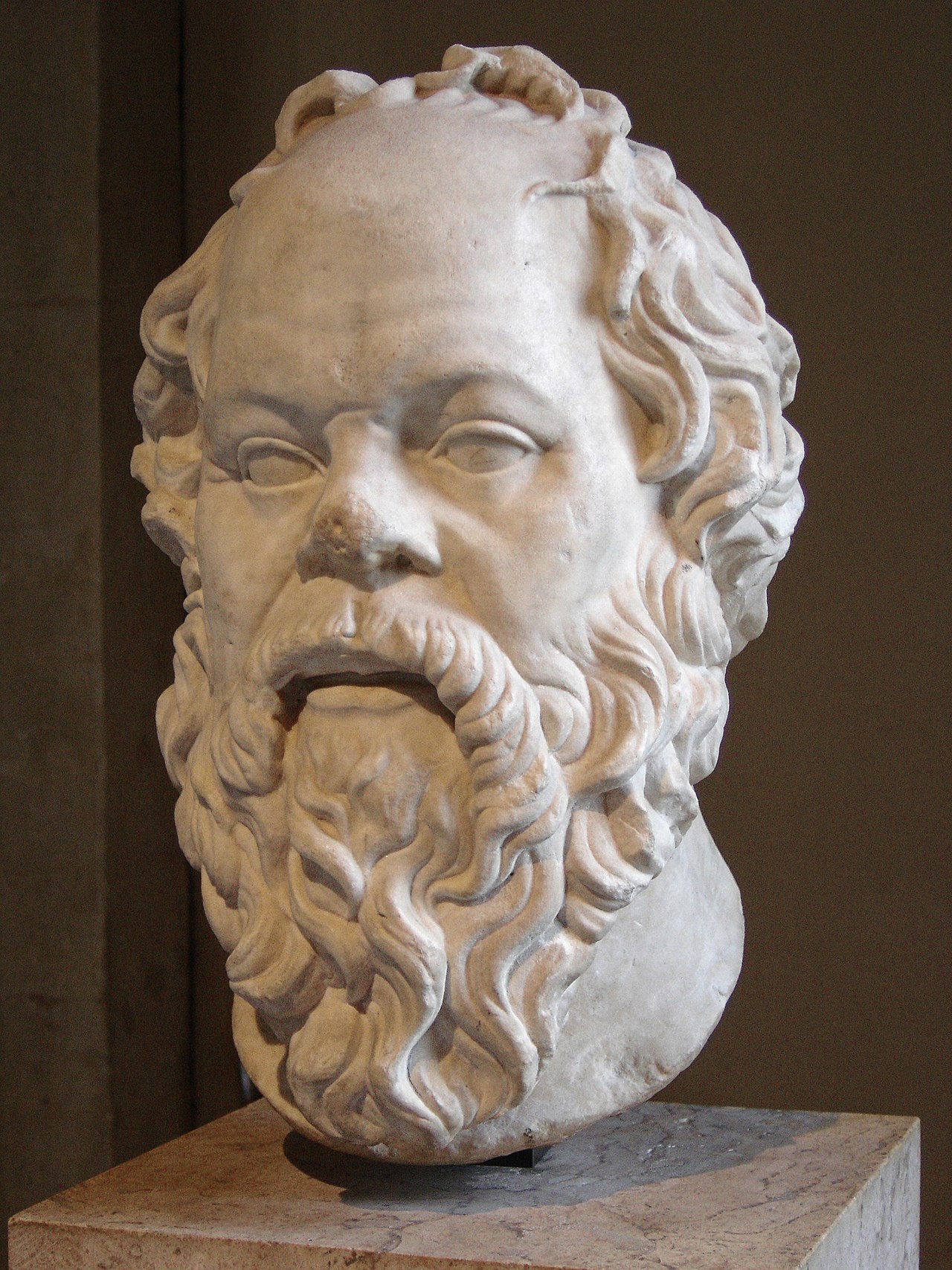
The fifth and fourth centuries BCE produced the figures most closely associated with the Greek Axial achievement. Socrates (c. 470–399 BCE) redirected philosophical inquiry from cosmology to ethics, insisting that the fundamental question was not how the world was made but how a human being should live. His method — systematic questioning that exposed the contradictions and unexamined assumptions in conventional beliefs about virtue, piety, justice, and knowledge — was a direct enactment of the Axial principle that received tradition must answer to rational reflection. The Socratic legacy, transmitted through the dialogues of Plato (c. 428–348 BCE), developed into a comprehensive philosophical system in which the material world was subordinated to an intelligible realm of eternal Forms, and the cultivation of the soul's capacity for reason became the highest human good.18
Aristotle (384–322 BCE), working within and against the Platonic tradition, systematised logic, natural science, ethics, and politics on empirical and teleological foundations. His ethics centred on the concept of eudaimonia (flourishing or happiness) as the proper end of human life, achieved through the exercise of characteristic human virtues — intellectual and moral excellences that constituted the realisation of human nature. The combination of Socratic ethical seriousness, Platonic transcendence, and Aristotelian systematic rationalism produced a philosophical inheritance that would shape intellectual life in the Mediterranean, the Islamic world, and Christian Europe for two and a half millennia.18
The Israelite prophetic tradition
The prophetic tradition of ancient Israel produced, across roughly three centuries, a series of figures whose ethical demands and theological innovations transformed the religion of the Hebrew Bible from a national cult of a tribal deity into a tradition capable of articulating moral claims of universal scope. The writing prophets of the eighth and seventh centuries BCE — Amos, Hosea, Isaiah of Jerusalem, Micah, and later Jeremiah — shared a set of characteristic concerns that scholars have identified as specifically Axial in character: the subordination of ritual observance to ethical conduct, the insistence that the deity demanded justice rather than sacrifice, and the willingness to pronounce judgment on the political and social order of Israel and its neighbours in the name of an absolute moral standard.11, 21
The book of Amos, probably the earliest of the writing prophets (c. 760 BCE), opens with a series of oracles denouncing not only Israel's enemies but Israel itself for its treatment of the poor and the vulnerable — its sale of "the righteous for silver, and the needy for a pair of sandals." The prophet insists that YHWH hates and despises the festivals and burnt offerings of Israel unless they are accompanied by justice rolling "down like waters, and righteousness like an ever-flowing stream." This prioritisation of ethical conduct over cultic performance is precisely the Axial move Jaspers identified: the claim that what ultimately matters is not the correct execution of inherited ritual but the quality of one's moral life.21
Second Isaiah (Isaiah 40–55), composed during the Babylonian exile in the sixth century BCE, represents a further theological development of particular significance: the explicit articulation of ethical monotheism, the claim that YHWH is not merely the most powerful deity but the only God, the creator of all things, before whom all the nations and their gods are as nothing.12 This move toward radical transcendence — a God who stands entirely outside and above the created order and its political structures — both intensifies the prophetic critique of worldly power and opens the possibility of a universalist ethics applicable to all human beings regardless of their particular national or cultic allegiance. The prophetic tradition's insistence on the universality of moral demands, addressed to Israel and its neighbours alike in the name of a God who is God of all, represents one of the most consequential contributions of the Axial period to subsequent religious and ethical thought.6, 21
Indian traditions of the Axial period
The Indian subcontinent's contribution to the Axial transformation was richly diverse, encompassing the philosophical innovations of the Upanishads, the ethical radicalism of Jainism, and the Middle Way of the Buddha — three distinct but historically related movements that collectively represented a fundamental challenge to the ritual order of Vedic religion.
The early Upanishads, composed approximately between 800 and 400 BCE, mark the most important internal reformation of the Brahmanical tradition. These philosophical dialogues, embedded at the end of the Vedic corpus (and therefore called Vedanta, "the end of the Vedas"), shift attention from the external performance of sacrifice to the inner meaning of the ritual and ultimately to the question of ultimate reality itself. The central insight of the principal Upanishads is the identity of atman (the individual self or soul) with brahman (the ground of all being, the ultimate reality that underlies the phenomenal world). This equation — "tat tvam asi," "that thou art" — dissolved the boundary between the individual and the absolute, and opened the way for the tradition of non-dual metaphysics that would become one of the defining features of Hindu philosophical thought.8 The shift from external ritual to internal realisation is paradigmatically Axial: the locus of religious significance moves from the properly executed sacrifice to the quality and depth of the practitioner's inner understanding.
Mahavira (c. 599–527 BCE, though dates are disputed), the twenty-fourth and last tirthankara ("ford-crosser") of the Jain tradition, brought to systematic completion a tradition of wandering ascetics that predated his own life. Jain ethics are built on the absolute prohibition of violence (ahimsa) toward any living being — a principle followed to its most rigorous practical consequences in the conduct of Jain monks and nuns, who sweep the path before them to avoid treading on insects and strain their water to prevent harm to microscopic organisms. The Jain tradition's insistence on the moral equality of all life, its suspicion of social hierarchy, and its emphasis on the individual practitioner's own effort as the only path to liberation represent a thoroughgoing application of the Axial emphasis on individual moral responsibility.17
Siddhartha Gautama, the Buddha (c. 563–483 BCE, with significant scholarly uncertainty about the dates), taught a path of liberation from suffering that was explicitly non-theistic and grounded in an analysis of the human condition rather than in revelation or ritual. The Four Noble Truths — that life as ordinarily experienced involves suffering (dukkha), that suffering arises from craving, that the cessation of craving leads to the cessation of suffering, and that there is a path leading to that cessation — constitute a diagnosis and treatment of the human condition that presupposes no divine authority and no hereditary priesthood. The Buddha's rejection of caste, his teaching that liberation was available to anyone regardless of birth, and his insistence on personal verification of his claims ("come and see") rather than blind acceptance represent the Axial emphasis on rational reflection and individual moral responsibility at its most direct.9
Chinese traditions of the Axial period
China's Axial period coincided with the Eastern Zhou dynasty (770–256 BCE), a period of political fragmentation and interstate warfare that paradoxically produced one of the most creative periods of intellectual history in any civilisation. The dissolution of the centralised Zhou order created both the social disruption that made new ideas necessary and the competitive environment among the warring states that gave thinkers the opportunity to test their ideas before different audiences and patrons. The result was the Hundred Schools of Thought (baijia), a designation covering the major philosophical traditions that emerged during this period, of which Confucianism, Daoism, and Mohism are most directly relevant to the Axial transformation.10
Confucius (Kong Qiu, 551–479 BCE) addressed the political and moral disorder of his time with a vision of social restoration grounded in the cultivation of personal virtue and the observance of proper social relationships. The core Confucian virtues — humaneness (ren), ritual propriety (li), righteousness (yi), and filial piety (xiao) — were presented not as conventions to be followed mechanically but as expressions of a moral nature that required cultivation through sustained ethical practice. His teaching that the capacity for moral cultivation was available to all, not merely to those of noble birth, and that legitimate political authority depended on moral virtue rather than hereditary right, carried unmistakable Axial implications for the social order of his time.9
Laozi, the legendary author of the Daodejing (probably compiled between the sixth and fourth centuries BCE), articulated a vision of human flourishing rooted in alignment with the Dao — the nameless, formless, inexhaustible principle from which all things arise and to which all things return. Where Confucius sought to restore social order through the cultivation of virtue, Laozi questioned whether the entire project of deliberate moral cultivation was not itself part of the problem: the Daodejing's celebrated paradoxes — "the sage does not act, yet nothing is left undone" — suggest that the highest wisdom consists in releasing the compulsion to impose human categories and desires on the natural flow of things. This critique of self-conscious moral effort as a form of violence against the natural order represents a distinctively Chinese contribution to Axial reflection on the limits of conventional wisdom.10
Mozi (c. 470–391 BCE) represented the most radical departure from Confucian social ethics. Where Confucius grounded social obligation in the graduated relationships of kinship — loving one's parents more than strangers, one's compatriots more than foreigners — Mozi advocated jian ai, often translated as "universal love" or "impartial caring": the principle that one should have equal concern for every human being regardless of their relationship to oneself. Mozi's utilitarianism, his opposition to aggressive warfare, his suspicion of expensive funerary and musical ceremonies that consumed resources without benefiting the people, and his argument that moral and political authority derived from Heaven's impartial concern for all human welfare, constitute one of the most systematically universalist ethical positions of the Axial period.22
Common themes across the Axial traditions
Despite their significant doctrinal differences and their independent origins, the Axial traditions share a cluster of overlapping preoccupations that scholars have repeatedly identified as marking the Axial transformation.2, 6
The most consistently noted is a new emphasis on individual moral responsibility. In pre-Axial religious systems, the primary unit of moral and religious life was typically the community — the tribe, the lineage, the people — and the correct performance of communal ritual was the primary religious obligation. The Axial thinkers, without entirely abandoning communal obligations, introduced or intensified the idea that each individual person was answerable for the quality of their inner life, their intentions, and their ethical conduct toward other persons. The Buddha's insistence on personal verification and the individual's own effort; the prophets' demand for justice in one's personal dealings with the poor and the vulnerable; the Socratic insistence that each person must examine their own life — these are all expressions of the same fundamental shift.1, 6
Transcendence — the appeal to a standard or reality that stands beyond the given social and political order and by which it can be judged — is equally characteristic. Whether that transcendent reference point is conceived as the Platonic Forms, the God of the Hebrew prophets, brahman, the Dao, or the dhamma, the effect is similar: it creates a critical distance between the ideal and the actual that makes possible a principled critique of power and tradition. Related to this is a concern with the nature of suffering and its causes: the Axial period saw, across its different centres, a new seriousness about the problem of human suffering that went beyond the propitiation of hostile supernatural forces to ask structural questions about the nature of human life and its deepest needs.2, 3
Finally, the Axial period is distinguished by the questioning of tradition itself as a sufficient justification for belief or practice. Socrates questioned the unexamined assumptions of his fellow Athenians; the prophets questioned the efficacy of Israel's sacrificial system; the Buddha questioned the authority of the Vedas; Confucius questioned the moral adequacy of his own age. In each case, inherited practice was subjected to a demand for rational or ethical justification that it could not always meet. It is this reflexive, critical dimension of Axial thought — the willingness to turn the tools of reason and conscience on the very tradition that shaped one's intellectual formation — that has made the Axial age appear to later observers as a genuine threshold in the history of human consciousness.1, 4
Proposed explanations
The apparent simultaneity of Axial transformations across widely separated civilisations invites causal explanation, and a number of hypotheses have been advanced, none of them fully satisfactory on its own but each capturing part of the picture.4, 7
Urbanisation and literacy are among the most frequently cited structural conditions. The period 800–200 BCE saw, in all four Axial regions, the growth of cities large enough to sustain populations of literate specialists, including teachers, scribes, merchants, and administrators, who were at least partially freed from the demands of subsistence agriculture. Urban environments concentrated diverse populations and exposed individuals to a wider range of practices, beliefs, and customs than was possible in village societies, creating the cognitive conditions for comparison, relativism, and critical reflection. The spread of alphabetic literacy, which lowered the barriers to textual production and made possible the sustained articulation and transmission of complex philosophical arguments, was particularly important in Greece and Israel.14, 20
The rise of coinage and market economies has been proposed as a specific catalyst, particularly in Greece and India. The adoption of coinage in Lydia and its rapid spread through the Greek world in the seventh and sixth centuries BCE created new forms of abstract value, new patterns of social mobility, and new kinds of economic relationship that cut across traditional hierarchies of birth and status. The experience of market exchange — in which the relevant question is the abstract value of goods rather than the social standing of the parties — may have encouraged more abstract and universalist modes of reasoning.13 In India, the rise of urban trading centres in the Ganges plain during the sixth century BCE created a prosperous merchant class whose support for the wandering teachers of heterodox traditions — the Buddha and Mahavira among them — provided a social base for the new teachings independent of the Brahmanical establishment.
Trade network expansion and cosmopolitan encounters have been emphasised by scholars who note that the first millennium BCE saw an intensification of long-distance trade connections across Eurasia, bringing into contact populations with different religious and philosophical traditions and creating the experience of cultural pluralism that stimulated comparative reflection. The Silk Road predecessors, the Phoenician trading networks, and the Persian empire's vast administrative system all contributed to an environment in which educated individuals encountered unfamiliar ideas and were compelled to articulate the foundations of their own traditions in more explicit and defensible terms.20
Robert Bellah's model of religious evolution, developed most fully in his 2011 work Religion in Human Evolution, offers a more comprehensive framework. Bellah drew on cognitive science, evolutionary biology, and comparative religion to argue that the Axial Age represented a genuine qualitative shift in the complexity of cultural and religious systems — from what he called "archaic" religion, organised around royal ritual and cosmological myth, to "theoretic" culture, in which explicit second-order reflection on first-order beliefs became possible. For Bellah, this shift was made possible by the development of literacy and the practices of reading and writing, which externalise thought and make it available for sustained critical examination in a way that oral tradition cannot.3 Literacy, on this account, was not merely a medium for transmitting Axial ideas but a cognitive technology that made Axial reflection possible in the first place.
Critiques of the Axial Age concept
The Axial Age hypothesis has attracted sustained criticism from several directions, and the critiques have substantially qualified, though not demolished, its standing as a useful organising concept.15, 16
The most fundamental criticism concerns the apparent Eurocentrism of the framework. Jack Goody and others have argued that Jaspers' category of "transcendence" and his criterion for identifying Axial transformations reflect specifically European and Near Eastern intellectual preoccupations and cannot be applied without distortion to Chinese and Indian traditions, which are then effectively judged by a standard derived from the traditions that generated the concept in the first place. On this view, the Axial Age is not a neutral descriptive category but a covert argument for the unity of "Western civilisation" (extended to include the traditions that influenced it) and for the comparative inferiority or absence of genuine philosophical development outside its boundaries.16
A related criticism concerns the exclusion of significant intellectual and religious developments that do not fit the Axial schema. Mesoamerican civilisations produced sophisticated cosmological, calendrical, and ethical systems during the relevant period, but they are absent from Jaspers' account. Sub-Saharan African philosophical and religious traditions, though less well-documented for this period due to the relative absence of writing, have also been marginalised by a framework that equates Axial breakthrough with the production of surviving texts. The selection of precisely four "Axial" regions, critics have suggested, tells us as much about the geographical limits of Jaspers' own knowledge as it does about the actual distribution of intellectual innovation in the first millennium BCE.15
The simultaneity problem has also been challenged. When the dates assigned to the various Axial figures are examined carefully, the period 800–200 BCE turns out to be sufficiently capacious to accommodate almost any significant development one might wish to include. The Upanishads were composed across several centuries; the dating of Zoroaster ranges in scholarly literature from the second millennium to the sixth century BCE;19 the canonical Buddhist tradition is subject to substantial chronological uncertainty. Critics have argued that the appearance of simultaneity is partly an artefact of the breadth of the time window and partly of the selective identification of traditions that happen to fall within it, with developments that do not conform to the Axial type quietly set aside.15
Finally, some historians have questioned whether the Axial period really represents a sharp discontinuity with what preceded it or whether it represents the culmination of longer-term developments — in literacy, urbanisation, and trade — that had been underway for centuries before the supposed breakthrough. The prophetic tradition of Israel had antecedents in earlier Near Eastern wisdom literature and in the specific experiences of political catastrophe and exile; Greek philosophy built on traditions of Ionian natural speculation that stretched back at least to the early seventh century BCE; and the heterodox ascetic traditions within which Buddhism and Jainism emerged were themselves ancient. From this perspective, the Axial Age may mark the intensification and systematisation of tendencies that were already present rather than a genuine qualitative threshold.7
Continuing influence
Whatever the force of these critiques, the practical influence of the Axial traditions on subsequent history is difficult to overstate. The philosophical and religious innovations of the period 800–200 BCE did not merely remain as historical curiosities: they became the living intellectual foundations of the world's most widely practised religions and philosophical systems, shaping the moral imagination of the majority of the human beings who have lived since their formulation.2, 6
In the West, the Greek philosophical tradition became the primary framework within which Christian theology was articulated from the second century CE onward, and it supplied the conceptual vocabulary of the European Enlightenment, modern science, and liberal political philosophy. The Israelite prophetic tradition provided the ethical core of Judaism, Christianity, and — mediated through those traditions — Islam, giving the Abrahamic religions their characteristic emphasis on justice, compassion, and the accountability of power to a transcendent moral standard. The Zoroastrian tradition of ancient Persia, often counted as a fifth Axial development, influenced the eschatology and dualistic theology of late Second Temple Judaism and, through it, Christian and Islamic conceptions of the last judgment and the cosmic struggle between good and evil.19
In South Asia, the Upanishadic, Buddhist, and Jain traditions became the living religions of hundreds of millions of people and generated philosophical literatures of extraordinary depth and sophistication. Buddhism spread along trade routes to central, east, and southeast Asia, becoming one of the great missionary religions of world history and transforming the intellectual and artistic cultures of China, Japan, Korea, Tibet, and southeast Asia. The principle of ahimsa, inherited from both the Jain and Buddhist traditions and adapted by the Hindu tradition, became the conceptual foundation for Gandhi's practice of non-violent resistance in the twentieth century — one of the most consequential applications of an ancient idea to a modern political problem.9, 17
In East Asia, Confucianism became the official ideology of the Chinese imperial state under the Han dynasty and retained its dominance as the framework for political ethics, education, and social life in China, Korea, Japan, and Vietnam until the twentieth century. The Chinese civil service examination system, which based official recruitment on mastery of the Confucian classics, institutionalised Axial values of moral cultivation and meritocratic service for over a millennium. The Daoist tradition gave Chinese culture its distinctive emphasis on the natural order, spontaneity, and the limits of deliberate human intervention — themes that permeate Chinese poetry, painting, medicine, and martial arts to the present day.9, 10
The Axial Age concept itself has become an important tool of cross-cultural dialogue. In the hands of scholars such as Shmuel Eisenstadt, Robert Bellah, and Karen Armstrong, it has been used to identify what is genuinely shared across the world's major intellectual traditions and to ground proposals for intercultural communication that go beyond a merely relative appreciation of cultural difference. Whether or not Jaspers' original thesis survives scrutiny in all its details, the questions it raises — about the conditions under which deep intellectual transformations occur, about the relationship between social complexity and ethical universalism, and about the common heritage of a species capable of producing both Socrates and the Buddha — remain among the most interesting questions that the human sciences can ask.2, 4
Key figures and approximate dates of the Axial period1, 6, 9, 10
| Region | Figure / development | Approximate date | Core contribution |
|---|---|---|---|
| Greece | Pre-Socratic philosophers | c. 600–450 BCE | Rational cosmology; critique of mythological explanation |
| Greece | Socrates | c. 470–399 BCE | Ethical inquiry; the examined life |
| Greece | Plato | c. 428–348 BCE | Theory of Forms; the soul and transcendent truth |
| Greece | Aristotle | 384–322 BCE | Systematic logic and ethics; eudaimonia |
| Israel | Amos, Isaiah, Micah | c. 760–700 BCE | Ethical prophecy; justice over ritual |
| Israel | Jeremiah | c. 627–587 BCE | Individual conscience; the new covenant of the heart |
| Israel | Second Isaiah | c. 550 BCE | Ethical monotheism; universal moral scope |
| India | Upanishadic teachers | c. 800–400 BCE | Atman/brahman identity; inner realisation over external ritual |
| India | Mahavira | c. 599–527 BCE | Radical ahimsa; individual liberation through ascetic effort |
| India | Siddhartha Gautama (the Buddha) | c. 563–483 BCE | Four Noble Truths; non-theistic path to liberation |
| China | Confucius | 551–479 BCE | Moral cultivation; virtue as ground of political legitimacy |
| China | Laozi | c. 6th–4th cent. BCE | The Dao; spontaneity and the limits of deliberate action |
| China | Mozi | c. 470–391 BCE | Universal love (jian ai); utilitarian ethics |