Overview
- The Toltec civilization, centred at the city of Tula (ancient Tollan) in the modern Mexican state of Hidalgo, dominated central Mexico during the Early Postclassic period (ca. 900–1150 CE), growing into an urban centre of approximately 16 km² with an estimated population of 60,000 inhabitants and a surrounding hinterland of 20,000–25,000 more.
- Tula served as a major hub of long-distance trade and craft production, particularly obsidian blade manufacture, and its distinctive architectural and iconographic style—including the iconic 4.6-metre Atlantean warrior columns atop Pyramid B—appeared at sites across Mesoamerica, most strikingly at Chichén Itzá in Yucatán, over 1,000 kilometres to the east.
- Later Aztec and colonial-period sources elevated the Toltecs to semi-mythical status as the originators of civilised arts, architecture, and the Feathered Serpent cult of Quetzalcoatl, making the separation of historical Tula from legendary Tollan one of the most challenging problems in Mesoamerican archaeology.
The Toltec civilization was a major Mesoamerican polity centred at the city of Tula (ancient Tollan) in what is now the state of Hidalgo, approximately 80 kilometres north of modern Mexico City.1, 2 Flourishing during the Early Postclassic period from approximately 900 to 1150 CE, Tula grew into one of the largest cities in Mesoamerica, covering roughly 16 km² and supporting an estimated 60,000 inhabitants at its peak, with an additional 20,000 to 25,000 people in the surrounding hinterland.1, 4 The Toltec state occupied a pivotal position in Mesoamerican history, bridging the gap between the collapse of Classic period centres such as Teotihuacan and the rise of the Aztec Empire in the fifteenth century.8, 14 Tula served as a major centre of craft production, long-distance trade, and military power, and its architectural and iconographic traditions appeared at sites across Mesoamerica, most dramatically at Chichén Itzá in the northern Yucatán Peninsula.9, 13 The Toltecs held a unique place in the memory of later Mesoamerican peoples: the Aztecs revered them as the founders of civilised arts, architecture, calendrical knowledge, and the cult of the Feathered Serpent, Quetzalcoatl, making the historical Toltec state inseparable from its legendary image as the ur-civilization of central Mexico.5, 6, 14
History and myth: the problem of Tollan
The study of the Toltec civilization is uniquely complicated by the fact that much of what was written about the Toltecs derives from Aztec and early colonial-period accounts that blend historical memory with mythology, political ideology, and cosmological narrative.5, 6 In Aztec tradition, Tollan was not merely a city but an archetype of the ideal civilised polity — a place of extraordinary artisans (toltecatl literally meant "craftsman" or "artist" in Nahuatl), abundant harvests, and divine kingship under the ruler-priest Ce Acatl Topiltzin Quetzalcoatl.6, 14 According to these narratives, Topiltzin Quetzalcoatl promoted peaceful worship and autosacrifice, but was driven from Tollan by the sorcerer-god Tezcatlipoca and departed eastward, vowing to return — a prophecy that some scholars have argued influenced the Aztec response to the arrival of Hernán Cortés in 1519, though this interpretation is heavily debated.6, 5
H. B. Nicholson's exhaustive analysis of all known primary sources, in Spanish, Nahuatl, and Mayan, concluded that the Topiltzin Quetzalcoatl traditions, while heavily mythologised, likely preserve a historical kernel referring to a real Toltec ruler or succession of rulers associated with the Feathered Serpent cult.6 The identification of archaeological Tula in Hidalgo with the legendary Tollan was established through the combined work of Wigberto Jiménez Moreno, Jorge Acosta, and subsequent excavators beginning in the 1940s and 1950s, though some scholars have argued that Teotihuacan, Cholula, or other sites may have also been known as "Tollan" in different traditions, since the name appears to have been a generic title applied to any great city.1, 5, 8 Since the 1990s, scholarship has increasingly adopted a critical approach to the Toltec narratives, treating "Toltec" partly as a historical designation for the people of Early Postclassic Tula and partly as an ideological construct through which later Mesoamerican peoples legitimised their own authority by claiming Toltec descent.5, 20
Origins and rise of Tula
The Tula region in the semiarid highlands of central Mexico was occupied long before the emergence of the Toltec state, but substantial urban growth began during the Epiclassic period (ca. 650–900 CE), a time of political fragmentation and population movement following the decline of Teotihuacan around 550–650 CE.1, 10 The earliest significant settlement at Tula, known as Tula Chico, was established between approximately 700 and 750 CE and appears to have functioned as a small ceremonial centre with modest pyramidal platforms, a ball court, and surrounding residential areas.10, 15 Tula Chico's architectural layout and ceramic assemblages show strong connections to the broader Epiclassic cultural sphere of central Mexico, with influences from Teotihuacan, the Bajío region to the northwest, and the Gulf Coast.1, 15
Around 900 CE, the settlement underwent a dramatic transformation.1, 10 The civic-ceremonial centre shifted approximately one kilometre south to a new complex known as Tula Grande, which became the monumental heart of the Toltec capital during the Tollan phase (ca. 950–1150 CE).4, 10 The city expanded rapidly, incorporating a remarkably diverse landscape of hills, alluvial valleys, plains, and marshland into a densely settled urban zone.4, 11 Excavations at more than 22 localities across the site have uncovered complex arrangements of residential compounds whose nondurable adobe and stone construction left relatively few surface traces, making population estimates challenging but placing the urban core at approximately 60,000 inhabitants.1, 3, 4 The factors driving this rapid urbanisation likely included agricultural intensification through canal irrigation in the Tula River valley, the growth of obsidian craft production, and Tula's strategic position along trade routes connecting central Mexico with the arid north and the Gulf Coast.1, 4, 7
The urban centre: Tula Grande
.jpg)
.jpg)
The ceremonial core of Tula Grande was organised around a central plaza flanked by pyramidal temples, colonnaded halls, ball courts, and a tzompantli (skull rack) — an architectural complex that would later be echoed in the layout of the Aztec Templo Mayor precinct at Tenochtitlan.1, 2, 4 The most famous structure is Pyramid B (also called the Temple of Tlahuizcalpantecuhtli, the Morning Star), a five-tiered stepped pyramid surmounted by four colossal Atlantean warrior figures, each standing approximately 4.6 metres tall and carved from basalt.2, 4 The Atlantean columns depict Toltec warriors wearing feathered headdresses, butterfly-shaped breast plates, and back discs representing the sun, while holding atlatls (spear throwers) and incense bags — a militaristic iconography that represents a significant departure from the priestly imagery that dominated earlier Mesoamerican monumental art.2, 9
Adjacent to Pyramid B, a large colonnaded hall known as Burned Palace (Palacio Quemado) contained rows of pillars that once supported a roof over a vast interior space, with low benches along the walls carved in relief with processions of warriors and other figures.1, 2 The presence of a Coatepantli (serpent wall) decorated with carved panels showing serpents devouring skeletal human figures further emphasised the martial and sacrificial themes that pervaded Toltec public architecture.2, 4 Two ball courts have been identified at Tula Grande, the larger of which measures approximately 67 metres in length, and the site also features chacmool sculptures — reclining figures with a receptacle on the abdomen for offerings — a sculptural form that became widespread across Postclassic Mesoamerica.1, 2, 8
Beyond the ceremonial core, the residential zones of Tula consisted of multi-room apartment compounds built from adobe and stone rubble, typically arranged around interior courtyards and organised into neighbourhoods that appear to have been ethnically and occupationally distinct.4, 11, 16 Dan Healan's systematic investigations of the city's northern sector revealed dense clusters of residential architecture interspersed with workshops, midden deposits, and open areas, indicating a complex urban fabric that extended well beyond the monumental centre.16
Economy and long-distance trade
The Toltec economy rested on a combination of irrigated agriculture, intensive craft production, and long-distance exchange networks that connected Tula to virtually every corner of Mesoamerica.1, 4 The Tula River valley provided water for canal irrigation that sustained maize, bean, squash, and amaranth cultivation in an otherwise semiarid environment receiving only 600–700 millimetres of annual rainfall.1, 10 Maguey (Agave) was also a critical resource, providing fibre for textiles and cordage, as well as the fermented drink pulque, and its cultivation on drier hillsides expanded the productive capacity of the landscape.1, 4
The most archaeologically visible craft industry at Tula was obsidian blade production.7 Healan, Kerley, and Bey's excavation of a workshop zone in the city recovered over 500,000 pieces of obsidian, revealing an exclusively core-and-blade industry that imported percussion macrocores from at least two geological sources and produced prismatic blade cores, blades, and finished blade products on an industrial scale.7 Chemical sourcing studies have shown that the majority of obsidian at Tula came from the Pachuca source in the Sierra de las Navajas, approximately 70 kilometres to the east, which produced a distinctive green obsidian highly prized across Mesoamerica.4, 7 The same Pachuca green obsidian appears in large quantities at Chichén Itzá and other distant sites, providing material evidence for the far-reaching trade connections that linked Tula to the wider Mesoamerican world.13, 9
Other trade goods moving through Tula included Tohil Plumbate ceramics from the Pacific coast of Guatemala and Chiapas, Fine Orange wares from the Gulf Coast lowlands, turquoise and other minerals from the arid north, and marine shell from both the Gulf and Pacific coasts.1, 4, 8 The presence of these goods at Tula and the reciprocal appearance of Toltec-style artefacts at distant sites indicate that the city functioned as a major node in Postclassic Mesoamerican trade networks, though the degree to which this exchange was administered by the state, conducted by independent merchants, or both, remains a subject of debate.4, 20
Principal trade goods at Tula and their origins4, 7, 8
| Trade good | Source region | Distance from Tula | Archaeological evidence |
|---|---|---|---|
| Green obsidian | Pachuca, Hidalgo | ~70 km | 500,000+ workshop debitage pieces |
| Grey obsidian | Ucareo/Zinapecuaro, Michoacán | ~250 km | Secondary source in blade workshops |
| Tohil Plumbate ceramics | Pacific coast, Guatemala/Chiapas | ~1,000 km | Elite residential and ceremonial contexts |
| Fine Orange ware | Gulf Coast lowlands | ~400 km | Domestic and ceremonial deposits |
| Turquoise | Northern Mexico / American Southwest | ~1,500+ km | Mosaic ornaments and offerings |
| Marine shell | Gulf and Pacific coasts | ~300–500 km | Ornaments, trumpets, ritual objects |
The Tula–Chichén Itzá connection
One of the most striking and debated phenomena in Mesoamerican archaeology is the extraordinary architectural and iconographic similarity between Tula and Chichén Itzá, a major Maya city in the northern Yucatán Peninsula, more than 1,000 kilometres to the east.9, 13 The parallels are remarkable in their specificity: both sites feature stepped pyramids surmounted by columnar warrior figures, colonnaded halls, chacmool sculptures, tzompantli skull racks, serpent columns, and nearly identical iconographic programmes depicting warriors, feathered serpents, eagles and jaguars consuming human hearts, and composite supernatural beings.9, 13 The Temple of the Warriors at Chichén Itzá is virtually a mirror of Pyramid B at Tula, and Karl Taube's detailed iconographic analysis demonstrated that the so-called "Toltec style" elements at Chichén Itzá form a coherent programme with clear connections to the art of Tula.9
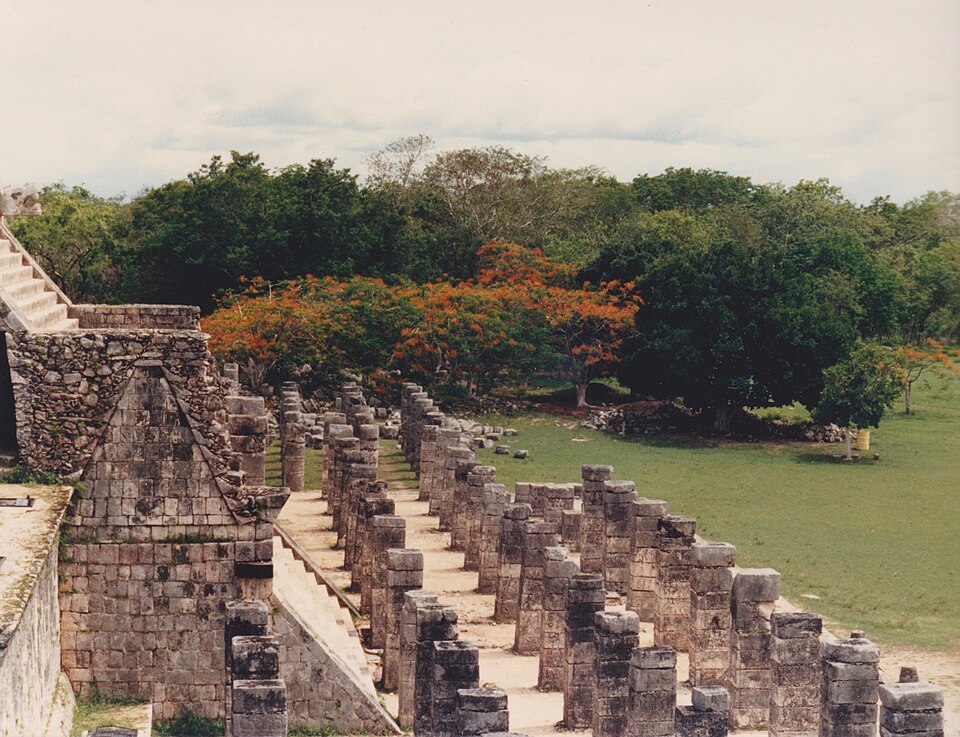

The traditional explanation, advanced by scholars from Désiré Charnay in the late nineteenth century onward, held that a Toltec invasion or migration from Tula to Yucatán around 987 CE — led by Topiltzin Quetzalcoatl (known in Maya as Kukulkan) after his expulsion from Tollan — introduced these architectural and iconographic forms to Chichén Itzá.6, 9, 19 However, revised radiocarbon chronologies have shown that many of the "Toltec" features at Chichén Itzá may be contemporary with or even earlier than their counterparts at Tula, undermining simple diffusionist models.13, 19 Michael E. Smith has argued that the similarities may reflect a shared participation in a broader Early Postclassic international style, with both cities drawing on a common ideological and artistic repertoire rather than one directly copying the other.13 Other scholars have proposed bidirectional exchange, with elite groups, merchants, and warrior sodalities moving between the two centres and transmitting ideas and artistic conventions in both directions.19 The question remains unresolved, but most current research rejects the simple "Toltec conquest" model in favour of more complex processes of interaction, emulation, and shared elite culture across Postclassic Mesoamerica.13, 19, 20
Religion and ideology
Toltec religious life, as reconstructed from both archaeological evidence at Tula and later Aztec accounts, centred on the veneration of Quetzalcoatl (the Feathered Serpent) and Tezcatlipoca (the Smoking Mirror), two of the most important deities in the Mesoamerican pantheon.6, 8 The feathered serpent motif appears prominently in Tula's monumental architecture, including the serpent columns at Pyramid B and the Coatepantli wall, while Tezcatlipoca — associated with warfare, darkness, and sorcery — may be represented in the warrior imagery that dominates the site.2, 6 The mythological tension between these two deities, embodied in the narrative of Topiltzin Quetzalcoatl's expulsion by Tezcatlipoca, may reflect real factional struggles within the Toltec elite between competing religious cults or political factions.6, 5
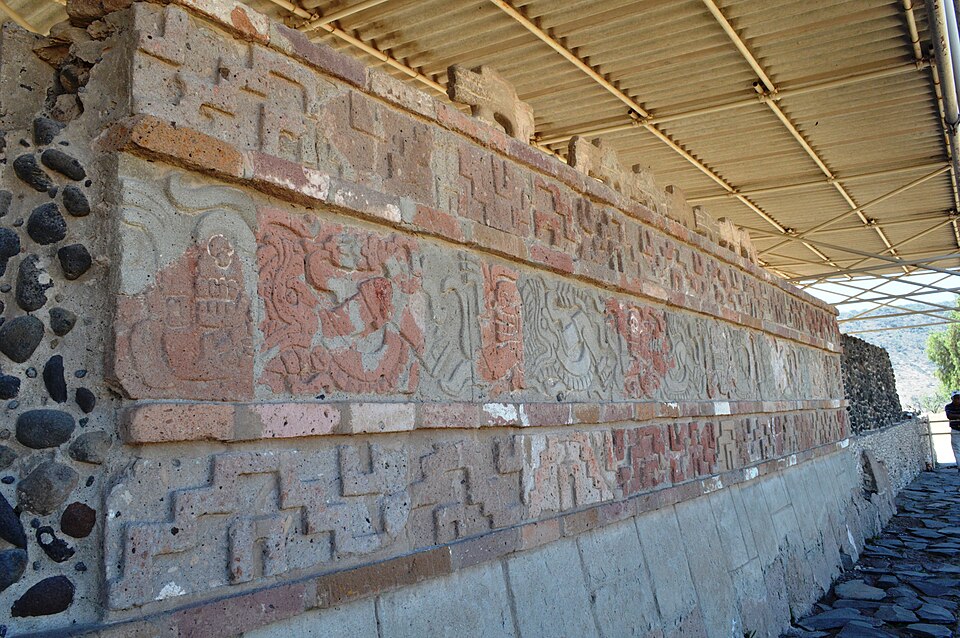

The iconographic programme at Tula Grande reveals a pronounced emphasis on warfare and sacrifice.2, 9 The Atlantean warrior figures atop Pyramid B, the processions of warriors carved on the benches of the Burned Palace, the eagles and jaguars depicted consuming human hearts on the relief panels, and the tzompantli (skull rack) adjacent to the ball court all point to an ideology in which military prowess and the ritual sacrifice of captives held central importance.2, 4 This martial iconography represents a significant shift from the more theocratic imagery of Classic period Teotihuacan and may reflect the political realities of the Postclassic world, in which competing polities vied for control of trade routes and agricultural territory in an environment of heightened interregional conflict.8, 18 The presence of chacmool sculptures — reclining figures holding receptacles that may have received sacrificial offerings including hearts, blood, pulque, and incense — further reinforces the centrality of ritual offering in Toltec religious practice.1, 2
Political organisation and regional influence
The political structure of the Toltec state remains imperfectly understood, in part because the ethnohistoric accounts that describe Toltec government are heavily mythologised and in part because the archaeological evidence for administrative organisation is limited.4, 20 Aztec traditions describe Toltec rulers (tlatoque) as divine or semi-divine kings who governed from Tollan, and colonial-period sources preserve king lists that name approximately a dozen rulers spanning roughly 200 years, though the historical reliability of these lists is uncertain.5, 6 Archaeological evidence from Tula suggests a society with significant social stratification: residential compounds near the ceremonial core are larger and contain more imported luxury goods than those on the periphery, indicating marked differences in wealth and status.4, 11
Whether the Toltec polity constituted an "empire" in any meaningful sense is vigorously debated.20 Michael E. Smith has estimated that the area under direct Toltec control may have encompassed approximately 8,000 km², including the Tula region, parts of the Basin of Mexico, and territory extending northward into the Mezquital Valley — a substantial regional state but far smaller than the later Aztec domain.20 The widespread distribution of Toltec-style artefacts across Mesoamerica does not necessarily indicate political control; it may instead reflect trade connections, ideological influence, the movement of artisan communities, or the deliberate emulation of Toltec forms by elites in distant polities seeking prestige and legitimacy.8, 20 The consensus view holds that Tula was the capital of a powerful regional state with extensive commercial and cultural reach, but that its political authority was largely confined to central Mexico.4, 20
Estimated area of direct Toltec political control compared with other Mesoamerican polities14, 18, 20
Collapse and abandonment
The Toltec state collapsed during the mid-twelfth century CE, and much of Tula was abandoned, burned, and systematically desecrated.1, 4 Archaeological evidence from Tula Grande documents the burning of the ceremonial centre, the toppling and partial burial of monumental sculptures (including the Atlantean columns, which were found in a collapsed state during Jorge Acosta's excavations in the 1940s), and the wholesale disruption of the ceramic traditions that had characterised the Tollan phase.4, 10 Many residential areas appear to have been abandoned by approximately 1150 CE, though the precise chronology of events — abandonment, burning, looting, and reoccupation — remains difficult to disentangle, and these need not represent a single catastrophic event.4, 10
Multiple factors likely contributed to Tula's decline.1, 4 Palaeoclimatic evidence from lake sediment cores in central Mexico documents a severe and sustained drought between approximately 1149 and 1167 CE, which would have devastated the irrigated agriculture on which the city depended.4 Ethnohistoric sources describe incursions by northern nomadic groups collectively termed Chichimecs, with raids recorded as early as 1115 CE that may have progressively weakened Toltec defences.5, 12 Internal political fragmentation, perhaps reflected in the mythological conflict between Quetzalcoatl and Tezcatlipoca factions, may have further undermined the ruling elite's capacity to maintain order.5, 6 As with many Mesoamerican collapses, the fall of Tula likely resulted from the interaction of environmental stress, external military pressure, and internal political dysfunction rather than any single cause.4, 18
Following the collapse, the Tula area was partially reoccupied during the Late Postclassic period (ca. 1200–1521 CE), and the Aztecs subsequently used the ruins of Tula as a quarry for sculptural and architectural elements, transporting Toltec artefacts to Tenochtitlan as sacred relics that reinforced their claim to Toltec heritage.5, 14, 17
Legacy
The Toltec legacy in Mesoamerican history is immense, though it operates as much through myth and ideology as through material culture.5, 14 For the Aztecs, claiming Toltec descent was essential to political legitimacy: the ruling dynasties of Tenochtitlan, Tetzcoco, and other Basin of Mexico city-states traced their lineages back to Toltec royalty, and the word toltecatl came to mean "artisan" or "civilised person" in general, signifying that Toltec culture was synonymous with high civilisation itself.14, 5 The Aztec tribute economy, ceremonial architecture, warrior iconography, and veneration of Quetzalcoatl all drew heavily on Toltec precedents, whether directly inherited or consciously revived.14, 8
Archaeologically, the Toltec period represents a critical episode in the broader transition from the Classic to the Postclassic era in Mesoamerica — a period marked by increased militarism, long-distance trade intensification, new forms of political organisation, and the emergence of a shared "international" art style that linked communities across vast distances.8, 18 The distinctive Toltec artistic vocabulary — warrior columns, chacmools, feathered serpent motifs, eagle-and-jaguar warrior orders — spread across Mesoamerica and became foundational elements of Postclassic visual culture.8, 9 Modern scholarship continues to grapple with the challenge of separating the historical Toltec state from its legendary afterlife, a task that requires the integration of archaeology, ethnohistory, iconographic analysis, and critical source evaluation in what Christopher Beekman has called one of the most complex problems in New World archaeology.5, 4
References
The Enduring Toltecs: History and Truth During the Aztec-to-Colonial Transition at Tula, Hidalgo
Salvage and Rescue Archaeology Inside Ancient Tula: Recent Discoveries and Revelations
The Return of the Toltecs: Reconsidering the Toltec Invasion Hypothesis at Chichen Itza