Overview
- Stellar evolution models, calibrated against observed nuclear physics, demonstrate that main-sequence lifetime depends on stellar mass — Sun-like stars burn hydrogen for ~10 billion years, while the oldest white dwarfs have been cooling for over 10 billion years, providing independent lower bounds on the age of the universe.
- Globular clusters contain the oldest stellar populations in the Milky Way; their Hertzsprung–Russell diagrams show main-sequence turnoff points consistent with ages of 10–13 billion years, confirmed by independent radioactive isotope dating of old stars using thorium and europium ratios.
- Galaxy lookback time provides direct evidence: light from distant galaxies was emitted billions of years ago, and the systematic differences between young and old galaxies confirm a universe that has been evolving over cosmic timescales.
The ages of stars and galaxies provide independent confirmation that the universe is billions of years old, corroborating the age of 13.8 billion years determined from the cosmic microwave background and the expansion of the universe.10 Multiple independent methods — stellar evolution modelling, white dwarf cooling ages, globular cluster main-sequence turnoff dating, nucleocosmochronology, and galaxy lookback time — all converge on timescales of billions of years for the oldest objects in the cosmos. Each method relies on different physics, and their mutual agreement constitutes powerful evidence for the reality of cosmic deep time.

Stellar lifetimes and the main sequence
Stars spend the majority of their lives on the main sequence of the Hertzsprung–Russell diagram, fusing hydrogen into helium in their cores. The duration of this hydrogen-burning phase depends critically on stellar mass: more massive stars have larger fuel reserves but burn through them at exponentially higher rates due to the extreme temperature sensitivity of nuclear fusion reactions. The result is a steep inverse relationship between mass and main-sequence lifetime.1
A star ten times the mass of the Sun exhausts its hydrogen fuel in roughly 20 million years. A Sun-like star persists on the main sequence for approximately 10 billion years. A red dwarf with one-tenth the solar mass will burn hydrogen for trillions of years — far longer than the current age of the universe. These lifetimes are not speculative: they are calculated from well-understood nuclear physics (the proton-proton chain and CNO cycle reactions, whose rates are measured in terrestrial laboratories) combined with the equations of stellar structure — hydrostatic equilibrium, energy transport, and conservation of energy.1 The models have been extensively validated against observed properties of stars at every evolutionary stage, including mass-luminosity relations, pulsation periods of variable stars, and the detailed properties of eclipsing binary systems whose masses can be measured directly.1, 4
Globular cluster ages
Globular clusters are dense, gravitationally bound collections of hundreds of thousands of stars that orbit in the halos of galaxies. They are among the oldest stellar systems in the universe, and their ages provide a firm lower bound on the age of the cosmos. Because all stars in a globular cluster formed from the same gas cloud at approximately the same time, they constitute a coeval stellar population that can be plotted on the H-R diagram as a single snapshot of stellar evolution at a specific age.12
The key diagnostic feature is the main-sequence turnoff point: the luminosity and temperature at which stars are just now exhausting their core hydrogen and beginning to evolve off the main sequence toward the red giant branch. The position of this turnoff is a direct measure of the cluster's age, because it identifies the most massive stars still on the main sequence — and therefore the main-sequence lifetime corresponding to that mass. In old globular clusters, the turnoff occurs at low luminosities, corresponding to stars only slightly more massive than the Sun, with main-sequence lifetimes of 10–13 billion years.2, 3
Chaboyer and colleagues, using improved stellar evolution models and Hipparcos-calibrated distances, derived ages for the oldest Milky Way globular clusters of 11.5 ± 1.3 billion years.3 Gratton and colleagues obtained similar results using subdwarf fitting with Hipparcos parallaxes.2 The ACS Survey of Galactic Globular Clusters, a comprehensive Hubble Space Telescope programme, produced high-precision H-R diagrams for 65 clusters, with the oldest showing turnoff ages of approximately 12–13 billion years.12 These ages are consistent with, and slightly younger than, the 13.8-billion-year age of the universe determined from the CMB, as expected — the oldest stars should be slightly younger than the universe itself.10, 13
White dwarf cooling ages
White dwarfs are the remnant cores of low- and intermediate-mass stars that have exhausted their nuclear fuel. They no longer generate energy through fusion; instead, they slowly radiate away their residual thermal energy, cooling and dimming over billions of years at rates that can be calculated from well-understood physics (crystallization, Coulomb interactions in dense plasma, and neutrino emission).8
The coolest, faintest white dwarfs in the Milky Way have been cooling for the longest time, and their luminosities provide an independent lower bound on the age of the stellar population they belong to. The white dwarf luminosity function — the number of white dwarfs as a function of luminosity — shows a sharp cutoff at the faintest end, corresponding to the oldest white dwarfs that have been cooling since the earliest epoch of star formation in the Galaxy. Liebert, Dahn, and Monet first used this cutoff to estimate the age of the Galactic disk at approximately 9–10 billion years.8 More recent analyses by Kilic and colleagues, using improved cooling models and larger samples, yield disk ages of 10–11 billion years and halo white dwarf cooling ages consistent with 12–13 billion years.9
White dwarf cooling chronology is entirely independent of main-sequence turnoff dating: it relies on thermal physics rather than nuclear physics. The agreement between the two methods provides strong mutual confirmation of billion-year timescales for the oldest stellar populations.9, 13
Radioactive dating of stars
A conceptually distinct approach to stellar age determination is nucleocosmochronology: measuring the abundances of long-lived radioactive isotopes in the atmospheres of old stars, analogous to radiometric dating of rocks on Earth. Thorium-232 (half-life 14.05 billion years) and uranium-238 (half-life 4.47 billion years) are produced by the rapid neutron-capture process (r-process) in neutron star mergers and supernovae. Their initial production ratios relative to stable r-process elements such as europium can be calculated from nuclear physics models, and the observed ratios in old stars reflect the amount of radioactive decay that has occurred since the elements were synthesized.5, 6
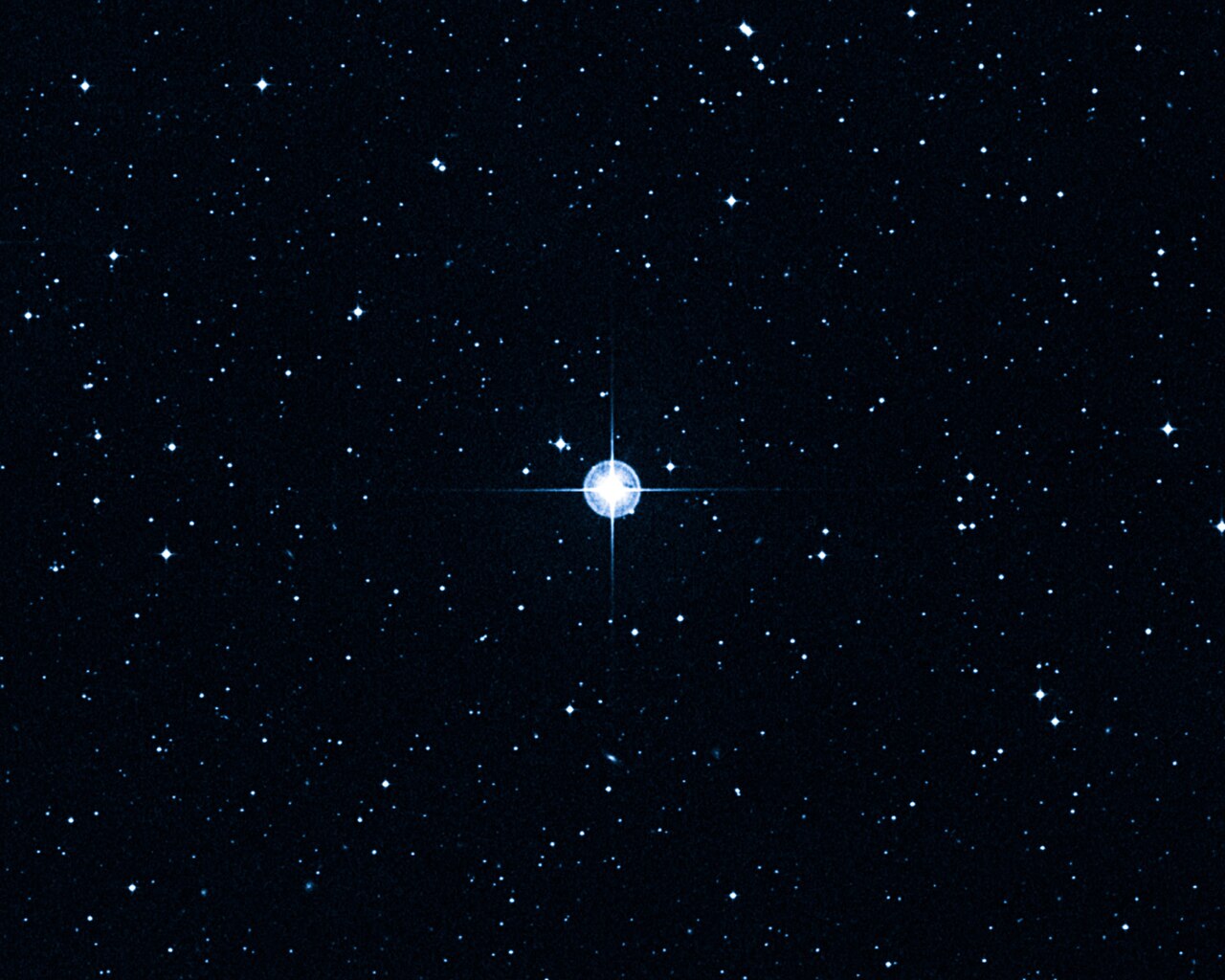
Cowan and colleagues measured the thorium-to-europium ratio in the ultra-metal-poor halo star CS 22892-052 and derived an age of approximately 15.2 ± 3.7 billion years, consistent within uncertainties with the age of the universe.6 Cayrel and colleagues subsequently measured both thorium and uranium in the metal-poor star CS 31082-001, using the Th/U ratio to obtain a more precise age of 12.5 ± 3 billion years.5 The star HD 140283, one of the oldest known stars in the solar neighbourhood, has been dated to 14.46 ± 0.8 billion years by Bond and colleagues using stellar evolution models constrained by Hubble Space Telescope parallaxes — formally consistent with the CMB age of 13.8 billion years within the quoted uncertainty.7
These radioactive ages are derived from entirely different physics than main-sequence turnoff or white dwarf cooling ages. The fact that all three approaches converge on timescales of 10–14 billion years for the oldest stars provides independent, cross-validated evidence for the antiquity of the stellar population.13
Galaxy lookback time
Perhaps the most direct evidence for billion-year timescales comes from the finite speed of light. Light travels at approximately 300,000 kilometres per second, and light from a galaxy one billion light-years away was emitted one billion years ago. Observing distant galaxies is therefore equivalent to looking into the past. The most distant galaxies detected by the James Webb Space Telescope have redshifts exceeding z = 10, meaning their light was emitted when the universe was less than 500 million years old.11
The systematic differences between distant (young) and nearby (mature) galaxies confirm that the universe has been evolving over these timescales. Distant galaxies are smaller, more irregular, bluer, and more actively forming stars than nearby galaxies of comparable mass. This evolution is not a selection effect: it is observed consistently across all wavelengths and survey strategies, and it matches the predictions of hierarchical structure formation in Big Bang cosmology.11 The existence of light that has been travelling for billions of years, from sources that look systematically different from present-day objects, is direct observational evidence that the universe is billions of years old.
The oldest individual stars
Among the most compelling evidence for the extreme antiquity of stellar populations are individual stars in the Milky Way halo that have been dated to ages approaching the age of the universe. HD 140283, an extremely metal-poor subgiant in the solar neighbourhood, has been the subject of particularly intensive study. Bond and colleagues used precise Hubble Space Telescope parallax measurements combined with detailed stellar evolution models to derive an age of 14.46 ± 0.8 billion years.7 While the central value formally exceeds the 13.8 Gyr age of the universe, it is consistent within the stated uncertainty, and more recent analyses incorporating revised oxygen abundances and updated stellar physics yield ages closer to 12–13 Gyr.15
Frebel and Norris have catalogued the properties of the most metal-poor stars known, some with iron abundances less than one hundred-thousandth of the solar value, representing material formed from gas enriched by only a few prior generations of supernovae. The very existence of these stars, with their extreme chemical poverty and kinematic properties consistent with the Galactic halo, indicates formation in the earliest phases of the Milky Way's assembly. Their inferred ages, whether from stellar evolution models, radioactive dating, or chemical abundance patterns, all point to formation within the first one to two billion years after the Big Bang.15, 16
Galaxies in the early universe
The James Webb Space Telescope (JWST), launched in December 2021, has extended the observational reach of galaxy lookback time to unprecedented distances. The JWST Advanced Deep Extragalactic Survey (JADES) has identified galaxies at redshifts exceeding z = 13, corresponding to lookback times of over 13.4 billion years — objects whose light was emitted when the universe was only approximately 300–400 million years old.14 These galaxies are compact, actively forming stars, and show spectral signatures of very young stellar populations with low metallicity, exactly as expected for objects observed at the dawn of cosmic star formation.14
The discovery of these very early galaxies does not challenge the age of the universe but confirms it: these objects are observed precisely where the Big Bang model predicts the first galaxies should be assembling. Their properties — small sizes, high specific star formation rates, and primitive chemical compositions — are systematically different from those of nearby mature galaxies, tracing a coherent evolutionary sequence from the young universe to the present day. The existence of light that has been travelling for over 13 billion years, from sources that display the expected signatures of cosmic youth, provides some of the most direct observational evidence that the universe has been evolving over billions of years.11, 14
Convergence of independent clocks
The significance of stellar and galactic age determinations lies in the convergence of methods that rely on independent physics. Main-sequence lifetimes depend on nuclear fusion rates. White dwarf cooling depends on thermal physics. Nucleocosmochronology depends on radioactive decay. Galaxy lookback time depends on the speed of light and the expansion of space. Each method has its own assumptions, its own sources of uncertainty, and its own potential systematic errors. Yet all converge on the same answer: the oldest objects in the universe are approximately 10–13 billion years old, consistent with a 13.8-billion-year-old cosmos.10, 13 This concordance is powerful evidence that the ages are real, and that the universe has existed for far longer than the timescales proposed by young-earth or young-universe models.
References
A new age diagnostic for stars in the turn-off region of the Hertzsprung-Russell diagram
The age of the oldest stars in the local Galactic disk from Hipparcos parallaxes of G and K subgiants
U/Th production ratio and the age of the Milky Way from meteorites and Galactic halo stars
ACS survey of globular clusters. V. Generating a comprehensive HR diagram for each cluster