Overview
- If the universe is only 6,000–10,000 years old, as young Earth creationism holds, light from galaxies billions of light-years away could not have reached Earth in that time—a contradiction that has resisted every attempted solution within the YEC framework.
- The four main YEC responses—Humphreys’ white hole cosmology, Lisle’s anisotropic synchrony convention, Setterfield’s c-decay hypothesis, and the mature creation (omphalos) argument—each fail on independent empirical or logical grounds.
- Mainstream cosmology dissolves the problem entirely: the universe is 13.8 billion years old, distances are confirmed by five independent methods, and the expanding universe itself explains why the observable radius exceeds 13.8 billion light-years.
The distant starlight problem is the most frequently cited internal challenge to young Earth creationism (YEC). It arises from a straightforward conflict between two sets of measurements. Cosmological observations consistently place numerous galaxies and quasars at distances of hundreds of millions to over thirteen billion light-years from Earth.1 A light-year is, by definition, the distance light travels in one year at the universal constant c ≈ 299,792 kilometers per second. If an object is ten billion light-years away, its light requires ten billion years to reach an observer—no shortcut through the physics exists under standard general relativity. YEC holds, on the basis of a literal reading of the Genesis genealogies, that the creation is between 6,000 and 10,000 years old. The contradiction is stark: the light arriving from the most distant observable objects tonight began its journey roughly two million times before the YEC date of creation. How, then, can a young Earth observer see it?
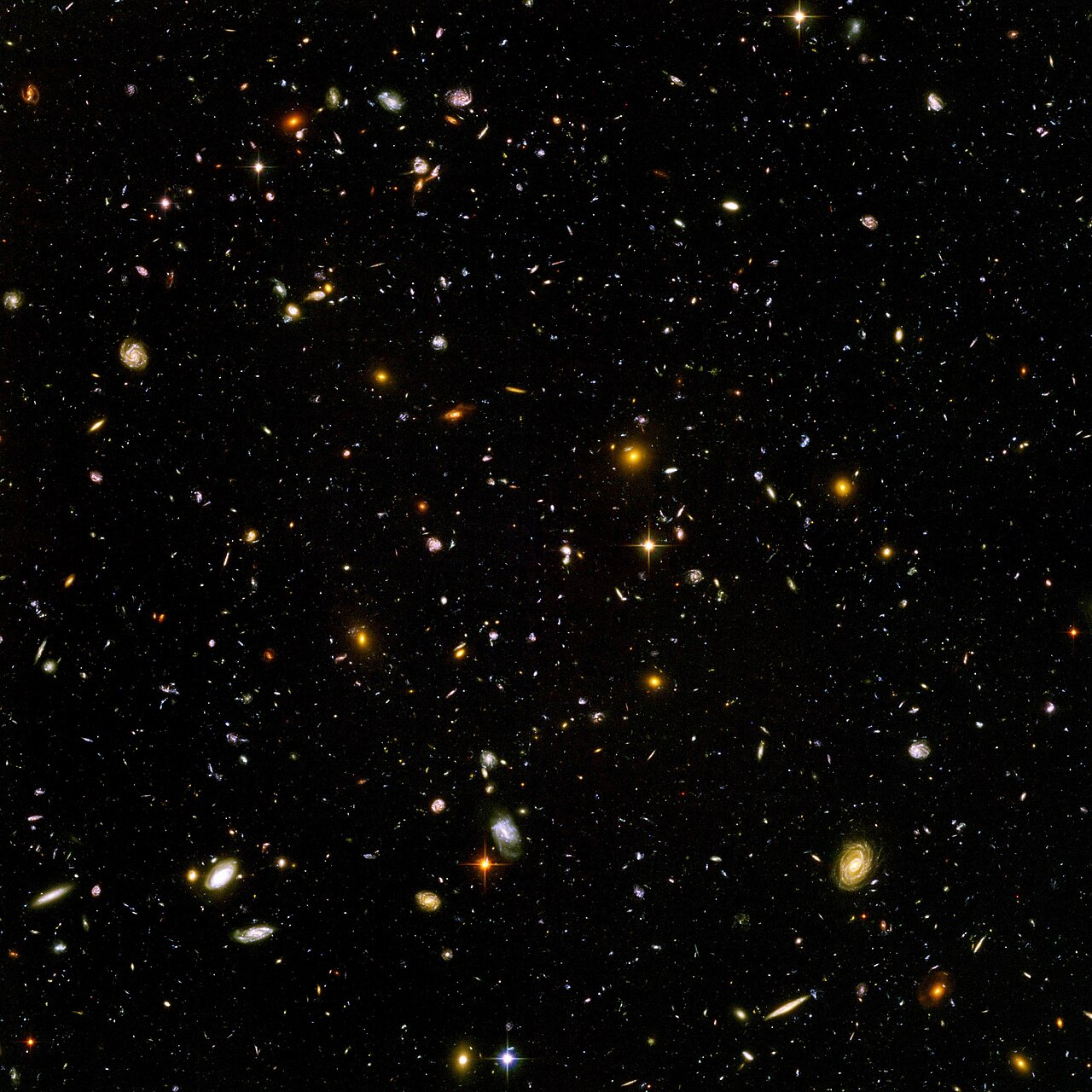

This is not a peripheral anomaly. It strikes at the center of YEC cosmology, which must either rewrite the physics of light propagation, reinterpret the meaning of cosmic distances, or invoke supernatural fiat. Over the past four decades, YEC researchers have pursued all three routes, producing a family of proposed solutions that differ dramatically in their premises and mechanisms.12, 13, 14 None has achieved acceptance outside the YEC community, and each fails for reasons that are independently verifiable.
The problem stated
The scale of the difficulty is worth appreciating in precise terms. The Andromeda Galaxy, the nearest large spiral galaxy to the Milky Way, lies approximately 2.537 million light-years from Earth, a distance established by multiple independent methods including Cepheid variable stars, the tip of the red giant branch, and eclipsing binary stars.18 Light observed from Andromeda tonight departed over two and a half million years ago—roughly the time of the earliest stone tool use in hominins. The Virgo Cluster of galaxies lies at approximately 54 million light-years. The Hubble Ultra Deep Field images contain galaxies whose light left them as early as 400–800 million years after the Big Bang, implying travel times of roughly 13 billion years.1 The observable universe—the sphere within which any signal could, in principle, have reached us since the beginning of time—extends approximately 46 billion light-years in comoving distance due to the expansion of space itself, though the lookback time to the cosmic horizon is 13.8 billion years.1
Within a YEC framework, none of this light could have completed its journey. The Andromeda photons, for instance, would need to have been en route for roughly 400 times the entire YEC age of creation when they arrived. The problem is not one of imprecision in measurement; it compounds across every distance rung of the cosmic distance ladder, from the nearest stars to the most distant quasars.5, 7
Young Earth creationist responses
Four major families of response have been developed within the YEC community. They are examined here in historical order of prominence.
Humphreys’ white hole cosmology. The most technically ambitious YEC response was published by physicist D. Russell Humphreys in his 1994 book Starlight and Time.12 Humphreys proposed a cosmological model in which the early universe was a bounded, finite body of water (a literal reading of Genesis 1) surrounded by empty space, with the Earth at or near its center. As this mass collapsed under gravity, he argued, a white hole—the time-reverse of a black hole—would form, generating extreme time dilation near the center. The proposal was that billions of years of stellar and cosmic evolution could have elapsed in the outer universe while only days passed on Earth near the gravitational center.
The model has been rejected by mainstream physicists and critically analyzed even by some within the creationist community on multiple grounds. White holes are not stable solutions in general relativity; they are mathematical time-reversals with no established physical mechanism for formation or persistence, and they evaporate almost instantly in semiclassical quantum gravity treatments.17 Humphreys’ metric does not consistently satisfy Einstein’s field equations across the transition regions his model requires. Additionally, the model predicts a highly inhomogeneous universe with Earth at a gravitational special point—a premise that contradicts the cosmological principle confirmed by the large-scale isotropy of the cosmic microwave background, which is uniform to one part in 100,000 across the entire sky.1 The CMB isotropy is precisely what one expects if no special spatial position exists. Humphreys’ model also fails to account for the detailed acoustic oscillation structure imprinted in the CMB, which requires a universe with a specific age and composition entirely inconsistent with YEC timescales.1
Lisle’s anisotropic synchrony convention. Astrophysicist Jason Lisle proposed in 2010 that the distant starlight problem dissolves if one adopts an alternative synchrony convention for time—specifically, the “Einstein synchrony convention” of standard physics (which assumes light speed is isotropic in all directions) is replaced with a convention in which light traveling toward an observer arrives instantaneously, while light traveling away travels at c/2.13 Under this anisotropic synchrony convention (ASC), starlight from across the universe arrives at Earth at the moment of its emission, meaning no travel time problem exists.
The proposal rests on a real mathematical fact: the one-way speed of light is not directly measurable, and different synchrony conventions are formally equivalent in their predictions for round-trip measurements. However, the argument is widely regarded as logically circular and physically vacuous. Lisle’s ASC does not change the physics; it merely relabels coordinate times. Under ASC, creation “day four” (when Genesis says God made the stars) would have an age in standard coordinates of billions of years—exactly the mainstream value—so the choice of convention changes no observable. More critically, the ASC applies only to the observation of light travel, not to the physical processes that produce the light. Stars billions of light-years away must still have been burning for billions of years to produce the spectral signatures, stellar evolution sequences, and supernova rates observed; a relabeling of arrival-time coordinates does nothing to compress stellar lifetimes or nucleosynthesis timescales.15 The problem Lisle’s convention sidesteps is not the problem of cosmic age, only the narrow sub-problem of light travel time framing.
Setterfield’s c-decay hypothesis. Beginning in the 1980s, Barry Setterfield and Trevor Norman proposed that the speed of light has been decreasing exponentially since creation, with c once orders of magnitude larger than its current value.14 Under this hypothesis, the enormous distances of the cosmos could be traversed in a short time if light once traveled fast enough. The proposal attracted early interest but was rapidly and thoroughly falsified by empirical evidence. Historical measurements of c show no trend when measurement error is properly accounted for; early high values reflected instrumentation limitations, not physical reality.15 More decisively, a varying c would alter the fine-structure constant α = e²/(ℏc), changing the wavelengths of atomic spectral lines in ways that are directly observable in the spectra of distant quasars. Spectroscopic surveys of quasar absorption systems show no such variation at a level of constraint orders of magnitude below what c-decay requires.15 Supernova light curves provide a further refutation: the decay rate of radioactive nickel-56 governs the brightness-versus-time shape of Type Ia supernova light curves, and those observed in high-redshift supernovae match the locally measured decay rates precisely, showing no evidence for altered physical constants in the past.4, 11 The Setterfield hypothesis is considered empirically dead even within most of the YEC community.
Mature creation (the omphalos argument). A fourth response avoids physical modification entirely: God created the universe with the appearance of age, including light already in transit from distant stars that never actually existed or that were created with their light beams already crossing space. This position, known as the omphalos argument (after Philip Henry Gosse’s 1857 book of that name), or “apparent age” or “mature creation,” holds that the starlight problem is not a problem because creation by fiat implies a created appearance of history. The difficulty is theological and epistemological rather than scientific. A universe created with false records of its own past—including supernova remnants of stars that never existed, the light curves of stellar explosions that never occurred, and the redshift history of galaxies that never formed—requires a Creator who systematically deceives observers. This implication was recognized by Gosse’s contemporaries, including Charles Kingsley, who declined to accept it on theological grounds.12 The mature creation position also renders cosmological inquiry uninformative by design: if God can implant any apparent history, no observation can constrain anything, and science becomes impossible. Most YEC proponents themselves reject the position because it makes the physical world a systematic lie.
How mainstream cosmology resolves the problem
The distant starlight problem does not arise within mainstream cosmology because the premise generating it—a universe thousands of years old—is not operative. The Big Bang model, supported by multiple independent lines of evidence, places the age of the universe at 13.787 ± 0.020 billion years.1 Within this framework, 13.8 billion years is more than sufficient time for light to arrive from objects at any observed lookback distance. The apparent puzzle of the observable universe extending 46 billion light-years despite a 13.8-billion-year age is also resolved: the universe has been expanding throughout its history, so regions that emitted the cosmic microwave background approximately 380,000 years after the Big Bang have since receded to comoving distances of about 46 billion light-years, while the photons they emitted have been traveling toward us the entire time.1 The expanding universe does not violate any speed limit; it is space itself that has expanded, carrying matter with it, and the recession velocity of sufficiently distant regions can exceed c without any object locally exceeding c.
The cosmic microwave background (CMB), first detected by Arno Penzias and Robert Wilson in 1965 and mapped to extraordinary precision by the Planck satellite, is itself a direct image of the universe at an age of approximately 380,000 years.8, 1 Its temperature anisotropies, which trace primordial density fluctuations at the level of one part in 100,000, encode the acoustic oscillation history of the photon-baryon fluid in the early universe. The angular scale of those oscillations, the relative heights of successive acoustic peaks, and the overall power spectrum are all precisely predicted by and consistent with a universe 13.8 billion years old with the observed baryon and dark matter densities.1 No YEC cosmology has reproduced this structure quantitatively.
Independent confirmations of cosmic distances
YEC responses to the starlight problem often focus on questioning whether cosmic distances are reliable. The distances, however, are confirmed by five independent measurement techniques, each based on different physics and each agreeing with the others to within observational uncertainties.2, 5, 7
Stellar parallax is the most direct measurement, requiring no astrophysical assumptions beyond basic geometry. As Earth orbits the Sun, nearby stars appear to shift against the background of distant stars by an angle that depends only on the star’s distance. The Gaia satellite, operating since 2013, has measured parallaxes for approximately 1.5 billion stars with precisions reaching tens of microarcseconds, directly confirming stellar distances up to several kiloparsecs—thousands of light-years—without reference to any physical model of stellar behavior.5
Cepheid variable stars extend the distance scale to tens of millions of light-years. Henrietta Swan Leavitt discovered in 1912 that Cepheid variables follow a precise period–luminosity relationship: their intrinsic brightness is determined by how fast they pulsate.6 By measuring a Cepheid’s pulsation period and apparent brightness, astronomers calculate its distance directly. The Cepheid distance scale is calibrated against parallax measurements for nearby Cepheids and confirmed by independent methods at every step.2, 7 Cepheids in the Andromeda Galaxy, the Large Magellanic Cloud, and dozens of other galaxies give distances consistent with all other methods.
Type Ia supernovae serve as standardizable candles reaching billions of light-years. When a white dwarf accretes enough mass to reach the Chandrasekhar limit (approximately 1.4 solar masses), it undergoes thermonuclear detonation in a remarkably uniform explosion.4 The peak luminosity of these events is related to the rate at which the light curve declines, a relationship quantified by Mark Phillips in 1993.4 Applying this Phillips relation to observed Type Ia supernovae at known redshifts allows distance determinations across cosmological scales, and was the technique that revealed the accelerating expansion of the universe in 1998.3, 11
Baryon acoustic oscillations provide an independent cosmological ruler at the largest scales. Sound waves propagating through the hot plasma of the early universe left a characteristic imprint in the distribution of matter across the cosmos—an excess of galaxy-galaxy separations at a scale corresponding to the sound horizon at recombination, approximately 150 megaparsecs (about 490 million light-years). This baryon acoustic peak, first detected in the Sloan Digital Sky Survey in 2005, agrees precisely with the CMB-derived distance scale and provides a cross-check that requires no calibration through Cepheids or supernovae.16
Gravitational lensing offers a geometrically independent method. When a massive galaxy or cluster lies between Earth and a more distant object, gravity bends the light from the background source into multiple images or arcs. The geometry of these configurations—the angular separation of images, the time delay between them for variable sources, and the Einstein ring radius—depends on the distances to the lens and source in a way that is calculable directly from general relativity.7 Time-delay cosmography using gravitationally lensed quasars provides Hubble constant measurements independent of all other rungs of the distance ladder, and these measurements agree with the Cepheid and supernova values.
Every one of these methods relies on different physical principles. Parallax uses trigonometry and Earth’s orbital geometry. Cepheids depend on stellar pulsation physics. Supernovae depend on thermonuclear detonation at a characteristic mass. Baryon acoustic oscillations depend on primordial plasma acoustics. Gravitational lensing depends on the geometry of curved spacetime. That all five converge on a consistent picture of a universe billions of years old, with galaxies at billions of light-years, is not a coincidence of method—it is the signature of a correct description of reality.1, 7
Supernovae as direct clocks
Among the most powerful direct refutations of any young-universe model is the behavior of Supernova 1987A (SN 1987A), which exploded in the Large Magellanic Cloud on 23 February 1987. The LMC lies at approximately 168,000 light-years—a distance established independently by Cepheids, RR Lyrae variables, eclipsing binaries, and the red clump method, all in agreement.9 When SN 1987A exploded, its ultraviolet flash illuminated a pre-existing ring of gas ejected by the progenitor star thousands of years earlier. This ring lit up approximately 410 days after the explosion, precisely as expected given the ring’s angular radius on the sky and the known distance to the LMC.9, 10 The delay was a direct light-travel-time measurement, confirming the LMC distance geometrically and independently of all standard candles.
For any YEC model that posits an accelerated speed of light in the past, SN 1987A is immediately problematic: if c were once vastly larger, the ring-illumination delay would be far shorter than the 410 days observed, since the light traversing the ring’s diameter would have arrived nearly simultaneously rather than with the observed lag. The observed delay constrains the speed of light in the LMC to be indistinguishable from its current value at the time of the event. Furthermore, the light curve shape of SN 1987A—the rise and fall of its brightness over months and years—is entirely governed by the radioactive decay of nickel-56 to cobalt-56 to iron-56, processes whose timescales are set by atomic nuclear physics.10 The light curve matches the laboratory-measured decay rates exactly, ruling out any alteration of nuclear constants or the speed of light during SN 1987A’s evolution.
Significance and assessment
The distant starlight problem occupies a unique position in discussions of YEC cosmology because it is entirely internal to the physical sciences, requiring no appeal to biology, geology, or history. The conflict is between a straightforward geometric fact—light takes time to travel—and a chronological claim about the age of creation. The YEC responses collectively illustrate the difficulty of the challenge: they are mutually incompatible (Humphreys requires different physics from Lisle, who requires different assumptions from Setterfield), and each has been independently shown to fail.12, 13, 14, 15
The mature creation response is the only one that is technically irrefutable, because it places the answer outside empirical reach by invoking supernatural fiat.12 This is precisely why it is unsatisfying to most YEC proponents themselves: a God who created the universe with a false apparent history is indistinguishable, in every physical measurement, from a universe that simply has that history. The epistemological consequence is that the distinction between “created with apparent age” and “actually old” becomes meaningless—there is no observation, in principle, that could distinguish the two. This is not a strength of the position but a disqualification from scientific discourse.
Mainstream cosmology does not face a starlight problem because it does not impose an external chronological constraint on the physical evidence. The age of the universe, 13.787 billion years, is itself a measurement—derived from the CMB power spectrum, the Hubble constant, the baryon acoustic oscillation scale, the supernova Hubble diagram, and the ages of the oldest stars—and every measurement agrees.1, 2, 7 The consistency of that age across independent methods is the result not of circular reasoning but of a correct physical model, one that is quantitatively predictive, independently testable, and continuously refined by new observations.
References
Observational evidence from supernovae for an accelerating universe and a cosmological constant
A comprehensive measurement of the local value of the Hubble constant with 1 km/s/Mpc uncertainty from the Hubble Space Telescope and the SH0ES team
Detection of the Baryon Acoustic Peak in the Large-Scale Correlation Function of SDSS Luminous Red Galaxies
The Carnegie-Chicago Hubble Program. VIII. An independent determination of the Hubble constant based on the tip of the red giant branch