Overview
- Five independent lines of evidence converge on the Big Bang model: the expansion of the universe (Hubble–Lemaître law), the cosmic microwave background radiation, primordial nucleosynthesis, large-scale structure formation, and the observed evolution of galaxies over cosmic time.
- Each line of evidence was discovered independently through different observational techniques and relies on different physics — their convergence on the same cosmological model is the hallmark of a well-confirmed scientific theory.
- No alternative cosmological model, including the Steady State theory, has successfully accounted for all five lines of evidence simultaneously.
The Big Bang model — the scientific framework describing the origin and evolution of the universe from an extremely hot, dense initial state approximately 13.8 billion years ago — rests on multiple independent lines of observational evidence. Each line was discovered through different instruments, different techniques, and different areas of physics. Their convergence on the same model is not a coincidence but the signature of a well-confirmed theory. This article presents five major categories of evidence, each sufficient on its own to strongly favour the Big Bang over competing models, and collectively constituting one of the most thoroughly supported frameworks in all of science.5

The expansion of the universe
The first and historically most important evidence for the Big Bang is the observed expansion of the universe. In 1927, the Belgian physicist Georges Lemaître derived from Einstein's general relativity equations that the universe should be expanding, and estimated the rate of that expansion from available galaxy recession data.2 Two years later, Edwin Hubble provided the landmark observational confirmation. Using Cepheid variable stars to measure distances to nearby galaxies, and spectroscopic redshifts to measure their recession velocities, Hubble demonstrated a linear relationship: the farther a galaxy, the faster it is receding from us.1
This relationship, now known as the Hubble–Lemaître law, is not the result of galaxies flying apart through a static space. Rather, it reflects the expansion of space itself: the fabric of the universe is stretching, carrying galaxies along with it. The redshift of distant galaxies is a cosmological redshift — the wavelength of light is stretched as space expands during the time the light is in transit. The expansion has been confirmed and refined by decades of subsequent observations, most dramatically by the 1998 discovery that the expansion is accelerating, driven by a mysterious dark energy that permeates all of space.11
If the universe is expanding today, then running time backward implies that the universe was smaller, denser, and hotter in the past. Extrapolated far enough, this logic leads to an initial state of extraordinary density and temperature — the Big Bang. The current best estimate of the expansion rate, combined with data from the cosmic microwave background and other probes, yields an age of 13.787 ± 0.020 billion years.5
The cosmic microwave background
The second pillar of evidence is the cosmic microwave background (CMB), a faint glow of microwave radiation permeating all of space. Its existence was predicted before it was discovered. In 1948, George Gamow and Ralph Alpher argued that the extreme temperatures of the early universe would produce a bath of thermal radiation, and Alpher and Robert Herman predicted that this radiation should still be detectable today, cooled by the expansion of the universe to a temperature of a few Kelvin.4, 15
In 1965, Arno Penzias and Robert Wilson at Bell Laboratories detected a persistent, isotropic microwave signal that they could not explain by any terrestrial or astronomical source. It came from every direction in the sky with equal intensity and corresponded to a thermal blackbody temperature of approximately 3 Kelvin.3 Robert Dicke and colleagues at Princeton immediately recognized it as the predicted relic radiation from the early universe. The precise temperature has since been measured to extraordinary accuracy at 2.7255 ± 0.0006 Kelvin, and its spectrum follows a near-perfect Planck blackbody curve — the most perfect blackbody spectrum ever observed in nature.16
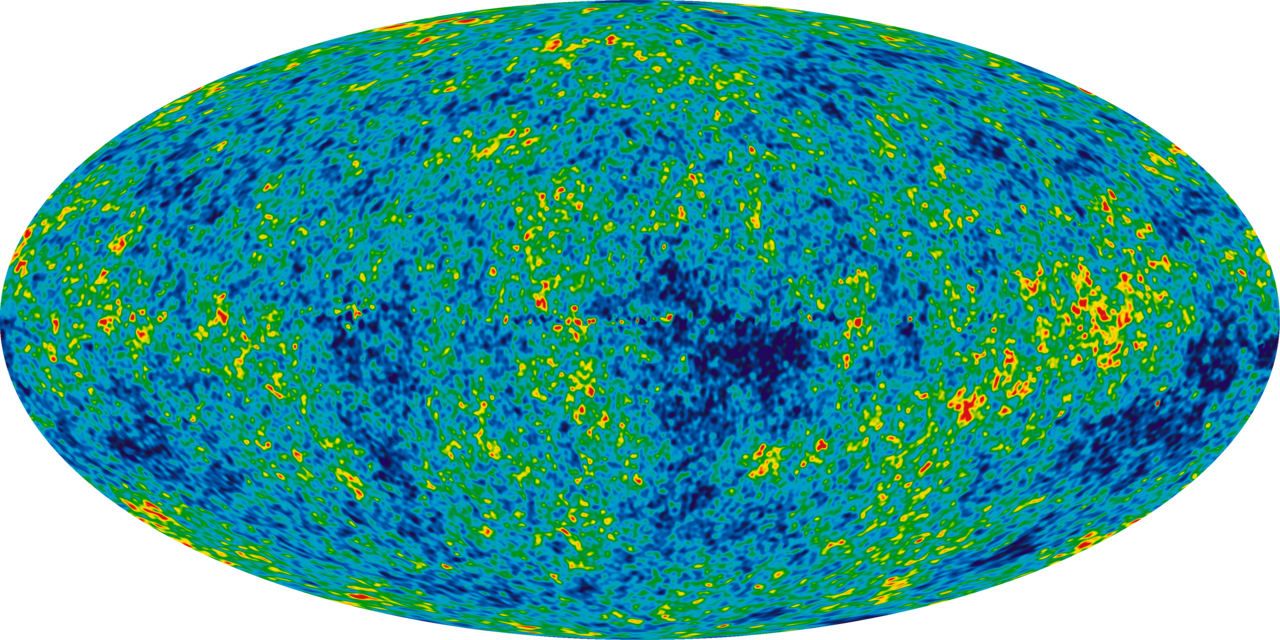
Subsequent satellite missions mapped tiny temperature fluctuations (anisotropies) in the CMB at the level of one part in 100,000. NASA's COBE satellite first detected these fluctuations in 1992.6 WMAP mapped them with far greater resolution from 2001 to 2010.7 The Planck satellite, operated by ESA, produced the most detailed CMB map ever assembled, extracting cosmological parameters with percent-level precision.5 The angular power spectrum of the CMB anisotropies encodes information about the density, composition, geometry, and expansion history of the universe, and the Big Bang model's predictions match the observed spectrum with remarkable fidelity. No competing cosmological model has reproduced this pattern.5, 7
Primordial nucleosynthesis
The third line of evidence is Big Bang nucleosynthesis (BBN): the formation of light atomic nuclei in the first minutes after the Big Bang. In the extreme heat of the early universe (temperatures exceeding one billion Kelvin), protons and neutrons collided and fused to form deuterium, helium-3, helium-4, and trace amounts of lithium-7. The Big Bang model makes precise quantitative predictions about the primordial abundances of each of these elements, depending on a single free parameter: the baryon density of the universe.8, 9
Astronomers measure primordial abundances in the oldest, most chemically pristine objects in the universe — metal-poor gas clouds illuminated by distant quasars, primitive dwarf galaxies, and ancient halo stars. The observed hydrogen-to-helium ratio (approximately 75 percent hydrogen, 25 percent helium by mass) matches the BBN prediction with striking precision. The deuterium abundance, measured in high-redshift absorption systems, agrees with the predicted value of approximately 2.5 × 10⁻⁵ relative to hydrogen.9, 10 The agreement between theory and observation for these elements is among the most precise quantitative confirmations in cosmology. A modest discrepancy exists for lithium-7, where observed abundances are approximately three times lower than predicted — the so-called "cosmological lithium problem" — but this is an active area of research and likely reflects stellar physics that depletes lithium over time rather than a fundamental flaw in BBN theory.10
Large-scale structure
The fourth line of evidence is the large-scale structure of the universe. Galaxies are not distributed randomly through space but are arranged in a cosmic web of filaments, sheets, and voids spanning hundreds of millions of light-years. This structure is precisely what the Big Bang model predicts: tiny density fluctuations in the early universe, visible as the anisotropies in the CMB, grew under gravitational attraction over billions of years into the galaxy clusters and voids observed today.5, 12
Massive galaxy surveys have mapped this structure in extraordinary detail. The Two-degree-Field Galaxy Redshift Survey (2dFGRS) measured redshifts for over 220,000 galaxies and found that the power spectrum of galaxy clustering matches the predictions of Big Bang cosmology with cold dark matter.12 The Sloan Digital Sky Survey extended this work, detecting baryon acoustic oscillations (BAO) — a characteristic scale of approximately 490 million light-years imprinted on the galaxy distribution by sound waves in the pre-recombination plasma. The BAO signal was predicted by Big Bang theory and its detection provides an independent measurement of the expansion history and geometry of the universe, fully consistent with the CMB and supernova data.13
Computer simulations of structure formation, starting from the initial conditions encoded in the CMB and evolving forward under gravity and known physics, reproduce the observed cosmic web with remarkable accuracy. The match between the predicted and observed distributions of matter at scales ranging from individual galaxy clusters to the largest structures in the universe is a powerful confirmation of the Big Bang framework.5, 12
The evolution of galaxies
The fifth line of evidence is the observed evolution of galaxies over cosmic time. Because light travels at a finite speed, observing distant galaxies is equivalent to looking into the past: a galaxy ten billion light-years away is seen as it appeared ten billion years ago. If the universe were eternal and unchanging (as the now-falsified Steady State theory proposed), galaxies at all distances should look statistically similar. They do not.14
Observations consistently show that distant galaxies — those seen as they were billions of years ago — are systematically different from nearby, present-day galaxies. Galaxies at high redshift are smaller, more irregular in shape, bluer in colour (indicating higher rates of star formation), and more likely to be undergoing mergers. The fraction of galaxies with active galactic nuclei (powered by accreting supermassive black holes) increases dramatically with lookback time. Quasars, the most luminous objects in the universe, were far more common in the early universe than they are today.14 These systematic differences with lookback time are exactly what the Big Bang model predicts: a universe that has been evolving from a simpler, more active state in its youth to its current mature state, with galaxies growing through hierarchical merging and their star formation rates declining over cosmic time.
The James Webb Space Telescope, launched in 2021, has extended these observations to the earliest epochs of galaxy formation, detecting galaxies that formed within the first few hundred million years after the Big Bang. These earliest galaxies are compact, low-mass, and actively forming stars at prodigious rates — consistent with the predictions of hierarchical structure formation in Big Bang cosmology and wholly inconsistent with a static, eternal universe.5
The power of convergence
The strength of the Big Bang model lies not in any single line of evidence but in the convergence of all five. The expansion of the universe was established through optical astronomy. The CMB was discovered through radio astronomy. Primordial element abundances are measured through spectroscopy of distant gas clouds and ancient stars. Large-scale structure is mapped through massive galaxy surveys. Galaxy evolution is documented through deep imaging across the electromagnetic spectrum. These five programmes use different instruments, different techniques, and different physical principles. They were pursued by different communities of scientists over decades, often without reference to one another.5, 7
Yet all five converge on the same model: a universe that began in a hot, dense state approximately 13.8 billion years ago and has been expanding and cooling ever since. The probability that five independent lines of evidence would all point to the same incorrect conclusion is vanishingly small. The convergence is the hallmark of a theory that describes something real about the physical world — not a construction of assumptions and adjustable parameters, but a genuine discovery about the history of the universe.5
References
Un univers homogène de masse constante et de rayon croissant rendant compte de la vitesse radiale des nébuleuses extra-galactiques
Nine-year Wilkinson Microwave Anisotropy Probe (WMAP) observations: cosmological parameter results
Observational evidence from supernovae for an accelerating universe and a cosmological constant