Overview
- Gamma-ray bursts are the most energetic electromagnetic explosions in the universe, releasing in seconds as much energy as the Sun will emit over its entire 10-billion-year lifetime; they were accidentally discovered in 1967 by the Vela nuclear-test-detection satellites and first reported by Klebesadel, Strong, and Olson in 1973.
- The population divides into two physical classes: long-duration bursts (longer than ~2 seconds), produced by the core collapse of rapidly rotating massive stars in the collapsar mechanism, and short-duration bursts (shorter than ~2 seconds), produced by mergers of compact objects such as neutron star pairs, as confirmed by the joint gravitational-wave and gamma-ray detection of GW170817/GRB 170817A in August 2017.
- GRB 221009A, detected in October 2022 at a redshift of 0.151, was the brightest gamma-ray burst ever recorded — roughly 70 times more luminous than any previous event — and is estimated to occur only once every 10,000 years, providing an unprecedented laboratory for studying relativistic jet physics and particle acceleration.
Gamma-ray bursts (GRBs) are brief, intensely luminous flashes of gamma radiation originating at cosmological distances, constituting the most energetic electromagnetic events known in the universe.6, 19 In a matter of seconds to minutes, a single GRB can release as much electromagnetic energy as the Sun will radiate over its entire ten-billion-year main-sequence lifetime, with isotropic-equivalent luminosities reaching 1054 erg per second in the most extreme cases.6, 8 First detected accidentally in 1967 by the Vela satellites—military spacecraft designed to monitor clandestine nuclear weapons tests—and publicly reported by Klebesadel, Strong, and Olson in 1973, GRBs remained one of the deepest mysteries in astrophysics for nearly three decades before their cosmological distances and physical origins were established.1, 17
The GRB population divides into two broad physical classes distinguished by duration and spectral hardness: long-duration bursts lasting more than approximately two seconds, produced by the core collapse of massive stars, and short-duration bursts lasting less than two seconds, generated by the mergers of compact objects such as binary neutron star systems.2, 7, 11 The study of GRBs has driven transformative advances across multiple areas of astrophysics, from relativistic jet physics and nucleosynthesis to multi-messenger astronomy and cosmography, and they remain among the most actively researched phenomena in modern science.17, 19
Discovery and early history
The discovery of gamma-ray bursts was an unintended consequence of Cold War nuclear monitoring. Beginning in 1963, the United States launched the Vela series of satellites to detect covert nuclear weapons tests in violation of the Partial Nuclear Test Ban Treaty. On 2 July 1967, the Vela 4a and 4b satellites recorded a brief flash of gamma radiation that did not match the signature of any nuclear detonation. The Los Alamos Scientific Laboratory team, led by Ray Klebesadel, accumulated additional detections over the following years and used the arrival-time differences between multiple satellites to triangulate rough sky positions, ruling out both terrestrial and solar origins.1, 17 Their findings, reporting sixteen gamma-ray bursts of unambiguously cosmic origin, were published in The Astrophysical Journal in 1973.1

For the next two decades, the nature and distance scale of GRBs remained profoundly uncertain. Without precise positional information, astronomers could not identify counterparts at other wavelengths and thus could not determine whether the sources lay within the Milky Way or at cosmological distances. A watershed came in 1991 with the launch of NASA’s Compton Gamma Ray Observatory carrying the Burst and Transient Source Experiment (BATSE), which detected over 2,700 bursts during its nine-year mission. BATSE demonstrated that GRBs are distributed isotropically across the sky with no concentration toward the Galactic plane or centre, strongly disfavouring models that placed them in the Milky Way’s disk or halo and pointing instead toward a cosmological origin.10, 6
The definitive proof of cosmological distances arrived through the afterglow revolution of 1997. The Italian-Dutch satellite BeppoSAX, equipped with wide-field X-ray cameras, detected the X-ray afterglow of GRB 970228 approximately eight hours after the initial burst, enabling the first identification of a fading optical counterpart and its association with a distant galaxy.3 Months later, the afterglow of GRB 970508 yielded absorption lines at a redshift of z = 0.835, directly confirming that at least some GRBs occur at cosmological distances and thus possess extraordinary intrinsic luminosities.4, 6 These discoveries transformed GRB science from a field dominated by mystery into one of the most data-rich frontiers of high-energy astrophysics.17, 18
Classification: long and short bursts
Analysis of the BATSE catalogue revealed that the duration distribution of GRBs is bimodal, with a dividing line at approximately two seconds. In their landmark 1993 study, Kouveliotou and colleagues identified two statistically distinct classes: short-duration, spectrally hard bursts with median durations of roughly 0.3 seconds, and long-duration, spectrally softer bursts with median durations of roughly 20 seconds.2 This phenomenological division proved to reflect a genuine physical dichotomy in progenitor systems, though subsequent observations have revealed important exceptions that blur the boundary.13, 14
Long GRBs, accounting for approximately 70% of the observed population, are associated with the deaths of massive stars. The collapsar model, developed by Woosley and MacFadyen, proposes that the iron core of a rapidly rotating massive star collapses directly to a black hole, with the infalling stellar envelope forming a temporary accretion disk. A pair of relativistic jets are launched along the rotation axis, powered by neutrino annihilation or magnetohydrodynamic processes in the disk, and bore through the stellar mantle to break out of the surface within roughly 10 seconds.7 The association between long GRBs and massive-star deaths was spectacularly confirmed in 1998 when GRB 980425 was found to coincide spatially and temporally with the energetic Type Ic supernova SN 1998bw, and subsequently by the unambiguous spectroscopic detection of supernova features in the afterglow of GRB 030329 (SN 2003dh).22, 23
Short GRBs, by contrast, are produced by the merger of two compact objects—typically two neutron stars or a neutron star and a black hole. These mergers can occur billions of years after star formation, as the binary system slowly loses orbital energy through gravitational-wave emission. The definitive confirmation came on 17 August 2017, when the LIGO and Virgo observatories detected the gravitational-wave signal GW170817 from a binary neutron star merger, followed 1.74 seconds later by the short GRB 170817A detected by the Fermi Gamma-ray Burst Monitor. The probability of this temporal and spatial coincidence occurring by chance was estimated at 5.0 × 10⁻⁸, establishing beyond reasonable doubt that neutron star mergers produce short GRBs.11, 12
Approximate duration distribution of gamma-ray bursts showing the bimodal population2, 18
Recent discoveries have complicated the simple two-class picture. In 2022, two independent teams reported the detection of a kilonova—the thermal emission from radioactive decay of freshly synthesised heavy elements—following GRB 211211A, a burst whose 50-second duration placed it firmly in the long-GRB category despite its compact-merger origin.13, 14 The even more striking case of GRB 230307A, the second brightest burst ever recorded with a duration exceeding 200 seconds, also showed clear kilonova signatures. James Webb Space Telescope observations identified tellurium emission lines in its infrared afterglow, confirming heavy r-process nucleosynthesis characteristic of neutron star mergers rather than collapsars.15 These hybrid events demonstrate that burst duration alone is an imperfect classifier and that the physical progenitor must be determined from the full suite of multi-wavelength and multi-messenger observations.13, 14, 15
The fireball model and relativistic jets
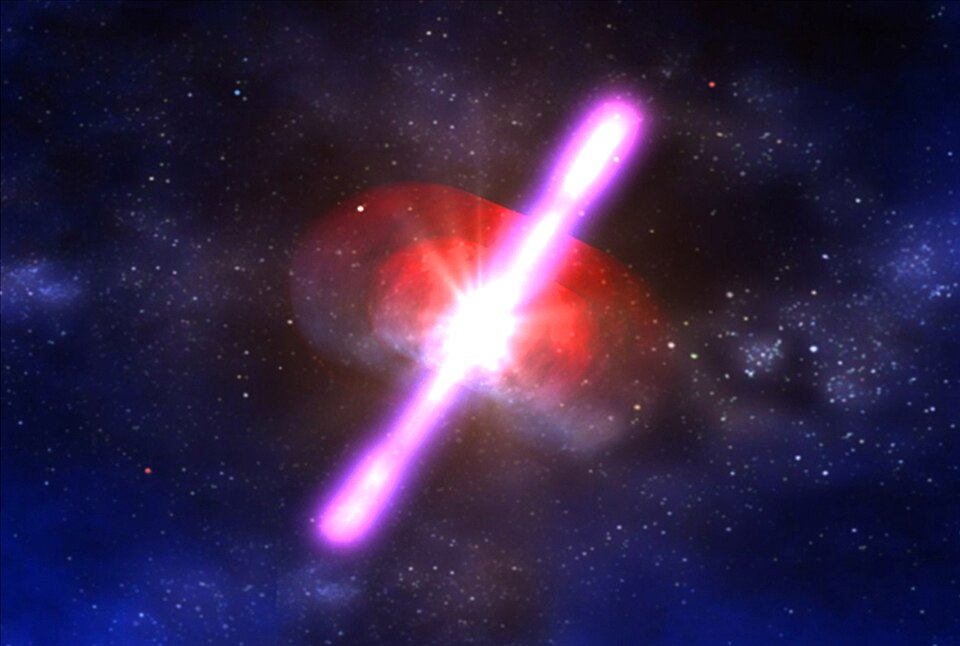
The standard theoretical framework for understanding GRB emission is the fireball model, developed primarily by Mészáros, Rees, Piran, and collaborators during the 1990s.5, 8, 20 In this model, the central engine—either a newly formed black hole with an accretion disk or a rapidly spinning, highly magnetised neutron star (magnetar)—launches a pair of ultra-relativistic jets with bulk Lorentz factors of 100 to 1,000.6, 8 The extreme relativistic motion is required by the “compactness problem”: without it, the enormous energy released in such a small volume would produce an opaque pair-production fireball incapable of producing the observed non-thermal gamma-ray spectra.6, 19
The prompt gamma-ray emission—the initial burst detected by satellites—is thought to arise from internal shocks within the jet, produced when faster shells of ejecta overtake slower ones and collide, converting bulk kinetic energy into the radiation observed as the GRB itself.8, 19 The spectrum of the prompt emission is characteristically non-thermal, well described by an empirical broken power law known as the Band function, with a peak energy typically between 100 keV and 1 MeV.6, 21 In some bursts, the Fermi Large Area Telescope has detected photons with energies exceeding 10 GeV arriving minutes to hours after the trigger, indicating either a separate high-energy emission component or sustained particle acceleration in the blast wave.21
The afterglow emission that follows the prompt phase is produced by the external shock—the decelerating blast wave driven into the circumburst medium by the relativistic ejecta.5, 8 As the shock sweeps up ambient material, it accelerates electrons to ultrarelativistic energies and amplifies magnetic fields, generating synchrotron radiation that fades predictably across the electromagnetic spectrum from X-rays through optical to radio wavelengths over timescales of hours to months.5, 6 The temporal and spectral evolution of afterglows has been extensively modelled and broadly confirms the predictions of the external-shock framework, providing estimates of the total burst energy, the density of the surrounding medium, and the geometry of the jet.6, 18
A critical insight from afterglow modelling is that GRB jets are collimated rather than isotropic. Achromatic steepening of the afterglow light curve—a “jet break”—occurs when the decelerating jet’s Lorentz factor drops low enough for the observer to see the edge of the cone. From the jet-break time, opening angles of 3° to 10° are typically inferred. Frail and colleagues showed in 2001 that correcting for this collimation reduces the wide range of apparent isotropic energies (spanning four orders of magnitude) to a much narrower cluster around 1051 erg, suggesting that most GRBs release a roughly standard total energy and that the apparent diversity in luminosity is largely geometric.9
Afterglows and multi-wavelength observations
The discovery of afterglow emission transformed GRB science by enabling precise localisations, redshift measurements, and host-galaxy identifications. The first X-ray afterglow, detected by BeppoSAX from GRB 970228, faded as a power law in time and was accompanied by an optical transient that pinpointed the burst to a faint, distant galaxy.3


The radio afterglow of GRB 970508, detected by Frail and colleagues with the Very Large Array, exhibited scintillation that placed an upper limit on the source size, directly demonstrating relativistic expansion as predicted by the fireball model.4 The radio afterglow of GRB 970508, detected by Frail and colleagues with the Very Large Array, exhibited scintillation that placed an upper limit on the source size, directly demonstrating relativistic expansion as predicted by the fireball model.4
The launch of NASA’s Swift satellite in 2004 marked a new era of rapid-response GRB astronomy. Swift’s Burst Alert Telescope detects GRBs in hard X-rays and autonomously slews the spacecraft within roughly 100 seconds to observe the afterglow with its X-Ray Telescope and UV/Optical Telescope, routinely providing arcsecond-precision positions within minutes of the burst.18 This rapid follow-up capability revealed previously unknown features in afterglow evolution, including steep early X-ray decays, X-ray flares superimposed on the power-law decline, and plateau phases lasting thousands of seconds before resuming the normal decay. These features, difficult to explain with the simplest external-shock models, suggest ongoing energy injection from a long-lived central engine, possibly a millisecond magnetar gradually spinning down and depositing rotational energy into the blast wave.18, 19
At the highest photon energies, ground-based imaging atmospheric Cherenkov telescopes have detected very-high-energy (VHE) gamma-ray emission above 100 GeV from several GRBs, beginning with GRB 190114C detected by the MAGIC telescopes in 2019. These detections probe particle-acceleration processes in the afterglow shock and have been interpreted as inverse Compton scattering of synchrotron photons by the same shock-accelerated electrons—a long-predicted but previously unobserved emission component.17, 19
The GRB–supernova connection
The physical link between long-duration GRBs and the deaths of massive stars was established through the detection of supernova signatures in GRB afterglows. The first compelling case was GRB 980425, a nearby, underluminous burst at a distance of only 40 megaparsecs, found to coincide in time and position with the unusually energetic Type Ic supernova SN 1998bw. The supernova lacked hydrogen and helium in its spectrum, consistent with a progenitor that had been stripped of its outer envelope, and exhibited expansion velocities exceeding 30,000 km s−1—several times faster than typical core-collapse supernovae.22
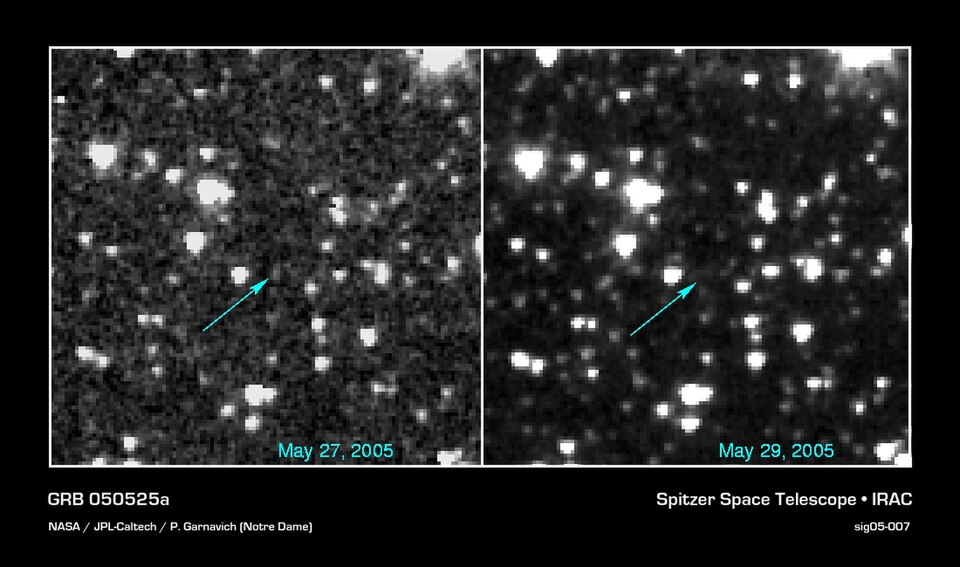

The case became definitive with GRB 030329, one of the closest cosmological GRBs at z = 0.1685. As its bright afterglow faded, spectroscopic observations by Stanek and colleagues revealed the unmistakable broad absorption features of a Type Ic supernova (SN 2003dh) emerging from beneath the afterglow continuum, proving beyond doubt that at least some long GRBs are produced during the core collapse of massive stars that have lost their hydrogen and helium envelopes.23 Subsequent observations have detected supernova components in dozens of long GRBs, firmly establishing the collapsar model as the dominant formation channel for this class of bursts.18, 19
Not all long GRBs produce detectable supernovae, however. Some well-observed nearby bursts have shown no supernova emission to deep limits, raising the possibility of “dark” collapsars in which the stellar envelope falls directly into the black hole without ejecting radioactive nickel, or alternative progenitor scenarios altogether.19
Short GRBs and compact object mergers
The progenitors of short-duration GRBs were long suspected to be mergers of compact binary systems—pairs of neutron stars or a neutron star and a black hole spiralling together through the emission of gravitational radiation over timescales of millions to billions of years.6, 8 Several lines of circumstantial evidence supported this hypothesis before 2017: short GRBs were found in both star-forming and elliptical galaxies, often offset from the centres of their hosts, consistent with progenitor binaries that received natal kicks during formation and migrated before merging.18
The transformative confirmation came on 17 August 2017 with the coincident detection of the gravitational-wave event GW170817 and the short gamma-ray burst GRB 170817A. The LIGO and Virgo interferometers recorded the characteristic inspiral, merger, and ringdown signal of two neutron stars coalescing at a distance of approximately 40 megaparsecs, while 1.74 ± 0.05 seconds later the Fermi GBM detected a weak, short-duration gamma-ray signal from the same sky region.11 The subsequent identification of an optical and infrared transient—a kilonova powered by the radioactive decay of r-process heavy elements synthesised in the neutron-rich merger ejecta—together with a delayed, rising radio and X-ray afterglow from an off-axis structured jet, provided the most complete multi-messenger picture of any astrophysical event in history.11, 12, 24
Very-long-baseline interferometric (VLBI) imaging of the radio afterglow by Ghirlanda and colleagues resolved apparent superluminal motion of the source, providing direct evidence that a collimated relativistic jet had been produced by the merger and was viewed off-axis at an angle of roughly 20–30 degrees.24 The joint detection had implications reaching far beyond GRB progenitor identification. The near-simultaneous arrival of gravitational waves and gamma rays after travelling 40 megaparsecs constrained the difference between the speed of gravity and the speed of light to fewer than a few parts in 1015, ruling out broad classes of modified gravity theories. The event also served as a “standard siren”—a gravitational-wave source with an independently measured distance—enabling the first gravitational-wave-based measurement of the Hubble constant.12
GRB 221009A: the brightest of all time
On 9 October 2022, space-based and ground-based detectors recorded GRB 221009A, an event so extraordinarily bright that it was designated the “Brightest Of All Time” or “BOAT.” Originating from a redshift of z = 0.151 (approximately 2.4 billion light-years), the burst was roughly 70 times more luminous than any previously recorded GRB and saturated multiple space-based gamma-ray instruments.16 Statistical analysis suggests that a burst this bright and this close occurs only once every 10,000 years, making it a genuinely rare event in the human observational record.16, 17
The BOAT’s prompt emission lasted approximately 600 seconds in total, with the most intense phase spanning about 300 seconds and an isotropic-equivalent energy exceeding 1054 erg—placing it at the extreme upper end of the GRB energy distribution.16 The burst was so powerful that its gamma radiation measurably disturbed Earth’s ionosphere, producing one of the strongest ionospheric perturbations ever attributed to a GRB. Observations with the Fermi LAT detected photons exceeding 10 GeV from the burst, while ground-based observations by LHAASO in China recorded photons above 10 TeV, marking the highest-energy photons ever observed from a GRB.16, 17
Detailed afterglow modelling revealed that the jet possessed a narrow, highly energetic core surrounded by wider wings with gradually decreasing energy—a structured jet morphology that naturally explains both the extreme brightness (from viewing nearly along the jet axis) and the specific temporal evolution of the afterglow at all wavelengths.25 Follow-up observations confirmed that GRB 221009A originated from the collapse of a massive star, consistent with the collapsar model, though the afterglow analysis was complicated by the burst’s position behind significant Galactic dust extinction along the line of sight.16, 25
Comparison of notable gamma-ray bursts across five decades1, 11, 15, 16, 22
| GRB | Year | Redshift | Class | Significance |
|---|---|---|---|---|
| GRB 670702 | 1967 / 1973 | — | Unknown | First GRB ever detected (Vela satellites) |
| GRB 970228 | 1997 | 0.695 | Long | First X-ray and optical afterglow |
| GRB 980425 | 1998 | 0.0085 | Long | First GRB–supernova association (SN 1998bw) |
| GRB 030329 | 2003 | 0.1685 | Long | Spectroscopic supernova confirmation (SN 2003dh) |
| GRB 170817A | 2017 | 0.0098 | Short | First GRB with gravitational-wave counterpart |
| GRB 221009A | 2022 | 0.151 | Long | Brightest GRB ever recorded (the BOAT) |
| GRB 230307A | 2023 | 0.065 | Long (merger) | Long-duration burst from compact merger; JWST kilonova |
Open questions and future prospects
Despite five decades of observation and theoretical development, several fundamental questions about gamma-ray bursts remain unresolved. The detailed mechanism by which the central engine converts gravitational and rotational energy into a collimated, ultra-relativistic outflow is not fully understood; the relative roles of magnetic fields (Poynting-flux-dominated jets) versus thermal pressure (hot fireball jets) in accelerating and collimating the outflow continue to be debated.19 The radiation mechanism responsible for the prompt gamma-ray emission is similarly uncertain: while the internal-shock model provides a general framework, it struggles to reproduce the observed spectra quantitatively, and alternative models invoking magnetic reconnection, photospheric emission, or combinations thereof remain under active investigation.6, 19
The discovery of long-duration GRBs produced by compact mergers (GRB 211211A, GRB 230307A) has disrupted the traditional classification scheme and raised the question of what fraction of the ostensibly long-GRB population may in fact arise from mergers rather than collapsars.13, 14, 15 Answering this question has direct implications for using GRB host galaxies and rates as tracers of star formation and chemical enrichment across cosmic time.17
Looking forward, the next generation of gravitational-wave detectors (including upgrades to LIGO, Virgo, and KAGRA, as well as the planned Einstein Telescope and Cosmic Explorer) will vastly increase the volume of space within which compact-binary mergers can be detected, enabling routine joint detections of gravitational waves and short GRBs out to cosmological distances.11, 17 Wide-field gamma-ray monitors such as the proposed THESEUS mission and next-generation X-ray satellites will improve the detection rate and localisation precision for both prompt emission and afterglows. The continued operation of JWST provides the capability to detect kilonova signatures and supernova components at unprecedented depth, while ground-based very-high-energy observatories such as the Cherenkov Telescope Array will systematically probe the TeV emission from GRB afterglows.17, 19 Together, these advances promise to resolve longstanding questions about the engines, jets, and cosmic roles of gamma-ray bursts—the most powerful explosions in the universe since the Big Bang itself.17
References
Gravitational Waves and Gamma-Rays from a Binary Neutron Star Merger: GW170817 and GRB 170817A
Relativistic Fireballs and Their Impact on External Matter: Models for Cosmological Gamma-Ray Bursts
Compact Radio Emission Indicates a Structured Jet Was Produced by a Binary Neutron Star Merger