Overview
- The interstellar medium is the gas and dust that fills the space between stars within a galaxy, comprising roughly 10 to 15 percent of the visible mass of the Milky Way's disk and serving as the reservoir from which new stars form and into which dying stars return their processed material.
- The ISM exists in multiple coexisting phases ranging from cold, dense molecular clouds at 10 to 20 kelvin to a hot, diffuse plasma exceeding one million kelvin, maintained in approximate pressure equilibrium by the continuous input of energy from stellar winds, ultraviolet radiation, and supernova explosions.
- Interstellar chemistry produces over 270 identified molecular species including complex organic molecules, while cosmic rays and magnetic fields thread the medium and regulate its dynamics, making the ISM not merely empty space but an active participant in the galactic ecosystem of matter and energy cycling.
The interstellar medium (ISM) is the matter and radiation that occupies the space between star systems within a galaxy. Composed overwhelmingly of gas — approximately 99 percent by mass — with a small but astrophysically significant admixture of solid dust grains, the ISM constitutes roughly 10 to 15 percent of the total baryonic mass of the Milky Way's disk.2, 3 Far from being empty void, the interstellar medium is a dynamic, multi-phase environment shaped by stellar radiation, supernova explosions, magnetic fields, and cosmic rays. It serves simultaneously as the raw material from which new generations of stars condense and as the repository into which dying stars expel their nucleosynthetically enriched debris, making it the central node in the galactic cycle of matter.2, 6
Composition and overall structure
The gas of the interstellar medium is primarily hydrogen, which constitutes about 70 percent of its mass, followed by helium at roughly 28 percent. The remaining approximately 2 percent consists of heavier elements — collectively termed "metals" in astrophysical usage — including carbon, nitrogen, oxygen, silicon, magnesium, and iron, all produced by nucleosynthesis in stellar interiors and distributed into the ISM by stellar winds and supernova explosions.3, 13 Hydrogen exists in the ISM in three forms: neutral atomic hydrogen (H I), which is detectable through its characteristic 21-centimetre radio emission line; ionised hydrogen (H II), which emits optical recombination radiation; and molecular hydrogen (H₂), which, lacking a permanent dipole moment, is largely invisible at radio wavelengths and must be traced indirectly through emissions from carbon monoxide and other molecules.2, 5
The average number density of the ISM in the Milky Way's disk is approximately one particle per cubic centimetre, though this figure conceals an enormous range — from fewer than 0.01 particles per cubic centimetre in the hottest, most rarefied cavities to more than 106 particles per cubic centimetre in the densest cores of molecular clouds.2, 3 Interstellar dust grains, though comprising only about 1 percent of the ISM by mass, play a disproportionate role in the medium's thermal balance, chemistry, and observational appearance. These solid particles, typically 0.01 to 1 micrometre in diameter, absorb and scatter starlight, provide catalytic surfaces for the formation of molecular hydrogen, and re-emit absorbed energy at infrared wavelengths.7
Phases of the interstellar medium
The ISM is not a uniform fluid but instead coexists in several distinct thermodynamic phases at vastly different temperatures and densities. The foundational theoretical framework was established by Field, Goldsmith, and Habing in 1969, who demonstrated that heating and cooling processes in the ISM produce a thermal instability that naturally segregates the gas into two stable phases — a cold, dense phase and a warm, diffuse phase — coexisting in rough pressure equilibrium.19 McKee and Ostriker extended this picture in 1977 with their influential three-phase model, which incorporated the pervasive effects of supernova explosions and added a third component: a hot, tenuous plasma that fills much of the galactic volume.1
The cold neutral medium (CNM) consists of atomic hydrogen at temperatures of roughly 50 to 100 kelvin and number densities of 20 to 50 particles per cubic centimetre. It occupies a small fraction of the galactic volume — perhaps 1 to 5 percent — but contains a substantial fraction of the total neutral hydrogen mass. The CNM is detectable through narrow 21-centimetre absorption features against background radio continuum sources.2, 3 The warm neutral medium (WNM) has temperatures of approximately 6,000 to 10,000 kelvin and densities of 0.2 to 0.5 particles per cubic centimetre. It fills roughly 30 to 40 percent of the disk volume and produces the broad 21-centimetre emission that dominates radio surveys of the Milky Way.2
The warm ionised medium (WIM), also known as the diffuse ionised gas or Reynolds layer, has similar temperatures to the WNM but is composed primarily of ionised hydrogen. It extends to large distances above and below the galactic plane and requires a substantial and still debated energy source to maintain its ionisation, with Lyman continuum photons from O and B stars being the leading candidate.17 The hot ionised medium (HIM), sometimes called the coronal gas by analogy with the solar corona, has temperatures exceeding 106 kelvin and extremely low densities of roughly 0.003 particles per cubic centimetre. It is generated primarily by supernova blast waves and fills an estimated 20 to 50 percent of the galactic disk volume, though it contains only a tiny fraction of the total mass.1, 2
Phases of the interstellar medium1, 2, 3
| Phase | Temperature (K) | Density (cm−3) | Volume fraction | Primary tracer |
|---|---|---|---|---|
| Molecular clouds | 10–20 | 102–106 | <1% | CO emission |
| Cold neutral medium | 50–100 | 20–50 | 1–5% | H I 21-cm absorption |
| Warm neutral medium | 6,000–10,000 | 0.2–0.5 | 30–40% | H I 21-cm emission |
| Warm ionised medium | ~8,000 | 0.1–0.3 | ~25% | Hα emission |
| Hot ionised medium | >106 | ~0.003 | 20–50% | Soft X-ray, O VI absorption |
Molecular clouds and star formation
The coldest and densest component of the ISM consists of molecular clouds — gravitationally bound or quasi-bound structures in which hydrogen exists predominantly in molecular form (H₂). Giant molecular clouds (GMCs) are the largest of these structures, with masses ranging from 104 to several times 106 solar masses, diameters of 15 to 100 parsecs, and internal temperatures of only 10 to 20 kelvin.4, 5 Despite occupying less than 1 percent of the galactic volume, molecular clouds contain roughly half of all the gas mass in the inner Milky Way, because their densities are orders of magnitude higher than those of the diffuse phases.5
Molecular clouds are the exclusive sites of star formation in the present-day universe. Within their interiors, localised regions of enhanced density called dense cores or clumps become gravitationally unstable and collapse to form protostars. The star formation process is regulated by the interplay of gravity, turbulence, magnetic pressure, and thermal pressure, and is notably inefficient: only about 1 to 10 percent of a molecular cloud's mass is converted into stars before stellar feedback — in the form of outflows, radiation, and eventually supernova explosions — disperses the remaining gas.6, 18 The timescale for the formation and destruction of a giant molecular cloud is approximately 10 to 30 million years, much shorter than the orbital period of the Sun around the galactic centre, indicating that the molecular cloud population is continuously being replenished from the diffuse ISM even as existing clouds are consumed by star formation or disrupted by feedback.18
H II regions
When massive, luminous O- and B-type stars form within or near molecular clouds, their intense ultraviolet radiation ionises the surrounding hydrogen gas, creating an expanding bubble of hot, glowing plasma called an H II region. The ionising photons have energies exceeding 13.6 electron volts — sufficient to strip the electron from a hydrogen atom — and the resulting nebula emits copious optical radiation as free electrons recombine with protons and cascade through the hydrogen energy levels, producing the characteristic red glow of the H-alpha line at 656.3 nanometres.3, 17
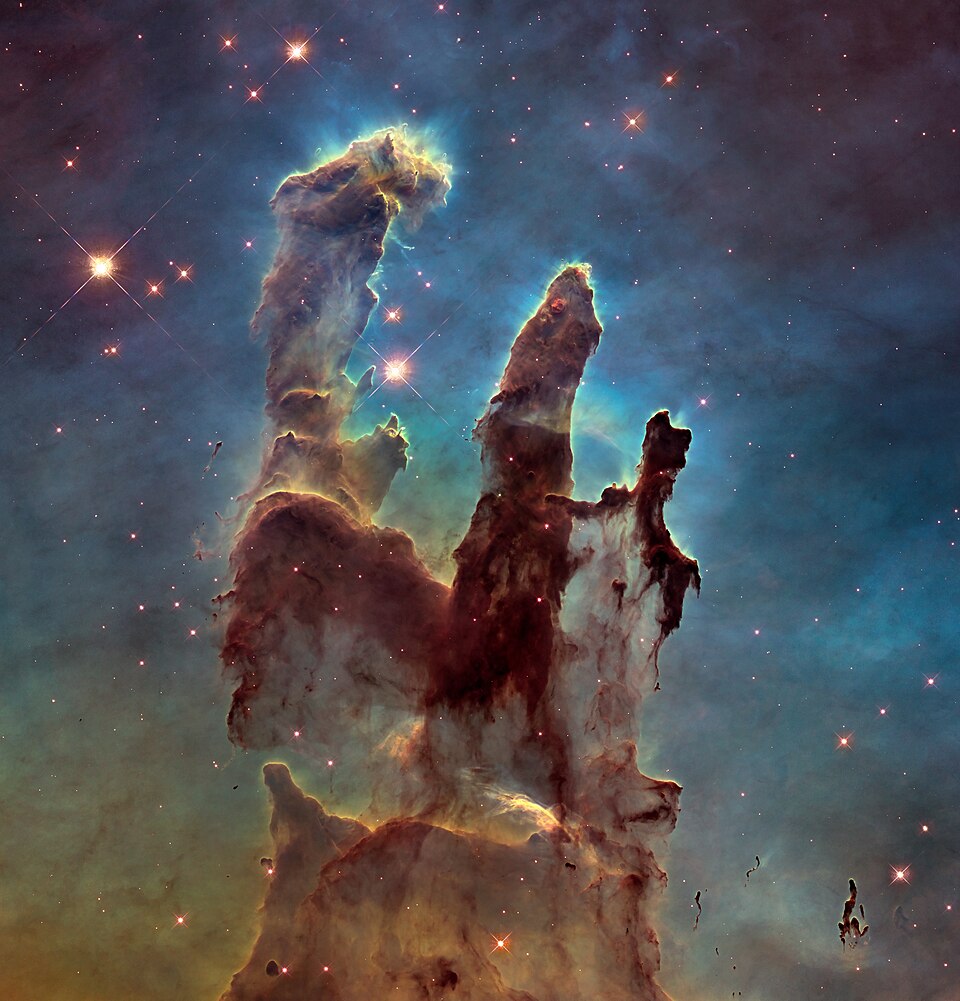

Classical H II regions such as the Orion Nebula, powered by the Trapezium cluster of young O stars, have diameters of roughly 1 to 30 parsecs, internal temperatures near 8,000 to 10,000 kelvin, and electron densities of 10 to 10,000 per cubic centimetre. They are bounded by a sharp ionisation front beyond which the gas returns abruptly to neutral. The theoretical radius of a fully ionised sphere around a hot star, known as the Strömgren radius, is determined by the balance between the rate of ionising photon production and the rate of recombination in the surrounding gas.3 H II regions are among the most prominent optical features of star-forming galaxies and serve as important tracers of recent star formation activity and of the chemical abundances of the ISM, because the emission lines from ionised metals such as oxygen, nitrogen, and sulfur can be measured spectroscopically to determine elemental ratios.17
Interstellar dust
Interstellar dust consists of solid particles, typically submicrometre in size, composed primarily of silicates and carbonaceous materials.


Silicate grains contain magnesium, iron, silicon, and oxygen in mineral structures analogous to olivine and pyroxene, while carbonaceous grains span a continuum from amorphous carbon and graphite-like particles to large polycyclic aromatic hydrocarbon (PAH) molecules containing 50 to several hundred carbon atoms.7 Dust grains are formed in the outflows of evolved stars, particularly asymptotic giant branch (AGB) stars and the ejecta of supernovae, and are subsequently modified by processing in the ISM through sputtering, shattering in grain-grain collisions, and accretion of atoms from the gas phase.7, 8
The most conspicuous observational effect of interstellar dust is extinction — the dimming of starlight by absorption and scattering as photons pass through dusty regions. Extinction is wavelength-dependent, affecting shorter (bluer) wavelengths more strongly than longer (redder) ones, a phenomenon known as interstellar reddening. The characteristic extinction curve of the Milky Way rises steeply toward the ultraviolet and exhibits a broad absorption feature centred at 217.5 nanometres, commonly attributed to small carbonaceous grains or PAHs.7, 8 In the visual band, the total extinction along a line of sight through the galactic plane amounts to roughly 1 to 2 magnitudes per kiloparsec, though it varies enormously depending on the distribution of dust clouds. At infrared and radio wavelengths, dust extinction is negligible, which is why observations at these wavelengths are essential for studying the galactic centre and other heavily obscured regions.8
Dust grains also play a fundamental chemical role. The formation of molecular hydrogen — the most abundant molecule in the universe — proceeds extremely slowly in the gas phase because two hydrogen atoms colliding in free space have no efficient mechanism to dissipate their binding energy. On the surface of a dust grain, however, hydrogen atoms can adsorb, migrate, find a reaction partner, and release the resulting H₂ molecule, with the grain absorbing the excess energy. This catalytic surface chemistry makes dust grains indispensable for the very existence of molecular clouds and, by extension, for star formation itself.3, 7
The role of supernovae in shaping the ISM
Supernova explosions are the single most important source of energy input to the interstellar medium. A typical core-collapse supernova releases approximately 1051 ergs of kinetic energy into its surroundings, driving a blast wave that sweeps up ambient gas into a thin, dense shell and leaves behind a hot, low-density cavity.14
The resulting supernova remnant (SNR) evolves through a well-studied sequence of phases: an initial free-expansion phase in which the ejecta expand ballistically; a Sedov-Taylor phase dominated by adiabatic expansion of the shock-heated interior; a radiative phase in which the shell cools and compresses; and finally a dissipative phase in which the remnant merges with the ambient ISM. A single SNR can reach diameters of 30 to 50 parsecs and persist for tens of thousands of years before dissipating.14, 16
The cumulative effect of multiple supernovae occurring within the same stellar association can create superbubbles — enormous cavities hundreds of parsecs across, filled with hot, X-ray-emitting gas at temperatures exceeding 106 kelvin. These superbubbles can break through the galactic disk entirely, venting hot gas into the halo in structures called galactic chimneys or galactic fountains. The hot ionised medium that permeates a large fraction of the galactic volume is thought to be maintained primarily by this ongoing supernova activity.1, 2
Supernovae also drive interstellar turbulence. Observations of the ISM reveal velocity fluctuations on scales from sub-parsec to hundreds of parsecs, with a turbulent energy spectrum broadly consistent with Kolmogorov or Burgers-type cascades. Supernova blast waves inject energy at scales of tens of parsecs, and this energy cascades down to smaller scales, maintaining the turbulent state of the medium and inhibiting large-scale gravitational collapse of the gas.9 Additionally, supernovae are the primary agents of chemical enrichment: the nucleosynthetic products forged in massive stars — oxygen, carbon, silicon, iron, and the full range of elements heavier than helium — are distributed into the ISM by supernova ejecta, progressively increasing the metallicity of the interstellar gas from which subsequent generations of stars form.13, 14
Cosmic rays and magnetic fields
The interstellar medium is permeated by two additional components that exert pressures comparable to those of thermal gas and turbulence: cosmic rays and magnetic fields. Cosmic rays are high-energy charged particles — predominantly protons, with smaller fractions of helium nuclei, heavier ions, and electrons — that travel through the ISM at relativistic velocities. Their energy spectrum extends from roughly 109 to beyond 1020 electron volts, and their energy density in the solar neighbourhood is approximately 1 electron volt per cubic centimetre, comparable to the energy densities of starlight, thermal gas pressure, and magnetic fields.10
The primary sources of galactic cosmic rays are supernova remnants, where diffusive shock acceleration at the expanding blast wave is thought to accelerate particles to energies up to approximately 3 × 10¹⁵ electron volts — the so-called "knee" of the cosmic ray spectrum. Cosmic rays are confined to the galaxy by the interstellar magnetic field, which deflects their trajectories and causes them to diffuse through the ISM over timescales of roughly 10 million years before escaping into intergalactic space.10 As they propagate, cosmic rays ionise atoms and molecules in regions too dense and shielded for ultraviolet photons to penetrate, making them the dominant source of ionisation in molecular cloud interiors and thereby regulating the degree to which the gas is coupled to the magnetic field.3, 10
The Galactic magnetic field has a large-scale ordered component that roughly follows the spiral arms, with a typical strength of 2 to 6 microgauss in the solar neighbourhood, plus a random or turbulent component of comparable magnitude.11 The magnetic pressure associated with this field is sufficient to provide partial support against gravitational collapse in molecular clouds and to channel the flow of gas along field lines. The field is measured through several complementary techniques: Faraday rotation of polarised radio emission from pulsars and extragalactic sources, synchrotron emission from relativistic electrons spiralling around field lines, and polarisation of starlight and dust emission caused by the alignment of non-spherical dust grains with the field.11 The interstellar magnetic field, cosmic rays, gas, and dust are dynamically coupled, and their mutual interactions govern much of the large-scale behaviour of the ISM.2, 11
Interstellar chemistry
Despite the extremely low densities and temperatures of the ISM, an astonishingly rich chemistry operates within it. As of the most recent comprehensive census, more than 270 distinct molecular species have been identified in interstellar and circumstellar environments, ranging from simple diatomic molecules such as carbon monoxide (CO), hydroxyl (OH), and molecular hydrogen (H₂) to complex organic molecules containing ten or more atoms.20 These detections are made primarily through rotational emission and absorption lines at millimetre and submillimetre wavelengths, observed with radio telescopes such as the Atacama Large Millimeter Array (ALMA) and the Green Bank Telescope.12
Interstellar chemistry proceeds through two broad classes of reactions. In the gas phase, ion-molecule reactions dominate at the low temperatures of molecular clouds because they typically have no activation energy barrier. A cosmic ray ionises an H₂ molecule, producing H₂+, which rapidly reacts with another H₂ to form H₃+ — a pivotal species that initiates reaction chains leading to the synthesis of numerous molecules including water, ammonia, and simple organic species.3, 12 On grain surfaces, atoms adsorbed onto cold dust particles at 10 to 20 kelvin can migrate and react, forming more complex species that are subsequently released into the gas phase through thermal desorption, photodesorption by ultraviolet photons, or energetic processing by cosmic rays. This surface chemistry is responsible for the formation of methanol, formaldehyde, and likely more complex organic molecules.12
Among the most significant detections are complex organic molecules (COMs) — carbon-bearing species with six or more atoms that are considered potential precursors to prebiotic chemistry. Molecules such as dimethyl ether (CH₃OCH₃), methyl formate (HCOOCH₃), glycolaldehyde (HCOCH₂OH), and even tentative detections of amino acid precursors have been found in the hot cores surrounding newly formed massive protostars and in cold prestellar cores.12, 20 A persistent set of optical and near-infrared absorption features known as the diffuse interstellar bands (DIBs), numbering over 500, have defied definitive identification since their discovery in the 1920s, though large carbonaceous molecules and PAH cations are leading candidates.15
The ISM and the galactic ecosystem
The interstellar medium is the nexus of a continuous cycle of matter that sustains star formation and chemical evolution across cosmic time. Stars form from the gravitational collapse of dense molecular gas, shine for millions to billions of years while fusing hydrogen and helium into heavier elements through nucleosynthesis, and ultimately return a substantial fraction of their mass to the ISM at the end of their lives — through gentle mass loss on the asymptotic giant branch for low- and intermediate-mass stars, and through violent supernova explosions for massive stars.6, 13 Each generation of stars enriches the ISM with a greater proportion of heavy elements, a process recorded in the increasing metallicity of successively younger stellar populations and known as galactic chemical evolution.13
This cycle is not perfectly closed within the galactic disk. Gas is exchanged between the disk and the galactic halo through the galactic fountain mechanism, in which supernova-heated gas rises buoyantly out of the plane, cools radiatively, and falls back as intermediate- and high-velocity clouds of neutral hydrogen.1, 2 Additionally, galaxies accrete fresh, relatively metal-poor gas from the intergalactic medium and from satellite galaxies, replenishing the ISM and sustaining star formation over timescales longer than the gas depletion time would otherwise permit.6 The rate at which galaxies convert their interstellar gas into stars, and the balance between accretion, feedback-driven outflows, and internal recycling, are among the central questions of contemporary astrophysics and are encapsulated in the empirical Kennicutt-Schmidt law, which relates the surface density of star formation to the surface density of gas.6
The stellar evolution of individual stars and the collective evolution of the interstellar medium are thus inextricably linked. The ISM is not a passive backdrop against which stellar processes unfold, but an active participant whose temperature, density, chemical composition, magnetic structure, and turbulent state regulate the rate and outcome of star formation. Every atom of carbon, oxygen, nitrogen, and iron in the present-day universe — including the atoms that constitute planets and living organisms — was synthesised inside a star and spent time dispersed in the interstellar medium before being incorporated into a new stellar system.3, 13
References
A theory of the interstellar medium: three components regulated by supernova explosions in an inhomogeneous substrate
The 2014 census of interstellar, circumstellar, extragalactic, protoplanetary disk, and exoplanetary molecules