Overview
- Binary neutron star systems form through the successive supernova explosions of two massive stars in a close binary, and their subsequent orbital decay through gravitational wave emission was first demonstrated by the Hulse–Taylor pulsar PSR B1913+16, whose orbit shrinks at a rate matching general relativity’s prediction to within 0.2 percent—a discovery that earned the 1993 Nobel Prize in Physics.
- On August 17, 2017, the LIGO and Virgo gravitational-wave detectors recorded the inspiral and merger of two neutron stars (GW170817) at a distance of approximately 40 megaparsecs in the galaxy NGC 4993, followed 1.7 seconds later by a short gamma-ray burst detected by Fermi and INTEGRAL—the first joint gravitational-wave and electromagnetic observation of any astrophysical source.
- The kilonova AT 2017gfo that followed GW170817 displayed spectroscopic signatures of freshly synthesized r-process elements, including the first individual identification of strontium, confirming that neutron star mergers are a major production site for the heaviest elements in nature—including gold, platinum, and uranium—with each merger ejecting an estimated 0.01 to 0.05 solar masses of r-process material.
Every atom of gold in a wedding ring, every grain of platinum in a catalytic converter, and every trace of uranium in terrestrial ore was forged in one of the most violent events the universe can produce: the collision and merger of two neutron stars. For decades, astrophysicists suspected that such mergers were responsible for synthesizing the heaviest elements through the rapid neutron-capture process (r-process), but direct observational confirmation remained elusive. That changed on August 17, 2017, when gravitational-wave detectors and electromagnetic telescopes jointly observed a binary neutron star merger for the first time, revealing the spectroscopic fingerprints of freshly created heavy elements in the expanding debris.4, 7, 13
The story of how neutron star mergers came to be recognized as cosmic forges of gold and platinum spans general relativity, nuclear physics, gravitational-wave astronomy, and galactic chemical evolution. It begins with the formation of binary neutron star systems through successive supernova explosions, continues through billions of years of orbital decay driven by gravitational radiation, and culminates in a cataclysmic collision that ejects neutron-rich matter into space at a significant fraction of the speed of light.3, 16
Binary neutron star systems
A binary neutron star (BNS) system is the endpoint of a complex evolutionary sequence that begins with two massive stars orbiting each other in a close binary. Each star must be massive enough—typically above approximately 8 solar masses—to end its life in a core-collapse supernova that leaves behind a neutron star rather than a white dwarf. The formation pathway involves at least two supernova explosions separated by millions of years, with multiple phases of mass transfer and orbital interaction between them.3
The standard formation scenario proceeds through several stages. The initially more massive star evolves first, expanding into a giant that transfers mass to its companion. When this primary star exhausts its nuclear fuel, it explodes as a supernova, leaving a neutron star. The explosion imparts an asymmetric natal kick to the newborn neutron star—typically hundreds of kilometers per second—which can disrupt the binary entirely if the kick is large or oriented unfavorably. Systems that survive this first supernova enter a phase where the neutron star orbits the still-evolving secondary star.3 When the secondary expands in turn, the system may undergo a common-envelope phase, in which the neutron star spirals inward through the outer layers of the giant companion. Drag forces during this phase shrink the orbital separation dramatically while ejecting the envelope. The exposed helium core of the secondary then undergoes its own supernova, producing a second neutron star and subjecting the binary to a second natal kick. The small fraction of systems that remain bound after both explosions emerge as tight binary neutron star systems with orbital periods typically ranging from hours to days.3
The first binary pulsar, PSR B1913+16, was discovered in 1974 by Russell Hulse and Joseph Taylor using the 305-meter Arecibo radio telescope.1 The system consists of a radio pulsar orbiting an unseen neutron star companion with an orbital period of 7.75 hours and an eccentricity of 0.617. Because the pulsar acts as an extraordinarily precise clock, the arrival times of its radio pulses can be measured with microsecond accuracy, allowing the orbital parameters to be tracked over decades. Hulse and Taylor, and later Weisberg and collaborators, demonstrated that the orbital period of PSR B1913+16 is decreasing at a rate of approximately 76 microseconds per year—the orbit is shrinking by about 3.1 millimeters per revolution.2 This decay matches the prediction of Einstein's general relativity for energy loss through gravitational wave emission to within 0.2 percent, providing the first indirect evidence for the existence of gravitational waves.2 Hulse and Taylor were awarded the 1993 Nobel Prize in Physics for this discovery. The system will continue to lose energy and spiral inward for approximately 300 million years before the two neutron stars finally merge.2
The inspiral and merger
The final stages of a binary neutron star inspiral unfold on a dramatically accelerating timescale. General relativity predicts that as the orbital separation decreases, the gravitational wave luminosity increases steeply—proportional to the fifth power of the orbital frequency—creating a positive feedback loop in which energy loss drives the stars closer together, which in turn increases the rate of energy loss. What takes hundreds of millions of years for the wide orbit of PSR B1913+16 accelerates to minutes and then seconds as the neutron stars approach their final plunge.16
The gravitational-wave signal produced by the inspiral is a chirp: a waveform that sweeps upward in both frequency and amplitude as the orbit tightens. In the last few minutes before merger, the signal sweeps from frequencies of a few tens of hertz into the hundreds of hertz, passing through the sensitive frequency band of ground-based gravitational-wave detectors such as LIGO and Virgo.4 As the two neutron stars approach within a few tens of kilometers, tidal forces begin to distort their shapes, and the nuclear matter at their surfaces is stretched and disrupted. The details of this tidal deformation encode information about the neutron star equation of state—the relationship between pressure and density in ultra-dense matter—making BNS mergers a unique laboratory for nuclear physics.16
At contact, the two neutron stars collide at roughly 30 percent of the speed of light. The merger itself lasts only a few milliseconds. Depending on the total mass of the system and the equation of state of neutron star matter, the remnant may be a hypermassive neutron star that survives for tens to hundreds of milliseconds before collapsing to a black hole, a supramassive neutron star that persists for seconds to minutes supported by uniform rotation, or—for the most massive systems—a black hole that forms promptly upon merger.16 In all cases, a hot, dense accretion disk of neutron-rich material forms around the central remnant, and neutron-rich matter is ejected both dynamically during the collision and subsequently through disk winds over the following seconds. A fraction of the systems launch a narrow, relativistic jet that produces a short gamma-ray burst detectable across cosmological distances.6, 16
GW170817: the first detection
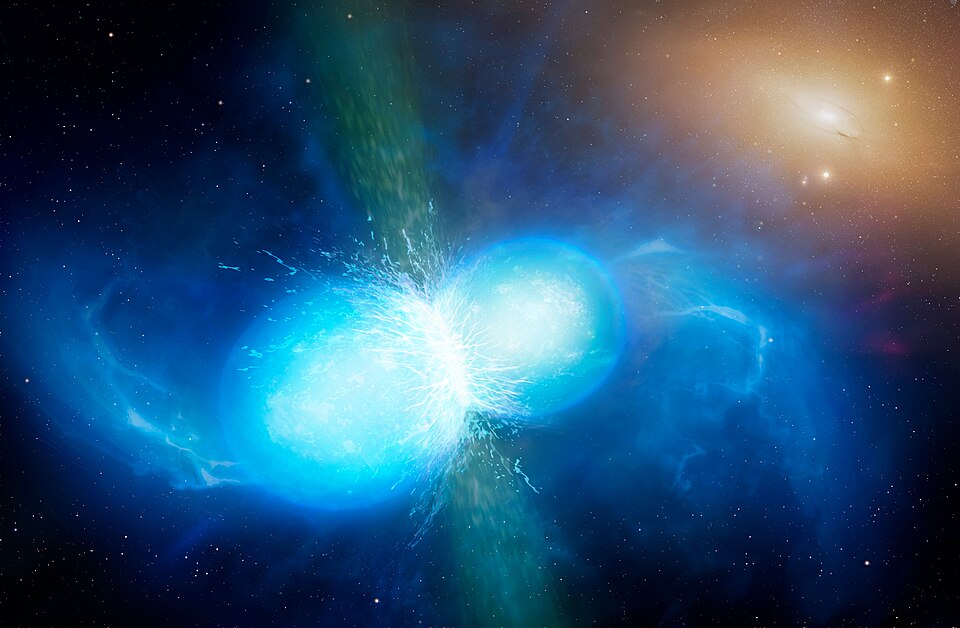

On August 17, 2017 at 12:41:04 UTC, the Advanced LIGO detectors at Hanford, Washington and Livingston, Louisiana, together with the Advanced Virgo detector near Pisa, Italy, recorded a gravitational-wave signal designated GW170817. The signal lasted approximately 100 seconds in the detectors' sensitive frequency band, beginning at 24 hertz and sweeping upward through roughly 3,000 orbital cycles to several hundred hertz—the characteristic chirp waveform of a compact binary inspiral. It was the loudest gravitational-wave signal yet observed, with a combined signal-to-noise ratio of 32.4.4
Analysis of the waveform yielded precise measurements of the binary's properties. The chirp mass—a particular combination of the two component masses that is the most accurately determined parameter from a gravitational-wave inspiral signal—was measured at 1.188+0.004−0.002 solar masses.5 The individual component masses, which depend on assumptions about the neutron stars' spins, were inferred to lie in the range of 1.17 to 1.60 solar masses when spins are restricted to values consistent with the observed population of Galactic binary neutron stars, with a total system mass of 2.73+0.04−0.01 solar masses.5 These values placed both components squarely in the neutron star mass range, distinguishing GW170817 from all previously detected gravitational-wave events, which had involved binary black hole mergers.
The three-detector network was critical for localizing the source on the sky. Although the Virgo detector recorded only a weak signal—consistent with the source lying near a null in Virgo's antenna pattern—the non-detection effectively constrained the sky position, reducing the localization area to approximately 28 square degrees.4 This localization was refined to the galaxy NGC 4993, a lenticular galaxy in the constellation Hydra at a distance of approximately 40 megaparsecs (about 130 million light-years).7
Just 1.74 seconds after the estimated merger time, the Fermi Gamma-ray Burst Monitor (GBM) detected a short gamma-ray burst designated GRB 170817A, and a corresponding signal was independently recorded by the SPI-ACS instrument aboard the INTEGRAL spacecraft.6 This near-simultaneous detection confirmed a hypothesis that had been debated for decades: that the merger of two neutron stars is a progenitor of short gamma-ray bursts. The 1.7-second delay between the gravitational-wave signal and the gamma-ray emission is consistent with the time required for a relativistic jet to form, break through the merger debris, and produce observable gamma-ray emission.6 GW170817 and GRB 170817A together constituted the first joint detection of gravitational waves and electromagnetic radiation from a single astrophysical source, inaugurating the era of multi-messenger astronomy with gravitational waves.7
Multi-messenger follow-up
The gravitational-wave localization and gamma-ray detection triggered one of the most intensive coordinated observing campaigns in the history of astronomy. Within hours, dozens of telescope teams began scanning the localization region in search of an optical counterpart. At 10 hours and 52 minutes after the merger, the 1-meter Swope Telescope at Las Campanas Observatory in Chile identified a new optical source in NGC 4993, initially designated Swope Supernova Survey 2017a (SSS17a) and later registered as AT 2017gfo.8 Five other teams independently identified the same transient within approximately one hour of each other, confirming the discovery.7
Over the following days and weeks, more than 70 observatories on all seven continents and in space observed AT 2017gfo across the electromagnetic spectrum, from radio wavelengths to X-rays. The resulting dataset made GW170817 the most thoroughly observed astronomical transient in history.7 Ultraviolet observations by the Swift and Hubble space telescopes captured the early, hot emission; ground-based optical and near-infrared telescopes tracked the rapid evolution of the transient's brightness and color; and radio and X-ray telescopes monitored the emergence of emission from the interaction of the relativistic jet with the surrounding medium over weeks to months.7, 9
Multi-messenger observations of GW1708174, 6, 7, 8, 9
| Time after merger | Wavelength / messenger | Instrument(s) | Key finding |
|---|---|---|---|
| 0 s | Gravitational waves | LIGO Hanford, Livingston, Virgo | Chirp signal, SNR 32.4, chirp mass 1.188 M⊙ |
| +1.7 s | Gamma rays | Fermi GBM, INTEGRAL SPI-ACS | Short GRB 170817A; first GW + GRB coincidence |
| +10.9 hr | Optical (i-band) | Swope 1-m Telescope | Discovery of SSS17a / AT 2017gfo in NGC 4993 |
| +11–15 hr | Ultraviolet + optical | Swift, DECam, Gemini-South | Blue, rapidly fading UV/optical emission |
| +1–4 d | Near-infrared | Gemini-South, VLT, HST | Rapid reddening; lanthanide-rich ejecta signature |
| +9 d | X-ray | Chandra X-ray Observatory | Rising off-axis jet afterglow |
| +16 d | Radio (3 GHz) | Karl G. Jansky VLA | Radio afterglow detection; structured jet confirmed |
The spectroscopic evolution of AT 2017gfo was particularly striking. In the first day after the merger, the optical spectrum was dominated by a blue, featureless continuum with a color temperature of roughly 10,000 kelvins, consistent with hot, rapidly expanding ejecta. Over the following three to four days, the emission rapidly shifted to redder wavelengths, and broad absorption features emerged in the near-infrared.9, 13 This blue-to-red evolution had been predicted by theoretical models of kilonovae and was immediately recognized as a signature of the transition from lighter r-process elements in the outer, faster ejecta to heavier, lanthanide-rich material in the deeper, slower layers.11
The kilonova and r-process confirmation
The optical and infrared transient that accompanied GW170817 was a kilonova—a class of transient powered by the radioactive decay of freshly synthesized r-process elements in the neutron-rich ejecta of a neutron star merger.
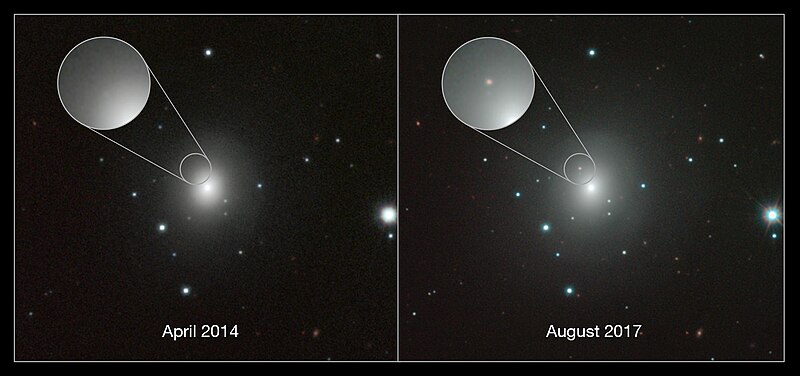

The existence of such transients was first predicted theoretically by Li and Paczyński in 1998, who argued that the radioactive heating from the decay of neutron-rich nuclei in merger ejecta would power a thermal transient broadly analogous to a supernova, though fainter and faster-evolving.18 In 2010, Metzger and collaborators developed detailed models of this emission, introducing the term "kilonova" to reflect the predicted peak luminosity of roughly one thousand times that of a classical nova. They highlighted the critical connection between kilonovae, short gamma-ray bursts, gravitational waves, and the astrophysical origin of r-process elements.10
A key theoretical advance came with the recognition that the opacity of r-process ejecta is dominated by the complex atomic structure of lanthanide and actinide elements. Kasen and collaborators showed that lanthanide-rich ejecta have opacities roughly ten times higher than iron-group elements, because the partially filled f-shell electron configurations of lanthanides produce an extremely dense forest of spectral lines in the optical and near-infrared.11 This high opacity has two consequences: it traps radiation for longer, extending the timescale of the emission; and it shifts the peak of the spectral energy distribution into the near-infrared, producing a characteristically red transient. Models predicted that a kilonova would have two components: a blue component from the polar ejecta, which are heated by neutrino irradiation from the central remnant and therefore have a higher electron fraction with fewer lanthanides; and a red component from the equatorial tidal ejecta, which remain highly neutron-rich and produce copious lanthanides and actinides.11
AT 2017gfo displayed precisely this two-component structure. The early blue emission, peaking at roughly 1 day after the merger, was consistent with ejecta of approximately 0.01 to 0.02 solar masses moving at 0.2 to 0.3 times the speed of light with a relatively low lanthanide fraction. The subsequent red emission, dominating from about 3 to 10 days after the merger, required a separate component of more massive, slower, lanthanide-rich ejecta with opacity roughly ten times higher.11, 13 Spectroscopic modeling indicated a total r-process ejecta mass of approximately 0.03 to 0.05 solar masses.11
The most definitive spectroscopic result came in 2019, when Watson and collaborators reanalyzed the early spectra of AT 2017gfo and identified absorption features at approximately 350 and 850 nanometers as the P Cygni profiles of singly ionized strontium (Sr II).12 Strontium is a neutron-capture element produced by the r-process (and also by the s-process in AGB stars). This identification represented the first robust detection of an individual r-process element in a kilonova, providing a direct and unambiguous link between neutron star mergers and the nucleosynthesis of heavy elements.12
Implications for heavy element origins
The detection of GW170817 and its kilonova transformed the long-standing debate over the astrophysical site of r-process nucleosynthesis from a theoretical question into an observational one.
For decades, core-collapse supernovae had been the leading candidate for the r-process, since they produce the extreme temperatures and densities that could in principle generate the required neutron flux. However, detailed neutrino-driven wind models consistently struggled to achieve sufficiently neutron-rich conditions in the ejecta above the proto-neutron star.14 The spectroscopic evidence from AT 2017gfo provided the most direct confirmation that neutron star mergers are a major—and possibly the dominant—site of r-process nucleosynthesis in the universe.11, 13, 14
The quantitative implications depend on two key numbers: the mass of r-process material ejected per merger event and the rate at which mergers occur in the Galaxy and throughout the universe. The kilonova modeling of AT 2017gfo indicated an r-process yield of roughly 0.03 to 0.05 solar masses per event.11 The binary neutron star merger rate estimated from LIGO observations during the first three observing runs falls in the range of approximately 80 to 810 per cubic gigaparsec per year, corresponding to a Milky Way event rate of roughly one merger every 10,000 to 100,000 years.15, 20 Multiplying these values yields a galactic r-process production rate that is broadly consistent with the total inventory of r-process elements inferred from stellar abundance measurements and meteoritic data, though substantial uncertainties remain in both the per-event yield and the merger rate.14, 15
A significant unresolved question is whether neutron star mergers alone can account for all r-process enrichment across cosmic history, or whether additional sources are required. The challenge arises from observations of extremely metal-poor stars in the Galactic halo—stars that formed in the earliest epochs of the Milky Way's history, when the Galaxy was less than a billion years old. Some of these ancient stars display strongly enhanced abundances of r-process elements such as europium, implying that the interstellar medium was already enriched with r-process material at very early times.14, 15 Binary neutron star mergers, however, require long delay times between the formation of the progenitor binary and the eventual merger—typically hundreds of millions to billions of years for the orbital decay driven by gravitational wave emission. This tension between the early appearance of r-process elements and the expected delay time of mergers has led some researchers to suggest that an additional, prompt source of r-process nucleosynthesis—such as rare classes of core-collapse supernovae, collapsars, or magnetorotational supernovae—may contribute at early times, with neutron star mergers dominating the r-process budget at later epochs.14, 15
The gold and platinum budget
Among the r-process elements synthesized in neutron star mergers, gold (atomic number 79), platinum (atomic number 78), and uranium (atomic number 92) are of particular interest both for their scientific significance and their cultural resonance. These elements lie in the third r-process abundance peak (near mass number A ≈ 195 for the platinum-group elements) and in the actinide region, where the r-process is the sole nucleosynthetic source; unlike lighter heavy elements such as barium and strontium, gold and platinum receive no contribution from the s-process in AGB stars.14
The total mass of r-process material ejected in GW170817 was estimated at 0.03 to 0.05 solar masses, of which the fraction in the form of elements near gold and platinum can be estimated from the theoretical r-process abundance pattern. Nucleosynthesis calculations indicate that elements in the second and third abundance peaks (the lanthanides, platinum-group metals, and gold) constitute a significant fraction of the total r-process yield. Translated into familiar terms, a single merger event such as GW170817 produced an estimated mass of gold-like elements equivalent to several Earth masses—with some models suggesting production of roughly 10 Earth masses of gold and comparable quantities of platinum in a single event.11, 14
The total inventory of gold and platinum in the Milky Way reflects the cumulative contribution of every neutron star merger that has occurred over the Galaxy's roughly 13-billion-year history. Given the estimated Galactic merger rate and per-event r-process yield, the integrated production is broadly consistent with the abundances of these elements observed in the solar system and inferred for the Galaxy as a whole, though precise accounting remains limited by uncertainties in the merger rate, the delay-time distribution, and the fraction of r-process material incorporated into new stellar systems versus lost to the intergalactic medium.14, 15
Independent evidence for the r-process origin of these elements comes from meteoritic measurements and deep-sea sediment analysis. The detection of live (not yet fully decayed) interstellar plutonium-244 (244Pu) in deep-sea manganese crusts and sediments provides a direct tracer of r-process nucleosynthesis in the solar neighborhood. Plutonium-244, with a half-life of 80.6 million years, is produced exclusively by the r-process; its presence in deep-sea samples deposited over the last 25 million years demonstrates that r-process events have occurred relatively recently in the local galactic environment. Notably, Wallner and collaborators found that the amount of interstellar 244Pu deposited on Earth is approximately two orders of magnitude lower than predicted by models of continuous r-process production, suggesting that the r-process operates in rare, high-yield events—precisely the signature expected from infrequent neutron star mergers rather than common supernovae.17
The gold and platinum present in Earth's crust and mantle were delivered during the late stages of planetary accretion. Because gold and platinum are siderophile (iron-loving) elements, the initial endowment of these metals sank to Earth's iron core during differentiation. The gold accessible at Earth's surface was therefore delivered later, primarily by a bombardment of asteroids and comets during the Late Veneer—a period roughly 4.5 to 3.8 billion years ago when chondritic material enriched in r-process elements accumulated on the already-differentiated Earth.14
Future observations
The single event GW170817 established neutron star mergers as a cornerstone of multi-messenger astrophysics, but a comprehensive understanding of their role in heavy element production and their physics requires a large population of observed events. The gravitational-wave detector network is being progressively upgraded to achieve this goal.19, 20
The fourth LIGO-Virgo-KAGRA observing run (O4) concluded in November 2025, with LIGO operating at a binary neutron star detection range of approximately 155 to 175 megaparsecs. Over the course of O4, the network detected gravitational-wave signals at a rate of roughly one event every two to three days, vastly exceeding the handful of detections in earlier runs, though the identification of binary neutron star events with electromagnetic counterparts remained challenging due to the large sky localization areas of many events.19 The fifth observing run (O5), expected to begin after further detector upgrades and to run until approximately 2028, will bring the LIGO detectors to their A+ design sensitivity with a binary neutron star range of 240 to 345 megaparsecs—roughly doubling the O4 range and increasing the observable volume by a factor of roughly eight.19, 20
Beyond the current generation of detectors, two next-generation ground-based observatories are in the planning and design stages. The Einstein Telescope, a proposed European facility with underground, triangular-geometry arms approximately 10 kilometers in length, would achieve sensitivity roughly ten times greater than current detectors at frequencies below 10 hertz, enabling the detection of binary neutron star inspirals from much earlier in their evolution and at far greater distances.20 Cosmic Explorer, a proposed American observatory with arms of 20 to 40 kilometers, would achieve comparable or superior sensitivity at frequencies above 10 hertz.20 Together, these observatories could detect essentially every binary neutron star merger in the observable universe, yielding samples of thousands of events per year and enabling precision studies of the r-process yield distribution, the neutron star equation of state, and the Hubble constant measured independently from electromagnetic distance indicators.20
Each additional kilonova observation will constrain the diversity of r-process yields across different merger configurations, addressing the fundamental question of whether GW170817 was a typical event or an outlier. Spectroscopic observations of future kilonovae with next-generation telescopes—including the James Webb Space Telescope and extremely large ground-based telescopes—will extend the identification of individual r-process elements beyond strontium, potentially including the lanthanides, platinum-group metals, and even actinides. Such identifications would provide direct, element-by-element constraints on nuclear physics models under conditions of extreme neutron density that cannot be replicated in terrestrial laboratories.12, 14 The coming decades of multi-messenger observations promise to complete the story of how the heaviest elements in the periodic table were forged in the most violent collisions in the cosmos.
References
An ordinary short gamma-ray burst with extraordinary implications: Fermi-GBM detection of GRB 170817A
Swope Supernova Survey 2017a (SSS17a), the optical counterpart to a gravitational wave source
Light curves of the neutron star merger GW170817/SSS17a: implications for r-process nucleosynthesis
Electromagnetic counterparts of compact object mergers powered by the radioactive decay of r-process nuclei
Origin of the heavy elements in binary neutron-star mergers from a gravitational-wave event
Spectroscopic identification of r-process nucleosynthesis in a double neutron-star merger
Neutron star mergers as sites of r-process nucleosynthesis and short gamma-ray bursts
Abundance of live 244Pu in deep-sea reservoirs on Earth points to rarity of actinide nucleosynthesis
Prospects for observing and localizing gravitational-wave transients with Advanced LIGO, Advanced Virgo, and KAGRA