Overview
- Neutron stars are the ultra-dense collapsed cores of massive stars, packing 1.1 to 2.3 solar masses into a sphere roughly 10 to 13 kilometres in radius, with central densities exceeding two to three times nuclear saturation density and surface gravitational fields approximately 200 billion times stronger than Earth's.
- First theoretically predicted by Baade and Zwicky in 1934 as remnants of supernovae and observationally confirmed in 1967 through Jocelyn Bell Burnell's discovery of the first radio pulsar, neutron stars now number over 3,000 known examples classified as rotation-powered pulsars, millisecond pulsars, magnetars, and X-ray binaries.
- The interior structure of neutron stars—from a crystalline iron crust through a neutron superfluid mantle to a core that may contain deconfined quark matter—serves as the only accessible laboratory for probing the equation of state of cold, ultra-dense matter, with missions such as NICER providing direct radius measurements that constrain nuclear physics at densities unreachable by terrestrial experiments.
Neutron stars are the extraordinarily dense remnants of massive stars that have exhausted their nuclear fuel and undergone gravitational collapse in core-collapse supernovae.5, 14 With masses between approximately 1.1 and 2.3 solar masses compressed into spheres roughly 10 to 13 kilometres in radius, neutron stars achieve mean densities of approximately 4 × 10¹⁴ g cm−3—comparable to the density of an atomic nucleus—and surface gravitational fields roughly 200 billion times stronger than Earth’s.5, 6 They represent one of the two possible endpoints of massive stellar evolution, the other being black holes, and their extreme physical conditions make them unique laboratories for studying matter at densities that cannot be replicated in any terrestrial experiment.5, 7
The concept of a star composed primarily of neutrons was proposed by Walter Baade and Fritz Zwicky in 1934, just two years after James Chadwick’s discovery of the neutron itself.1, 21 For more than three decades the neutron star remained a theoretical curiosity, until the serendipitous detection of the first radio pulsar by Jocelyn Bell Burnell and Antony Hewish in 1967 provided direct observational confirmation of their existence.3 Since that discovery, neutron stars have become central objects in astrophysics, underpinning the study of gravitational waves, the origin of heavy elements through neutron star mergers, precision tests of general relativity, and the physics of matter under extreme conditions.5, 17
Theoretical prediction and discovery
The theoretical foundation for neutron stars was laid in 1934, when Baade and Zwicky published a pair of landmark papers in the Proceedings of the National Academy of Sciences proposing that “super-novae” represent the transition of an ordinary star into a body composed of closely packed neutrons, which they termed a neutron star.1 They argued that the gravitational binding energy released during this collapse—of order 1053 erg—could power the enormous luminosities observed in supernovae and simultaneously produce cosmic rays.1 This prediction was remarkable in its prescience, arriving only two years after Chadwick had demonstrated the existence of the neutron in 1932.21
In 1939, J. Robert Oppenheimer and George Volkoff performed the first detailed calculation of neutron star structure by solving the equations of hydrostatic equilibrium within general relativity, deriving what is now known as the Tolman–Oppenheimer–Volkoff (TOV) equation.2 Treating the neutron star interior as a cold, ideal Fermi gas of neutrons, they calculated a maximum stable mass of approximately 0.7 solar masses, above which the star would collapse into what would later be understood as a black hole.2 Although this initial mass limit was significantly underestimated because the calculation neglected the repulsive short-range component of the nuclear force, the TOV equation itself remains the fundamental framework for computing neutron star models with any equation of state.2, 5
Observational confirmation came unexpectedly on 28 November 1967, when Jocelyn Bell Burnell, a graduate student at Cambridge, detected a series of precisely periodic radio pulses with a period of 1.337 seconds from a source later designated PSR B1919+21.3 The astonishing regularity of the pulses initially prompted the half-serious designation “LGM-1” (Little Green Men), but the rapid discovery of additional pulsating sources at different sky positions ruled out an artificial origin.3 Thomas Gold swiftly proposed in 1968 that pulsars are rapidly rotating, highly magnetised neutron stars whose beamed electromagnetic radiation sweeps across the observer’s line of sight like a lighthouse beacon, a model that has been confirmed by all subsequent observations.4
Formation in core-collapse supernovae
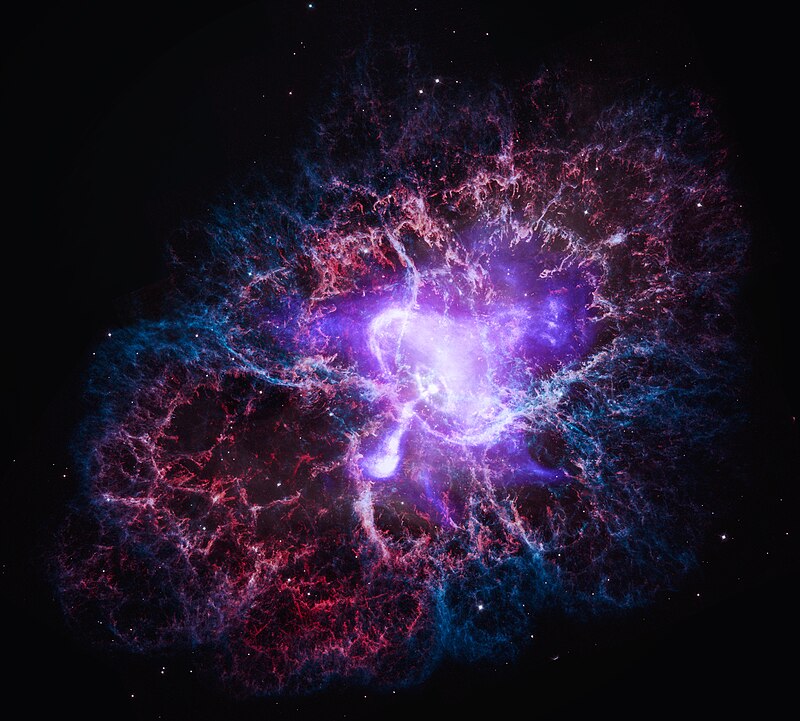
Neutron stars form during the catastrophic gravitational collapse of the iron core of a massive star, typically one with an initial mass between roughly 8 and 25 solar masses.5, 14
.jpg)
.png)
Throughout its life, a massive star fuses progressively heavier elements in concentric shells—hydrogen, helium, carbon, neon, oxygen, and silicon—until it accumulates an iron core of approximately 1.4 solar masses, the Chandrasekhar mass limit for electron-degenerate matter.14 Throughout its life, a massive star fuses progressively heavier elements in concentric shells—hydrogen, helium, carbon, neon, oxygen, and silicon—until it accumulates an iron core of approximately 1.4 solar masses, the Chandrasekhar mass limit for electron-degenerate matter.14 Because iron has the highest nuclear binding energy per nucleon, no further energy can be extracted from fusion, and the core loses its pressure support.5
The collapse proceeds on a timescale of less than one second.14 As the core density exceeds approximately 1012 g cm−3, electrons are captured by protons in a process known as neutronisation, converting the core into an increasingly neutron-rich fluid and releasing a vast flux of electron neutrinos.5, 14 The inner core collapses homologously until it reaches nuclear density (approximately 2.7 × 10¹⁴ g cm−3), at which point the strong nuclear force provides a repulsive pressure that abruptly halts the contraction, forming a protoneutron star with an initial radius of roughly 30 to 50 kilometres and a temperature exceeding 50 billion kelvin.14 The infalling outer core rebounds off this stiffened interior, launching a shock wave that propagates outward but initially stalls as it loses energy to the photodissociation of iron nuclei and continued neutrino losses.14
The mechanism by which the stalled shock is revived to produce a successful supernova explosion remains one of the most intensively studied problems in astrophysics.14 The leading model is the neutrino-driven mechanism, in which a small fraction of the approximately 3 × 1053 erg of gravitational binding energy radiated as neutrinos from the protoneutron star is reabsorbed behind the shock, depositing sufficient energy to revive the explosion.14 Multi-dimensional hydrodynamic simulations incorporating neutrino transport, convection, and the standing accretion shock instability have increasingly succeeded in producing explosions consistent with observed supernova energies and remnant neutron star masses.14 Over the following tens of seconds, the protoneutron star cools by radiating its thermal neutrinos and contracts to its final radius of approximately 10 to 13 kilometres, becoming a stable, cold neutron star.5, 14
Mass and radius
The mass and radius of a neutron star are determined by the equation of state (EOS) of cold, ultra-dense matter—the relationship between pressure and density at conditions far beyond those accessible to laboratory experiments.5, 6 Different theoretical models of the EOS, incorporating various assumptions about nuclear interactions, the presence of hyperons, meson condensates, or deconfined quarks, predict different families of mass–radius curves, making observational measurements of these quantities a direct probe of fundamental nuclear physics.5, 6, 7

The most precise neutron star masses have been obtained through radio timing of millisecond pulsars in binary systems, exploiting relativistic effects such as the Shapiro delay.7, 8 In 2010, Demorest and collaborators measured the mass of PSR J1614−2230 at 1.97 ± 0.04 solar masses using this technique, immediately ruling out many soft equations of state that predicted maximum masses below this value and constraining the presence of exotic matter at nuclear saturation density.8 Cromartie and collaborators subsequently measured the mass of PSR J0740+6620 at 2.14+0.10−0.09 solar masses, later refined by Fonseca and collaborators to 2.08 ± 0.07 solar masses, establishing it as the most massive neutron star with a precisely determined mass.9, 19
Radius measurements are more challenging because neutron stars are compact, distant, and faint at most wavelengths.7 The Neutron Star Interior Composition Explorer (NICER), an X-ray telescope installed on the International Space Station in 2017, has provided the most precise radius determinations by modelling the energy-dependent pulsed thermal emission from hot spots on the surfaces of millisecond pulsars.10, 11 Miller and Riley and their respective teams independently analysed NICER data for PSR J0030+0451, obtaining consistent results with a radius of approximately 13.0+1.2−1.1 km for a mass of 1.44+0.15−0.14 solar masses.10, 11 Critically, NICER also measured the radius of the massive pulsar PSR J0740+6620 at 13.7+2.6−1.5 km, demonstrating that even at two solar masses the neutron star radius does not shrink dramatically—a result that disfavours particularly soft equations of state and supports the presence of relatively stiff nuclear matter at high densities.12
Key neutron star mass and radius measurements8, 9, 10, 12
| Pulsar | Mass (M⊙) | Radius (km) | Method | Reference |
|---|---|---|---|---|
| PSR J1614−2230 | 1.97 ± 0.04 | — | Shapiro delay | Demorest et al. 2010 |
| PSR J0030+0451 | 1.44+0.15−0.14 | 13.0+1.2−1.1 | NICER pulse profile | Miller et al. 2019 |
| PSR J0740+6620 | 2.08 ± 0.07 | 13.7+2.6−1.5 | Shapiro delay + NICER | Fonseca et al. / Miller et al. 2021 |
Internal structure
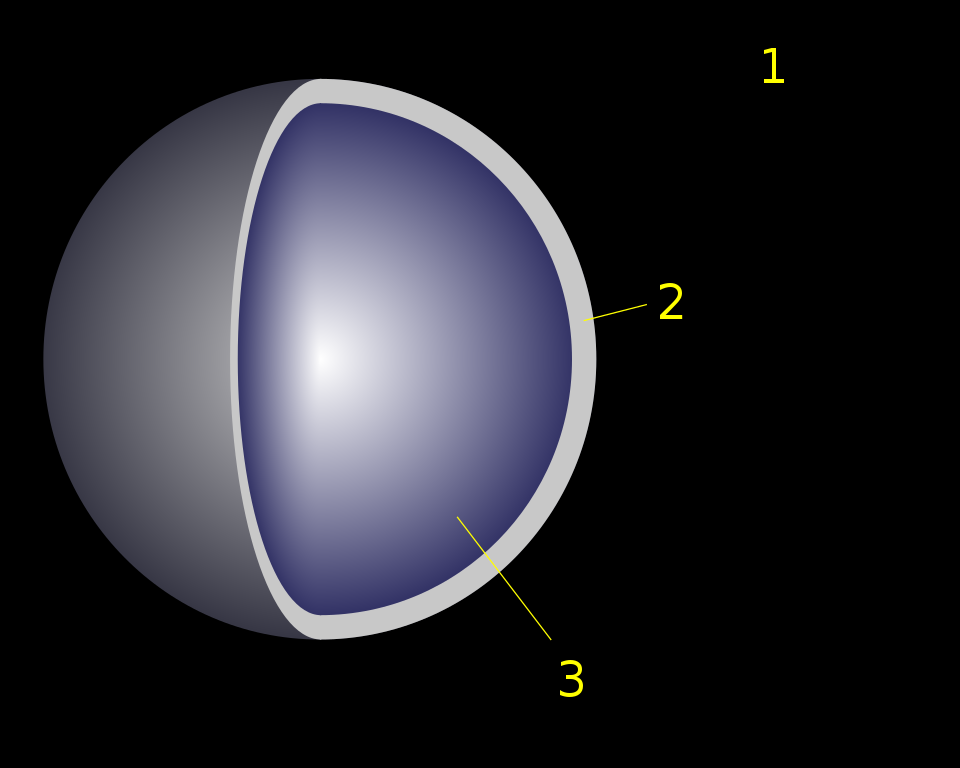
The interior of a neutron star is conventionally divided into several distinct layers, each governed by different physics as the density increases from the surface inward.5, 15

The outermost layer is a thin atmosphere, typically less than a centimetre thick, composed of hydrogen, helium, or heavier elements depending on the star’s age and accretion history, through which thermal radiation is emitted and whose composition determines the observed X-ray spectrum.5
Beneath the atmosphere lies the outer crust, extending from the surface to a density of approximately 4 × 10¹¹ g cm−3, where matter is organised as a body-centred cubic lattice of increasingly neutron-rich nuclei embedded in a degenerate electron gas.15 With increasing depth, the nuclear species become progressively more exotic, progressing from iron-56 at the surface through neutron-rich isotopes of nickel, selenium, and zirconium deeper in the crust.15 At the base of the outer crust, the neutron drip line is reached: nuclei become so neutron-rich that free neutrons begin to leak out and coexist with the nuclear lattice, marking the boundary of the inner crust.15
The inner crust, spanning densities from approximately 4 × 10¹¹ to 2 × 10¹⁴ g cm−3, consists of increasingly neutron-rich nuclear clusters immersed in a superfluid of dripped neutrons and a relativistic electron gas.15 Near the crust–core transition, at roughly half nuclear saturation density, the competition between nuclear surface energy and Coulomb repulsion is predicted to produce exotic configurations collectively known as “nuclear pasta”—elongated rods (“spaghetti”), flat sheets (“lasagna”), and cylindrical voids (“bucatini”) of nuclear matter—that may represent the strongest material in the universe.15, 20
The outer core, which constitutes the bulk of the star’s volume, extends from the crust–core boundary at nuclear saturation density to approximately twice that density.5, 6 Here matter consists predominantly of superfluid neutrons with a smaller admixture of superconducting protons, relativistic electrons, and muons in beta equilibrium.5 The neutrons are expected to form Cooper pairs in the triplet state, producing a superfluid with a critical temperature of approximately 109 to 1010 kelvin, while the protons pair in the singlet state to form a type II superconductor threaded by quantised magnetic flux tubes.5, 20
The composition of the inner core, at densities exceeding two to three times nuclear saturation density, remains one of the great unsolved questions in physics.5, 13, 20 Theoretical proposals include the appearance of hyperons (baryons containing strange quarks), Bose–Einstein condensates of pions or kaons, and a phase transition to deconfined quark matter in which quarks are no longer bound within individual nucleons.5, 20 Annala and collaborators combined first-principles calculations from chiral effective field theory at low densities and perturbative quantum chromodynamics at asymptotically high densities with astrophysical observations, finding that matter in the cores of the most massive neutron stars exhibits characteristics consistent with deconfined quark matter—the strongest evidence to date for this exotic phase in nature.13
Magnetic fields and observational classes
Neutron stars possess the strongest magnetic fields known in the universe, a consequence of magnetic flux conservation during the collapse of the progenitor star’s core: compressing a stellar core with a radius of several thousand kilometres and a magnetic field of approximately 100 gauss down to a neutron star of 10 kilometres amplifies the surface field to roughly 1012 gauss (108 tesla).5 This immense field strength governs nearly every aspect of neutron star phenomenology, from the coherent radio emission of pulsars to the catastrophic energy releases of magnetar flares.5, 7
Rotation-powered pulsars, the most numerous class with over 3,000 known examples, emit beamed electromagnetic radiation powered by the loss of rotational kinetic energy as the magnetic dipole radiates and a relativistic particle wind is driven from the magnetosphere.4, 5 Their spin periods range from about 1.4 milliseconds (the fastest known, PSR J1748−2446ad) to several seconds, and their surface magnetic fields typically range from 1011 to 1013 gauss.5, 7 Over time, pulsars spin down as they radiate away rotational energy, eventually crossing the “death line” in the period–period derivative diagram below which coherent radio emission ceases.5
Millisecond pulsars represent a distinct evolutionary channel in which an old, spun-down neutron star has been recycled—spun back up to periods of 1 to 10 milliseconds—by the accretion of matter and angular momentum from a binary companion.5, 7 The accretion process also buries and reduces the surface magnetic field to approximately 108 to 109 gauss, giving millisecond pulsars exceptionally stable spin rates that make them among the most precise natural clocks in the universe.5 Pulsar timing arrays exploit this stability to search for nanohertz gravitational waves from supermassive black hole binaries.7
Magnetars occupy the opposite extreme of the magnetic field distribution, with surface fields of 1014 to 1015 gauss and inferred interior fields that may reach 1016 gauss or higher.5 Unlike ordinary pulsars, magnetars are powered primarily by the decay and rearrangement of their extreme magnetic fields rather than by rotation, producing luminous X-ray emission, soft gamma-ray repeater bursts, and rare giant flares releasing up to 1046 erg in less than a second.5 Approximately 30 magnetars have been identified, and recent observations have established connections between magnetars and fast radio bursts, with the Galactic magnetar SGR 1935+2154 producing a radio burst in April 2020 that was energetically consistent with the weaker end of the cosmological fast radio burst population.5
Neutron star observational classes by magnetic field strength5, 7
Superfluidity and pulsar glitches
One of the most striking manifestations of quantum mechanics on macroscopic scales occurs in the interior of neutron stars, where the neutron fluid is expected to form a superfluid—a state of zero viscosity in which angular momentum is carried by an array of quantised vortex lines rather than by bulk fluid rotation.5, 16 In the inner crust, the dripped neutrons pair in the singlet state (1S0), while in the outer core, where the density and Fermi momentum are higher, the neutrons pair in the triplet state (3P2).5, 20 The critical temperature for this superfluid transition is estimated at approximately 109 to 1010 kelvin, well above the interior temperature of all but the youngest neutron stars, implying that superfluidity is essentially ubiquitous in the neutron star population.5
The most direct observational evidence for interior superfluidity comes from pulsar glitches—sudden, discontinuous increases in the spin frequency of a pulsar, observed as abrupt decreases in the pulse period.16 The Vela pulsar (PSR B0833−45) is the most prolific glitcher, exhibiting large glitches with fractional frequency increases of approximately 10−6 at intervals of roughly two to three years.16 The prevailing explanation for glitches invokes the interaction between the neutron superfluid and the solid crust: as the crust spins down under electromagnetic braking, the superfluid vortices, which are pinned to crustal lattice sites by the nuclear interaction, do not initially decelerate.16 This builds up a differential rotation—a lag in angular velocity—between the superfluid and the crust, storing angular momentum in the superfluid reservoir.16 When the lag exceeds a critical threshold, a catastrophic unpinning event releases the stored angular momentum to the crust in a sudden spin-up observed as a glitch.16
Detailed modelling of glitch activity, particularly the cumulative angular momentum transferred in glitches from the Vela pulsar over 45 years of observations, has been used to constrain the fraction of the stellar moment of inertia that resides in the superfluid component.16 Ho and collaborators showed that the observed glitch sizes and rates require a superfluid reservoir that extends well beyond the crust into the outer core, providing evidence that the core neutron superfluid participates in the glitch mechanism and constraining the neutron star mass and the density dependence of the pairing gap.16
Neutron stars as gravitational laboratories
The extreme gravitational fields of neutron stars—with surface gravitational redshifts of approximately 0.2 to 0.4 and compactness parameters (GM/Rc2) of order 0.15 to 0.25—make them unparalleled laboratories for testing general relativity in the strong-field regime.5, 7 The most celebrated example is the Hulse–Taylor binary pulsar PSR B1913+16, discovered in 1974, a system comprising two neutron stars in a highly eccentric 7.75-hour orbit.18 Over decades of precise pulse timing, Taylor and collaborators measured the orbital decay of this system and demonstrated that it matched the prediction of general relativity for energy loss through gravitational wave emission to better than 0.2 percent—the first indirect detection of gravitational waves, for which Hulse and Taylor received the 1993 Nobel Prize in Physics.18
The direct detection of gravitational waves from a binary neutron star merger, GW170817, by the LIGO and Virgo observatories in August 2017 opened an entirely new chapter in neutron star physics.17 The gravitational waveform encodes information about the tidal deformability of the merging neutron stars—a measure of how easily their shapes are distorted by the companion’s tidal field—which is directly determined by the equation of state.17 The constraint on the dimensionless tidal deformability from GW170817, combined with the requirement that the equation of state must support neutron stars of at least two solar masses, has significantly narrowed the range of viable equations of state, favouring models with intermediate stiffness and radii for a 1.4 solar mass neutron star in the range of approximately 11 to 13 kilometres.17
Neutron stars in binary systems also enable measurements of several post-Keplerian orbital parameters—including the advance of periastron, gravitational redshift, orbital decay, and Shapiro delay—that together provide multiple independent tests of gravitational theory within a single system.7, 8 The double pulsar PSR J0737−3039A/B, in which both neutron stars are visible as pulsars, has permitted the most precise strong-field tests of general relativity ever performed, confirming the theory to a level of approximately 0.05 percent and constraining alternative theories of gravity with unprecedented stringency.7
The equation of state and fundamental physics
The quest to determine the equation of state of dense matter represents one of the deepest connections between astrophysics and fundamental physics, as neutron stars probe the behaviour of quantum chromodynamics (QCD) in a regime of high baryon density and low temperature that is inaccessible to lattice QCD calculations and complementary to the high-temperature, low-density regime explored at heavy-ion colliders such as the Relativistic Heavy Ion Collider and the Large Hadron Collider.5, 6, 13
At densities near and below nuclear saturation density (approximately 2.7 × 10¹⁴ g cm−3), the equation of state is relatively well constrained by nuclear physics experiments and chiral effective field theory calculations, which provide reliable predictions for the energy of pure neutron matter and symmetric nuclear matter.6, 13 Above approximately twice nuclear saturation density, however, theoretical uncertainties grow dramatically because the relevant degrees of freedom—whether nucleonic, hyperonic, or quark—are not well established, and perturbative QCD becomes applicable only at asymptotically high densities far above those realised in neutron star cores.6, 13
The convergence of multiple observational channels has begun to close this gap.7, 17 Precise mass measurements above two solar masses from radio timing rule out equations of state that are too soft to support such massive stars.8, 9 Radius measurements from NICER constrain the pressure at one to two times nuclear saturation density, while tidal deformability measurements from gravitational wave events such as GW170817 probe the density-dependent stiffness at somewhat higher densities encountered during the late inspiral.10, 11, 12, 17 Together, these constraints have narrowed the radius of a canonical 1.4 solar mass neutron star to approximately 11.5 to 13.5 kilometres and the maximum neutron star mass to approximately 2.1 to 2.4 solar masses, with most analyses favouring a TOV maximum mass near 2.2 to 2.3 solar masses.7, 12, 17
Future advances will come from continued NICER observations of additional pulsars, next-generation gravitational wave detectors such as the Einstein Telescope and Cosmic Explorer that will detect hundreds of neutron star mergers per year with improved tidal deformability constraints, and nuclear physics experiments at facilities such as the Facility for Antiproton and Ion Research (FAIR) in Germany that will probe the high-density EOS with heavy-ion collisions.7, 12 The neutron star thus stands at a unique intersection of astronomy, nuclear physics, and particle physics—a natural experiment in extreme matter whose full decoding promises to reveal the fundamental behaviour of the strong nuclear force at the highest densities accessible in the observable universe.5, 13
References
PSR J0030+0451 Mass and Radius from NICER Data and Implications for the Properties of Neutron Star Matter