Overview
- Pulsars are rapidly rotating, highly magnetized neutron stars that emit beams of electromagnetic radiation from their magnetic poles; first detected in 1967 by Jocelyn Bell and Antony Hewish, they were identified within months as rotating neutron stars by Thomas Gold, and more than 3,000 are now catalogued in the Milky Way alone.
- Millisecond pulsars, spun up to periods of 1–10 ms by accretion from binary companions, are among the most stable clocks in nature and form the basis of pulsar timing arrays that in 2023 provided the first evidence for a nanohertz gravitational-wave background permeating the universe.
- Binary pulsars—most notably PSR B1913+16, whose orbital decay matched general relativity's prediction for gravitational-wave emission to within 0.3%—have provided the most stringent tests of Einstein's theory in the strong-field regime, earning Hulse and Taylor the 1993 Nobel Prize in Physics.
Pulsars are rapidly rotating, highly magnetized neutron stars that emit focused beams of electromagnetic radiation from regions near their magnetic poles. As the star rotates, these beams sweep across the sky like a lighthouse, producing periodic pulses detectable at radio, optical, X-ray, and gamma-ray wavelengths. First observed in 1967 as a mysterious source of precisely timed radio pulses, pulsars were quickly identified as the long-predicted neutron stars—objects so dense that a teaspoon of their material would weigh roughly a billion tonnes on Earth.1, 2
In the decades since their discovery, pulsars have become indispensable tools for fundamental physics. They serve as natural laboratories for testing general relativity in the strong-field regime, as cosmic clocks precise enough to detect gravitational waves, and as probes of matter at densities unreachable in terrestrial experiments. The study of pulsars has yielded two Nobel Prizes in Physics and continues to open new windows on the universe.6, 7, 8
Discovery
The first pulsar was detected on 28 November 1967 by Jocelyn Bell, a graduate student at the Mullard Radio Astronomy Observatory in Cambridge, England, working under the supervision of Antony Hewish. Using a large 81.5 MHz interplanetary scintillation array designed to study quasars, Bell noticed a recurring signal—a series of radio pulses arriving with a remarkably stable period of 1.3373 seconds and pulse widths of approximately 0.3 seconds. The signal was initially so regular that it was jokingly nicknamed "LGM-1" (Little Green Men), reflecting a brief, half-serious consideration that it might be of artificial origin.1
Hewish, Bell, and their colleagues published the discovery in February 1968, reporting the source as a rapidly pulsating radio emitter of unknown nature and tentatively associating the radiation with oscillations of a white dwarf or neutron star.1 Within months, Thomas Gold at Cornell University proposed the correct explanation: the pulses arise from a rapidly rotating neutron star whose intense magnetic field channels radiation into narrow beams that sweep past the observer once per rotation. Gold predicted that the rotation would slow measurably over time as energy was radiated away—a prediction confirmed within the year for the Crab Nebula pulsar (PSR B0531+21), which was found to have a period of just 33 milliseconds and a measurable spin-down rate.2
Hewish was awarded the 1974 Nobel Prize in Physics for the discovery of pulsars. Bell's omission from the prize remains one of the most widely discussed controversies in the history of Nobel awards, though Bell herself has publicly expressed acceptance of the decision. By the early 1970s, dozens of pulsars had been identified, confirming that they represented an entirely new class of astronomical object and validating decades of theoretical speculation about the existence of neutron stars.1, 2
The pulsar mechanism
A pulsar is fundamentally a rotating magnetic dipole. Neutron stars are born in the core-collapse supernovae of massive stars, inheriting a compressed version of the progenitor star's magnetic field and angular momentum. Conservation of magnetic flux during the collapse amplifies the surface field to typical strengths of 1012 gauss, while conservation of angular momentum spins the star up to initial periods of tens of milliseconds. The result is a compact object roughly 10 kilometres in radius, with a mass of 1.4 to 2 solar masses, rotating at extraordinary speed and embedded in an enormously strong magnetic field.17
.jpg)
.jpg)
Goldreich and Julian demonstrated in 1969 that a rotating magnetized neutron star cannot exist in a vacuum. The rotation of the magnetic field induces an electric field at the stellar surface so intense—on the order of 1012 volts per metre—that it tears charged particles from the surface, filling the surrounding space with a co-rotating plasma known as the magnetosphere. They derived the minimum charge density required for co-rotation, now called the Goldreich-Julian density, and showed that the magnetosphere extends outward to the light cylinder, the cylindrical surface at which co-rotation velocity would equal the speed of light.3
Inside the light cylinder, magnetic field lines close back on the star and plasma is trapped. Outside it, field lines are forced open by the relativistic constraint, and charged particles stream outward along these open field lines, carrying away rotational kinetic energy. This energy loss manifests as a gradual deceleration of the star—the observed pulsar spin-down. The rate of spin-down is directly related to the magnetic field strength: stronger fields produce greater torques and faster deceleration.3, 2
The actual radio emission is thought to originate from coherent processes in the relativistic plasma above the magnetic polar caps. Electrons and positrons are accelerated to extreme Lorentz factors along curved magnetic field lines, emitting curvature radiation that triggers pair-production cascades. The coherent nature of this process is required to explain the extraordinary brightness temperatures of pulsar radio emission, which can exceed 1025 kelvin—far beyond what any incoherent thermal or synchrotron source could produce. Despite decades of effort, the precise emission mechanism remains one of the outstanding unsolved problems in astrophysics.3
The pulsar population
The ATNF Pulsar Catalogue, the community-standard database maintained by CSIRO since 2003, catalogued 1,509 pulsars in its foundational 2005 publication. As of its most recent updates, the catalogue contains well over 3,000 entries, encompassing rotation-powered radio pulsars, millisecond pulsars, gamma-ray pulsars, X-ray pulsars, and magnetars.14 Population synthesis models estimate that the Milky Way harbours on the order of 100,000 to 1,000,000 active radio pulsars, the vast majority of which are either too faint to detect with current telescopes or oriented so that their beams never sweep past Earth.14
Pulsars are conventionally divided into two broad populations on the basis of their spin period and period derivative (the rate at which they slow down), which together define the so-called P–Ṗ diagram. Normal (or "canonical") pulsars have periods ranging from about 30 milliseconds to several seconds and period derivatives of approximately 10−15 seconds per second, corresponding to characteristic ages of millions of years and inferred surface magnetic fields of roughly 1012 gauss. These are young to middle-aged neutron stars spinning down steadily under their magnetic dipole torque.14, 17
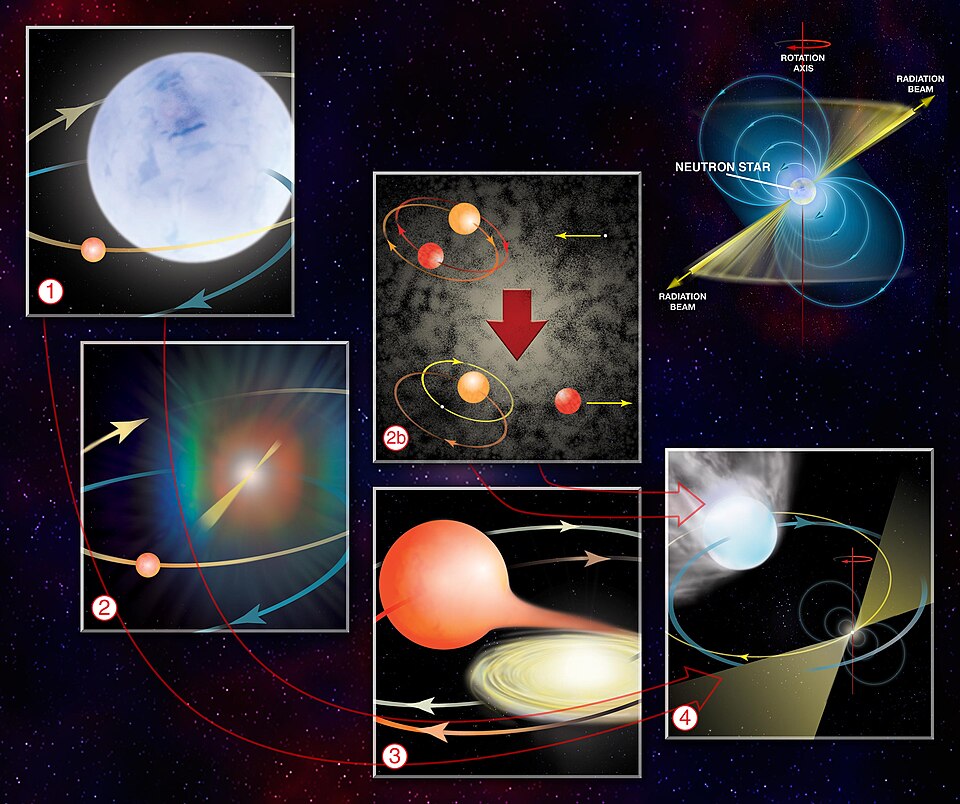
A distinct second population, the millisecond pulsars (MSPs), clusters in the lower-left corner of the P–Ṗ diagram, with periods of 1 to 30 milliseconds and period derivatives as small as 10−20 seconds per second. Their characteristic ages are billions of years—far older than normal pulsars—and their inferred magnetic fields are only 108 to 109 gauss. These properties indicate that MSPs are ancient neutron stars that have been "recycled" by accretion from a binary companion, as described in the following section.4, 5
Pulsar period distribution by class14
Millisecond pulsars and recycling
The first millisecond pulsar, PSR B1937+21, was discovered on 9 November 1982 by Donald Backer and colleagues using the 305-metre Arecibo telescope in Puerto Rico. With a period of just 1.5578 milliseconds—corresponding to 642 rotations per second—it was by far the fastest-spinning pulsar known at the time and immediately posed a challenge to existing models of pulsar evolution, which predicted that neutron stars should spin down monotonically after birth.4
The explanation came in the same year from Alpar, Cheng, Ruderman, and Shaham, who proposed the recycling model. In this scenario, an old, slowly rotating neutron star in a binary system accretes matter and angular momentum from a companion that overflows its Roche lobe. As material spirals inward through an accretion disc and strikes the neutron star surface, it transfers orbital angular momentum, gradually spinning the star up to millisecond periods. Simultaneously, the accretion process buries and dissipates the magnetic field, reducing it from the canonical 1012 gauss to 108–109 gauss. When mass transfer ceases—typically because the companion has been ablated or evolved into a white dwarf—the recycled neutron star reactivates as a radio pulsar, now spinning rapidly but decelerating only slowly because of its weakened magnetic field.5
Millisecond pulsars are among the most stable rotators known in nature. Their period derivatives are so small that the accumulated timing residuals over years of observation can be as low as a few hundred nanoseconds—competitive with the best terrestrial atomic clocks. This extraordinary stability is the foundation of pulsar timing arrays, which exploit ensembles of MSPs to search for correlated timing perturbations caused by passing gravitational waves.4, 8
Binary pulsars and tests of general relativity
In July 1974, Russell Hulse and Joseph Taylor, using the Arecibo telescope to conduct a systematic pulsar survey, discovered PSR B1913+16—a 59-millisecond pulsar in a highly eccentric binary orbit with an unseen neutron star companion. The orbital period was 7.75 hours and the eccentricity 0.617, indicating an extraordinarily compact and relativistic system.6
The Hulse-Taylor binary immediately became a premier testing ground for Einstein's general theory of relativity. Taylor and Weisberg showed in 1982 that the orbit was shrinking: the orbital period was decreasing at a rate corresponding to approximately 3.1 millimetres per orbit, or about 76 microseconds per year. This matched—to within 0.3%—the prediction of general relativity for energy loss due to the emission of gravitational waves. It was the first observational evidence, albeit indirect, for the existence of gravitational radiation.7 The advance of periastron in the system was measured at 4.2266 degrees per year—roughly 35,000 times the rate of Mercury's famous perihelion precession—providing a separate, independent confirmation of strong-field relativistic dynamics. Hulse and Taylor received the 1993 Nobel Prize in Physics for this discovery.6, 7
An even more remarkable system was found in 2003: PSR J0737−3039, the only known double pulsar, in which both neutron stars are detected as active pulsars. Discovered by Burgay and colleagues with the Parkes radio telescope, the system consists of a 22.7-millisecond pulsar (A) and a 2.77-second pulsar (B) orbiting each other every 2.4 hours with an eccentricity of 0.088.9, 10 The orbital period is so short that the system will merge due to gravitational-wave emission in approximately 85 million years, making it the most relativistic binary pulsar known. Kramer and colleagues used 16 years of timing data to measure seven post-Keplerian orbital parameters simultaneously, confirming general relativity's predictions at the 99.99% level in the strong-field regime—the most stringent test of Einstein's theory ever performed in a gravitational field comparable to that near a neutron star.11, 19
Key binary pulsar systems and their contributions to physics6, 7, 9, 19
| System | Year | Orbital period | Key result |
|---|---|---|---|
| PSR B1913+16 | 1974 | 7.75 hr | First indirect evidence for gravitational waves (0.3% GR match) |
| PSR J0737−3039A/B | 2003 | 2.4 hr | Only double pulsar; GR confirmed at 99.99% in strong field |
| PSR J1614−2230 | 2010 | 8.7 days | 2.01 M⊙ neutron star via Shapiro delay |
Pulsar timing arrays and gravitational waves
Pulsar timing arrays (PTAs) exploit the extraordinary rotational stability of millisecond pulsars to detect gravitational waves at nanohertz frequencies—wavelengths so long that a single oscillation takes years to decades to complete.

The technique relies on monitoring an ensemble of precisely timed MSPs distributed across the sky and searching for correlated deviations in their pulse arrival times. A passing gravitational wave stretches and compresses the spacetime between Earth and each pulsar, producing timing residuals whose angular correlation pattern across pulsar pairs follows the distinctive Hellings-Downs curve predicted by general relativity.8
In June 2023, the North American Nanohertz Observatory for Gravitational Waves (NANOGrav) announced compelling evidence for a stochastic gravitational-wave background using 15 years of timing data from 67 millisecond pulsars. The data revealed the characteristic Hellings-Downs angular correlation at frequencies of approximately 1 to 30 nanohertz, consistent with a background produced by a cosmological population of supermassive black hole binaries inspiralling toward merger throughout the universe. Three independent PTA collaborations—the European Pulsar Timing Array (EPTA), the Parkes Pulsar Timing Array (PPTA), and the Indian Pulsar Timing Array (InPTA)—announced consistent results in the same week, establishing the detection on a global basis.8
This achievement is fundamentally distinct from the direct gravitational-wave detections by LIGO and Virgo, which operate at frequencies of tens to thousands of hertz and are sensitive to the mergers of stellar-mass compact objects. PTAs probe a complementary regime: the slow inspiral of billion-solar-mass black hole binaries over cosmological distances, opening an entirely new observational window on the gravitational-wave universe.8
Glitches and the superfluid interior
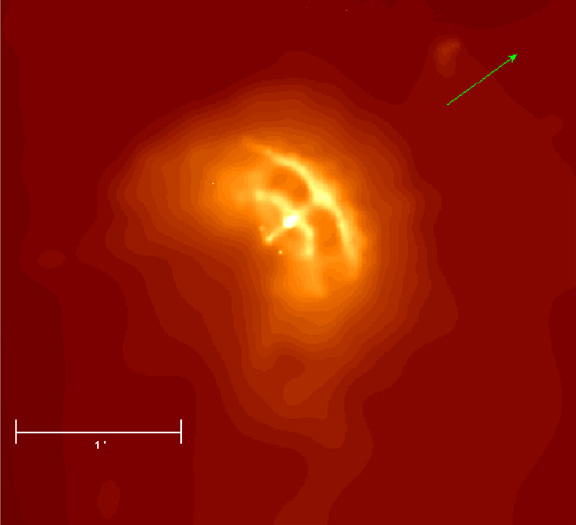
Pulsar glitches are sudden, discontinuous increases in a pulsar's rotation rate—fractional spin-ups of order ΔΩ/Ω ∼ 10−9 to 10−6—followed by a gradual, partial relaxation over timescales of days to years. They provide a unique window into the otherwise inaccessible interior of neutron stars. The Vela pulsar (PSR B0833−45), with a period of 89 milliseconds, is the most prolific glitcher known, having exhibited more than 20 large glitches since 1969.15
.jpg)
The standard model for pulsar glitches, proposed by Anderson and Itoh in 1975, invokes the superfluid properties of the neutron-rich matter in the inner crust of a neutron star. At the extreme densities and low temperatures found in a neutron star interior (below roughly 1010 kelvin), neutrons pair via an attractive nuclear interaction and form a superfluid—a quantum fluid that flows without viscosity. In the inner crust, this superfluid permeates a crystalline lattice of neutron-rich nuclei. The superfluid rotates by forming an array of quantized vortices, each carrying a single quantum of circulation.15
As the pulsar spins down under its electromagnetic torque, the charged crust and everything coupled to it decelerate. The superfluid, however, is decoupled from this electromagnetic braking because the vortices become pinned to nuclei in the crustal lattice and resist outward migration. A velocity lag builds between the faster-spinning superfluid and the slower crust. When the lag exceeds a critical threshold, large numbers of vortices unpin catastrophically and transfer their stored angular momentum to the crust in a matter of seconds—producing the observed glitch.15, 17
The cumulative angular momentum transferred in Vela's glitches constrains the fraction of the star's moment of inertia that resides in the superfluid component, providing direct observational evidence for superfluidity in neutron star interiors—a prediction of nuclear theory that would be extraordinarily difficult to test by any other means.15, 20
Magnetars
Magnetars are an extreme subclass of neutron stars distinguished by surface magnetic fields of 1014 to 1015 gauss—roughly 100 to 1,000 times stronger than those of ordinary radio pulsars. They manifest observationally as two historically distinct classes, anomalous X-ray pulsars (AXPs) and soft gamma-ray repeaters (SGRs), now understood to be the same type of object viewed under different circumstances. Approximately 30 confirmed magnetars are currently known.16
Unlike rotation-powered pulsars, whose luminosity derives from the loss of rotational kinetic energy, magnetars are powered primarily by the decay of their extraordinary magnetic fields. Their persistent X-ray luminosities—typically 1034 to 1036 erg per second—exceed their spin-down luminosities, sometimes by orders of magnitude. Magnetars exhibit dramatic transient behaviour including short X-ray bursts, prolonged outbursts in which the X-ray flux increases by factors of 10 to 1,000, and rare giant flares of staggering power. The giant flare from SGR 1806−20 on 27 December 2004 released approximately 1046 erg in 0.2 seconds—more energy than the Sun emits in 100,000 years.16
Magnetars have characteristically long spin periods, ranging from 2 to 12 seconds, consistent with rapid magnetic braking by their extreme dipole fields. Their characteristic ages are young—typically 103 to 104 years—and several are associated with known supernova remnants. In 2020, the Galactic magnetar SGR 1935+2154 produced a radio burst bright enough to be detectable from extragalactic distances, establishing a direct connection between magnetars and at least some fast radio bursts (FRBs)—one of the most active areas of current astrophysical research.16
Probing ultradense matter
Pulsars, and neutron stars more broadly, are the densest directly observable objects in the universe. Their central densities reach several times nuclear saturation density (approximately 2.7 × 10¹⁴ g/cm3), a regime where the behaviour of matter is governed by the strong nuclear force under conditions that cannot be replicated in any terrestrial laboratory. The relationship between a neutron star's mass and radius is determined by its equation of state (EOS)—the fundamental relation between pressure and density in the stellar interior—making precise measurements of neutron star masses and radii a direct probe of nuclear physics at its most extreme.17, 20
Pulsar timing has provided some of the most important mass measurements. In 2010, Demorest and colleagues used the Shapiro delay—the general-relativistic time delay experienced by radio pulses as they pass through the curved spacetime of a companion star—to measure the mass of PSR J1614−2230 at 1.97 ± 0.04 solar masses. This single measurement ruled out a large family of "soft" equations of state that predicted maximum neutron star masses below 2 solar masses, immediately constraining the allowed forms of the strong interaction at supranuclear densities.18
A complementary approach is provided by NASA's Neutron Star Interior Composition Explorer (NICER), an X-ray telescope mounted on the International Space Station since 2017 that measures the thermal X-ray pulse profiles of rotating neutron stars. By modelling how the star's mass, radius, and surface temperature distribution affect the observed pulse shape through relativistic light-bending, two independent teams analysed the millisecond pulsar PSR J0030+0451 in 2019. Miller and colleagues obtained a radius of 13.02 (+1.24/−1.06) km for a mass of 1.44 (+0.15/−0.14) solar masses, while Riley and colleagues found a consistent result of approximately 12–13 km.12, 13 These measurements favour moderate equations of state and, combined with the 2-solar-mass constraint from pulsar timing, have significantly narrowed the allowed region of the mass-radius plane.12, 13, 20
Ongoing significance
Six decades after their accidental discovery, pulsars remain at the frontier of multiple fields of physics. The continued refinement of pulsar timing array datasets promises to characterise the nanohertz gravitational-wave background in detail, potentially distinguishing between a supermassive black hole binary origin and more exotic cosmological sources such as cosmic strings or phase transitions in the early universe.8 Next-generation radio telescopes, including the Square Kilometre Array (SKA), are expected to discover thousands of new pulsars—including potentially a pulsar in orbit around Sagittarius A*, the supermassive black hole at the centre of the Milky Way, which would enable an unprecedented test of general relativity in the strong-field regime of a black hole spacetime.14
Advances in X-ray timing from missions like NICER continue to tighten constraints on the neutron star equation of state, with implications reaching from nuclear physics to gravitational-wave astronomy. The connection between magnetars and fast radio bursts has opened an entirely new observational channel, while the continued monitoring of glitching pulsars provides an ever-sharper view of superfluidity in the densest matter in the universe. From their origin as a puzzling signal on a strip-chart recorder in Cambridge, pulsars have become one of the most versatile and consequential objects in all of astrophysics.12, 16, 15
References
A new test of general relativity — Gravitational radiation and the binary pulsar PSR 1913+16
An increased estimate of the merger rate of double neutron stars from observations of a highly relativistic system
A Double-Pulsar System: A Rare Laboratory for Relativistic Gravity and Plasma Physics
PSR J0030+0451 Mass and Radius from NICER Data and Implications for the Properties of Neutron Star Matter