Overview
- Sagittarius A* is the supermassive black hole at the center of the Milky Way, with a precisely determined mass of approximately 4.15 million solar masses established through decades of stellar orbit monitoring by independent teams led by Reinhard Genzel and Andrea Ghez—work recognised with the 2020 Nobel Prize in Physics; the star S2, tracing a 16-year elliptical orbit that brings it within roughly 120 AU of the black hole at speeds up to 7,650 km/s, has revealed both the gravitational redshift and orbital precession predicted by general relativity.
- The Event Horizon Telescope collaboration released the first direct image of Sgr A* in May 2022, showing a bright emission ring approximately 52 microarcseconds in diameter surrounding a central brightness depression—the photon capture shadow—in close agreement with the predictions of general relativity for a black hole of the measured mass; this followed the 2019 EHT image of M87*, a black hole 1,500 times more massive and located 2,000 times farther away.
- Despite being only 26,000 light-years from Earth, Sgr A* is remarkably quiescent for a supermassive black hole, accreting at less than one ten-thousandth of its Eddington luminosity; its relative quiet makes it an exceptional laboratory for studying the physics of low-luminosity accretion, strong-field gravity, and the co-evolution of supermassive black holes with their host galaxies.
Sagittarius A* (pronounced "Sagittarius A-star") is the supermassive black hole residing at the dynamical center of the Milky Way, located approximately 26,000 light-years from Earth in the direction of the constellation Sagittarius. With a mass of roughly 4.15 million solar masses compressed within a region smaller than the distance from the Sun to Mercury, it is the closest supermassive black hole to Earth by a wide margin and therefore the best-studied object of its kind. Its discovery emerged from radio astronomy in 1974, its mass was determined through four decades of infrared stellar orbit monitoring, and its shadow was directly imaged for the first time in 2022—each milestone representing a watershed in our understanding of black hole physics and galactic structure.1, 9, 13
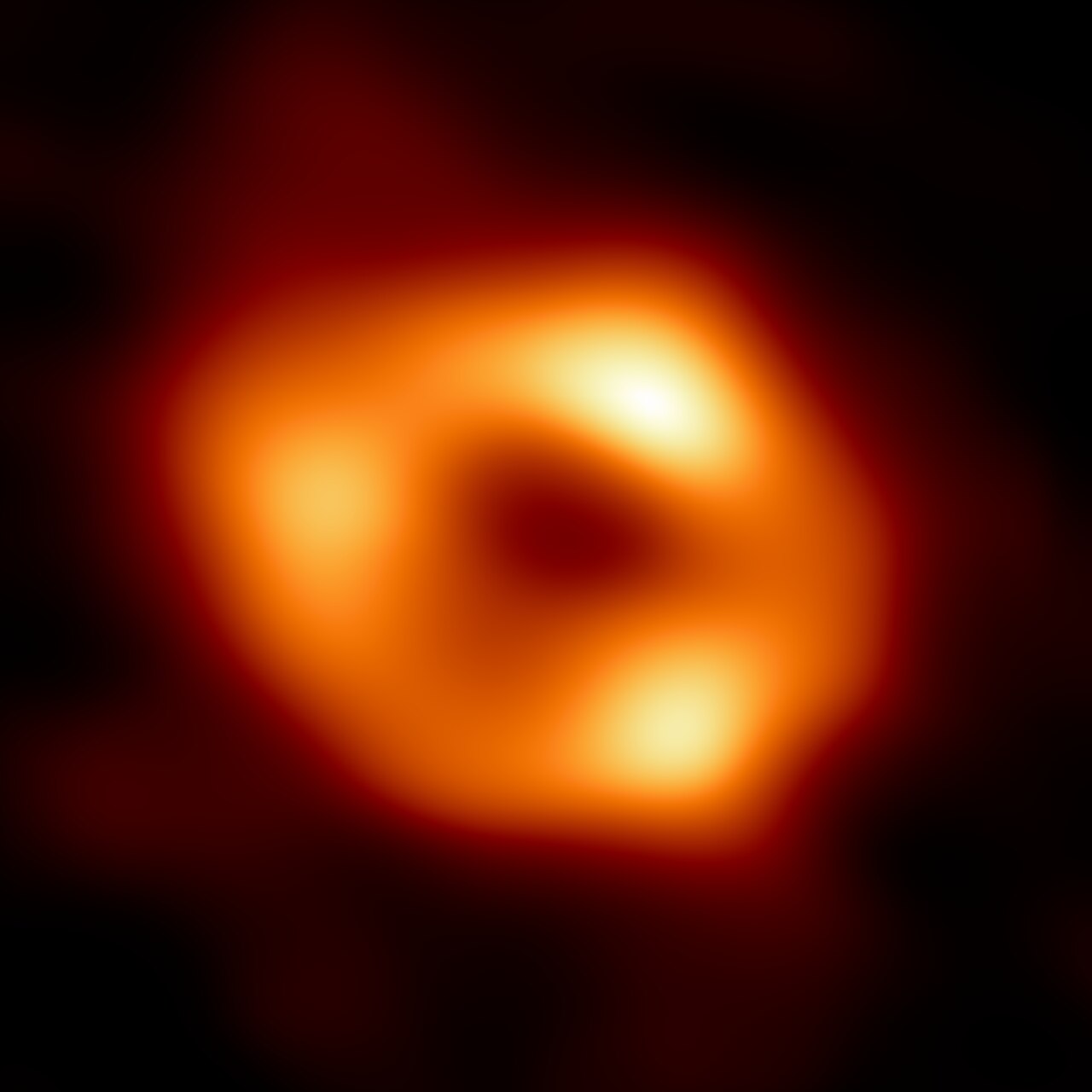
The name "Sgr A*" encodes the history of the discovery. The designation Sagittarius A refers to the compact radio complex near the galactic center, and the asterisk was appended by radio astronomer Robert Brown in 1982 to signify the most compact and energetically excited component within that complex—a notation borrowed from the convention in atomic physics for excited states. Although the galactic center is completely opaque to visible light, obscured by roughly 25 magnitudes of dust extinction, radio and infrared wavelengths penetrate the interstellar medium cleanly, allowing Sgr A* to be studied with millimeter-wave radio interferometry, near-infrared adaptive optics, and space-based X-ray observatories.1, 12, 13
Discovery: a compact radio source at the galactic center
The story of Sgr A* begins with a compact radio source detected in 1974 by Bruce Balick and Robert Brown using the Green Bank Interferometer. In their paper in the Astrophysical Journal, they reported the discovery of an unusually bright, compact, and spectrally flat radio source positionally coincident with the dynamical center of the Galaxy. Its angular size was unresolved at arcsecond resolution, implying extraordinary brightness temperatures, and its position was consistent with the gravitational center inferred from stellar kinematics.1
Over the following years, increasingly sensitive and high-resolution radio observations refined the source's properties. By the early 1980s, very long baseline interferometry (VLBI) had established that the intrinsic angular size of the source was far smaller than the apparent size, which is broadened by scattering in the turbulent interstellar plasma along the line of sight. The intrinsic radio source was extraordinarily compact. Ron Ekers and colleagues at Westerbork published early high-resolution maps of the galactic center radio complex, helping to establish the positional framework within which Sgr A* would be pinned with increasing precision over subsequent decades.12 The radio source's extreme compactness, its position at the dynamical center of the Galaxy, and its non-thermal radio spectrum all pointed toward a massive black hole—but a direct mass measurement required a fundamentally different observational approach.
The S-stars and mass determination
The decisive proof that Sgr A* is a supermassive black hole came from monitoring the motions of individual stars in the dense nuclear star cluster surrounding it. Beginning in the early 1990s, two independent teams turned their infrared telescopes toward the galactic center: Reinhard Genzel's group at the Max Planck Institute for Extraterrestrial Physics, working primarily with the New Technology Telescope and later the Very Large Telescope; and Andrea Ghez's group at UCLA, working with the Keck Observatory. Both teams used the technique of speckle imaging and later adaptive optics to overcome Earth's atmospheric turbulence and resolve individual stars within a fraction of a parsec of Sgr A*.3, 4, 13
The stars orbiting Sgr A* in this innermost region are collectively called the S-stars (or S0-stars in the UCLA notation). The most important among them is S2 (also designated S0-2 by the Ghez group), a roughly 15-solar-mass B-type main-sequence star that traces a highly elliptical Keplerian orbit around the black hole with a period of approximately 16 years. At closest approach—periapsis—S2 passes within roughly 120 AU of Sgr A*, moving at a peak velocity of approximately 7,650 km/s, or about 2.5 percent of the speed of light. From the orbital parameters of S2 and other S-stars, both teams independently derived a mass for the central dark object of approximately 4 million solar masses, with the most precise modern measurements from the GRAVITY instrument converging on 4.154 million solar masses at a distance of 8.178 kiloparsecs (about 26,670 light-years).2, 5, 11
Crucially, the combination of mass and upper limit on the source's physical size—the radio source fits within the orbit of S2, which is smaller than our solar system—pushes the density of the central mass concentration to values far exceeding any plausible alternative explanation, such as a compact cluster of dark stellar remnants. The only known object that can pack 4 million solar masses into a region so small while remaining dynamically stable over galactic timescales is a single black hole. For this work, Reinhard Genzel and Andrea Ghez shared one half of the 2020 Nobel Prize in Physics, with the other half awarded to Roger Penrose for theoretical contributions to black hole physics.13
Key orbital parameters of S2 around Sgr A*2, 3, 11
| Parameter | Value |
|---|---|
| Orbital period | ~16.05 years |
| Semi-major axis | ~1,031 AU (~5.5 mpc) |
| Eccentricity | ~0.884 |
| Periapsis distance | ~120 AU |
| Peak orbital speed | ~7,650 km/s (~2.5% of c) |
| Implied black hole mass | ~4.154 × 10⁶ M⊙ |
Tests of general relativity
The extreme velocities and deep gravitational potential of S2's orbit near Sgr A* turn the galactic center into an unrivaled laboratory for testing general relativity in the strong-field regime. As S2 passed through periapsis in May 2018, the GRAVITY collaboration detected its gravitational redshift—the shift in the star's spectral lines caused by photons climbing out of the intense gravitational well of the black hole. The measured redshift parameter Υ = 0.88 ± 0.17 is consistent with the value of 1.0 predicted by general relativity and inconsistent with zero, the Newtonian expectation, at greater than five sigma significance.6 Independently, the UCLA team's measurement of S0-2 at the same periapsis passage confirmed the gravitational redshift detection, providing a second self-consistent verification of the effect at the galactic center.8
A second relativistic signature followed with the next periapsis passage of S2 in 2021. The GRAVITY collaboration reported the detection of Schwarzschild precession in S2's orbit: the ellipse itself rotates in the same direction as the star's motion, exactly as general relativity predicts for a test mass in the Schwarzschild spacetime surrounding a non-rotating black hole. The measured precession angle is approximately 12 arcminutes per orbit, consistent with the general relativistic prediction and ruling out a purely Newtonian potential at high significance.7 These detections represent the most precise tests of general relativity in the galactic center environment and are directly analogous to the celebrated advance of Mercury's perihelion that was one of the first empirical confirmations of Einstein's theory in 1915. Higher-order effects including frame dragging from the spin of Sgr A* are projected to become detectable as S2 and other short-period S-stars are tracked over future orbital cycles.
The Event Horizon Telescope image
On 12 May 2022, the Event Horizon Telescope (EHT) collaboration announced the first direct image of the emission region surrounding Sgr A*, published simultaneously in a suite of papers in the Astrophysical Journal Letters. The image shows a ring of bright, diffuse emission approximately 52 microarcseconds in apparent diameter encircling a dark central depression—the black hole's shadow, or more precisely the photon capture region from which no light can escape to the observer. The ring's brightness is uneven, with regions of enhanced emission that vary in position among the different imaging methods used, reflecting the inherent difficulty of imaging a source whose brightness fluctuates on timescales of minutes.9
The 52-microarcsecond ring diameter is in excellent agreement with the theoretical prediction for a black hole of Sgr A*'s measured mass. In general relativity, the photon ring diameter scales linearly with black hole mass and inversely with distance; the prediction for a 4.15-million-solar-mass black hole at 8.18 kiloparsecs is approximately 50 microarcseconds, and the observed value falls squarely within the uncertainty range of both the measurement and the mass estimate. The consistency between the mass-from-stellar-orbits and the mass-from-image-scale provides a powerful, self-consistent test of the Kerr metric of general relativity.9
Imaging Sgr A* presented different technical challenges from the earlier EHT imaging of M87*. Although Sgr A* is far closer—8 kiloparsecs versus 16.8 megaparsecs for M87*—its mass is 1,500 times smaller, which means its dynamical timescale (the time for gas to complete an orbit near the photon sphere) is also 1,500 times shorter, on the order of minutes rather than weeks. During EHT observations spanning several hours, the emission pattern around Sgr A* changed substantially, requiring sophisticated statistical imaging algorithms to construct a time-averaged representative image from rapidly evolving data. The plasma scattering screen between Earth and the galactic center also broadens and distorts the observed radio emission, requiring careful correction. Nevertheless, the resulting image agreed with general relativistic magnetohydrodynamic (GRMHD) simulations across more than 5 million model variants, confirming that Sgr A* is consistent with a Kerr black hole.9
Sagittarius A* and M87*
The EHT had already published the first-ever image of a black hole shadow on 10 April 2019, when it released a picture of M87*—the supermassive black hole at the center of the giant elliptical galaxy Messier 87 in the Virgo Cluster. That image showed a crescent-shaped emission ring approximately 42 microarcseconds in diameter surrounding a central dark region, with the southern arc brighter due to Doppler beaming from plasma orbiting toward the observer. M87* carries a mass of approximately 6.5 billion solar masses—about 1,500 times the mass of Sgr A*—and powers a spectacular relativistic jet extending thousands of light-years from the nucleus.10
Together, M87* and Sgr A* bracket more than three orders of magnitude in black hole mass while both producing photon rings consistent with general relativistic predictions. This breadth of validation is scientifically significant: a modified theory of gravity that deviated from Kerr predictions would have to do so in opposite ways at different mass scales to evade both tests, a highly contrived scenario. The two images also illustrate how differently supermassive black holes can behave: M87* is actively accreting at roughly 0.1 percent of its Eddington luminosity and drives a powerful jet, while Sgr A* is accreting at less than one ten-thousandth of its Eddington limit and shows no persistent jet structure. This contrast is not accounted for by mass alone and reflects differences in the mode and rate of accretion between the two systems.10, 14
The galactic center environment
Sgr A* is embedded in one of the most extraordinary environments in the Milky Way. The central parsec harbors the nuclear star cluster, one of the densest stellar aggregations in the Galaxy, containing tens of millions of stars per cubic parsec. The S-star cluster—the innermost component—includes several dozen young, massive B-type stars with orbital periods ranging from 12 to a few hundred years. Their presence within the tidal disruption radius of the black hole has never been satisfactorily explained: forming massive stars in situ is difficult because tidal forces from Sgr A* should disrupt molecular clouds before they can collapse, and migrating them from beyond the tidal radius is dynamically challenging. This "paradox of youth" remains one of the unresolved problems of galactic center astrophysics.13
Beyond the S-star cluster, the central few parsecs contain a circumnuclear disk of molecular gas, streamers of ionized gas called minispiral arms that flow toward Sgr A*, and an extended region of diffuse hot X-ray-emitting plasma. In 2011, astronomers discovered a gas cloud designated G2 approaching Sgr A* on a nearly radial orbit, sparking predictions of a dramatic flare as the cloud was tidally disrupted and accreted. G2 passed periapsis in 2014 with remarkably little fanfare—Sgr A*'s X-ray and infrared emission brightened only modestly, and the cloud survived relatively intact, suggesting it may contain a compact stellar core rather than being a purely gaseous structure.16
The galactic center magnetar SGR J1745−2900, discovered in 2013 when it entered outburst and was detected by the Swift X-ray Telescope, lies only about 0.1 parsecs in projection from Sgr A*—extraordinarily close. Magnetars are neutron stars with ultrastrong magnetic fields (up to 1015 gauss), and their radio pulses probe the extreme rotation measure and scattering properties of the galactic center plasma. This object has been used as a natural probe of the magnetic environment near Sgr A*, revealing that the region supports magnetic fields of order a few millitesla within the innermost accretion zone—strong enough to potentially play a role in driving outflows and moderating the accretion rate.17
Accretion, quiescence, and flaring
One of the most striking properties of Sgr A* is how little it eats. At its measured accretion rate of roughly 10−8 to 10−7 solar masses per year, its bolometric luminosity is approximately 1036 erg per second—about 0.003 percent of the Sun's luminosity and less than 10−8 of the Eddington luminosity for a 4-million-solar-mass black hole. This extreme under-luminosity cannot be explained by simple thin-disk accretion theory and instead requires a radiatively inefficient accretion flow (RIAF) model, in which the plasma falls inward in a geometrically thick, optically thin, hot configuration that advects most of its thermal energy across the event horizon rather than radiating it away. The theoretical framework of the advection-dominated accretion flow (ADAF), developed primarily by Ramesh Narayan and colleagues, provides the standard description of this mode of accretion.14
Despite its general quiescence, Sgr A* flares. Near-infrared and X-ray monitoring reveal sudden brightness increases of factors of a few in the infrared and up to 160 times the quiescent X-ray flux, occurring roughly once per day. The infrared flares, first detected by Genzel and colleagues in 2003, last tens of minutes and show quasi-periodic sub-structure on timescales of 17 to 20 minutes, close to the orbital period of the innermost stable circular orbit around a 4-million-solar-mass black hole. The physical origin of these flares is debated—proposed mechanisms include magnetic reconnection events in the innermost accretion flow, transiently heated hot spots orbiting at the ISCO, or synchrotron emission from episodic plasma injection into a compact radio jet base.15 The GRAVITY instrument has detected orbital motion of infrared-bright "hotspots" around Sgr A* during flares, with centroid positions tracing arcs consistent with orbital radii near the ISCO, providing the most direct kinematic evidence yet for near-horizon dynamics.2
Evidence for episodic past activity at a far higher accretion rate includes the Fermi Bubbles: two lobes of gamma-ray and microwave emission extending roughly 25,000 light-years above and below the galactic plane, discovered by the Fermi Gamma-ray Space Telescope in 2010. Their energetics imply that Sgr A* underwent a period of dramatically elevated activity several million years ago, releasing energy equivalent to a sustained luminosity of 1044 erg/s for roughly 10 million years. Whether this represents a prior AGN-like active phase or a series of large accretion events remains under investigation, but it demonstrates that Sgr A*'s current quiescence is not its permanent state.18
Black hole physics and galaxy co-evolution
Sagittarius A* occupies a central role in two of the largest questions in modern astrophysics: the nature of black holes as physical objects, and the mechanism by which supermassive black holes co-evolve with their host galaxies. As the only supermassive black hole whose sphere of influence can be spatially resolved, it provides the most precise test of the Kerr metric—the mathematical description of a spinning, uncharged black hole in general relativity—at any mass scale. Future astrometric monitoring of S2 and shorter-period stars with the GRAVITY+ instrument is projected to measure the spin and orientation of Sgr A*'s rotation axis, probing the Kerr quadrupole moment and testing the no-hair theorem: the prediction that a black hole is completely specified by just three parameters (mass, spin, and charge).7, 13
The broader significance of Sgr A* for galaxy evolution lies in the tight empirical correlation between the masses of supermassive black holes and the velocity dispersions of their host galaxy bulges—the M–σ relation. The Milky Way sits precisely on this relation, with Sgr A*'s mass consistent with what is predicted from the Galaxy's bulge velocity dispersion. This correlation, observed across more than four orders of magnitude in black hole mass, implies that black holes and galaxies regulate each other's growth, likely through feedback processes in which AGN activity suppresses star formation by heating and expelling gas from the host. Sgr A* is currently too quiescent to provide this kind of feedback, but its past active phases—as suggested by the Fermi Bubbles—may have shaped the structure of the Milky Way's central regions.14, 18
Looking forward, Sgr A* will remain the premier target for tests of strong-field gravity and black hole accretion physics. The next-generation EHT, incorporating additional stations and higher observing frequencies, aims to produce movies of the photon ring rather than static images, directly observing the dynamical structure of plasma near the event horizon. Space-based gravitational wave detectors such as LISA, scheduled for launch in the 2030s, will detect gravitational waves from compact objects spiraling into Sgr A*—so-called extreme mass ratio inspirals—mapping the spacetime geometry around the black hole with a precision unattainable by any electromagnetic technique. In this sense, the galactic center black hole discovered in a single radio observation half a century ago will continue to anchor some of the most ambitious experiments in twenty-first-century physics.9, 13
References
- Balick, B. & Brown, R. L. (1974). Observations of a Highly Variable Radio Source: Sgr A*. Astrophysical Journal, 194, 265–270. doi:10.1086/153242
- Gravity Collaboration (Abuter, R. et al.) (2019). A geometric distance measurement to the Galactic center black hole with 0.3% uncertainty. Astronomy & Astrophysics, 625, L10. doi:10.1051/0004-6361/201935656
- Schödel, R. et al. (2002). A star in a 15.2-year orbit around the supermassive black hole at the centre of the Milky Way. Nature, 419, 694–696. doi:10.1038/nature01121
- Ghez, A. M. et al. (2005). Stellar Orbits around the Galactic Center Black Hole. Astrophysical Journal, 620, 744–757. doi:10.1086/427175
- Ghez, A. M. et al. (2008). Measuring Distance and Properties of the Milky Way's Central Supermassive Black Hole with Stellar Orbits. Astrophysical Journal, 689, 1044–1062. doi:10.1086/592738
- Gravity Collaboration (Abuter, R. et al.) (2018). Detection of the gravitational redshift in the orbit of the star S2 near the Galactic centre massive black hole. Astronomy & Astrophysics, 615, L15. doi:10.1051/0004-6361/201833718
- Gravity Collaboration (Abuter, R. et al.) (2020). Detection of orbital precession of the S2 star around the Galactic center. Astronomy & Astrophysics, 636, L5. doi:10.1051/0004-6361/202037813
- Do, T. et al. (2019). Relativistic redshift of the star S0-2 orbiting the Galactic center supermassive black hole. Science, 365, 664–668. doi:10.1126/science.aav8137
- Event Horizon Telescope Collaboration (2022). First Sagittarius A* Event Horizon Telescope Results. I. The Shadow of the Supermassive Black Hole in the Center of the Milky Way. Astrophysical Journal Letters, 930, L12. doi:10.3847/2041-8213/ac6674
- Event Horizon Telescope Collaboration (2019). First M87 Event Horizon Telescope Results. I. The Shadow of the Supermassive Black Hole. Astrophysical Journal Letters, 875, L1. doi:10.3847/2041-8213/ab0ec7
- Gravity Collaboration (Abuter, R. et al.) (2018). The mass of Sgr A* from the orbital motion of the star S2. Astronomy & Astrophysics, 618, L10. doi:10.1051/0004-6361/201834294
- Ekers, R. D. et al. (1983). Radio-continuum observations of the Galactic centre—Detection of an unusual radio source near Sgr A. Astronomy & Astrophysics, 122, 143–150. ADS
- Genzel, R., Eisenhauer, F. & Gillessen, S. (2010). The Galactic Center stellar cluster: the central parsec. Reviews of Modern Physics, 82, 3121–3195. doi:10.1103/RevModPhys.82.3121
- Yuan, F. & Narayan, R. (2014). Accretion onto the Galactic Center black hole. Annual Review of Astronomy and Astrophysics, 52, 529–588. doi:10.1146/annurev-astro-082812-141003
- Genzel, R. et al. (2003). Near-infrared flares from accreting gas around the supermassive black hole at the Galactic Centre. Nature, 425, 934–937. doi:10.1038/nature02065
- Madigan, A.-M. & McCourt, M. (2016). G2 Can Survive Its Encounter with the Galactic Center Black Hole. Monthly Notices of the Royal Astronomical Society: Letters, 457, L99–L103. doi:10.1093/mnrasl/slv197
- Kennea, J. A. et al. (2013). A magnetar outburst at the Galactic center. Astrophysical Journal Letters, 770, L24. doi:10.1088/2041-8205/770/2/L24
- Ressler, S. M. et al. (2020). Galactic center star formation and accretion feedback from first principles. Monthly Notices of the Royal Astronomical Society, 492, 3272–3289. doi:10.1093/mnras/stz3605
References
A geometric distance measurement to the Galactic center black hole with 0.3% uncertainty
A star in a 15.2-year orbit around the supermassive black hole at the centre of the Milky Way
Measuring Distance and Properties of the Milky Way's Central Supermassive Black Hole with Stellar Orbits
Detection of the gravitational redshift in the orbit of the star S2 near the Galactic centre massive black hole
Relativistic redshift of the star S0-2 orbiting the Galactic center supermassive black hole
First Sagittarius A* Event Horizon Telescope Results. I. The Shadow of the Supermassive Black Hole in the Center of the Milky Way
First M87 Event Horizon Telescope Results. I. The Shadow of the Supermassive Black Hole
Radio-continuum observations of the Galactic centre—Detection of an unusual radio source near Sgr A
Near-infrared flares from accreting gas around the supermassive black hole at the Galactic Centre