Overview
- Walter Baade's 1944 resolution of the Andromeda galaxy into individual stars revealed two distinct stellar populations: metal-rich Population I stars concentrated in the galactic disk and metal-poor Population II stars inhabiting the halo and bulge—a dichotomy that encoded the history of successive generations of star formation and chemical enrichment across cosmic time.
- Each generation of stars enriches the interstellar medium with heavy elements forged in stellar cores and expelled in supernovae, so that metallicity—quantified as [Fe/H], the iron abundance relative to the Sun on a logarithmic scale—functions as a cosmic clock: the most metal-poor stars in the Milky Way halo preserve a chemical fossil record of the universe's first billion years.
- The alpha-element knee at [Fe/H] ≈ −1 records the delayed contribution of Type Ia supernovae relative to Type II: early rapid enrichment by core-collapse explosions elevates [α/Fe] ratios before iron from white dwarf detonations floods the interstellar medium, creating a distinctive bend in chemical abundance diagrams that constrains the timescale and efficiency of star formation across galactic environments.
The stars visible in the night sky are not a homogeneous population. They differ not only in mass, temperature, and luminosity, but in chemical composition—and that compositional variation encodes the entire prior history of star formation in the universe. The recognition of this fact transformed astronomy in the mid-twentieth century, turning individual stellar abundances into a fossil record of cosmic chemical history stretching from the first minutes after the Big Bang to the present day.

The concept of stellar populations emerged from one of the decisive observational achievements of the twentieth century: Walter Baade's 1944 resolution of Messier 31, Messier 32, and NGC 205 into individual stars during wartime blackouts over Los Angeles, which darkened the sky above the Mount Wilson Observatory sufficiently to reveal stellar populations previously unresolvable.1 What Baade saw were two morphologically distinct classes of stars, each with characteristic colors, luminosities, and spatial distributions. That two-fold classification—Population I and Population II—launched a new discipline: galactic chemical evolution, the study of how successive generations of stars gradually enrich the interstellar medium with every element heavier than hydrogen and helium.
Baade's discovery and the two populations
In the 1940s, the prevailing assumption was that the stellar content of galaxies was broadly uniform. Baade's red-sensitive photographic plates revealed otherwise. In the central regions of Andromeda and its satellite galaxies, the brightest resolved stars were red giants, while the outer spiral arms of M31 contained blue and luminous supergiant stars. This morphological difference, Baade proposed, reflected a genuine physical distinction between two stellar populations that he labeled simply Population I and Population II.1, 2
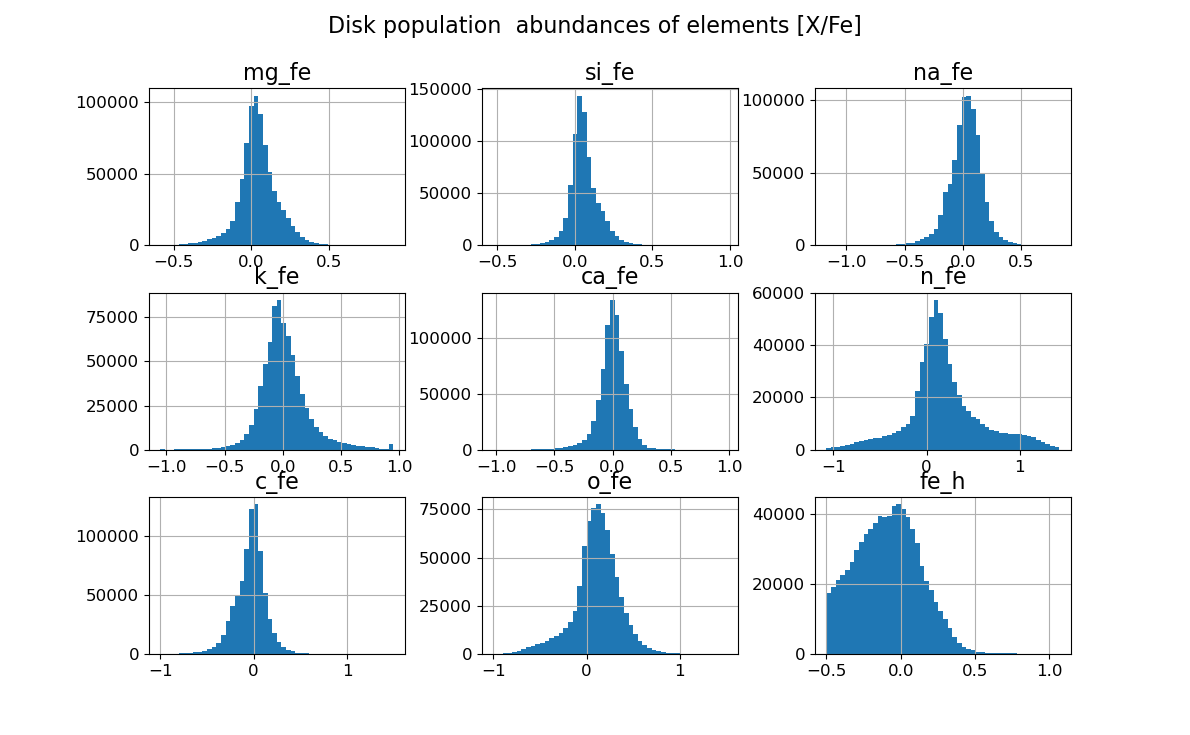
Population I stars are young, relatively metal-rich objects concentrated in the spiral arms and disk of a galaxy. The Sun is a canonical Population I star, with iron abundance by definition at the reference value [Fe/H] = 0. Population I stars form from interstellar gas that has already been enriched by many preceding generations of stellar nucleosynthesis. Their high metallicity reflects this accumulated chemical inheritance. They tend to follow nearly circular orbits within the galactic plane and are associated with active star-forming regions, giant molecular clouds, and open clusters.2, 7
Population II stars are old, metal-poor objects preferentially found in the galactic halo, bulge, and globular clusters. With [Fe/H] values typically ranging from −0.5 to below −3, they formed from gas that had been only lightly enriched—or not at all—when the galaxy was young. Population II stars occupy high-inclination, often eccentric orbits that carry them far from the disk plane, a kinematic signature of formation before the collapse of the protogalactic gas into a rotating disk structure. Their defining observational subtypes include subdwarfs—main-sequence stars lying below the standard solar-metallicity main sequence on the Hertzsprung-Russell diagram because of their lower opacity—and horizontal branch stars, the Population II equivalent of helium-core burning, recognized as the RR Lyrae variable stars abundant in globular clusters.7, 11
The spatial and kinematic segregation of these populations provided the first empirical evidence that the Milky Way had assembled hierarchically: an old, chemically primitive halo formed first, followed by a younger, enriched disk. Later work would reveal that neither population is a monolithic entity—the disk itself comprises a chemically and kinematically distinct thin disk and thick disk, and the halo contains multiple ancient subpopulations likely accreted from disrupted dwarf galaxies—but the fundamental Baade dichotomy remains embedded in every modern model of galactic formation and evolution.12, 14
Population III: the first stars
Extrapolating Baade's logic backward in time leads to an unavoidable prediction. If each stellar generation is more metal-rich than the last, then the very first stars—formed from the primordial gas produced in Big Bang nucleosynthesis—must have been entirely free of metals. These hypothetical first stars are designated Population III, a label introduced in the 1970s to distinguish them from the two classes Baade had identified.3
Primordial gas consists almost entirely of hydrogen (roughly 75 percent by mass) and helium (roughly 25 percent), with trace amounts of lithium and no heavier elements whatsoever. The absence of metals has profound consequences for stellar formation and structure. In present-day molecular clouds, carbon monoxide and dust grains are the primary coolants that allow gas to radiate away the thermal energy liberated by gravitational compression, enabling fragmentation into the range of stellar masses typical today. In the absence of these coolants, primordial gas cannot cool as efficiently; theoretical models consistently predict that Population III stars were therefore far more massive than typical present-day stars, potentially reaching hundreds of solar masses, with characteristic masses perhaps 10 to 1000 times the solar value.3, 4
Such extremely massive stars would have had very short lifetimes—as little as a few million years—compared to the billions-of-years lifetimes of solar-mass stars. They would have ended their lives as pair-instability supernovae (if sufficiently massive), core-collapse supernovae, or directly collapsing into black holes. In any of these outcomes, the metals synthesized in their cores would have been partly or wholly ejected into the surrounding intergalactic medium, providing the first seeds of heavy-element enrichment. Because Population III stars are predicted to have lived and died within the first few hundred million years of cosmic history—well before any currently functioning telescope can resolve individual stars at those redshifts—no Population III star has ever been directly observed. They are, at present, a theoretical necessity supported by indirect evidence rather than a confirmed observational category.3, 4 The reionization of the universe was likely driven in part by the ultraviolet radiation of these massive, hot first stars.
The nucleosynthesis cycle
The chemical enrichment of successive stellar generations proceeds through a cycle of remarkable elegance. A star forms from the collapse of an interstellar gas cloud, spends its life fusing progressively heavier elements in its core, and then returns a large fraction of its processed material to the interstellar medium—either through stellar winds during its late evolutionary stages or through the explosive violence of a supernova. That returned material becomes part of the reservoir from which the next generation of stars forms, each new generation inheriting the chemical legacy of all its predecessors.5, 6
The details of this cycle depend critically on stellar mass. Low-mass stars (below roughly 8 solar masses) evolve more slowly and never reach the temperatures required for oxygen, silicon, or iron synthesis. They ascend the asymptotic giant branch late in life, during which thermal pulses drive convective mixing between the helium-burning shell and the hydrogen-rich envelope in a process called third dredge-up. This brings carbon and heavy s-process elements synthesized by slow neutron capture to the stellar surface, whence they are expelled in a slow wind. The residual core becomes a white dwarf, chemically inert from the standpoint of further nucleosynthesis.5, 9
Massive stars (above roughly 8 solar masses) follow a grander and more violent path. Through a succession of nuclear burning stages—hydrogen, helium, carbon, neon, oxygen, silicon—they synthesize progressively heavier elements in an onion-shell structure before collapsing catastrophically when their iron cores exceed the Chandrasekhar mass. The resulting core-collapse supernova expels the outer shells of the star at thousands of kilometers per second, injecting oxygen, magnesium, silicon, sulfur, calcium, and smaller amounts of iron into the surrounding interstellar medium. The shock wave from the explosion compresses neighboring gas clouds, potentially triggering new episodes of star formation in a self-propagating cycle of stellar birth and death.5, 6
Summary of stellar populations and their properties2, 3, 7, 10
| Population | Metallicity [Fe/H] | Age | Location | Formation epoch |
|---|---|---|---|---|
| Population III | None (metal-free) | >13 Gyr (predicted) | Unknown (predicted minihalos) | <200 Myr after Big Bang |
| Population II | −0.5 to <−5 | 10–13 Gyr | Halo, bulge, globular clusters | First ∼2–3 Gyr |
| Population I (thick disk) | −0.7 to −0.1 | 8–10 Gyr | Thick disk | ∼8–10 Gyr ago |
| Population I (thin disk) | −0.5 to +0.5 | 0–8 Gyr | Thin disk, spiral arms | Last ∼8 Gyr (ongoing) |
Metallicity as a cosmic clock
Because each stellar generation is more metal-rich than its predecessors, the iron abundance of a star carries information about when it formed. This is the principle underlying the use of metallicity as a cosmic clock. The relationship is not perfectly monotonic—local conditions, infall of pristine gas, and variations in the star formation rate introduce scatter—but the overall trend is robust: older stellar populations have lower [Fe/H], and the lowest-metallicity stars in the Milky Way halo are the oldest known stellar objects, with ages inferred from stellar evolution theory approaching 13 billion years.10, 14
The [Fe/H] notation expresses iron abundance logarithmically relative to the Sun: [Fe/H] = log10(Fe/H)star − log10(Fe/H)Sun. A value of −1 therefore indicates one-tenth solar iron abundance; −2 indicates one-hundredth. The most metal-poor stars known, discovered through systematic high-resolution spectroscopic surveys such as the Hamburg/ESO Survey and the SkyMapper survey, have [Fe/H] below −5, meaning iron abundances less than 1/100,000th of the solar value. A handful of carbon-enhanced metal-poor stars have been reported with [Fe/H] approaching −7.10
These extremely metal-poor (EMP) stars, defined as having [Fe/H] < −3, are living fossils of early galactic chemical evolution. Their element-to-element abundance ratios reflect the nucleosynthetic output of only one or a few progenitor supernovae, because so little prior enrichment had occurred when they formed. Detailed spectroscopic analysis of EMP stars has revealed enormous star-to-star scatter in elements like carbon, strontium, and barium—a scatter that directly reflects the inhomogeneous, incomplete mixing of the interstellar medium in the early galaxy, before many generations of supernovae had homogenized the chemical landscape.10, 13 Each EMP star is thus a partial record of a single early enrichment event, a chemical snapshot of the first few hundred million years of stellar nucleosynthesis that cannot be recovered from any other source.
The alpha-element pattern and the chemical knee
Among the most powerful diagnostics of galactic chemical evolution is the behavior of the alpha elements—oxygen, magnesium, silicon, sulfur, calcium, and titanium—relative to iron as a function of overall metallicity. This [α/Fe] vs. [Fe/H] diagram encodes the relative timing of two distinct supernova channels, and the bend in that diagram, called the alpha knee or alpha break, functions as a clock for the star formation history of any stellar system in which it can be measured.5, 15
Type II supernovae (core-collapse events from massive stars with lifetimes of ∼3–30 million years) produce large quantities of oxygen, magnesium, silicon, sulfur, and calcium, but relatively little iron. They begin enriching the interstellar medium almost immediately after the onset of star formation, on timescales of tens of millions of years. During this early rapid-enrichment phase, [α/Fe] remains elevated at roughly +0.3 to +0.4, a plateau reflecting the characteristic nucleosynthetic output of core-collapse events.5, 14
Type Ia supernovae—thermonuclear explosions of white dwarfs in binary systems—produce the majority of iron in the universe but almost no alpha elements. Critically, they operate on a delayed timescale. Because the white dwarf must accrete sufficient mass from a companion (or merge with another white dwarf), Type Ia events begin contributing meaningfully to interstellar iron enrichment only after roughly 1–3 billion years of stellar evolution have elapsed. When the Type Ia iron flood arrives, the [α/Fe] ratio begins to decline, tracing a downward trend that continues as iron accumulates faster than alpha elements in subsequent stellar generations.5, 6
The metallicity at which [α/Fe] turns over—typically [Fe/H] ≈ −1 in the Milky Way disk, though it varies with galactic environment—encodes the star formation efficiency of the system. In environments with rapid, efficient star formation, the metallicity rises quickly before Type Ia iron has time to dilute the alpha enhancement, and the knee occurs at higher [Fe/H]. In slowly star-forming systems such as dwarf spheroidal galaxies, the knee shifts to lower metallicity because Type Ia supernovae begin contributing iron before much enrichment has occurred from core-collapse events. This differential in the position of the alpha knee has been observationally confirmed and provides a quantitative constraint on the star formation histories of different galactic components and satellite systems.6, 15
Neutron-capture nucleosynthesis: the s- and r-processes
Iron and the elements near it in the periodic table—the iron-peak elements—represent the end product of charged-particle nuclear fusion in stellar interiors. Elements heavier than iron cannot be synthesized by fusion; their production requires a different mechanism entirely, based on neutron capture. Two distinct neutron-capture processes operate in nature, named for the timescale on which neutrons are added relative to the beta-decay timescale of unstable intermediate nuclei.9, 13
The slow neutron-capture process, or s-process, occurs when neutron fluxes are low enough that unstable nuclei have time to beta-decay before capturing another neutron. The reaction path therefore follows the valley of beta stability in the chart of nuclides, building up elements from strontium through barium and beyond in a step-by-step chain. The s-process operates primarily in the helium-burning shells of asymptotic giant branch stars, where neutrons are released by the 13C(α,n)16O and 22Ne(α,n)25Mg reactions during thermal pulses. The resulting enriched material is dredged to the stellar surface and expelled in winds, making low- and intermediate-mass AGB stars the principal cosmic factories for s-process elements such as barium, lanthanum, cerium, and lead.9 The pathways of neutron-capture nucleosynthesis have been mapped in detail through laboratory nuclear physics measurements and stellar spectroscopy.
The rapid neutron-capture process, or r-process, requires extreme neutron fluxes—so intense that nuclei capture neutrons far faster than they can beta-decay, driving the reaction path deep into the neutron-rich side of the nuclide chart before the neutron flux subsides and the unstable products decay back to stability. The r-process produces roughly half of all elements heavier than iron, including gold, platinum, uranium, and the heaviest naturally occurring nuclei. The astrophysical site of the r-process was debated for decades; the leading candidates were core-collapse supernovae and neutron star mergers. The 2017 detection of gravitational waves from the binary neutron star merger GW170817, accompanied by a kilonova whose optical and infrared emission spectroscopically matched r-process nucleosynthesis in real time, provided the first direct confirmation that neutron star mergers are a major r-process site.16, 8 Whether neutron star mergers alone suffice, or whether core-collapse supernovae also contribute significantly at early cosmic times, remains an active question.
The chemical signature of the r-process is detectable in extremely metal-poor halo stars. Stars classified as r-process enhanced—most notably CS 22892−052, discovered in 1995, and the exceptionally r-process-rich star J0954+5246—show europium, barium, and other heavy elements in proportions matching the solar r-process pattern with remarkable fidelity. This universality of the r-process pattern across a wide range of metallicities suggests that the process operated from very early times with a consistent nucleosynthetic signature, regardless of the total metallicity of the environment.13, 16
The search for Population III: fossil evidence in living stars
Because no Population III star has been directly detected, the evidence for their existence and properties comes primarily from the chemical fingerprints they left in the stars they enriched. A Population III supernova, enriching a cloud of otherwise metal-free primordial gas, would produce a next-generation star with an element-to-element abundance pattern reflecting the nucleosynthetic output of a single massive zero-metallicity supernova. Such a star would be detectable as a carbon-enhanced metal-poor (CEMP) star with unusual ratios of carbon, nitrogen, oxygen, and iron compared to normal metal-poor stars.10, 3
Large spectroscopic surveys have now identified several hundred stars with [Fe/H] below −3, and the frequency of carbon-enhanced metal-poor stars rises steeply at the lowest metallicities, comprising roughly 40 percent of stars with [Fe/H] < −3 and an even larger fraction at lower [Fe/H]. Some CEMP stars show no enhancement in neutron-capture elements (the CEMP-no subclass) and are the most plausible surviving chemical relics of the Population III era: their peculiar abundance patterns are consistent with the yields of faint, mixing-and-fallback Population III core-collapse supernovae that ejected large amounts of carbon but relatively little iron.10
The lowest-metallicity stars known—including SMSS J031300.36−670839.3, with an iron upper limit of [Fe/H] < −7.1—may be genuine second-generation stars, born from gas enriched by a single Population III supernova. Their existence confirms that the Milky Way halo preserves, in chemically readable form, the nucleosynthetic legacy of the universe's very first stellar generation. Ongoing and future spectroscopic surveys, including the 4MOST survey and the Subaru Prime Focus Spectrograph, are expected to discover thousands of additional extremely metal-poor stars and dramatically expand the chemical fossil record of early galactic history.10
The study of stellar populations and galactic chemical evolution thus spans the full arc of cosmic time: from the metal-free primordial gas of the first minihalos, through the rapid chemical enrichment of the early halo, to the slow, disk-building enrichment that produced the solar neighborhood and ultimately the conditions necessary for rocky planets rich in heavy elements. The Sun itself, with its particular complement of iron, oxygen, silicon, and trace heavy metals, is in this sense a cumulative chemical record of the entire prior history of the Milky Way—a Population I star built from the ash of billions of predecessors.5, 6
References
- Baade, W. · "Resolution of Messier 32, NGC 205, and the Central Region of the Andromeda Nebula" · Astrophysical Journal 100: 137–146, 1944.
- Baade, W. · "Stellar Populations in Galaxies" · Publications of the Astronomical Society of the Pacific 56(332): 247–258, 1944.
- Bromm, V. & Larson, R. B. · "The First Stars" · Annual Review of Astronomy and Astrophysics 42: 79–118, 2004.
- Bromm, V., Coppi, P. S. & Larson, R. B. · "The Formation of the First Stars and Galaxies" · Astrophysical Journal 564(1): 23–51, 2002.
- Nomoto, K., Kobayashi, C. & Tominaga, N. · "Nucleosynthesis in Stars and the Chemical Enrichment of Galaxies" · Annual Review of Astronomy and Astrophysics 51: 457–509, 2013.
- Matteucci, F. · The Chemical Evolution of the Galaxy · Astrophysics and Space Science Library 253, Springer, 2001.
- Renzini, A. · "Stellar Populations: A User Guide from Low to High Redshift" · Annual Review of Astronomy and Astrophysics 44: 141–192, 2006.
- Cote, B. et al. · "The Galactic Chemical Evolution of r-Process Elements" · Astrophysical Journal 855(2): 99, 2018.
- Käppeler, F. et al. · "New Observational Constraints on the s-Process in AGB Stars" · Reviews of Modern Physics 83(1): 157–194, 2011.
- Frebel, A. & Norris, J. E. · "The Most Metal-Poor Stars in the Milky Way and the Local Group" · Annual Review of Astronomy and Astrophysics 53: 631–688, 2015.
- Harris, W. E. · "Globular Cluster Systems" · Annual Review of Astronomy and Astrophysics 29: 543–579, 1991.
- Freeman, K. & Bland-Hawthorn, J. · "The New Galaxy: Signatures of Its Formation" · Annual Review of Astronomy and Astrophysics 40: 487–537, 2002.
- Sneden, C., Cowan, J. J. & Gallino, R. · "Neutron-Capture Elements in the Early Galaxy" · Annual Review of Astronomy and Astrophysics 46: 241–288, 2008.
- Chiappini, C., Matteucci, F. & Gratton, R. · "The Chemical Enrichment of the Milky Way Disk" · Astrophysical Journal 477(2): 765–780, 1997.
- Fuhrmann, K. · "Nearby Stars of the Galactic Disk and Halo" · Astronomy and Astrophysics 338: 161–183, 1998.
- Cowan, J. J. et al. · "Origin of the Heaviest Elements: The Rapid Neutron-Capture Process" · Reviews of Modern Physics 93(1): 015002, 2021.
References
Chemical Abundances of Metal-Poor Stars in the Galactic Halo: Constraints on the Site of the r-Process
The Chemical Enrichment of the Milky Way Disk: An Investigation of Two Independent Enrichment Timescales