Overview
- Sexual conflict arises when the reproductive interests of males and females diverge, generating antagonistic coevolution between the sexes that can drive the rapid evolution of reproductive traits, genital morphology, and mating behaviour in ways that reduce the fitness of one or both sexes.
- The two main forms are interlocus conflict, in which different genes in males and females are subject to opposing selection and fuel coevolutionary arms races such as toxic seminal fluids in Drosophila and elaborate genital counter-adaptations in waterfowl, and intralocus conflict, in which a single gene has opposing fitness effects in the two sexes, constraining adaptation in both.
- Sexual conflict is now recognised as a major evolutionary force distinct from conventional sexual selection, capable of driving speciation, shaping genome architecture, and producing traits that are harmful to one sex but persist because they benefit the other.
Sexual conflict is the evolutionary phenomenon that arises when the reproductive interests of males and females diverge, such that traits or behaviours that increase the fitness of one sex do so at a cost to the other. First formalised as a distinct concept by Geoffrey Parker in 1979, and developed into a comprehensive theoretical framework by Arnqvist and Rowe in 2005, sexual conflict is now recognised as a major force shaping the evolution of reproductive traits, mating systems, genital morphology, and even genome architecture across sexually reproducing organisms.1, 2, 14 Unlike conventional models of sexual selection, which often assume a degree of mutual benefit in mating interactions, the sexual conflict framework emphasises that the evolutionary interests of males and females are frequently opposed, generating antagonistic coevolution between the sexes that can be as intense as any predator-prey arms race.1
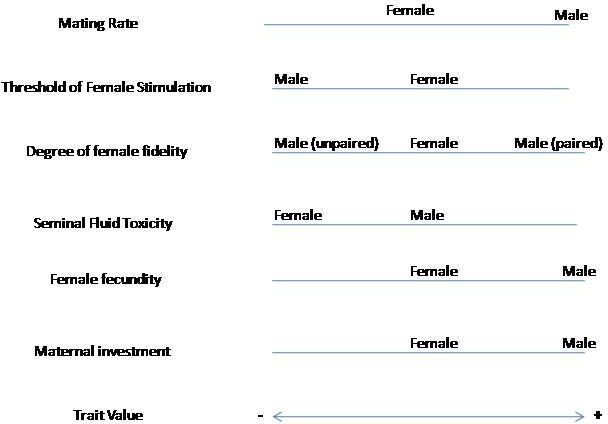

The concept rests on a fundamental asymmetry in reproductive biology. Because males and females typically differ in gamete size, parental investment, and the rate at which they can produce offspring, the conditions that maximise reproductive success differ between the sexes.2 Males often benefit from mating with as many females as possible, while females may maximise their fitness by being selective about mates, mating less frequently, or controlling the timing and conditions of reproduction. When these divergent optima cannot be simultaneously achieved, sexual conflict ensues, and the resulting selective pressures can drive the rapid evolution of traits in both sexes.1, 2
Interlocus sexual conflict
Interlocus sexual conflict occurs when genes expressed in males and genes expressed in females interact antagonistically across loci, with alleles at one locus in one sex gaining a fitness advantage at the expense of alleles at a different locus in the other sex.1, 2 This form of conflict generates coevolutionary arms races between the sexes: as males evolve traits that manipulate or coerce females into mating or investing more heavily in reproduction, females evolve counter-adaptations that resist or mitigate these manipulations. The result is an ongoing cycle of adaptation and counter-adaptation that can escalate indefinitely, much like the Red Queen dynamics observed in host-parasite coevolution.1
The logic of interlocus conflict can be illustrated with a simple example. If a male evolves a seminal fluid protein that stimulates a female to lay more eggs after mating, this benefits the male (more offspring sired) but may harm the female if the accelerated egg production reduces her lifespan or her ability to invest in each offspring. Females that evolve resistance to the stimulatory protein — for instance, by modifying the receptor to which it binds — will be favoured by selection, which in turn selects for males with more potent versions of the protein, and so on.2, 6 This escalatory dynamic is the hallmark of interlocus sexual conflict and distinguishes it from conventional models of mate choice in which both sexes benefit from the interaction.
Chase-away selection
The chase-away selection model, proposed by Brett Holland and William Rice in 1998, provides a formal theoretical framework for understanding how interlocus sexual conflict can drive the evolution of elaborate male traits and female resistance.4 In contrast to Fisherian runaway selection, in which female preferences and male ornaments coevolve in a mutually reinforcing cycle, chase-away selection posits that males evolve traits that exploit pre-existing sensory biases in females, effectively manipulating females into mating when it is not in their reproductive interest to do so. Females then evolve increased resistance to the manipulative signal, which selects for more exaggerated versions of the male trait, producing a coevolutionary chase in which males persistently pursue and females persistently retreat.4
The key distinction between chase-away and runaway models lies in the fitness consequences for females. Under Fisherian runaway, female preferences evolve because choosy females produce attractive sons, generating an indirect genetic benefit. Under chase-away selection, there is no such benefit; the female preference (or, more precisely, the female susceptibility to the male signal) is maintained against the female's interest because resistance is costly to evolve or because the sensory bias is pleiotropically linked to other adaptive functions.4 Holland and Rice argued that many traits traditionally interpreted as products of female choice may in fact be products of male sensory exploitation maintained by sexual conflict, a perspective that challenged conventional interpretations of ornament evolution and stimulated extensive empirical research.1, 4
Seminal fluid toxicity in Drosophila
The fruit fly Drosophila melanogaster has provided some of the most compelling experimental evidence for interlocus sexual conflict. Tracey Chapman and colleagues demonstrated in 1995 that the accessory gland proteins (Acps) present in male seminal fluid are toxic to females: females that mated with males producing normal quantities of Acps suffered significantly reduced lifespan compared to females mated with males whose accessory glands had been experimentally ablated.3 The Acps stimulate female oviposition rate and reduce female receptivity to remating, both of which benefit the male by increasing his share of the female's reproductive output. However, these effects come at a direct cost to female survival, creating a clear conflict of interest between the sexes.3, 6
William Rice's landmark experimental evolution studies provided further evidence for sexually antagonistic coevolution in this system. In a 1996 experiment, Rice used a novel genetic technique to prevent females from coevolving with males over multiple generations, effectively removing the female side of the arms race. Males that evolved in the absence of female counter-evolution became significantly more harmful to their mates — female lifespan declined and male competitive fertilisation success increased — demonstrating that female resistance normally constrains the evolution of male harmfulness and that relaxing this constraint allows male-benefit, female-cost traits to escalate rapidly.6 These experiments provided among the first direct demonstrations that sexual conflict drives antagonistic coevolution and that the traits produced by this process can be genuinely harmful rather than merely costly.
Genital morphology and arms races
Some of the most striking evidence for sexual conflict comes from the evolution of genital morphology. Across a wide range of taxa, male and female genitalia show patterns of rapid divergent evolution that are difficult to explain by conventional sexual selection models but are readily understood as products of antagonistic coevolution between the sexes.1, 9
The traumatic insemination system of the bed bug (Cimex lectularius) is a particularly vivid example. Male bed bugs bypass the female reproductive tract entirely, using a modified intromittent organ called the lanceolate paramere to pierce the female's abdominal wall and inject sperm directly into the body cavity. This mode of insemination is costly to females: it causes wound infection, immune activation, and reduced lifespan.7 Females have evolved a counter-adaptation in the form of the spermalege, a specialised organ at the site of insemination that appears to reduce the costs of traumatic mating by guiding the male's paramere and limiting tissue damage. The spermalege has no function other than to mitigate the harm caused by male mating behaviour, making it a clear product of sexually antagonistic coevolution.7
An equally remarkable case involves the genital morphology of waterfowl. Patricia Brennan and colleagues documented that male ducks of species with high rates of forced copulation possess long, spiralling phalluses that can exceed 40 centimetres in some species, while females of these same species have evolved vaginal morphology featuring dead-end pouches and clockwise spirals that run counter to the counter-clockwise spiral of the male phallus.10 Experimental work demonstrated that these female vaginal structures impede intromission and reduce the probability that forced copulations result in fertilisation, effectively allowing females to retain some degree of cryptic mate choice even under coercion.10 The degree of elaboration in both male and female genital morphology was positively correlated across species with the frequency of forced copulation attempts, consistent with the prediction of an escalating arms race driven by sexual conflict.9, 10
Mating harassment in water striders
Water striders of the genus Gerris have become a model system for studying sexual conflict over mating frequency. In these semiaquatic insects, males attempt to mate far more frequently than is optimal for females, and mating itself imposes costs on females by increasing their exposure to predation and reducing their foraging efficiency. Arnqvist and Rowe documented that males have evolved grasping adaptations — modified antennae, abdominal spines, and leg structures — that allow them to maintain their grip on reluctant females, while females have evolved counter-adaptations including abdominal spines, modified body shapes, and vigorous dislodging behaviours that make it harder for males to achieve or maintain intromission.1, 8
Comparative analyses across water strider species revealed that the degree of armament in males is positively correlated with the degree of counter-armament in females, a pattern consistent with a coevolutionary arms race.8 Moreover, in populations and species where males have more effective grasping structures, females suffer greater mating harassment and its associated fitness costs. This system illustrates a key prediction of sexual conflict theory: that the net outcome for female fitness depends on the current state of the arms race, and that male adaptations for persistence can evolve even when they reduce the overall productivity of the population.1, 8
Intralocus sexual conflict
Intralocus sexual conflict occurs when the same gene or set of genes has different fitness optima in males and females, such that alleles favoured in one sex are disfavoured in the other.11 Because males and females share the vast majority of their genome, a gene that enhances male competitive ability may simultaneously reduce female fecundity, and vice versa. This form of conflict constrains adaptation in both sexes: neither sex can reach its fitness optimum because doing so would drag the shared genome away from the optimum of the other sex.5, 11
William Rice's 1992 experiment provided foundational evidence for intralocus conflict. Using chromosome manipulation techniques in Drosophila melanogaster, Rice demonstrated that alleles conferring high fitness in males were associated with low fitness in females, and conversely, establishing a negative intersexual genetic correlation for fitness.5 Chippindale and colleagues extended this work in 2001, measuring the fitness effects of haploid genomes expressed in both male and female genetic backgrounds. They found a strong negative correlation: genomes that produced high-fitness males tended to produce low-fitness females, and vice versa.15 These sexually antagonistic fitness effects were pervasive across the genome rather than confined to a small number of loci, suggesting that intralocus conflict is a widespread feature of the genetic architecture of sexually dimorphic organisms.11, 15
The resolution of intralocus conflict can occur through the evolution of sex-limited or sex-biased gene expression, in which the same locus is regulated differently in males and females so that each sex can approach its own phenotypic optimum.11 Sexual dimorphism in body size, ornamentation, behaviour, physiology, and life history may thus represent the partial resolution of ongoing intralocus conflicts. However, the evolution of sex-specific expression is itself constrained by the genetic and developmental architecture of the organism, and many loci may remain in a state of unresolved conflict for extended evolutionary periods.11
Sexual conflict and speciation
Sexual conflict has been implicated as a driver of speciation, potentially accelerating the rate at which reproductive isolation evolves between diverging populations. Arnqvist and colleagues tested this hypothesis in 2000 by comparing speciation rates across insect lineages that differ in the intensity of sexual conflict. They found that polyandrous lineages — those in which females mate with multiple males, generating stronger sexual conflict — had significantly higher speciation rates than monandrous lineages, even after controlling for confounding variables such as body size, geographic range, and ecological diversity.13
The mechanism by which sexual conflict promotes speciation is thought to involve the rapid and divergent coevolution of male persistence traits and female resistance traits in geographically separated populations.1, 13 Because the trajectory of a sexually antagonistic arms race is influenced by the particular mutations that arise and the ecological conditions that prevail in each population, different populations are likely to follow different coevolutionary paths. When members of two such populations come into secondary contact, the mismatch between male traits and female resistance traits can reduce mating success or offspring viability, effectively creating a post-mating or pre-mating reproductive barrier. In this way, sexual conflict can generate reproductive isolation as a by-product of within-population antagonistic coevolution, without requiring ecological divergence or adaptation to different environments.1, 13
Genomic dimensions of sexual conflict
Sexual conflict has important implications for genome evolution and architecture. Because the majority of the genome is shared between the sexes, sexually antagonistic alleles create a form of balancing selection that can maintain genetic variation at loci that would otherwise be driven to fixation by directional selection.5, 11 This mechanism may help explain a longstanding puzzle in evolutionary genetics: the maintenance of substantial heritable variation in fitness-related traits despite persistent directional selection.
The sex chromosomes occupy a special position in the genomics of sexual conflict. Theory predicts that sexually antagonistic alleles should accumulate on the X chromosome (or Z chromosome in birds and lepidopterans), because X-linked alleles spend two-thirds of their time in females and one-third in males, altering the balance of selection between the sexes.5, 11 Empirical studies in Drosophila have provided some support for this prediction, finding that the X chromosome harbours a disproportionate share of sexually antagonistic variation relative to the autosomes.15 The evolution of sex-limited gene expression, sex-biased gene regulation, and the expansion of sex-linked genetic regions may all represent genomic responses to the selective pressures imposed by ongoing sexual conflict.11
Distinguishing sexual conflict from sexual selection
Sexual conflict and sexual selection are related but distinct concepts, and the boundary between them has been a source of considerable theoretical debate.1, 2, 12 In classical models of sexual selection, male ornaments evolve because females benefit from choosing ornamented males — either through direct benefits (such as superior parental care) or indirect genetic benefits (such as "good genes" for offspring). Under these models, the interests of males and females are broadly aligned: both sexes gain from the mating interaction, even if they gain in different currencies.
Sexual conflict models, by contrast, describe situations in which the mating interaction itself is costly to one party. When males evolve traits that coerce, manipulate, or exploit females, and females evolve resistance to these traits, the resulting coevolutionary dynamics are fundamentally antagonistic rather than cooperative.1, 4 The distinction matters because the two frameworks generate different predictions about the direction and tempo of trait evolution, the maintenance of genetic variation, the degree of exaggeration in sexually selected traits, and the consequences for population fitness. Sexual conflict can reduce mean population fitness by driving the evolution of harmful traits that persist because of their benefit to one sex, a phenomenon sometimes termed the "gender load."1, 12
In practice, sexual selection and sexual conflict often operate simultaneously on the same traits, and disentangling their relative contributions remains an active area of research. Some traits may originate through female choice for honest signals of male quality and subsequently become arenas of conflict as males evolve to exploit or exaggerate those signals beyond the female optimum. The recognition that mating interactions involve a complex mixture of cooperation and conflict, rather than being purely one or the other, has enriched evolutionary biology's understanding of the forces shaping reproductive behaviour and morphology across the tree of life.1, 2, 12
References
Toxic males: triggering of premature reproductive senescence in female fruit flies by male accessory gland products
The evolution of genital shape in female ducks: coevolution with male phallus morphology