Overview
- Most caves form through the chemical dissolution of soluble bedrock — primarily limestone and dolomite — by slightly acidic groundwater, a process called speleogenesis that operates over timescales of tens of thousands to millions of years.
- Speleothems such as stalactites, stalagmites, and flowstone precipitate from supersaturated drip water inside caves and serve as high-resolution paleoclimate archives, preserving records of temperature, rainfall, and vegetation spanning hundreds of thousands of years.
- Caves also form through volcanic, tectonic, and coastal erosion processes, and major cave systems like Mammoth Cave and the Sistema Sac Actun provide unique windows into regional hydrogeology, paleontology, and ancient human activity.
Caves are naturally occurring underground voids large enough for a human to enter, formed through a variety of geological processes collectively termed speleogenesis. The vast majority of the world's caves develop in soluble bedrock — most commonly limestone and dolomite — through the chemical action of slightly acidic groundwater, a process that operates over timescales ranging from tens of thousands to several million years.1, 2 Because caves preserve mineral deposits, sedimentary sequences, fossil remains, and geochemical records that are shielded from surface weathering, they function as uniquely valuable archives of Earth's geological and climatic past. The study of caves and their contents spans karst geomorphology, hydrogeology, mineralogy, paleoclimatology, and archaeology.
Dissolution and carbonate chemistry
The primary mechanism of cave formation in carbonate rocks is chemical dissolution driven by carbonic acid. Rainwater absorbs carbon dioxide from the atmosphere and, more significantly, from the soil zone where biological respiration elevates CO2 concentrations to values ten to one hundred times atmospheric levels. This CO2-enriched water reacts with water to form carbonic acid (H2CO3), which dissociates into hydrogen ions and bicarbonate ions. When this weakly acidic solution encounters limestone (calcium carbonate, CaCO3), it dissolves the mineral according to the reaction CaCO3 + H2CO3 → Ca2+ + 2HCO3−.3, 16
The rate of limestone dissolution depends on the partial pressure of CO2 in the water, the temperature, the flow rate, and the degree to which the solution is already saturated with dissolved calcium. Kinetic studies have shown that dissolution proceeds rapidly when the water is far from equilibrium but slows dramatically as the solution approaches saturation, following a non-linear rate law that has important implications for the geometry of developing cave passages.16 This non-linearity means that long, narrow conduits can remain aggressive — capable of dissolving rock — over considerable distances, allowing cave passages to extend for kilometres through seemingly uniform limestone beds.3, 4
Although most caves form in limestone, the same dissolution process operates in dolomite (CaMg(CO3)2), gypsum (CaSO4·2H2O), and even halite (NaCl), though caves in these latter minerals are comparatively rare and typically short-lived because gypsum and halite dissolve far more readily than carbonate rocks.1
Epigenic and hypogenic speleogenesis
Caves formed by descending meteoric water — rain and snowmelt that percolates downward through the soil and into the bedrock — are classified as epigenic caves and represent the most common type worldwide. In epigenic speleogenesis, the aggressive water enters the rock from above through joints, fractures, and bedding planes, gradually enlarging these discontinuities into interconnected conduit networks. The geometry of the resulting cave system is strongly controlled by the pre-existing fracture pattern and by the position of the water table, which separates the upper vadose zone (where passages drain freely under gravity) from the lower phreatic zone (where passages are entirely water-filled).2, 4
A fundamentally different mode of cave development, termed hypogenic speleogenesis, occurs when aggressive fluids rise from depth rather than descending from the surface. Hypogenic caves form through the action of deep-seated acids — including sulfuric acid generated by the oxidation of hydrogen sulfide (H2S) from petroleum reservoirs or volcanic sources, and carbonic acid dissolved under high pressure at depth.5 Because the dissolving fluids ascend along faults and fractures from below, hypogenic caves lack the dendritic, downstream-converging drainage patterns typical of epigenic systems and instead display isolated chambers, blind passages, and rising network mazes. Carlsbad Caverns and Lechuguilla Cave in New Mexico are among the best-studied examples of sulfuric-acid-driven hypogenic speleogenesis.5, 1
Non-solutional caves
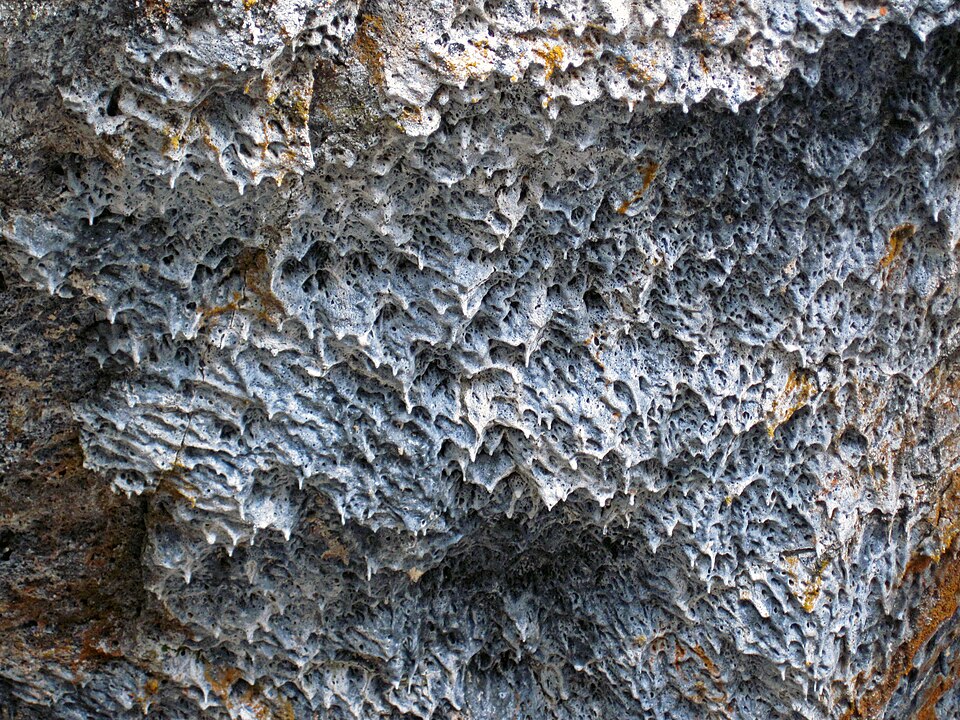
Not all caves form through chemical dissolution. Lava tubes develop during basaltic volcanic eruptions when the surface of a lava flow solidifies and insulates the still-molten interior, which eventually drains away to leave a hollow tube. Lava tubes can extend for tens of kilometres; the Kazumura Cave system on the island of Hawai'i reaches approximately 66 kilometres in surveyed length and descends over 1,100 metres in elevation, making it the longest and deepest known lava tube on Earth.10
.jpg)
Sea caves form along coastlines through the mechanical erosion of rock by wave action, concentrated at zones of structural weakness such as faults, joints, and contacts between rock types of differing resistance. The hydraulic force of breaking waves, combined with abrasion by entrained sand and gravel, excavates cavities that can extend tens of metres into coastal cliffs.11 Additional cave types include tectonic caves formed by rock displacement along faults, glacier caves melted within or beneath ice bodies, and talus caves created by openings between fallen boulders — though none of these rival solution caves in extent or geological significance.1
Speleothems and cave mineralogy
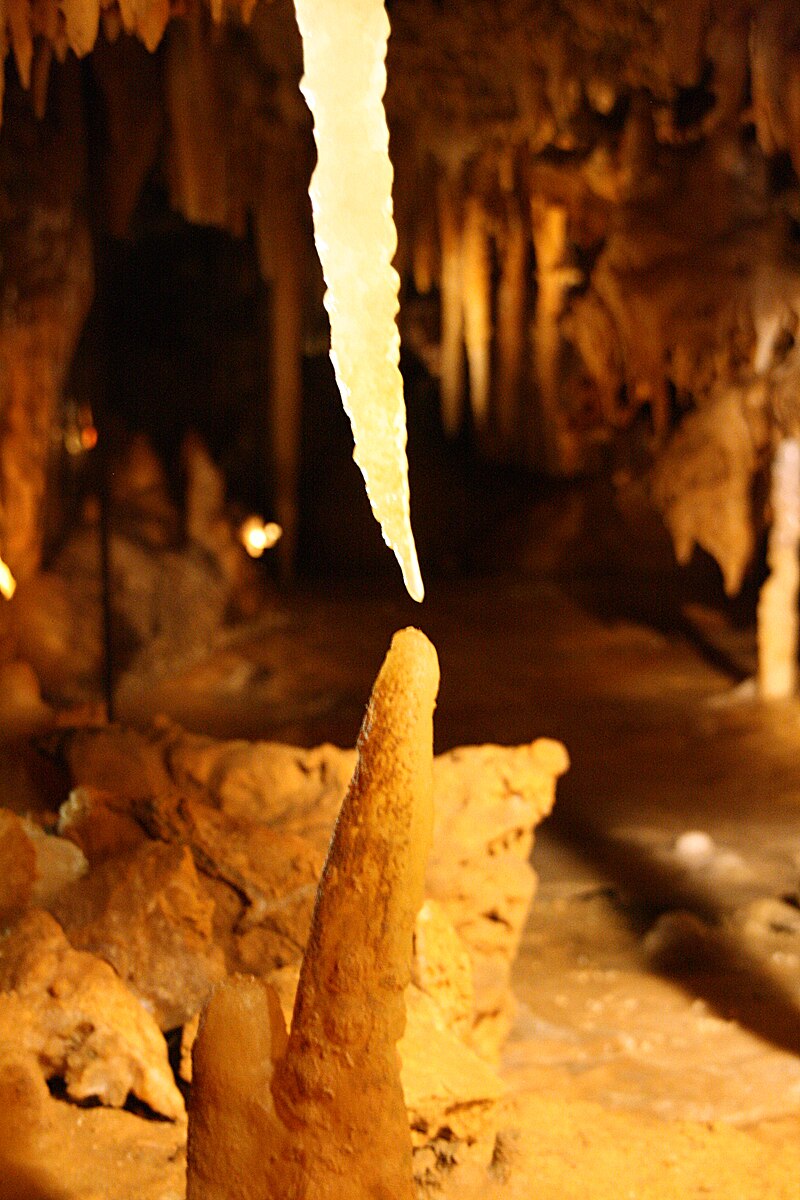

Once a cave passage has been drained of water and exposed to air, the chemical process that created it can reverse. Water seeping into the cave through cracks in the ceiling carries dissolved calcium bicarbonate. When this water enters the cave atmosphere, which typically contains far less CO2 than the soil zone above, CO2 degasses from the solution, driving it to supersaturation with respect to calcite and causing calcium carbonate to precipitate. The resulting mineral deposits are collectively called speleothems.6
Stalactites grow downward from cave ceilings where water drips through a fracture, depositing a ring of calcite around the water drop and gradually building a hollow tube (called a soda straw) that can thicken into a conical form. Stalagmites grow upward from the cave floor where drip water impacts, spreads, and degasses. Where a stalactite and stalagmite meet, they form a column. Flowstone forms as thin sheets of calcite deposited by water flowing over walls and floors, while draperies develop where water trickles along an inclined ceiling.6 Beyond calcite, over 300 mineral species have been identified in caves, including aragonite, gypsum, and a range of phosphate, sulfate, and oxide minerals whose formation depends on local chemistry, humidity, and microbial activity.6
Growth rates of common speleothem types7, 9
Caves as paleoclimate archives
Speleothems have emerged as one of the most important terrestrial archives of past climate. The oxygen isotope ratio (δ18O) preserved in the calcite of a stalagmite reflects the isotopic composition of the drip water, which in turn records changes in rainfall source, amount, temperature, and atmospheric circulation patterns at the time the calcite was deposited.18 Carbon isotope ratios (δ13C) provide complementary information about soil productivity, vegetation type (C3 versus C4 plants), and the degree of prior calcite precipitation along the water's flow path.7
A critical advantage of speleothems over other paleoclimate proxies — such as ice cores or ocean sediments — is that they can be dated with exceptional precision using uranium-thorium (U-Th) radiometric methods. Because calcite incorporates trace amounts of uranium but essentially no thorium at the time of deposition, the ingrowth of 230Th from the radioactive decay of 234U provides a chronometer accurate to within a few decades for samples up to approximately 600,000 years old.9 This dating precision has enabled the construction of continuous, absolutely dated climate records that anchor the chronology of events such as the timing of glacial terminations, the phasing of Northern and Southern Hemisphere climate shifts, and the behaviour of the Asian monsoon system over multiple glacial-interglacial cycles.8, 14
The landmark record from Hulu Cave in eastern China, published by Wang and colleagues in 2001, provided a continuous 640,000-year record of East Asian monsoon variability derived from oxygen isotope measurements in five stalagmites, demonstrating a close coupling between monsoon intensity and orbital forcing at precessional and oblique timescales.14 Subsequent work by Cheng and colleagues extended speleothem-based monsoon records even further and used the precise U-Th chronology of Chinese cave stalagmites to constrain the timing of the last four glacial terminations, showing that each termination began during a period of increasing Northern Hemisphere summer insolation.8, 15
Major cave systems as geological records
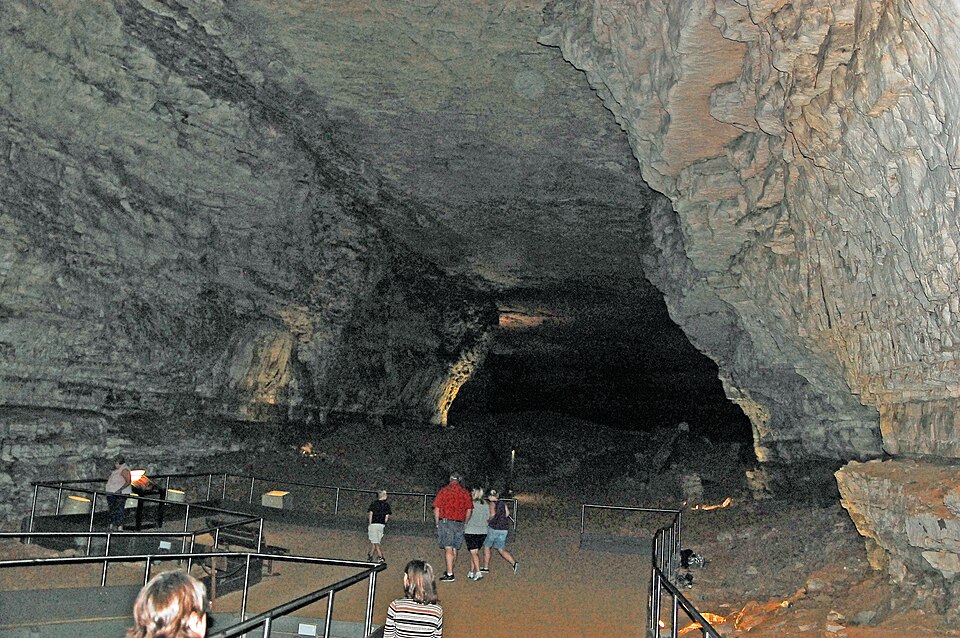

Mammoth Cave in Kentucky, United States, is the longest known cave system in the world, with over 680 kilometres of surveyed passages distributed across five vertical levels that record successive positions of the regional water table as the Green River incised its valley over the past several million years.12, 13 Each level represents a period of relative base-level stability during which lateral dissolution widened passages at the water table, followed by renewed downcutting that drained the upper level and initiated development of a new passage below. The stratigraphy of Mammoth Cave thus preserves a detailed record of regional landscape evolution and river incision history extending back to the late Tertiary.13
Sistema Sac Actun on the Yucatán Peninsula of Mexico is the longest known underwater cave system, with over 370 kilometres of surveyed submerged passages developed in Cenozoic limestone.17 The system formed under phreatic conditions when sea levels were lower during Pleistocene glaciations, exposing the karst landscape and allowing aggressive freshwater to dissolve extensive conduit networks. When post-glacial sea-level rise flooded the passages, they preserved remarkable archaeological and paleontological deposits, including the remains of Pleistocene megafauna and some of the earliest known human inhabitants of the Americas.17
These and other major cave systems illustrate the broader significance of speleogenesis: caves are not mere voids in rock but dynamic geological features whose morphology, sediments, and mineral deposits encode information about weathering processes, groundwater hydrology, sea-level change, climate variability, biological evolution, and human prehistory. As analytical techniques continue to improve — particularly in the precision of U-Th geochronology and the spatial resolution of stable isotope sampling — caves will remain at the forefront of paleoenvironmental research.7, 9
References
Origin of limestone caverns: a model from the River Styx drainage system, Mammoth Cave, Kentucky
A 640,000-year-long continuous terrestrial record of climate change from a Chinese cave
The kinetics of calcite dissolution and precipitation in geologically relevant situations of karst areas