Overview
- Karst landscapes form through the chemical dissolution of soluble bedrock, primarily limestone and dolomite, by slightly acidic water, producing a distinctive suite of surface and subsurface features including sinkholes, caves, disappearing streams, and tower karst.
- Approximately 15 to 20 percent of the Earth's ice-free land surface is underlain by carbonate rocks susceptible to karstification, and karst aquifers supply drinking water to roughly 25 percent of the global population, making karst processes both geologically significant and practically consequential.
- Karst terrain develops over timescales ranging from thousands to millions of years, shaped by the interplay of rock composition, fracture patterns, precipitation, vegetation cover, and tectonic uplift, with speleothems in caves providing some of the highest-resolution paleoclimate records available.
Karst landscapes are terrains formed primarily by the chemical dissolution of soluble bedrock, most commonly limestone, dolomite, marble, gypsum, and rock salt. The word "karst" derives from the Kras Plateau on the border of Slovenia and Italy, where the distinctive landforms produced by limestone dissolution were first systematically studied in the nineteenth century.1 Karst processes produce a characteristic suite of surface features, including sinkholes, closed depressions, disappearing streams, dry valleys, and residual hills, alongside an equally distinctive subsurface architecture of enlarged fractures, conduits, and caves through which groundwater flows in turbulent, channel-like fashion rather than through the slow, diffuse percolation typical of most aquifers.1, 8 Approximately 15 to 20 percent of the Earth's ice-free land surface is underlain by carbonate rocks susceptible to karstification, and karst aquifers supply drinking water to roughly one-quarter of the global population, making karst processes both a major shaping force in geomorphology and a matter of considerable practical importance for water resources and land-use planning.3, 9
The chemistry of dissolution
The fundamental process driving karst development is the chemical dissolution of calcium carbonate (CaCO3) by carbonic acid (H2CO3), a weak acid formed when carbon dioxide dissolves in water. Rainwater absorbs atmospheric CO2 (currently about 420 ppm) as it falls, and acquires substantially more CO2 as it percolates through soil, where biological respiration by plant roots, fungi, and soil microorganisms can elevate CO2 concentrations to 10,000 to 100,000 ppm, one to two orders of magnitude above atmospheric levels.1, 4
The dissolution reaction can be summarised as: CaCO3 + CO2 + H2O → Ca2+ + 2HCO3−. This reaction is reversible: when CO2 is lost from solution (for example, when water emerges from a confined space into a cave passage with lower CO2 partial pressure), the equilibrium shifts back toward precipitation of calcite, a process responsible for the formation of speleothems such as stalactites, stalagmites, and flowstone.4, 5
The kinetics of calcite dissolution were characterised quantitatively by Plummer, Wigley, and Parkhurst in a landmark 1978 study, which demonstrated that the dissolution rate depends on the CO2 partial pressure, pH, temperature, and the degree of saturation of the solution with respect to calcite. Far from equilibrium, dissolution proceeds rapidly; as the solution approaches saturation, the rate slows dramatically. This kinetic behaviour has profound implications for cave formation, because it means that slightly undersaturated water can travel long distances through bedrock fractures before dissolving enough rock to enlarge them significantly, while highly undersaturated water concentrated at the soil-bedrock interface dissolves rock aggressively and drives the formation of the epikarst, a zone of intense dissolution at the top of the bedrock surface.4, 14
Surface features
Sinkholes (also called dolines) are the most ubiquitous surface expression of karst. They are closed depressions in the land surface, typically circular or elliptical in plan, ranging from a few metres to several hundred metres in diameter. Sinkholes form through several mechanisms: solution sinkholes develop gradually as the bedrock surface is lowered by dissolution beneath a thin soil cover; collapse sinkholes form abruptly when the roof of an underlying cave or conduit fails under gravity; and suffosion sinkholes (also called cover-subsidence sinkholes) form where unconsolidated sediment is gradually piped downward into solution-widened fractures in the underlying bedrock.1, 7
Collapse sinkholes pose significant geotechnical hazards. The abrupt formation of a collapse sinkhole can swallow buildings, roads, and vehicles with little or no warning. Notable examples include the 2013 sinkhole in Seffner, Florida, that collapsed beneath a house and killed a resident, and the 2010 Guatemala City sinkhole, a 20-metre-wide, 30-metre-deep void that opened suddenly in an urban area, caused by the piping failure of volcanic ash deposits overlying karstified limestone.7
Poljes are large, flat-floored, closed depressions that can extend for kilometres and are characteristic of mature karst in the Dinaric Alps, from which much karst terminology originates. Poljes are bounded by steep walls and may contain seasonal lakes that flood when groundwater levels rise above the floor of the depression. Karren (also called lapies) are small-scale dissolution features on exposed limestone surfaces, including rills, grooves, pits, and flutes carved by thin films of slightly acidic rainwater. Uvala are compound depressions formed by the coalescence of adjacent sinkholes.1, 8
Cave formation and speleogenesis
Caves are the most spectacular products of karstification. The process of cave formation, called speleogenesis, begins when slightly acidic water enters the bedrock through fractures, bedding planes, and joints and dissolves the rock along these initial openings. Early dissolution is slow and distributed across many potential flow paths, but a positive feedback mechanism drives the system toward concentration of flow in a few dominant pathways: once a fracture is enlarged slightly, it captures more flow, which accelerates dissolution, which captures still more flow.2, 11
Palmer distinguished two principal modes of speleogenesis. In epigenetic caves, the most common type, dissolution is driven by meteoric water descending from the surface through the vadose zone (above the water table) and flowing laterally through the phreatic zone (below the water table) to discharge points in river valleys. Most large horizontal cave systems, including Mammoth Cave in Kentucky (the longest known cave at over 680 kilometres of surveyed passage), were formed by this process, with passages developing preferentially along the water table or at the intersection of the water table with particularly permeable bedding planes.1, 11
In hypogenic caves, dissolution is driven by water rising from depth, often carrying dissolved hydrogen sulfide (H2S) or CO2 derived from deeper geological sources such as petroleum reservoirs, volcanic degassing, or the oxidation of sulfide minerals. When H2S-bearing water reaches the water table or mixes with oxygenated water, the sulfide is oxidised to sulfuric acid, which is far more aggressive toward carbonate rock than carbonic acid. Carlsbad Caverns and Lechuguilla Cave in New Mexico are iconic examples of hypogenic caves formed by sulfuric acid speleogenesis.2, 15
Tower karst and tropical karst
In tropical and subtropical regions with heavy rainfall, prolonged tectonic stability, and thick sequences of pure limestone, karstification can produce dramatic tower-like residual hills rising abruptly from flat alluvial plains. This landform type, known as tower karst (or fenglin in Chinese), is most spectacularly developed in the Guilin region of Guangxi Province, southern China, where hundreds of near-vertical limestone towers, 100 to 300 metres high, rise from a flat plain that is itself underlain by deeply karstified bedrock.10
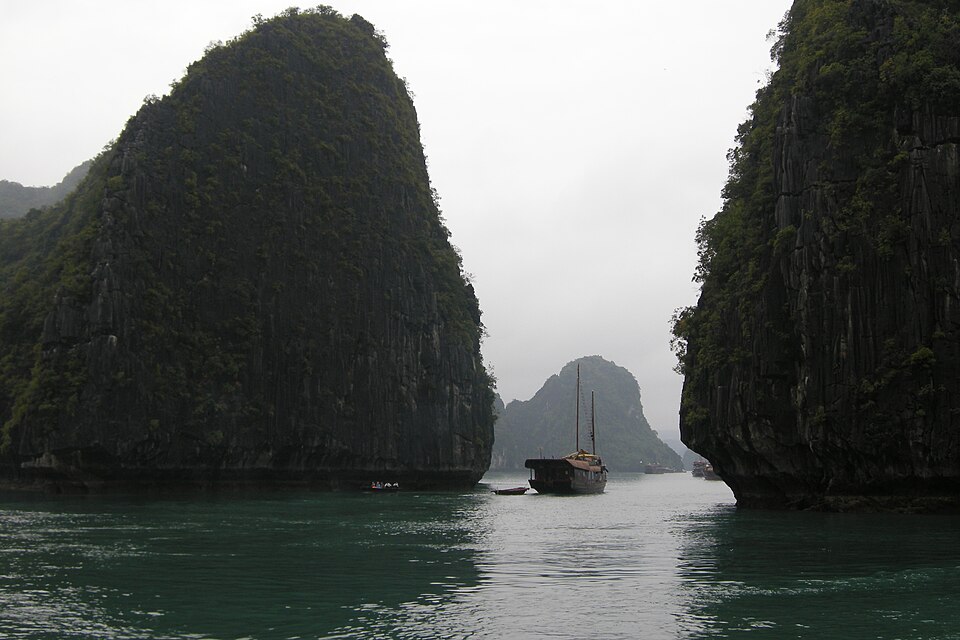

Tower karst represents an advanced stage of karst landscape evolution in which prolonged dissolution has removed most of the original limestone surface, leaving only isolated remnant towers separated by broad alluvial plains. The towers themselves are maintained by the near-vertical orientation of their walls, which sheds water rapidly and limits the duration of contact between acidic water and the rock surface, slowing further dissolution. An intermediate stage, called cone karst (or fengcong), consists of conical hills with interconnected bases and star-shaped valleys between them, representing a less advanced degree of landscape denudation.1, 10
Similar tower and cone karst landscapes are found in Vietnam (Ha Long Bay, where the towers rise from the sea), Belize, Jamaica, Puerto Rico, Papua New Guinea, and the Dinaric karst region of the western Balkans, though the Chinese examples remain the largest and most fully developed.1
Karst hydrology
Karst aquifers behave fundamentally differently from most other groundwater systems. In a typical porous-media aquifer (such as a sandstone), water flows slowly and diffusely through interconnected pore spaces, following Darcy's law and producing predictable, gradual responses to recharge events. In a karst aquifer, water flows through a hierarchical network of enlarged fractures and conduits that may range from millimetre-wide solution-enlarged joints to passages tens of metres in diameter, producing rapid, turbulent flow that responds almost immediately to rainfall events.1, 6
Springs emerging from karst aquifers are among the largest on Earth. The Fontaine de Vaucluse in southern France, which discharges from a Cretaceous limestone aquifer with a catchment area of approximately 1,100 square kilometres, has a mean annual discharge of roughly 23 cubic metres per second. Comparable springs exist in the Dinaric karst, the Edwards Aquifer of Texas, and the karst plateaus of southern China.6, 9
The rapid, concentrated flow through karst conduits has important implications for water quality. Contaminants introduced at the surface, whether agricultural chemicals, sewage, or industrial pollutants, can travel through a karst aquifer to discharge at a spring within hours to days, far faster than in conventional aquifers, and with little or no filtration or attenuation. This vulnerability makes karst aquifer protection a critical concern in regions where karst groundwater is a major water supply.6, 13
Cenotes and coastal karst
The Yucatán Peninsula of Mexico provides a spectacular example of karst development in a low-lying, tectonically stable, tropical limestone platform. The peninsula is underlain by a thick sequence of Cenozoic limestones and is essentially devoid of surface rivers; virtually all drainage is underground, through an extensive network of solution conduits that discharge at coastal springs and along the shoreline.16
Cenotes (from the Yucatec Maya word dzonot) are natural sinkholes formed by the collapse of thin limestone roofs over underlying cave passages or chambers. More than 6,000 cenotes have been catalogued on the Yucatán Peninsula, and many are connected by submerged cave systems that form some of the longest underwater cave networks in the world, with individual systems exceeding 350 kilometres of surveyed passage. Cenotes served as the primary freshwater sources for the ancient Maya civilisation and held deep religious significance as portals to the underworld.16
A striking ring of cenotes on the Yucatán Peninsula traces the buried rim of the Chicxulub impact crater, the structure produced by the asteroid impact at the end of the Cretaceous period 66 million years ago. The fractured zone along the crater rim created a zone of enhanced permeability that focused groundwater flow and dissolution, producing a near-circular alignment of cenotes that is visible on satellite imagery and was instrumental in the identification and mapping of the buried crater.16
Speleothems and paleoclimate
Caves preserve some of the most valuable paleoclimate archives on Earth in the form of speleothems, mineral deposits that precipitate from drip water and flowing water inside caves. Stalagmites (growing upward from the cave floor), stalactites (hanging from the ceiling), and flowstone (sheet-like deposits on cave walls and floors) are composed primarily of calcite or aragonite and grow incrementally as dissolved calcium carbonate precipitates from supersaturated drip water that has lost CO2 to the cave atmosphere.5
The oxygen isotope ratios (δ18O) preserved in speleothem calcite record information about past temperature, rainfall amount, and moisture source, depending on the climatic setting. In monsoon-influenced regions, speleothem δ18O primarily tracks rainfall amount, with more negative values indicating stronger monsoon rainfall. In higher-latitude settings, it more strongly reflects temperature. Uranium-thorium (U-Th) dating of speleothems, which exploits the decay of 234U to 230Th within the calcite, can provide absolute ages with uncertainties of less than 1 percent over the past 500,000 years, far more precise than the radiocarbon dating used for most other paleoclimate archives over this timescale.5, 12
A landmark study by Cheng and colleagues in 2009 reconstructed the Asian monsoon record over the past 224,000 years from stalagmites in Sanbao Cave, China, demonstrating that monsoon intensity varied in close correspondence with Northern Hemisphere summer insolation, modulated by Milankovitch orbital cycles. This record, and the dozens of comparable records produced from caves on every continent, have become foundational datasets in Quaternary paleoclimatology, providing continuous, precisely dated records of past climate variability at resolutions of decades or better.12
Geological and human significance
Karst landscapes occupy a distinctive position at the intersection of geology, hydrology, ecology, and human geography. The caves and sinkholes of karst terrain harbour unique ecosystems, including highly adapted cave-dwelling organisms (troglobites) that have evolved in isolation for millions of years. Karst regions support some of the highest levels of endemic aquatic biodiversity on Earth, with cave-adapted species of fish, crayfish, amphipods, and insects found nowhere else.1
For human societies, karst terrain presents both resources and hazards. Karst aquifers are critical water sources, particularly in the Mediterranean, Southeast Asia, the Caribbean, and the interior of China, where carbonate rocks underlie vast areas and surface water is scarce. At the same time, the susceptibility of karst aquifers to rapid contamination, the potential for sudden sinkhole collapse, and the difficulties of constructing foundations and infrastructure on karstified bedrock create engineering and environmental challenges that require specialised geological knowledge to manage.6, 7, 13
The ongoing dissolution of carbonate rocks by CO2-charged water is itself a component of the global carbon cycle. The dissolution reaction consumes CO2, and the reverse reaction (calcite precipitation in oceans and in caves) releases it. On geological timescales, the chemical weathering of silicate and carbonate rocks constitutes a major sink for atmospheric CO2 and a long-term regulator of Earth's climate. Karst processes are thus not merely a curiosity of landscape evolution but an active participant in the planetary cycles that govern atmospheric composition and climate over millions of years.1, 4
References
Cave and karst evolution in the Alps and their relation to paleoclimate and paleotopography