Overview
- Radioactive decay rates are measured with high precision in laboratory experiments and have been shown to be constant over billions of years by multiple independent lines of evidence, including the Oklo natural nuclear reactor (which operated 1.78 billion years ago under conditions requiring the same nuclear constants as today), concordance of meteorite ages from different decay systems, and astronomical observations of nuclear processes in distant stars and supernovae.
- Decay constants are governed by the fundamental forces of physics — the strong nuclear force, the weak nuclear force, and electromagnetic interaction — and theoretical physics provides no known mechanism by which these constants could have varied by the orders of magnitude required to compress billions of years of radiometric history into a young-Earth timescale.
- The mutual agreement of ages derived from decay systems with fundamentally different physical mechanisms (alpha decay, beta decay, electron capture, spontaneous fission) provides overwhelming evidence that the decay constants used in geochronology are both accurately measured and unchanged over the age of the solar system.
The accuracy of radiometric dating depends on the precision with which the decay constants of radioactive isotopes are known and on the assumption that these constants have remained unchanged over geological time. A decay constant (λ) describes the probability per unit time that a given radioactive atom will undergo nuclear transformation; it is related to the more familiar half-life (t1/2) by the equation λ = ln(2) / t1/2. For geochronology, the decay constants of key isotopes — including 238U, 235U, 87Rb, 40K, 147Sm, and 187Re — have been determined through decades of increasingly precise laboratory measurements and cross-calibration against each other.2, 8 Multiple independent lines of evidence, from the Oklo natural nuclear reactor to astronomical observations of distant supernovae, confirm that these constants have not varied over the age of the solar system.3, 13

How decay constants are measured
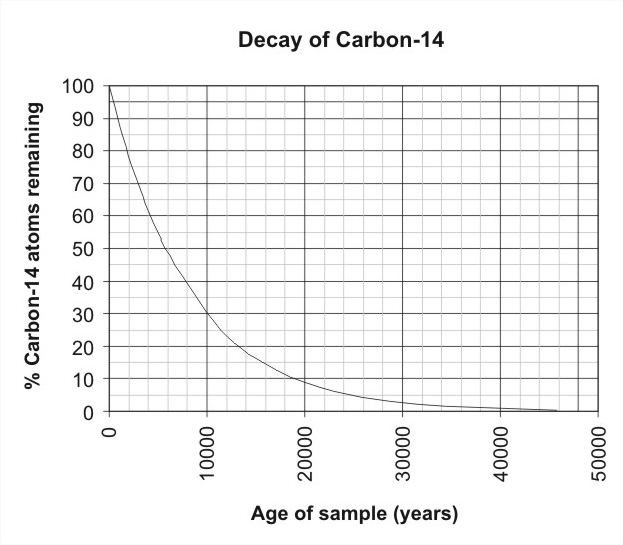
Decay constants are determined by two complementary approaches. The direct method involves placing a known quantity of the parent isotope in a detector and counting the number of decay events over a measured time interval. For isotopes with relatively short half-lives, such as 14C (half-life 5,730 years) or 210Pb (half-life 22.3 years), the activity is high enough that the decay constant can be measured with high precision from counting statistics alone.8 For long-lived isotopes used in deep-time geochronology — 238U (half-life 4.468 billion years), 87Rb (half-life 49.6 billion years), 147Sm (half-life 106 billion years) — direct counting requires extremely sensitive detectors and very pure, well-characterized samples, but the measurements have been performed with increasing precision since the mid-twentieth century.2, 10, 14
The second approach uses geological cross-calibration: the decay constant of one system is adjusted so that ages from that system agree with ages from an independently and more precisely calibrated system when applied to the same rocks. For example, the decay constant of 87Rb has been refined by comparing rubidium-strontium ages from meteorites with the highly precise uranium-lead ages from the same samples.10 The decay constant of 187Re has similarly been calibrated against iron meteorite ages dated by other systems.11, 12 While this cross-calibration approach is circular if used in isolation, it becomes self-consistent and robust when combined with direct counting measurements: the independently measured decay constants and the cross-calibrated values converge within their respective uncertainties.2, 8
The Oklo natural nuclear reactor
Perhaps the most remarkable demonstration that nuclear constants have not changed over geological time comes from the Oklo natural reactor in Gabon, West Africa. Approximately 1.78 billion years ago, a series of uranium ore deposits in the Oklo and Okelobondo regions sustained natural nuclear fission chain reactions for several hundred thousand years.3, 4 These reactions were possible because the natural abundance of the fissile isotope 235U was approximately 3.7 percent at that time (compared to 0.72 percent today), high enough to sustain a chain reaction when moderated by water — precisely the enrichment predicted by the known decay constants of 235U and 238U operating over 1.78 billion years.3, 9
Detailed analysis of the isotopic composition of fission products, neutron capture products, and remaining uranium at Oklo provides stringent constraints on the values of nuclear constants at the time the reactor operated. The ratios of fission product isotopes (particularly of samarium, neodymium, and ruthenium) match the ratios predicted by modern nuclear physics to within measurement precision, indicating that the neutron capture cross sections, fission yields, and decay rates of these isotopes 1.78 billion years ago were identical to those measured in modern laboratories.3, 4 Quantitative analyses of the Oklo data constrain any variation in the fine-structure constant (α), which governs electromagnetic interactions relevant to nuclear decay, to less than approximately one part in ten million over this timespan.3
Meteorite evidence
The concordance of ages derived from multiple decay systems in meteorites provides a powerful test of decay constant constancy. Clair Patterson's landmark 1956 determination of the age of the Earth at 4.55 billion years was based on the uranium-lead isochron of meteorites, using both the 238U–206Pb and 235U–207Pb decay systems.1 Subsequent analyses using rubidium-strontium, samarium-neodymium, rhenium-osmium, hafnium-tungsten, and manganese-chromium systems on the same or coeval meteorites have consistently returned ages in the range of 4.56–4.57 billion years.8, 16
Each of these decay systems operates through a different nuclear mechanism: uranium decays by alpha emission, rubidium-87 by beta-minus emission, potassium-40 by both beta-minus emission and electron capture, samarium-147 by alpha emission, and rhenium-187 by beta-minus emission.8 The strong nuclear force governs alpha decay, the weak nuclear force governs beta decay, and the electromagnetic force influences electron capture rates. There is no single physical variable whose alteration could change all of these fundamentally different processes by the same factor while maintaining the observed concordance of ages. If decay rates had varied, the different systems would diverge wildly rather than converge on the same age.8, 9
Astronomical evidence
Nuclear decay processes operating at cosmological distances provide an independent check on the constancy of decay rates over both deep time and vast spatial scales. Supernova SN 1987A, observed in the Large Magellanic Cloud approximately 168,000 light-years from Earth, provided a direct test: the gamma-ray light curve of the supernova remnant, powered by the radioactive decay of 56Co (half-life 77.2 days) and 57Co (half-life 271.8 days), declined at rates precisely matching the laboratory-measured half-lives of these isotopes.13 Because the light from SN 1987A was emitted 168,000 years ago and traveled through intergalactic space, this observation demonstrates that nuclear decay rates were unchanged at that time and in that distant location.13
Observations of quasar absorption spectra have been used to search for variation in the fine-structure constant over cosmological timescales. Some studies have reported marginal evidence for extremely small variations (on the order of a few parts per million over 10 billion years), but these results remain contested and, even if confirmed, would imply changes far too small to affect radiometric dating at any meaningful level.5 Big Bang nucleosynthesis provides additional constraints: the observed cosmic abundances of hydrogen, helium, deuterium, and lithium match the predictions of standard nuclear physics to high precision, indicating that nuclear reaction rates and decay constants during the first few minutes of the universe were the same as those measured today.6, 7
Theoretical constraints
From the standpoint of nuclear physics, decay rates are determined by the fundamental constants of nature — the coupling constants of the strong, weak, and electromagnetic forces, and the masses of elementary particles.8 Altering decay rates by the factors of a million or more required to compress 4.5 billion years of geological history into a few thousand years would require changes to these fundamental constants that would have catastrophic consequences for the stability of matter itself. The strong force binds protons and neutrons in atomic nuclei; even a small increase would change the binding energies of all nuclei, altering the entire periodic table of elements. The weak force governs beta decay and neutrino interactions; changes of the required magnitude would affect stellar fusion and the production of elements in stars.6, 8
Proposals for accelerated nuclear decay, advanced primarily in the young-Earth creationist RATE project, acknowledged that accelerating decay by the required factors would release enough heat to melt the Earth's crust many times over, and enough radiation to sterilize the planet.15 The RATE authors appealed to miraculous divine intervention to dissipate this heat and radiation, placing the hypothesis outside the domain of testable science. No laboratory experiment has ever demonstrated a mechanism for altering decay rates by more than trivially small amounts under any physically realizable conditions, and the multiple independent lines of evidence discussed above — the Oklo reactor, meteorite concordance, supernova light curves, and Big Bang nucleosynthesis abundances — collectively rule out significant variation in decay constants over the age of the universe.3, 8, 9, 13
Invariance under environmental conditions
Laboratory experiments have systematically tested whether decay rates can be altered by changes in environmental conditions such as temperature, pressure, electric and magnetic fields, and chemical bonding state. For alpha and beta decay, no measurable changes have been detected under any physically realizable laboratory conditions. Norman and colleagues subjected samples of several radioactive isotopes to temperatures ranging from 12 to 470 kelvins, pressures up to 27 GPa, and strong electric and magnetic fields, finding no variation in decay rates beyond the measurement uncertainty of approximately 0.1 percent.17
The one exception to complete invariance is electron capture decay, in which the nucleus captures an inner-shell electron. Because the decay rate depends on the electron density at the nucleus, extreme ionization (stripping of all electrons) can affect electron capture rates. This effect has been demonstrated for a few isotopes in storage ring experiments, but the conditions required (fully ionized atoms at relativistic velocities) are astrophysical, not geological, and the affected isotopes (such as 7Be) are not used in geochronology. For the isotopes relevant to geological dating — 238U, 235U, 87Rb, 40K, 147Sm, 176Lu, and 187Re — no physically plausible mechanism exists for altering their decay rates under any conditions encountered in the Earth or solar system.8, 17, 18
Significance for geochronology
The constancy of decay rates is not an assumption that geochronologists adopt uncritically; it is a conclusion supported by extensive empirical evidence. The precision of modern decay constant measurements, combined with their confirmation through geological cross-calibration, the natural experiment of the Oklo reactor, the concordance of meteorite ages across fundamentally different decay mechanisms, and astronomical observations spanning cosmological distances and timescales, establishes that the nuclear clocks underlying radiometric dating have ticked at the same rate throughout the history of the solar system.2, 8, 9 This conclusion underpins the entire framework of absolute geochronology and, by extension, the geologic time scale and our understanding of the age of the Earth at 4.54 billion years.1, 16
References
Recommended values for the decay constants, half-lives, and branching ratios of naturally occurring radioactive nuclides
The Oklo natural reactor, analogue for nuclear waste disposal: brief review of the conditions and results with focus on long term transport processes
New determinations of the fine structure constant from the radioactive decay of distant quasars
Limit on the cosmological variation of Tp/Te from nucleosynthesis in Big Bang and stars
Measurement of the 187Re decay constant via mass spectrometric analysis of molybdenites