Overview
- Turbidites are graded sedimentary layers deposited within hours or days by submarine turbidity currents — dense, sediment-laden gravity flows that can travel hundreds of kilometres at speeds exceeding 100 km/h, as demonstrated by the sequential cable breaks that followed the 1929 Grand Banks earthquake.
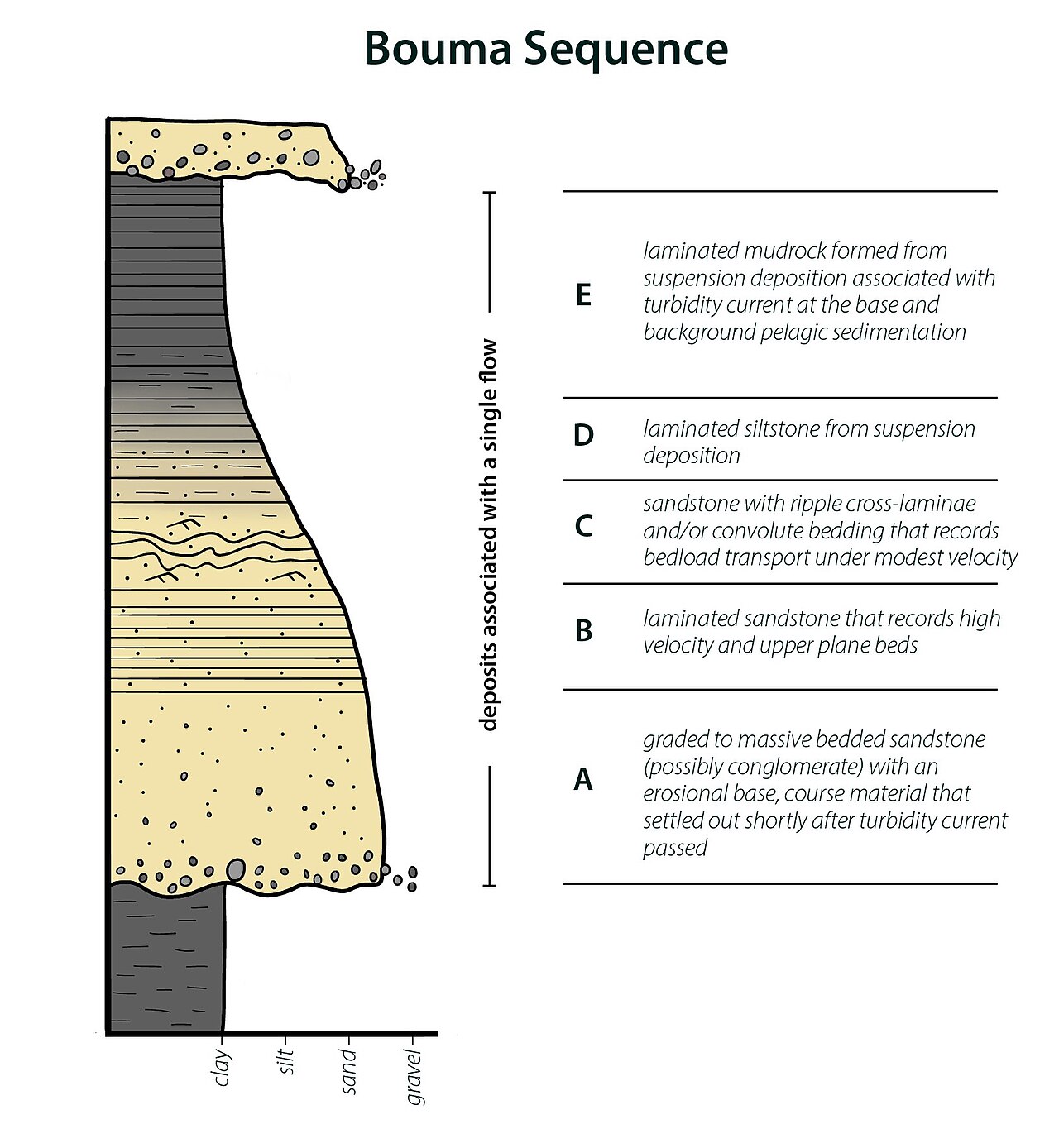
- The Bouma sequence describes the internal architecture of a turbidite from base to top: a graded sand layer (Ta), parallel laminated sand (Tb), ripple cross-laminated fine sand (Tc), upper parallel laminated silt (Td), and a pelagic or hemipelagic mud cap (Te) — a systematic structure that reflects the waning energy of a single flow event.
- Event beds — turbidites, tempestites, tsunamites, tephra layers, and impact ejecta horizons — are brief punctuations within sequences that otherwise accumulate at millimetres per thousand years, demonstrating that rapid local deposition and vast spans of slow background sedimentation coexist within the same stratigraphic column.
Not all sedimentary layers form slowly. The rock record is punctuated throughout by event beds — discrete strata deposited within minutes, hours, or days by catastrophic physical processes — and the most thoroughly studied of these are turbidites, the product of submarine avalanches of sediment-laden water that can transport enormous quantities of sand and mud from shallow continental shelves to the deepest ocean basins in a single surge.2, 13 Understanding how turbidites and other event beds form, what internal structures they preserve, and how they relate to the surrounding background sediment is essential for reading the stratigraphic record correctly and for evaluating claims about the tempo of geological processes.

Event beds occupy a paradoxical position in the history of science. For much of the nineteenth and early twentieth centuries, uniformitarian geology emphasized the slow, steady accumulation of sediment as the dominant mode of deposition, and geologists were sometimes reluctant to invoke sudden catastrophic events even when the evidence called for them. The discovery of turbidity currents in the 1950s helped resolve this tension: it demonstrated that catastrophic events are real, powerful, and geologically common, while also confirming that they are brief episodes embedded within far longer intervals of quiescent background sedimentation.3, 13 The geological record thus encodes both slow time and fast time simultaneously, and recognizing the difference between them is the key to interpreting it correctly.15
What turbidity currents are
A turbidity current is a density-driven gravity flow in which sediment particles suspended in water create a mixture denser than the surrounding seawater or lake water, causing it to accelerate downslope under its own weight.2 The mechanism is self-sustaining once initiated: as the current accelerates, it erodes additional sediment from the seafloor, increasing its density and therefore its velocity. At sufficient speeds the current becomes highly turbulent, keeping even coarse sand grains in suspension. The result is a fast-moving underwater avalanche capable of travelling hundreds of kilometres from its point of origin, scouring deep channels into the continental slope and eventually spreading across the abyssal plain.2, 20
Turbidity currents are triggered by a variety of mechanisms. Earthquakes can destabilize thick accumulations of sediment on the continental shelf, producing submarine slides that transform into turbidity currents as they disaggregate and mix with ambient water.20 Storm waves can similarly liquefy shelf sediments during major hurricanes or typhoons, generating smaller hyperpycnal flows that spill over the shelf edge. River floods occasionally deliver so much sediment to a delta that the accumulating pile becomes unstable and collapses. In each case, the initiating event is brief — a few seconds of shaking, a single storm — but the turbidity current it generates may travel for many hours before its suspended sediment settles out and forms a new layer on the ocean floor.5
The 1929 Grand Banks earthquake: proof of concept
For decades, turbidity currents were hypothetical. The idea that dense sediment-laden flows could travel long distances across the seafloor had been proposed theoretically, but direct evidence was lacking until a natural experiment unfolded on the night of November 18, 1929. An earthquake of magnitude 7.2 struck the Grand Banks off the coast of Newfoundland, triggering a massive submarine slump on the continental slope. The slump quickly transformed into a turbidity current that surged southward across the abyssal plain at speeds that could be calculated precisely because it snapped a series of transatlantic telegraph cables at known positions and known times.3
Heezen and Ewing’s analysis of the cable break sequence, published in 1952, remains one of the classic demonstrations in sedimentary geology.3 The cables nearest the earthquake epicentre broke almost simultaneously with the seismic event, consistent with direct slope failure. But cables progressively farther to the south broke at progressively later times, allowing calculation of the flow’s velocity over each segment of its journey. Near the top of the continental slope the current was travelling at approximately 100 km/h; by the time it reached the abyssal plain, it had slowed to around 25 km/h but still covered the final cables — more than 700 km from the earthquake epicentre — within hours.3, 4 Subsequent seafloor surveys confirmed the deposition of a turbidite layer up to 1 metre thick across a vast area of the North Atlantic floor, physically correlated with the cable breaks by its position, composition, and radiometric age.4, 19
The Grand Banks event converted turbidity currents from theoretical constructs into observed geological agents. It also revealed something important about the timescales involved: the entire deposition of a layer metres thick across thousands of square kilometres of ocean floor took a matter of hours. This is rapid deposition in any reasonable sense of the phrase — but it is a single event, not a sustained process, and it is followed immediately by a return to the background sedimentation rates of the deep ocean, which average on the order of centimetres to millimetres per thousand years.15
The Bouma sequence
The internal structure of a turbidite reflects the systematic waning of energy as a turbidity current decelerates and its suspended load settles out. Arnold Bouma formalized this architecture in 1962 after studying flysch sequences in the Alps and comparing them with turbidite deposits from other basins.1 He described a five-division ideal sequence, now universally known as the Bouma sequence, in which each division records a progressively lower-energy phase of a single depositional event. The five divisions are conventionally labelled Ta through Te from base to top.1
The basal division, Ta, consists of massive or graded coarse sand or granule gravel deposited rapidly from the head and body of the turbidity current when its velocity drops below the threshold needed to keep coarse particles in suspension.1, 5 Graded bedding — coarser grains at the base grading imperceptibly upward to finer grains — is the diagnostic feature of this division, produced by the preferential settling of heavier particles first. Above Ta, the Tb division preserves parallel, planar lamination in medium to fine sand, formed under the high-velocity traction conditions that persist as the current continues to flow but with diminishing competence. The Tc division records ripple cross-lamination in fine sand and silt — the small-scale climbing ripples that form as the current velocity drops further into the lower flow regime, producing asymmetric foresets that can indicate palaeocurrent direction.1
The Td division consists of upper parallel laminae in very fine sand and coarse silt, deposited under conditions approaching the threshold of motion. Finally, the Te cap is composed of unlaminated or faintly laminated mud and clay that settled slowly from the dilute tail of the turbidity current, often grading imperceptibly upward into the background pelagic or hemipelagic sediment that accumulated between events.1, 2 Not every turbidite preserves all five divisions; distal turbidites laid down far from the source often consist only of the upper divisions Tc through Te, because the coarser material that would form Ta and Tb never reached that distance. Proximal turbidites near the base of the continental slope may be dominated by Ta and Tb, with the finer divisions either absent or very thin. The completeness of the Bouma sequence therefore serves as a proxy for the distance and energy of transport.2, 5
At the base of many turbidites, the basal contact with the underlying sediment is not simply a flat surface but a sole marked with a variety of erosional and load-related structures. Flute casts, formed when turbulent eddies scour spoon-shaped hollows into soft mud that are then filled and preserved as casts on the base of the overlying sand, are among the most diagnostic.11 Groove casts record the dragging of clasts or tool marks along the seafloor, and load casts form when denser sand sinks into underlying water-saturated mud. These sole marks are visible on the undersides of exhumed turbidite beds in outcrop and provide not only evidence of turbidite origin but also palaeocurrent direction.11
Other event beds
Turbidites are the most extensively studied event beds, but they are not the only kind. Stratigraphy recognizes a broader family of event horizons deposited by distinct physical mechanisms, each with characteristic sedimentary signatures that allow them to be identified and distinguished from both turbidites and background sediment.13
Tempestites are storm-generated event beds produced in shallow marine environments, typically the shoreface and inner shelf, where major storms drive oscillatory waves and combined flows powerful enough to erode and transport seabed sediment.6 A typical tempestite rests on an erosional base, shows hummocky cross-stratification — a distinctive low-angle dune-like internal geometry produced by combined oscillatory and unidirectional flow — and grades upward into parallel laminated or bioturbated fine sand. Like turbidites, tempestites record brief episodes of high energy within sequences that are otherwise characterized by slow, steady deposition of mud or carbonate.6 Their presence in the rock record provides evidence for the ancient storm climate and the depth of the depositional environment relative to storm wave base.
Tsunamites are sedimentary layers deposited by tsunami waves, which differ from storm waves in their much longer wavelengths and their ability to transport sediment both onshore and offshore in rapid oscillating surges.7 Identifying ancient tsunamites is more challenging than identifying turbidites or tempestites because the sedimentary signature can superficially resemble those of storms and river floods. Diagnostic criteria include anomalously large transported clasts (including boulders moved far above normal wave reach), mixed marine and terrestrial assemblages of microfossils indicating bidirectional transport, an absence of the hummocky cross-stratification typical of storms, and the geographic distribution of the deposit, which may extend across coastal plains far inland from the contemporary shoreline.7
Volcanic ash beds, formally called tephra layers, are produced when explosive eruptions inject fine volcanic glass and mineral fragments into the atmosphere at heights of tens of kilometres, from which they settle globally over days to weeks.10 A single large eruption can deposit a geochemically distinctive layer simultaneously across millions of square kilometres, creating one of the most powerful correlation tools available to stratigraphers. The Toba supereruption of approximately 74,000 years ago, for example, deposited a tephra layer identifiable from India to Greenland in ice cores and from Africa to Southeast Asia in marine and lacustrine sediments.18 Because the chemical composition of volcanic glass is specific to each eruption source and magmatic episode, tephra layers serve as time-parallel marker beds that allow independent dating and correlation of otherwise unconnected sedimentary sequences.10, 17
Impact ejecta layers represent the most extreme class of event bed: material excavated from the crust by a large bolide impact and distributed globally within hours of the collision. The most famous example is the clay layer at the Cretaceous–Paleogene (K–Pg) boundary, approximately 66 million years old, which was identified independently at dozens of sites worldwide before its origin was understood.9 Luis Alvarez and colleagues reported in 1980 that the boundary clay was enriched in iridium at concentrations two to three orders of magnitude above normal crustal values, an anomaly best explained by the addition of extraterrestrial material from a large asteroid or comet.9 Subsequent work identified shocked quartz grains, spherules of rapidly quenched melt glass, and soot consistent with global wildfires within the same layer, and the source impact crater was identified as Chicxulub, buried beneath the Yucatán Peninsula.8 The K–Pg boundary layer is now recognized at more than 350 sites on six continents and the deep ocean floor, everywhere falling precisely at the boundary between Cretaceous and Paleogene fossils — a global event bed recording a single catastrophic instant in geological time.8
Recognizing event beds in the rock record
Several physical features reliably distinguish event beds from the background sediment that surrounds them. The most consistent is the basal contact: event beds characteristically rest on sharp, often erosional surfaces that truncate the underlying lamination, whereas background sedimentation produces gradational contacts as grain size slowly shifts.13 The sharpness reflects the abrupt onset of the event — a turbidity current or storm arrives suddenly and immediately begins eroding, leaving no transitional record between quiescence and deposition.
Graded bedding is the second key criterion. A layer in which grain size systematically decreases from base to top records the settling of a suspended population of mixed-size particles, a process that can be accomplished in hours to days during a single event.1, 13 Background pelagic or hemipelagic sediment accumulating slowly from suspension is typically homogeneous in grain size through any given interval because the supply rate and current energy vary only gradually over long periods. Grading within a single bed therefore points strongly to event deposition.
Sole marks on the base of the layer — flute casts, groove casts, and prod marks cast in sand against an underlying mud — provide additional evidence of a high-energy erosional event at the base of deposition and are virtually absent from slowly accumulated background sediment.11 Internal sedimentary structures also differ: the parallel lamination and cross-lamination of turbidite divisions Tb and Tc require traction currents that are typically absent during background pelagic settling, which produces massive or very faintly laminated mud without cross-bedding.
Lateral continuity distinguishes event beds from most turbidites in one important sense: a tephra layer or impact ejecta horizon can be traced continuously across an entire ocean basin or across continents because the depositional mechanism — atmospheric fallout from a single eruption or impact — operates simultaneously over the entire area. Turbidites, by contrast, thin and fine away from the source, eventually disappearing into the background sediment beyond the reach of the flow. This difference in lateral extent is itself diagnostic: a laterally continuous layer of anomalous composition (iridium-enriched clay, volcanic glass, shocked quartz) is characteristic of atmospheric-transport events, while a layer that thickens toward a slope and thins distally points to a submarine gravity flow.13, 17
Event stratigraphy and marker beds
Because event beds are deposited nearly instantaneously at a geological scale, they constitute time-parallel surfaces that can in principle be used to correlate sections across great distances. This application — event stratigraphy — uses distinctive horizons as isochronous markers to align otherwise disparate sequences.13, 17 A tephra layer from a known eruption, independently dated by radiometric methods, allows two sections of sediment accumulated in entirely different environments to be placed on the same time axis simply by identifying the ash horizon in each. The K–Pg boundary clay performs the same function at a global scale: wherever it appears, it marks the same instant 66 million years ago, regardless of whether the surrounding sediment is deep-sea limestone, continental shale, or shallow marine chalk.
The stratigraphic utility of event beds extends to petroleum geology, where turbidite sandstones are among the most important deep-water reservoir targets.12 Stacked turbidite systems form elongate sand bodies that can accumulate to thicknesses of hundreds of metres within submarine fan complexes, and their distinctive internal architecture — recognizable in seismic reflection data by their geometry and in cores by the Bouma sequence — allows geologists to predict the distribution of reservoir rock away from drilled wells.12 The North Sea, West Africa, and the Gulf of Mexico host some of the world’s largest hydrocarbon accumulations in turbidite sands, demonstrating the practical importance of understanding event deposition.
In sequence stratigraphy, the relationship between event beds and background sedimentation provides insight into the controls on sediment delivery to deep water. Turbidites are most frequent during lowstands of sea level, when rivers deliver sediment directly to the shelf edge rather than depositing it across a broad shelf, and when slopes are steepest and most prone to failure.2, 12 The cyclical bundling of turbidite frequency with sea-level cycles provides an independent line of evidence for the reality of those cycles and for their pacing by orbital forcing — a link that connects event stratigraphy to the Milankovitch framework of orbital climate forcing.
Turbidites, varves, and the meaning of rapid deposition
A persistent misreading of event beds in young-Earth creationist literature conflates turbidites — rapidly deposited event layers — with varves, the annually laminated sediments used as direct counters of elapsed years. The argument runs that because turbidites can deposit multiple laminae within a single event, varve counts are unreliable and could record far shorter time spans than conventionally assumed. This conflation reflects a fundamental misunderstanding of how the two deposit types are distinguished.14, 16
Sedimentologists have developed a robust toolkit for telling turbidites from varves, and the criteria operate at multiple independent levels. Turbidites display graded bedding, erosional basal contacts, sole marks, and internal traction structures; varve couplets display no internal grading, biotically controlled compositional alternation (diatom-rich vs. clay-rich), and gradational seasonal contacts.14 Turbidites are laterally discontinuous, thinning away from their source; annually deposited varves can be traced across an entire lake floor with consistent thickness. Most decisively, the geochemical and biological content of true varve couplets records a complete seasonal cycle: oxygen isotope ratios in the carbonate of a single couplet show the full amplitude of summer–winter temperature variation, diatom assemblages within individual laminae follow a systematic seasonal succession, and pollen content tracks the annual growing season.14, 16 None of these seasonal signals appear in turbidites, which are deposited too rapidly for biological productivity cycles to register.
The distinction is not merely academic. It means that the observation that turbidites can be deposited rapidly tells us nothing about the timescale recorded by a sequence of varves. The two phenomena are physically, chemically, and biologically distinct, and they have been reliably distinguished in the literature for decades. Where a turbidite does appear within a varved sequence — intercalated by a local slope failure or seismic event — it is identifiable by the criteria above, it is excluded from the varve count, and its presence can itself provide independent evidence of the earthquake or storm that triggered it.16
More broadly, event beds reveal something that integrates naturally with the evidence from varves and annual layers, deep-sea sediment cores, and radiometric dating: that rapid deposition and deep time are not alternatives but coexisting features of the same geological record. A turbidite deposited in three hours sits within a sequence of background pelagic sediment that accumulated at a rate of one centimetre per thousand years.15 The event horizon is real, rapid, and physically impressive; the surrounding sediment is genuinely ancient. Recognizing both is not a contradiction but a demonstration of how thoroughly the rock record has been read. The brevity of a single turbidite does not compress the time represented by the entire section any more than a single rainstorm compresses the meaning of a long drought.13, 15
References
- Bouma, A. H. Sedimentology of Some Flysch Deposits. Elsevier, Amsterdam, 1962. doi:10.1017/S0016756800049074
- Mutti, E. et al. “Turbidite systems: state of the art and future trends.” Bulletin de la Société Géologique de France 180: 75–111, 2009. doi:10.2113/gssgfbull.180.2.75
- Heezen, B. C. & Ewing, M. “The 1929 Grand Banks earthquake, slump, and turbidity current.” Geological Society of America Bulletin 63: 1155–1206, 1952. doi:10.1130/0016-7606(1952)63[1155:TGBEAS]2.0.CO;2
- Piper, D. J. W. et al. “Submarine cable breaks in the 1929 Grand Banks earthquake.” Geological Society of America Bulletin 111: 79–93, 1999. doi:10.1130/0016-7606(1999)111<0079:SCBITG>2.3.CO;2
- Mutti, E. & Ricci Lucchi, F. “Turbidites of the northern Apennines: introduction to facies analysis.” International Geology Review 20: 125–166, 1978. doi:10.1016/0037-0738(72)90022-9
- Aigner, T. Storm Depositional Systems. Lecture Notes in Earth Sciences 6, Springer, Berlin, 1985. doi:10.1007/BFb0011517
- Dawson, A. G. & Shi, S. “Sedimentary signatures of tsunamis.” Pure and Applied Geophysics 160: 2001–2012, 2003. doi:10.1007/s00024-003-2414-5
- Schulte, P. et al. “The Chicxulub asteroid impact and mass extinction at the Cretaceous-Paleogene boundary.” Science 327: 1214–1218, 2010. doi:10.1126/science.1177265
- Alvarez, L. W. et al. “Extraterrestrial cause for the Cretaceous-Tertiary extinction.” Science 208: 1095–1108, 1980. doi:10.1126/science.208.4448.1095
- Lowe, D. J. “Tephrochronology and its application: a review.” Quaternary Geochronology 6: 107–153, 2011. doi:10.1016/j.quageo.2010.08.003
- Dzulynski, S. & Walton, E. K. Sedimentary Features of Flysch and Greywackes. Developments in Sedimentology 7, Elsevier, 1965. doi:10.1016/S0070-4571(08)70578-4
- Weimer, P. & Link, M. H. (eds.) Seismic Facies and Sedimentary Processes of Submarine Fans and Turbidite Systems. Springer, New York, 1991. doi:10.2110/pec.91.37
- Einsele, G. et al. (eds.) Cycles and Events in Stratigraphy. Springer, Berlin, 1991. doi:10.1007/978-3-642-75861-6
- Francus, P. et al. “Distinguishing varves from turbidites: sedimentological and geochemical criteria in Holocene lake sediments of New England.” Quaternary Science Reviews 27: 2191–2208, 2008. doi:10.1016/j.quascirev.2008.08.008
- Shanmugam, G. “The Bouma sequence and the turbidite mind set.” Earth-Science Reviews 42: 201–229, 1997. doi:10.1016/S0012-8252(97)00010-7
- Mulder, T. & Alexander, J. “Turbidites vs. varves: a conceptual framework for lacustrine event stratigraphy.” Sedimentology 48: 269–299, 2001. doi:10.1046/j.1365-3091.2001.00359.x
- Gradstein, F. M. et al. A Geologic Time Scale 2012. Cambridge University Press, 2012. doi:10.1017/CBO9780511977985
- Chesner, C. A. et al. “Eruptive history of Earth’s largest Quaternary caldera (Toba, Indonesia) clarified.” Geology 19: 200–203, 1991. doi:10.1130/0091-7613(1991)019<0200:EHOELS>2.3.CO;2
- Piper, D. J. W. & Aksu, A. E. “The 1929 Grand Banks earthquake, slump and turbidity current: implications for the origin of the North Atlantic T-3 layer.” Geo-Marine Letters 7: 1–10, 1987. doi:10.1007/BF02237988
- Masson, D. G. et al. “Submarine landslides: processes, triggers and hazard prediction.” Philosophical Transactions of the Royal Society A 364: 2009–2039, 2006. doi:10.1098/rsta.2006.1810
References
Background sedimentation rates in deep-sea basins and their relationship to turbidite frequency
The Toba eruption and its global tephra layer: a benchmark in Quaternary stratigraphy
Ocean floor geomorphology and the sedimentary record of the Grand Banks turbidity current