Overview
- The style of a volcanic eruption is controlled primarily by magma composition, volatile content, and viscosity, producing a spectrum from gentle effusive Hawaiian lava flows to catastrophic Plinian eruption columns that can reach 40 kilometres or more into the stratosphere.
- The Volcanic Explosivity Index, a logarithmic scale from 0 to 8 developed by Newhall and Self in 1982, provides a standardized measure of eruption magnitude based on ejected volume, column height, and qualitative descriptors, with each integer step representing a roughly tenfold increase in explosivity.
- Supervolcanic eruptions of VEI 8, which produce more than 1,000 cubic kilometres of ejecta and form massive calderas, occur globally at average intervals of roughly 100,000 to 200,000 years and can trigger volcanic winters with hemispheric or global cooling of several degrees Celsius lasting years.
Volcanic eruptions are among the most dramatic and consequential geological phenomena on Earth, yet they span an enormous range of intensity and style. At one end of the spectrum, basaltic lava flows quietly across the flanks of Hawaiian shield volcanoes at walking pace; at the other, Plinian eruption columns punch through the tropopause and inject thousands of cubic kilometres of fragmented rock and gas into the stratosphere, altering global climate for years.1, 3 The classification of volcanic eruptions into distinct types — Hawaiian, Strombolian, Vulcanian, Plinian, and others — was formalised in the twentieth century through the work of Walker, Newhall, Self, and others, who recognised that eruption style is governed primarily by the composition, temperature, and volatile content of the magma, and that these parameters determine whether an eruption is effusive or explosive.1, 2
Understanding what controls eruption style is not merely academic. The distinction between a gentle lava flow and a catastrophic pyroclastic eruption can determine whether tens of millions of people living near active volcanoes face minor inconvenience or existential danger. The Volcanic Explosivity Index (VEI), introduced by Newhall and Self in 1982, provides a standardised logarithmic scale for comparing eruptions across the full range of observed magnitudes, from quiet effusions to civilisation-threatening supervolcanic events.1
Controls on eruption style
The fundamental dichotomy in volcanology is between effusive eruptions, which produce lava flows, and explosive eruptions, which fragment magma into pyroclastic material (tephra) and eject it into the atmosphere. Whether a given eruption is effusive or explosive depends on the interplay of three primary controls: magma composition, volatile content, and magma viscosity.3, 12
Silica content is the single most important compositional variable. Basaltic magma, with approximately 50 percent SiO2 by weight, has a relatively open molecular structure that permits ions and dissolved gas molecules to move freely, resulting in low viscosity. Andesitic magma (approximately 60 percent SiO2), dacitic magma (approximately 65 percent), and rhyolitic magma (70 percent or more) are progressively richer in silica, forming increasingly polymerised networks of silicon-oxygen tetrahedra that dramatically increase viscosity.3, 10 Rhyolitic magma can be ten thousand to one million times more viscous than basalt at equivalent temperatures and volatile contents. This viscosity contrast is the principal reason that basaltic eruptions tend to be effusive while silicic eruptions tend to be explosive.
Volatile content — chiefly dissolved water (H2O) and carbon dioxide (CO2) — exerts the second critical control. As magma ascends toward the surface, decreasing confining pressure causes dissolved volatiles to exsolve and form bubbles through a process analogous to the fizzing of an opened carbonated drink. In low-viscosity basaltic magma, gas bubbles can nucleate, grow, coalesce, and escape relatively easily, allowing the magma to degas passively and erupt as fluid lava. In high-viscosity silicic magma, bubbles cannot rise through or escape from the melt; they continue to grow as pressure decreases, and the gas fraction of the magma increases until the bubble walls rupture in an explosive fragmentation event that converts the magma into a mixture of volcanic gas and pyroclastic fragments.10, 12
Temperature also influences eruption style through its effect on viscosity. Basaltic magmas erupt at approximately 1,100 to 1,250 degrees Celsius, while rhyolitic magmas erupt at 700 to 900 degrees Celsius. Hotter magma is less viscous, which further favours effusive behaviour in basaltic systems. The crystal content of the magma also matters: as crystals form during cooling, they increase the effective viscosity of the magma and can contribute to the transition from effusive to explosive behaviour.3, 12 Walker's 1973 classification scheme recognised that eruption types could be distinguished quantitatively by the dispersal area of their pyroclastic deposits and the degree of fragmentation of the ejected material, reflecting these underlying physical controls.2
Effusive eruption styles

Hawaiian eruptions are the gentlest form of volcanic activity. They are named after the shield volcanoes of Hawai'i, particularly Kīlauea and Mauna Loa, where fluid basaltic magma with low dissolved gas content erupts as spectacular lava fountains and extensive lava flows. Lava fountains during Hawaiian eruptions can reach heights of several hundred metres, driven by the expansion of gas bubbles as magma reaches the surface, but the fountaining produces little fine-grained ash because the low viscosity of the magma prevents extensive fragmentation.18 The lava produced during Hawaiian eruptions takes two principal forms, classified by their surface textures: pāhoehoe, which has a smooth, billowy, or ropy surface formed when lava flows slowly at relatively low effusion rates, and ʻaʻā, which has a rough, clinkery, jagged surface formed at higher effusion rates when the partially solidified crust is broken apart by continued flow of the interior.3
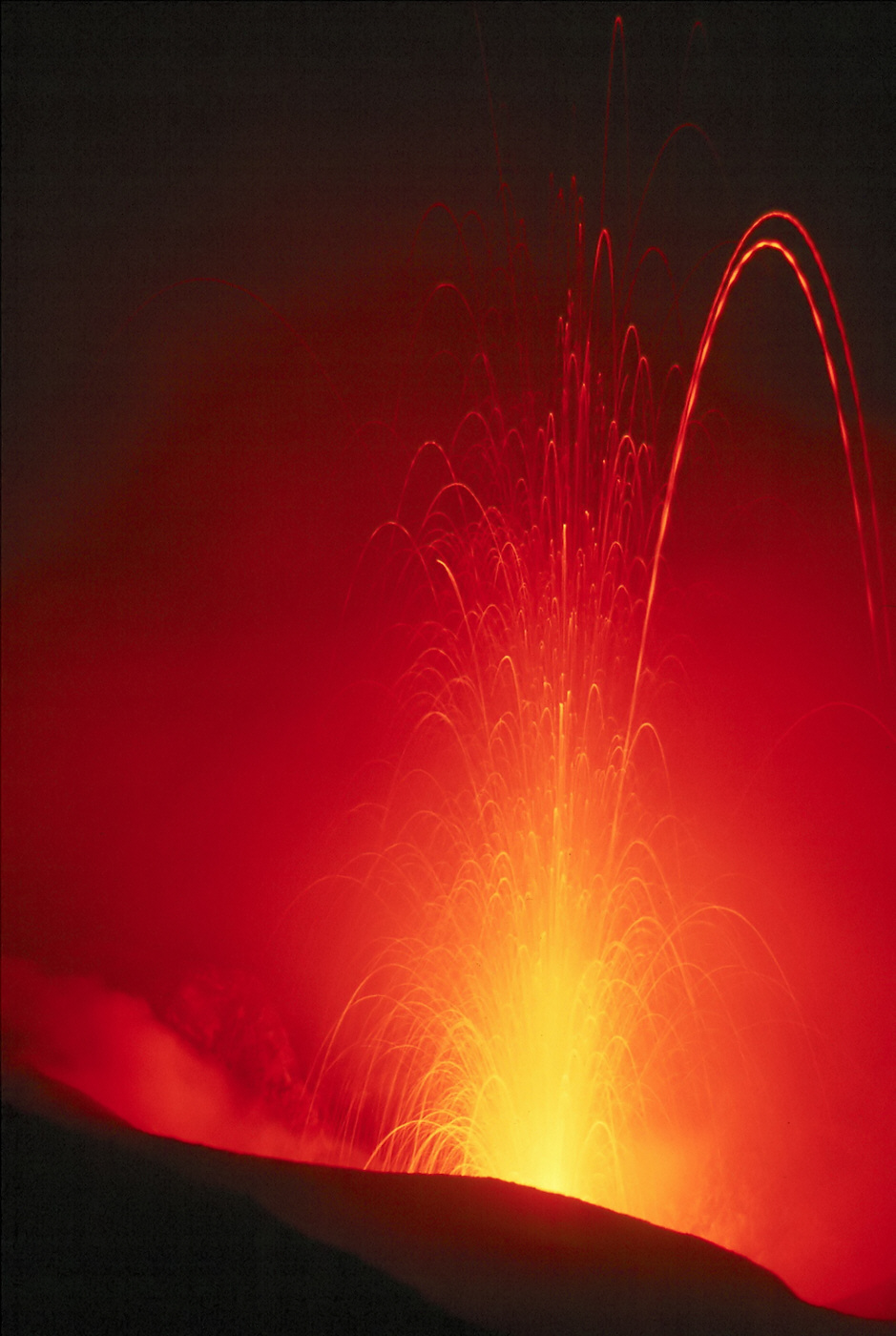
Strombolian eruptions are named after the volcano Stromboli in the Aeolian Islands of Italy, which has been in a state of nearly continuous mild explosive activity for at least two millennia. Strombolian eruptions are characterised by rhythmic, discrete explosions occurring at intervals of seconds to minutes, each of which ejects incandescent blobs of fluid lava (known as spatter or volcanic bombs) to heights of tens to a few hundred metres above the vent.2, 18 These explosions are caused by the bursting of large gas slugs that have risen through the magma column and expanded as they approach the surface. The tephra produced by Strombolian eruptions is coarse-grained and falls close to the vent, building steep-sided cinder cones that are among the most common volcanic landforms on Earth.2
Fissure eruptions occur when magma erupts not from a central vent but from an elongated crack or series of cracks in the crust, sometimes extending for tens of kilometres. These eruptions are typically basaltic and can produce enormous volumes of lava over periods of months to years. The 1783–1784 Laki eruption in Iceland, one of the most voluminous effusive eruptions in recorded history, issued approximately 14.7 cubic kilometres of basaltic lava from a fissure system 27 kilometres long over a period of eight months. The eruption released roughly 122 megatonnes of sulphur dioxide into the atmosphere, creating a persistent sulphuric acid aerosol haze over the Northern Hemisphere that contributed to crop failures and famine across Europe and is estimated to have caused tens of thousands of excess deaths.17 More recently, the 2014–2015 Holuhraun eruption in Iceland produced approximately 1.6 cubic kilometres of basaltic lava from a fissure over six months, making it the largest Icelandic eruption since Laki.3
Explosive eruption styles
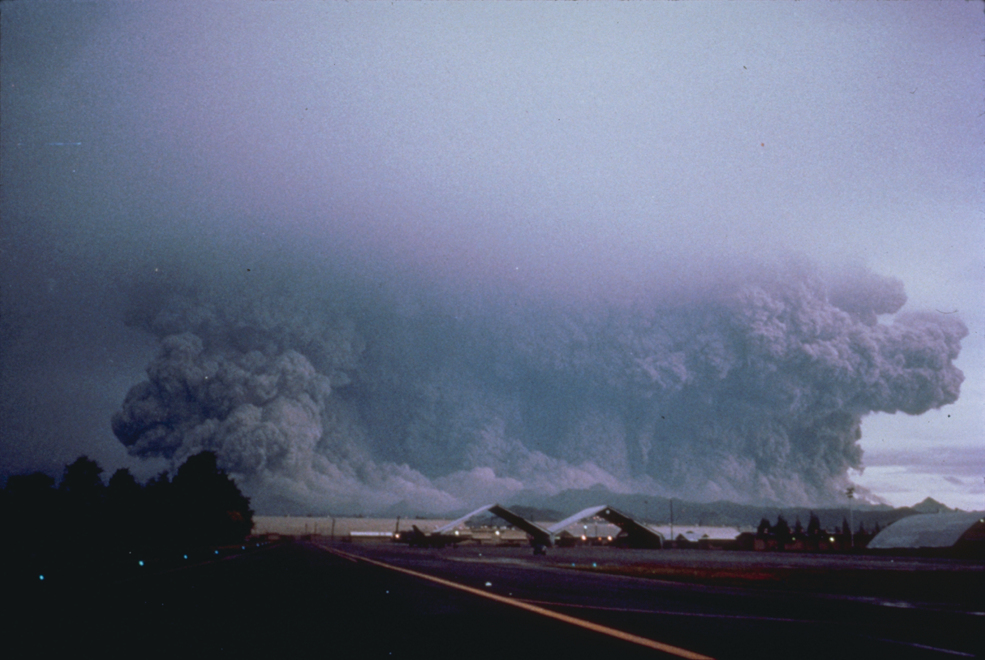

Vulcanian eruptions are short-lived, violent explosions that produce dense, dark, cauliflower-shaped ash clouds rising to altitudes of 5 to 15 kilometres. They are named after the island of Vulcano in the Aeolian Islands, where the eruption style was first described. Vulcanian explosions typically last only seconds to minutes and are caused by the sudden release of gas pressure that has accumulated beneath a solidified plug or dome of viscous lava capping the vent. The resulting blasts eject dense ballistic blocks, breadcrust bombs (which crack on their surfaces as the interior continues to expand after the exterior has solidified), and fine-grained ash at velocities that can exceed 200 metres per second.2, 3 Individual Vulcanian explosions are of moderate magnitude, but they frequently occur in series during prolonged eruptive episodes and can pose severe hazards to populations near the volcano.
Sub-Plinian eruptions represent a transitional category between Vulcanian and Plinian activity, producing sustained convective eruption columns with heights of approximately 10 to 20 kilometres and generating moderate volumes of tephra fall deposits and sometimes small pyroclastic flows. Sub-Plinian eruptions are commonly associated with intermediate to silicic magma compositions and can last from hours to days.5, 11
Plinian eruptions are the most powerful category of sustained explosive volcanism. They are named in honour of Pliny the Younger, whose two letters to the Roman historian Tacitus provide the earliest detailed eyewitness account of a major eruption — the catastrophic 79 CE eruption of Vesuvius that buried the cities of Pompeii and Herculaneum.20 Plinian eruptions are characterised by sustained convective eruption columns that can reach 20 to 45 kilometres or more into the stratosphere, maintained by the continuous high-velocity discharge of gas and pyroclastic fragments from the vent at mass eruption rates that can exceed 108 kilograms per second.5, 11 These eruption columns entrain and heat ambient air as they rise, becoming buoyant and spreading laterally at the level of neutral buoyancy to form an umbrella cloud that can deposit tephra over areas of thousands of square kilometres. Carey and Sparks demonstrated through quantitative modelling that the maximum grain size found at a given distance from the vent is a direct function of column height and wind speed, providing a method for reconstructing the column heights of ancient eruptions from their deposits.9
The 79 CE eruption of Vesuvius sustained a Plinian column for approximately 18 to 20 hours, depositing up to 2.8 metres of pumice over Pompeii before the column collapsed and generated devastating pyroclastic flows that killed the remaining inhabitants.20 The 1991 eruption of Mount Pinatubo in the Philippines, the largest eruption of the twentieth century, produced a Plinian column exceeding 35 kilometres in height and ejected approximately 5 cubic kilometres of dacitic magma. The eruption injected roughly 15 to 20 megatonnes of sulphur dioxide into the stratosphere, where it formed a global sulphuric acid aerosol layer that reduced average global surface temperatures by approximately 0.5 degrees Celsius over the following two years.13
Pyroclastic phenomena
Explosive eruptions generate a range of pyroclastic phenomena that together constitute the deadliest hazards associated with volcanism. Tephra is the general term for all fragmented material ejected into the atmosphere during an explosive eruption. It is classified by grain size: ash (less than 2 millimetres), lapilli (2 to 64 millimetres), and blocks or bombs (greater than 64 millimetres). Tephra fall from sustained eruption columns can blanket enormous areas, collapsing roofs, contaminating water supplies, disrupting agriculture, and grounding aircraft hundreds or thousands of kilometres from the volcano.9
Pyroclastic flows (also known historically as nuées ardentes, or “glowing clouds”) are the single most lethal volcanic hazard. They are fast-moving, ground-hugging currents of hot gas and volcanic debris that travel down the flanks of a volcano at velocities that can exceed 100 metres per second, with internal temperatures ranging from 200 to over 700 degrees Celsius.5, 21 Pyroclastic flows are generated primarily by the collapse of a Plinian eruption column. When the mass eruption rate becomes too great for the column to remain buoyant — or when external factors such as partial vent blockage reduce the proportion of entrained air — the dense mixture of gas and pyroclastic fragments can no longer be supported by buoyancy and collapses under gravity, pouring down the volcano's slopes as a pyroclastic flow. This mechanism, called column collapse, was elucidated through the fluid-dynamical modelling of Sparks and Woods, who demonstrated that the transition between sustained convective columns and collapsing fountains depends on the balance between the mass eruption rate, the vent velocity, the volatile content, and the efficiency of air entrainment.5, 11
Pyroclastic surges are a more dilute, turbulent variant of pyroclastic flow in which the gas phase dominates over the solid particle fraction. Surges are less dense than pyroclastic flows but can travel faster, override topographic barriers, and extend farther from the source. They were responsible for many of the fatalities in the 79 CE Vesuvius eruption, reaching Herculaneum and Pompeii as fast-moving, superheated gas clouds that killed inhabitants through thermal shock and asphyxiation.20
Lahars, though not pyroclastic phenomena in the strict sense, are among the most destructive secondary hazards of explosive eruptions. A lahar is a rapidly flowing mixture of volcanic debris and water that behaves like a slurry of wet concrete, moving down river valleys at high velocities and entraining boulders, trees, and structures in its path. Lahars are triggered when eruptions melt summit glaciers or snowpacks, when heavy rainfall mobilises freshly deposited tephra, or when crater lakes breach their rims.3
The physics of eruption columns
The eruption column is the defining feature of explosive volcanism, and its behaviour determines whether tephra is carried high into the atmosphere and dispersed over a wide area or collapses back to the ground as pyroclastic flows. Sparks and subsequent workers established that eruption columns can be divided into three vertically successive regions, each governed by different physical processes.5, 11
The gas-thrust region occupies the lowest portion of the column, immediately above the vent. Here the mixture of gas and pyroclastic fragments exits the vent at high velocity (typically 100 to 300 metres per second) and is denser than the surrounding atmosphere. The mixture is carried upward by its initial momentum, decelerating as it rises. In this region the column behaves as a momentum-driven jet rather than a buoyant plume.5
As the jet decelerates, it entrains and heats ambient air. If sufficient air is entrained and heated, the bulk density of the mixture drops below that of the surrounding atmosphere, and the column transitions into the convective region, where buoyancy drives continued ascent. The column rises convectively like a thermal, accelerating again as it gains buoyancy from the heated entrained air. Woods showed that the thermal energy stored in the hot pyroclastic particles is the primary source of heat for this convection: as particles transfer heat to the entrained air, the air expands and the column becomes buoyant.11
Eventually the column reaches the altitude where its bulk density equals that of the surrounding atmosphere, the level of neutral buoyancy. The column overshoots this level because of residual momentum, then settles back and spreads laterally as a gravity current, forming the characteristic umbrella or mushroom-shaped cloud visible in satellite imagery of major eruptions. The maximum height reached by the column is a strong function of the mass eruption rate, scaling approximately as the fourth root of the eruption rate in the theoretical models of Sparks and Woods.5, 11 Plinian columns with eruption rates of 107 to 109 kilograms per second reach heights of 20 to 45 kilometres, penetrating well into the stratosphere, where injected aerosols and fine ash can circulate globally and persist for months to years.9, 13
The Volcanic Explosivity Index
The need for a simple, standardised measure of eruption magnitude led Newhall and Self in 1982 to propose the Volcanic Explosivity Index (VEI), a semi-quantitative logarithmic scale that assigns eruptions an integer value from 0 to 8 based primarily on the volume of ejected tephra, together with eruption column height, qualitative descriptions, and eruption duration.1 Each step on the VEI corresponds to a roughly tenfold increase in the volume of eruptive products. VEI 0 denotes non-explosive eruptions producing less than 104 cubic metres of tephra; VEI 8, the maximum value observed in the geological record, denotes mega-colossal eruptions producing more than 1012 cubic metres (1,000 cubic kilometres) of tephra.1
The VEI has become the most widely used metric for comparing eruptions of different sizes and has been applied retrospectively to historical and prehistoric eruptions using the volumes and dispersal characteristics of their deposits. Eruptions of VEI 0 to 2 are extremely common, with hundreds to thousands occurring each year worldwide, while eruptions of VEI 5 and above are rare, and VEI 7 and 8 events occur only a few times per hundred thousand years.1, 19
The Volcanic Explosivity Index with historical examples1, 7, 19
| VEI | Classification | Tephra volume | Column height | Example eruption |
|---|---|---|---|---|
| 0 | Non-explosive | < 104 m³ | < 100 m | Kīlauea (ongoing) |
| 1 | Gentle | 104–106 m³ | 100–1,000 m | Stromboli (frequent) |
| 2 | Explosive | 106–107 m³ | 1–5 km | Galeras, 1993 |
| 3 | Severe | 107–108 m³ | 3–15 km | Nevado del Ruiz, 1985 |
| 4 | Cataclysmic | 108–109 m³ | 10–25 km | Eyjafjallajökull, 2010 |
| 5 | Paroxysmal | 109–1010 m³ | > 25 km | Mount St. Helens, 1980 |
| 6 | Colossal | 1010–1011 m³ | > 25 km | Pinatubo, 1991 |
| 7 | Super-colossal | 1011–1012 m³ | > 25 km | Tambora, 1815 |
| 8 | Mega-colossal | > 1012 m³ | > 25 km | Toba, ~74 ka |
The most recent eruption to reach VEI 7 was the 1815 eruption of Mount Tambora on the island of Sumbawa, Indonesia. Tambora ejected approximately 50 cubic kilometres of magma (dense-rock equivalent) and approximately 140 gigatonnes of eruptive material, making it the largest eruption in recorded history. The eruption injected an estimated 60 megatonnes of sulphur into the stratosphere — six times the amount released by Pinatubo in 1991 — producing a global sulphate aerosol veil that lowered average Northern Hemisphere temperatures by an estimated 0.5 to 1.0 degrees Celsius and caused the “Year Without a Summer” of 1816, with widespread crop failures, famine, and social disruption across Europe and North America. Over 71,000 people died during or in the immediate aftermath of the eruption on Sumbawa and the neighbouring island of Lombok.7
Supervolcanic eruptions
At the extreme end of the VEI scale are supervolcanic eruptions — VEI 8 events that eject more than 1,000 cubic kilometres of material and produce vast caldera depressions tens of kilometres in diameter where the roof of the emptied magma chamber collapses. These eruptions are qualitatively different from even the largest historically observed events: the volume of material ejected in a VEI 8 eruption exceeds that of Tambora (VEI 7) by at least an order of magnitude.4, 19
The best-studied supervolcanic systems include Yellowstone in the western United States, which has produced three major caldera-forming eruptions over the past 2.1 million years, the largest of which (the Huckleberry Ridge Tuff, approximately 2.1 million years ago) ejected roughly 2,500 cubic kilometres of material.15 The Toba caldera in Sumatra, Indonesia, was the site of the most recent VEI 8 eruption, the Youngest Toba Tuff, approximately 74,000 years ago. This eruption ejected a minimum of 2,800 cubic kilometres of magma, of which approximately 800 cubic kilometres was deposited as airfall ash distributed across the Indian Ocean and South Asia, with the remainder emplaced as massive ignimbrite sheets around the caldera.6, 16 The Taupo Volcanic Zone in New Zealand has also produced eruptions of extraordinary magnitude, including the approximately 26,500 years ago Oruanui eruption (approximately 530 cubic kilometres of magma) and the 232 CE Taupo eruption, notable for producing one of the most energetic pyroclastic flows in the geological record, which devastated an area of approximately 20,000 square kilometres in a matter of minutes.8, 21
Analysis of the global record of large eruptions by Mason, Pyle, and Oppenheimer identified 47 eruptions of magnitude 8 or greater (using a magnitude scale based on erupted mass) spanning from the Ordovician to the Pleistocene, with 42 of these occurring in the last 36 million years. Their analysis indicates that VEI 8 eruptions have occurred with an average recurrence interval of approximately 100,000 to 200,000 years, though the record is almost certainly incomplete for older events.19
Climate impacts of large eruptions
Large explosive eruptions affect global climate primarily through the injection of sulphur dioxide (SO2) into the stratosphere, where it reacts with water vapour and hydroxyl radicals to form sulphuric acid (H2SO4) aerosol droplets.


For VEI 7 eruptions such as Tambora in 1815, the climatic effects are substantially more severe. Oppenheimer's comprehensive review of the Tambora eruption documented not only the global cooling and agricultural failures of 1816 but also anomalous weather patterns including persistent fog, unusual red and orange sunsets caused by stratospheric aerosol scattering, and frost events in the northeastern United States during June and July.7 The Laki fissure eruption of 1783–1784, though primarily effusive (VEI 4), demonstrated that even eruptions of moderate explosivity can have severe climatic and environmental consequences if they release large quantities of sulphur: the approximately 122 megatonnes of SO2 emitted by Laki produced a persistent dry fog across Europe and contributed to one of the coldest winters in recorded European history.17
For supervolcanic eruptions of VEI 8, modelling studies suggest that the climatic effects would be catastrophic. Rampino and Self proposed in 1992 that the Toba eruption approximately 74,000 years ago could have produced a volcanic winter lasting several years, with hemispheric surface temperature decreases of 3 to 5 degrees Celsius and reductions in incident sunlight sufficient to severely limit photosynthesis.6 Self estimated that super-eruptions producing more than 450 cubic kilometres of magma could generate sulphate aerosol loadings sufficient to reduce global surface temperatures by 5 to 10 degrees Celsius, with effects persisting for a decade.4
The Toba catastrophe hypothesis, advanced by Ambrose in 1998, proposed that the volcanic winter following the Toba eruption may have reduced human populations to a severe genetic bottleneck, with perhaps as few as a few thousand breeding individuals surviving in isolated tropical refugia. Ambrose argued that this bottleneck could explain the low genetic diversity observed in modern human populations relative to other great ape species.14 Subsequent research has challenged aspects of this hypothesis: archaeological evidence from sites in southern Africa and India suggests that human populations in at least some regions persisted through the Toba eruption without catastrophic decline, and genetic analyses have not unambiguously detected a bottleneck precisely coincident with the eruption date. The question of whether super-eruptions can drive significant biological and demographic change remains an active area of interdisciplinary investigation.4, 14
Comparative eruption magnitudes
Placing volcanic eruptions on a common scale of ejected volume illustrates the enormous range of eruptive output across the spectrum of eruption styles. The following chart compares the dense-rock equivalent (DRE) volumes of several well-studied eruptions, spanning from relatively modest historical events to the largest known eruption in the Quaternary record.1, 7, 15, 16
Dense-rock equivalent volumes of notable eruptions (km³)1, 7, 15, 16
The logarithmic nature of the VEI is strikingly apparent in this comparison. The Toba eruption ejected roughly 560 times more material than the 1991 Pinatubo eruption, which was itself the twentieth century's largest volcanic event and caused measurable global cooling. The Huckleberry Ridge Tuff eruption at Yellowstone ejected approximately 2,500 times the volume of Mount St. Helens' 1980 eruption, which was considered a major natural disaster in its own right.1, 15, 16 These comparisons underscore both the rarity and the potential severity of supervolcanic events, and they highlight the fundamental challenge facing volcanologists: the eruptions that would have the greatest impact on human civilisation are precisely those for which the historical record provides the least observational data, forcing reliance on the geological record and numerical modelling to assess their frequency and consequences.4, 19
References
The volcanic explosivity index (VEI): an estimate of explosive magnitude for historical volcanism
Climatic, environmental and human consequences of the largest known historic eruption: Tambora volcano (Indonesia) 1815
Quantitative models of the fallout and dispersal of tephra from volcanic eruption columns
Late Pleistocene human population bottlenecks, volcanic winter, and differentiation of modern humans
The Quaternary and Pliocene Yellowstone Plateau volcanic field of Wyoming, Idaho, and Montana
Atmospheric and environmental effects of the 1783–1784 Laki eruption: a review and reassessment
The eruption of Vesuvius in A.D. 79: reconstruction from historical and volcanological evidence