Overview
- Archaeopteryx lithographica, discovered in 1861 from the Late Jurassic Solnhofen limestone of Bavaria, was the first fossil to demonstrate a morphological intermediate between non-avian dinosaurs and modern birds, combining a toothed jaw, clawed fingers, and a bony tail with fully developed asymmetric flight feathers.
- Thirteen known specimens and a single isolated feather have been recovered over 160 years, each preserving a different combination of skeletal and integumentary features that have successively refined scientific understanding of basal avian anatomy and the origin of flight.
- Phylogenetic analyses consistently place Archaeopteryx near the base of Avialae, closely related to deinonychosaurian theropods such as dromaeosaurids and troodontids, confirming that it occupies a pivotal position in the evolutionary transition from non-avian maniraptoran dinosaurs to crown-group birds.
Archaeopteryx lithographica is a genus of feathered theropod dinosaur from the Late Jurassic period, approximately 150 million years ago. First described in 1861 from the fine-grained Solnhofen limestone of Bavaria, Germany, it was immediately recognized as one of the most significant fossils ever found: a creature that combined the skeletal features of a small predatory dinosaur — teeth, clawed fingers, and a long bony tail — with the asymmetric flight feathers of a modern bird.1 For over a century, Archaeopteryx stood as the oldest and most compelling evidence for the evolutionary link between non-avian dinosaurs and birds, and it remains central to scientific understanding of the dinosaur-to-bird transition. Thirteen skeletal specimens and one isolated feather have been recovered, all from the Solnhofen deposits, making it one of the best-represented Mesozoic avialans despite the rarity of each individual find.6, 7
Discovery and historical significance
The first evidence of Archaeopteryx came to light in 1860 as a single isolated feather impression found in a lithographic limestone quarry near Solnhofen in the Altmuhl Valley of Bavaria. The feather was described in 1861 by Hermann von Meyer, who coined the name Archaeopteryx lithographica — meaning "ancient wing from lithographic stone." Later that same year, a nearly complete skeleton with clear feather impressions was discovered in a quarry near Langenaltheim and sold to the Natural History Museum in London, where it was described by Richard Owen in 1863.1 This specimen, now known as the London specimen, electrified the scientific world. Charles Darwin's On the Origin of Species had been published only two years earlier, and critics had demanded transitional forms as evidence for evolution by natural selection. Archaeopteryx, with its striking mosaic of reptilian and avian characters, appeared to be precisely such a form.
.jpg)
.jpg)
Owen's description emphasized the avian affinities of the skeleton, including the furcula (wishbone) and the well-developed flight feathers, but also noted unambiguously reptilian features such as the toothed jaws and the long tail composed of many free vertebrae rather than the fused pygostyle of modern birds.1 Thomas Henry Huxley, Darwin's most vocal advocate, seized upon Archaeopteryx as evidence for the dinosaurian ancestry of birds, drawing detailed comparisons between its skeleton and those of small theropod dinosaurs. This hypothesis fell out of favour for much of the twentieth century, but was revived decisively in the 1960s and 1970s by John Ostrom, whose comparative study of Deinonychus and Archaeopteryx established the detailed skeletal similarities between dromaeosaurid theropods and early birds.3, 4
Geological setting
All known specimens of Archaeopteryx come from the Solnhofen limestone of Bavaria, a unit of exceptionally fine-grained lithographic limestone deposited during the Late Jurassic (Tithonian stage, approximately 150.8 to 148.5 million years ago). During this period, the Solnhofen region lay at a tropical latitude of roughly 30 degrees north, situated on the margins of the shallow Tethys Sea. The depositional environment consisted of a series of lagoons separated from the open ocean by coral-sponge reefs, with restricted water circulation and hypersaline, anoxic bottom conditions.21
These lagoons acted as natural death traps: organisms that fell or were washed into the stagnant water sank to the bottom, where the absence of oxygen inhibited decomposition and scavenging, preserving even the most delicate structures such as feathers, wing membranes of pterosaurs, and soft tissues of jellyfish. The Solnhofen limestone is consequently one of the world's most celebrated Konservat-Lagerstatten — deposits of extraordinary preservational quality — and it is this exceptional taphonomic environment that allowed the preservation of Archaeopteryx's feather impressions in such exquisite detail.21
Known specimens
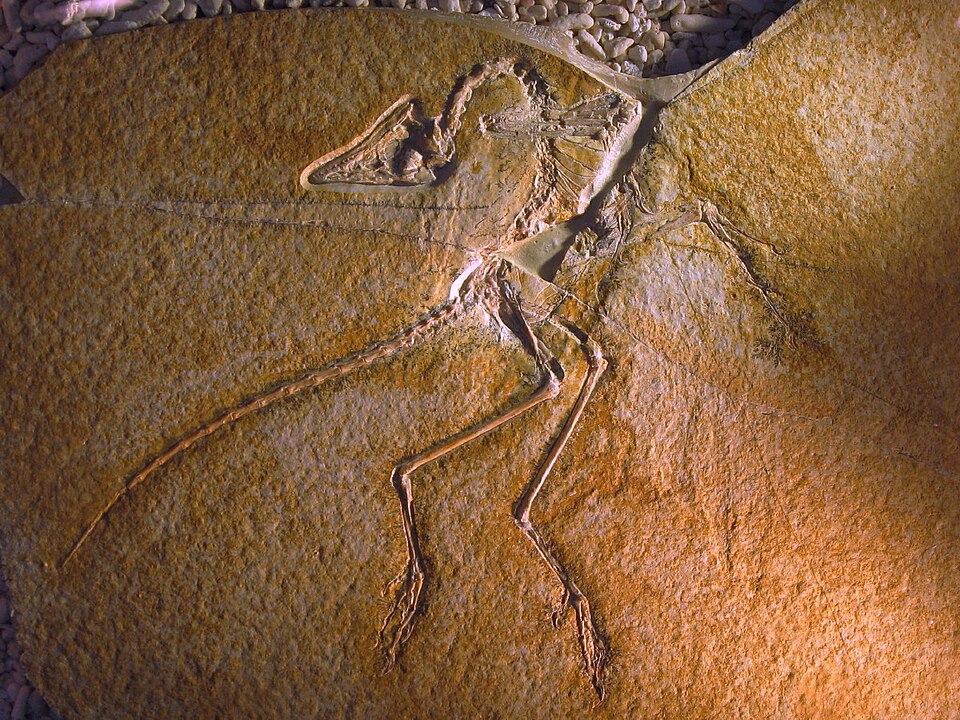
Thirteen skeletal specimens of Archaeopteryx are currently recognized, along with the isolated feather described by von Meyer. The specimens vary considerably in completeness, preservation quality, and the anatomical information they have contributed. The London specimen, acquired by the Natural History Museum in 1862, lacks a complete skull but preserves extensive feather impressions on the wings and tail and provided the basis for Owen's original description.1 The Berlin specimen, discovered in 1876 or 1877 near Blumenberg and acquired by the Humboldt Museum fur Naturkunde, is the most complete and arguably the most famous, preserving a nearly intact skeleton with a well-preserved skull, spread wings, and a full fan of tail feathers. It remains the most reproduced and iconic image of Archaeopteryx.
Subsequent discoveries have added important anatomical details. The Solnhofen specimen, described by Wellnhofer in 1988, revealed details of the pelvic girdle and hindlimb that had been obscured in earlier finds.5 The Thermopolis specimen, described by Mayr and colleagues in 2007, is notable for its exceptional skull preservation, which confirmed the presence of a hyperextensible second toe similar to that of dromaeosaurid dinosaurs, strengthening the phylogenetic link between Archaeopteryx and the Deinonychosauria.6 The eleventh specimen, described by Foth, Tischlinger, and Rauhut in 2014, provided the first evidence that pennaceous feathers extended onto the body and legs of Archaeopteryx, not just the wings and tail, indicating a more complete feathered covering than previously suspected.7
Selected specimens of Archaeopteryx1, 5, 6, 7
| Specimen | Year found | Repository | Key contribution |
|---|---|---|---|
| Isolated feather | 1860 | Humboldt Museum, Berlin | First evidence; basis of the name |
| London specimen | 1861 | Natural History Museum, London | First skeleton; Owen's description |
| Berlin specimen | ~1876 | Humboldt Museum, Berlin | Most complete; preserved skull |
| Maxberg specimen | 1956 | Currently missing | Torso and partial limbs |
| Solnhofen specimen | 1960s | Burgermeister-Muller-Museum | Pelvic and hindlimb details |
| Thermopolis specimen | 2005 | Wyoming Dinosaur Center | Best skull; hyperextensible second toe |
| Eleventh specimen | 2011 | Palaontologisches Museum, Munich | Body feathering; pennaceous leg feathers |
Anatomy and mosaic of characters
Archaeopteryx was a small animal, roughly the size of a common raven, with an estimated body mass of 0.8 to 1.0 kilograms and a wingspan of approximately 0.5 metres.20 Its anatomy is a striking mosaic of features found separately in non-avian theropod dinosaurs and in modern birds, which is precisely what makes it so significant for evolutionary biology. The skull bore small, conical, unserrated teeth set in sockets — a condition shared with non-avian theropods but absent in all living birds. The premaxillary and maxillary bones were not fused into a keratinous beak as in modern birds but instead bore teeth along their entire length.17 CT scanning and detailed preparation of the skull in the Thermopolis and Berlin specimens have revealed that the braincase was expanded relative to non-avian theropods, intermediate between the condition in dromaeosaurids and that of modern birds, suggesting that neurological reorganization accompanied the early stages of avian evolution.6, 17
The forelimb of Archaeopteryx was proportionally long and bore three separate, clawed fingers — a reptilian feature — yet the hand and arm supported large, asymmetric flight feathers arranged in a configuration closely resembling that of modern flying birds. The asymmetry of the primary feathers, in which the leading vane is narrower than the trailing vane, is a hallmark of aerodynamically functional flight feathers and indicates that the plumage of Archaeopteryx was capable of generating lift.13 The tail, composed of approximately twenty free caudal vertebrae rather than a fused pygostyle, bore paired rows of long retrices (tail feathers) arranged along its length, giving the animal a distinctive elongated tail profile quite unlike that of any living bird.1, 7
The pectoral girdle included a furcula, a structure formed by the fusion of the two clavicles and present in both modern birds and many non-avian theropods. However, Archaeopteryx lacked the large, keeled sternum that anchors the powerful flight muscles of modern birds, and its coracoid was shorter and less strut-like than in later avialans, suggesting that its capacity for powered flight was limited compared to living birds.5, 12 The pelvic girdle was theropod-like, with a pubis oriented downward and slightly forward in some specimens, though the exact orientation has been debated depending on the specimen examined. The hindlimbs were proportionally robust, with a hyperextensible second toe pedal digit revealed in the Thermopolis specimen, a feature characteristic of deinonychosaurian theropods and suggesting predatory or climbing capabilities.6
Feathers and plumage
The preservation of feathers in Archaeopteryx has been central to its scientific importance from the very beginning. The primary and secondary flight feathers of the wing are asymmetric, with the rachis (central shaft) positioned toward the leading edge and the barbs interlocking through a system of barbules and hooklets essentially identical to those of modern bird feathers. This architecture confirms that Archaeopteryx possessed aerodynamically competent flight surfaces.13 The tail feathers were long, symmetric, and paired along the caudal vertebrae, a configuration distinct from the fan-shaped rectricial array of modern birds and more reminiscent of the ribbon-like tail feathers of some non-avian paravian dinosaurs.
.jpg)
Analysis of the eleventh specimen by Foth and colleagues in 2014 demonstrated that pennaceous feathers also covered the body, hindlimbs, and possibly the feet, indicating that Archaeopteryx was more extensively feathered than earlier reconstructions had suggested. The hindlimb feathers, though shorter than the wing feathers, were pennaceous and vaned, raising the possibility that the legs contributed aerodynamic surface area, as has been proposed for the four-winged dromaeosaurid Microraptor.7, 11
Synchrotron X-ray fluorescence imaging of the isolated feather by Bergmann and colleagues in 2010 detected chemical traces of the original organic pigment melanin, preserved as residual copper and other metals associated with melanosomes. This analysis indicated that the feather was dark in colour, probably black, though the extent to which colour can be inferred from trace-metal distributions in 150-million-year-old fossils remains an active area of methodological development.18 Comparable techniques applied to other feathered dinosaurs, such as the dromaeosaurid Microraptor, have revealed iridescent black plumage, demonstrating that complex structural coloration had evolved among paravian dinosaurs well before the origin of crown-group birds.14
Phylogenetic position
The phylogenetic placement of Archaeopteryx has been debated since its discovery, but modern cladistic analyses consistently recover it at or near the base of Avialae, the clade containing modern birds and all taxa more closely related to them than to deinonychosaurians. In the landmark phylogenetic analysis of Jacques Gauthier in 1986, Archaeopteryx was placed as the most basal avialan, a sister taxon to all other birds, situated within the broader clade Maniraptora alongside dromaeosaurids and troodontids.2 This placement has been supported by the overwhelming majority of subsequent analyses, reinforced by the discovery of dromaeosaurid and troodontid theropods from China that share numerous derived characters with Archaeopteryx, including pennaceous feathers, elongated forelimbs, and a semilunate carpal bone.9
A brief challenge to this consensus arose in 2011, when Xu and colleagues described Xiaotingia zhengi, a small feathered theropod from the Late Jurassic of China, and conducted a phylogenetic analysis that recovered Archaeopteryx within Deinonychosauria rather than Avialae, suggesting it was more closely related to dromaeosaurids than to modern birds.8 However, subsequent analyses incorporating additional taxa and character data have generally restored Archaeopteryx to its traditional position at the base of Avialae, though the phylogenetic boundary between basal avialans and deinonychosaurians is recognized as extremely narrow, reflecting the mosaic distribution of characters among Late Jurassic paravian theropods.22 The discovery of Aurornis xui from the Middle to Late Jurassic of China by Godefroit and colleagues in 2013 provided further resolution, recovering Aurornis as the most basal avialan and Archaeopteryx as only slightly more derived, while confirming the exclusion of deinonychosaurians from Avialae.22
The difficulty of resolving relationships among basal paravians reflects the rapid evolutionary radiation of feathered theropods during the Middle and Late Jurassic, a period during which body sizes were miniaturizing rapidly and anatomical innovations were accumulating at elevated rates along the lineage leading to birds. Quantitative analyses of evolutionary rates by Lee and colleagues in 2014 demonstrated that the direct avian lineage experienced sustained miniaturization and accelerated skeletal evolution over a period spanning at least 50 million years, culminating in the small-bodied, flight-capable bauplan represented by Archaeopteryx and its close relatives.16
Flight capability
Whether Archaeopteryx was capable of powered, flapping flight comparable to that of modern birds, or was limited to gliding or brief bursts of aerial locomotion, has been debated for over a century. Ostrom argued in 1974 that Archaeopteryx was at best a weak flier, noting the absence of a keeled sternum and the relatively gracile pectoral musculature implied by the skeleton, and proposed that feathers originally evolved for insulation or prey capture and were only secondarily co-opted for flight.15
Biomechanical analyses have yielded varying conclusions. Speakman and Thomson in 1993 estimated that the wing loading (body mass per unit wing area) of Archaeopteryx was within the range of modern birds capable of powered flight, and argued that the asymmetric primary feathers were sufficient to generate the thrust required for flapping locomotion.19 However, Nudds and Dyke in 2010 challenged this interpretation by examining the strength of the primary feather rachises, concluding that the feather shafts of Archaeopteryx were too narrow to withstand the bending forces associated with sustained flapping flight at the body masses estimated from the fossils, and suggesting that Archaeopteryx was limited to gliding or very brief powered strokes.12
The absence of a keeled sternum is particularly significant. In modern birds, the keel provides the attachment surface for the pectoralis and supracoracoideus muscles, which power the downstroke and upstroke of the wing, respectively. Without a keel, the flight muscles of Archaeopteryx would have been substantially smaller and weaker than those of any living volant bird. The coracoid, which acts as a strut bracing the shoulder joint against the sternum in modern birds, was also less developed in Archaeopteryx.5, 12 Taken together, the evidence suggests that Archaeopteryx possessed aerodynamically functional feathers and was capable of some form of aerial locomotion, but that it was not a strong or sustained flier by modern avian standards. It likely occupied an intermediate locomotor grade, capable of short powered flights, gliding descents from elevated perches, or wing-assisted incline running, rather than the continuous flapping flight of most extant birds.
Growth and physiology
Histological analysis of bone microstructure provides direct evidence for the growth rate and metabolic physiology of Archaeopteryx. Erickson and colleagues in 2009 sectioned bone samples from several specimens and found that the cortical bone displayed lines of arrested growth (LAGs) — annual growth marks indicating seasonal pauses in bone deposition — and relatively slowly deposited parallel-fibered and lamellar bone tissue, rather than the rapidly deposited woven or fibrolamellar bone characteristic of modern birds and many non-avian dinosaurs.20
Based on growth-line counts, the known specimens of Archaeopteryx appear to represent individuals that died at various juvenile and subadult stages, none having reached full skeletal maturity. Growth-curve modeling suggested that Archaeopteryx required approximately 970 days (roughly 2.5 years) to reach adult size, a growth rate far slower than that of modern birds of comparable body mass, which typically reach adult size within weeks to months, and instead comparable to the growth rates of non-avian paravian dinosaurs.20 This slow growth rate implies that the high sustained metabolic rates and rapid development characteristic of modern birds had not yet evolved in the earliest avialans, and that the physiological transition to modern avian endothermy was a gradual process that postdated the acquisition of feathers and flight.
Broader evolutionary significance
Archaeopteryx holds a singular place in the history of evolutionary biology. Its discovery provided the first tangible fossil evidence for a major evolutionary transition between two classes of vertebrates, and it was instrumental in establishing the scientific credibility of Darwin's theory of descent with modification in the years immediately following the publication of On the Origin of Species.1, 4 For over a century, it was the oldest known avialan, and its unique combination of dinosaurian and avian characters made it the textbook example of a transitional fossil.
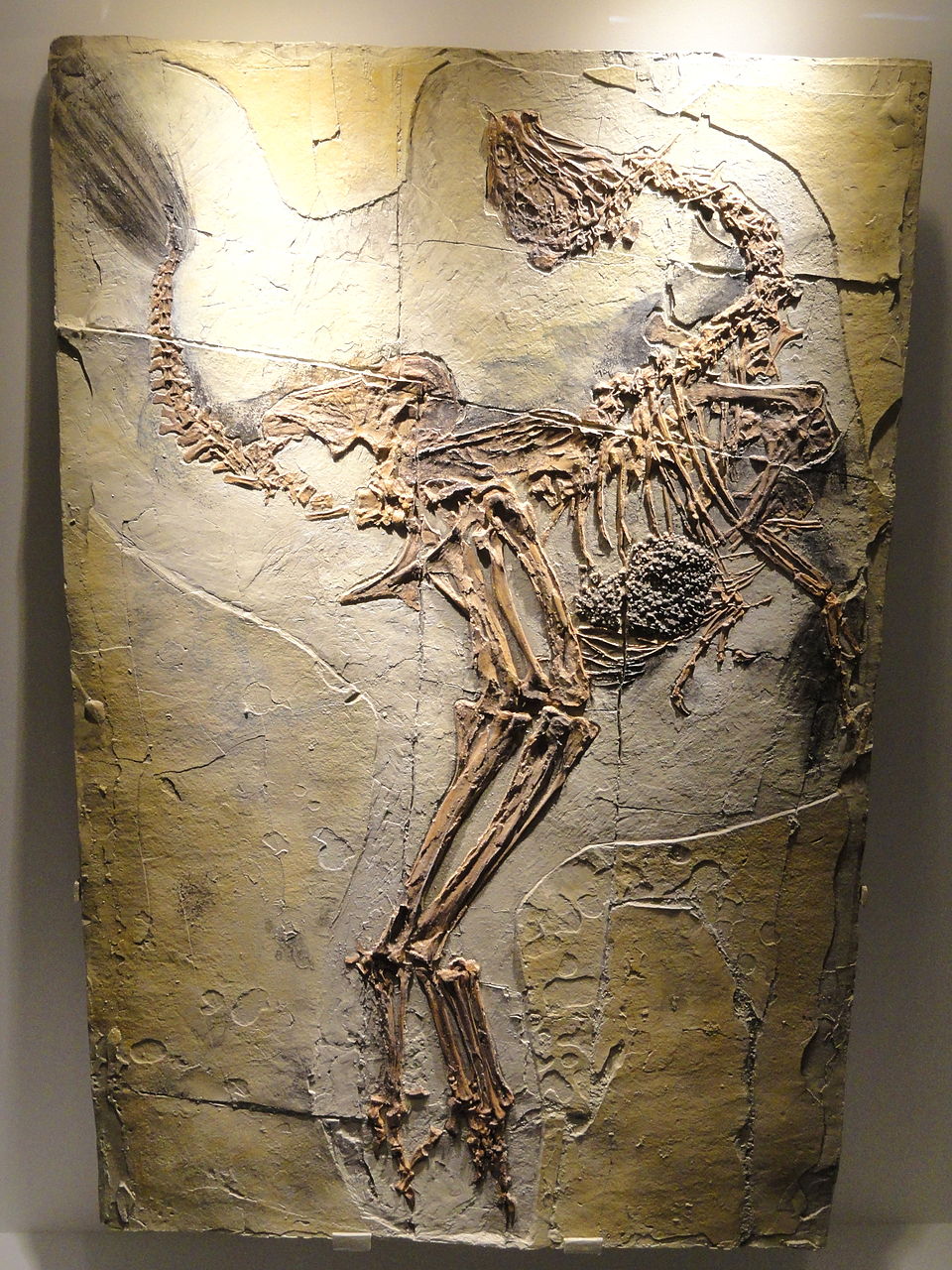

The subsequent discovery of hundreds of feathered non-avian dinosaurs from the Cretaceous and Jurassic of China, beginning in the mid-1990s, has enriched but not diminished the significance of Archaeopteryx. These discoveries have confirmed the theropod ancestry of birds with overwhelming evidence, filled in many of the morphological gaps between Archaeopteryx and its non-avian relatives, and revealed that feathers, once thought to be uniquely avian, were widespread among coelurosaurian dinosaurs and evolved long before the origin of flight.9, 10, 16 Yet Archaeopteryx remains a critical calibration point for understanding when and how the key avian features — flight feathers, a fused furcula, an enlarged brain, and aerial locomotion — were assembled in evolutionary history. It demonstrates that these features did not appear simultaneously as a coordinated package but were acquired piecemeal over tens of millions of years of theropod evolution, a pattern of mosaic evolution now recognized as characteristic of major evolutionary transitions throughout the history of life.2, 16
References
On the Archaeopteryx of von Meyer, with a description of the fossil remains of a long-tailed species, from the lithographic stone of Solenhofen
Osteology of Deinonychus antirrhopus, an unusual theropod from the Lower Cretaceous of Montana
New specimen of Archaeopteryx provides insights into the evolution of pennaceous feathers
A pre-Archaeopteryx troodontid theropod from China with long feathers on the metatarsus
Aerodynamic performance of the feathered dinosaur Microraptor and the evolution of feathered flight
Sustained miniaturization and anatomical innovation in the dinosaurian ancestors of birds
Synchrotron imaging of Archaeopteryx feathers reveals complex chemical and structural patterns
Bone microstructure indicates that Archaeopteryx resembled a slow-growing dinosaur rather than a fast-growing bird
A Jurassic avialan dinosaur from China resolves the early phylogenetic history of birds