Overview
- Ceratopsia was a diverse clade of marginocephalian dinosaurs that originated in the Late Jurassic of Asia around 160 million years ago, with the earliest known member being Yinlong downsi from the Oxfordian-age Shishugou Formation of northwestern China, and ultimately produced more than 80 described species spanning roughly 95 million years of evolution.
- Ceratopsian skulls underwent dramatic evolutionary elaboration, from the small, parrot-beaked heads of basal forms like Psittacosaurus to the massive horned and frilled skulls of derived ceratopsids such as Triceratops, which at over two meters in length represent the largest skulls of any known land animal, with cranial ornamentation evolving under sexual selection at rates far exceeding those of non-ornamental traits.
- The two subfamilies of Ceratopsidae — Centrosaurinae and Chasmosaurinae — dominated Late Cretaceous herbivore communities across western North America (Laramidia), exhibiting extreme regional endemism and rapid species turnover, with as many as four or five sympatric ceratopsid species coexisting in single formations during the Campanian stage before the entire clade perished in the end-Cretaceous mass extinction 66 million years ago.
Ceratopsia, the "horned faces," constitutes one of the most successful and morphologically distinctive radiations of herbivorous dinosaurs in Earth's history.3, 19 Ranging from small, bipedal, parrot-beaked forms scarcely larger than a dog to multi-tonne quadrupeds bearing the largest skulls of any land animal, ceratopsians occupied herbivore niches across Asia and North America from the Late Jurassic through the terminal Cretaceous, a span of approximately 95 million years.1, 12 As members of Marginocephalia—the ornithischian clade united by a bony shelf at the back of the skull—ceratopsians are distinguished by the rostral bone, a unique unpaired element at the tip of the upper jaw that formed the upper half of a keratinous beak, together with an increasingly elaborated array of horns and frills that reached extraordinary proportions in the derived ceratopsids of the Late Cretaceous.3, 12 The group includes some of the most iconic dinosaurs ever discovered, among them Triceratops, Styracosaurus, and Protoceratops, and their abundant, well-preserved fossil record has made them central to understanding dinosaur ecology, biogeography, and the evolution of elaborate display structures.10, 11
Origins and early evolution
The evolutionary origin of Ceratopsia lies in the Late Jurassic of eastern Asia. The earliest unambiguous ceratopsian is Yinlong downsi, a small bipedal herbivore from the Oxfordian-age Shishugou Formation of the Junggar Basin in northwestern China, dating to approximately 160–155 million years ago.1, 5 Yinlong possesses a mosaic of ancestral and derived features: its skull bears a small, incipient rostral bone and a modestly expanded parietosquamosal shelf foreshadowing the elaborate frills of later forms, while its postcranial skeleton retains the gracile, bipedal proportions of basal ornithischians.5, 6 Detailed cranial and postcranial analyses have confirmed Yinlong as the sister taxon to all other ceratopsians, establishing the Late Jurassic of Asia as the temporal and geographic cradle of the clade.5, 6

Several other basal ceratopsians from the Late Jurassic and earliest Cretaceous of China document the initial diversification of the group. Chaoyangsaurus and Xuanhuaceratops, both from Upper Jurassic deposits, and Hualianceratops, a contemporary of Yinlong from the same formation, demonstrate that at least four to five ceratopsian lineages coexisted by the end of the Jurassic.1, 16 Computed tomographic analysis of the dental systems of these Jurassic ceratopsians has revealed that even the earliest members of the clade already exhibited relatively rapid tooth replacement rates compared to other ornithischians, suggesting that dietary specialization was an early driver of ceratopsian evolution.16
Classification and major groups
Ceratopsia is divided into a series of progressively more derived clades reflecting the stepwise acquisition of the group's hallmark features. The most basal forms—Yinlong, Chaoyangsaurus, and their relatives—are small, bipedal animals with only rudimentary cranial ornamentation.1, 5 Psittacosauridae, containing the genus Psittacosaurus and its approximately 13 recognized species, represents the most species-rich basal ceratopsian radiation, dominating Early Cretaceous herbivore faunas across China, Mongolia, Russia, and Thailand from roughly 125 to 100 million years ago.2, 7 Psittacosaurids were small to medium-sized bipedal or facultatively quadrupedal dinosaurs characterized by a deep, laterally compressed skull with a pronounced parrot-like beak, a feature that gives the group its name.2, 8
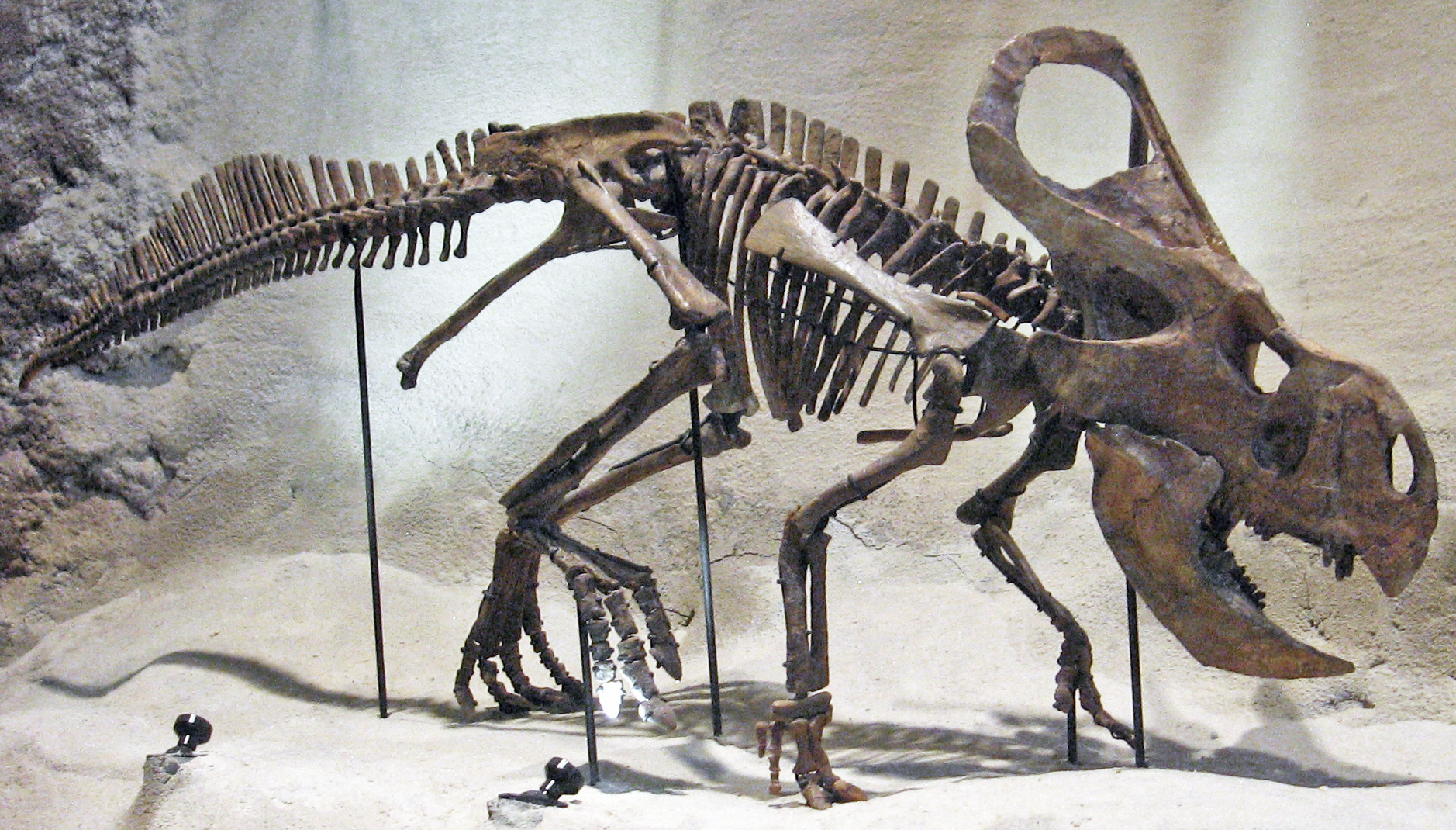
Neoceratopsia encompasses all ceratopsians more derived than Psittacosaurus, united by features including an enlarged skull relative to body size, a more developed frill, and increasingly complex dentitions.3, 9 Basal neoceratopsians include an array of small to medium-sized forms such as Protoceratops from the Late Cretaceous of Mongolia—one of the most abundantly preserved dinosaurs, with over 100 known specimens representing all growth stages—and the leptoceratopsids, a primarily North American family of small, gracile ceratopsians that persisted alongside their giant ceratopsid relatives until the end of the Cretaceous.9, 14
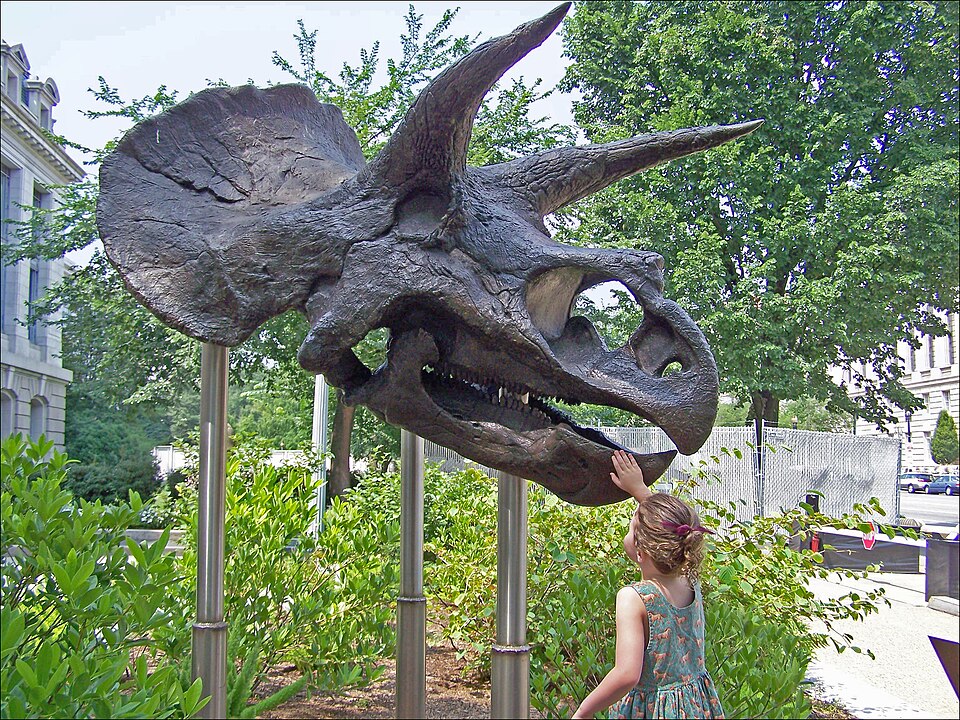
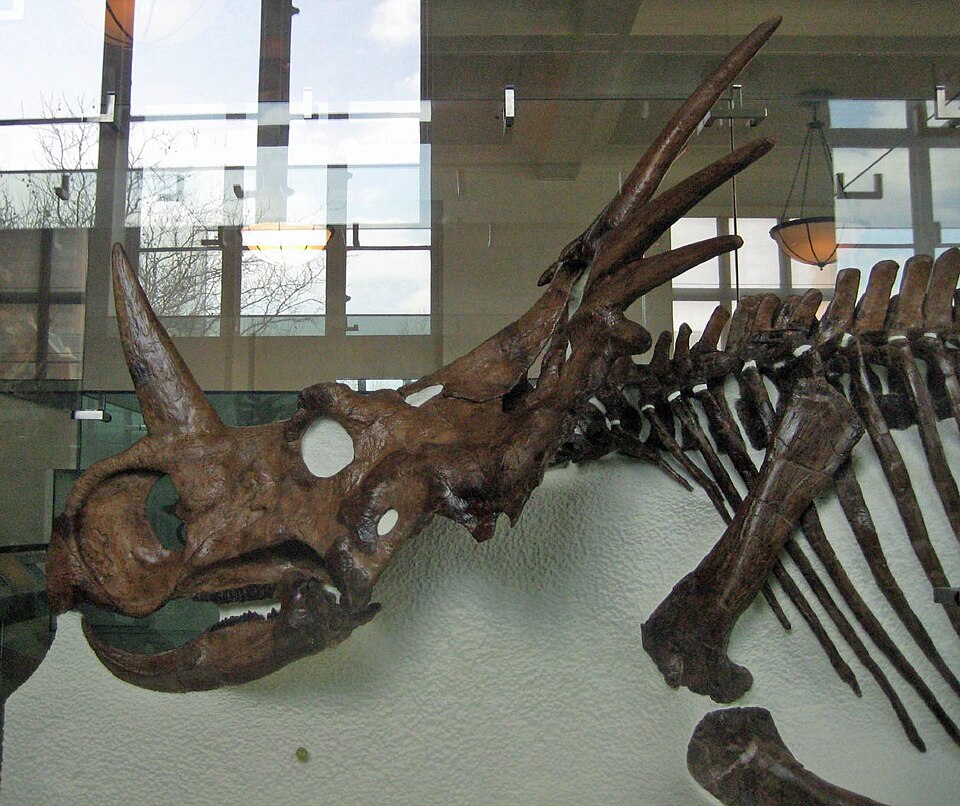
Ceratopsidae, the crown of ceratopsian evolution, comprises two subfamilies: Centrosaurinae and Chasmosaurinae.17, 19 Centrosaurines, including genera such as Centrosaurus, Styracosaurus, and the recently described Lokiceratops, are generally characterized by elaborate nasal horns, reduced or absent brow horns, and ornate frill margins adorned with hooks, spikes, or procurving hornlets.17, 20 Chasmosaurines, including Triceratops, Torosaurus, and Chasmosaurus, typically possess long brow horns, a shorter nasal horn, and relatively large, elongated frills that often bear fenestrae (openings) to reduce weight.10, 12 Both subfamilies were obligate quadrupeds that attained body masses of several tonnes, with Triceratops reaching estimated masses of 6–12 tonnes and skull lengths exceeding two meters.12, 19
Major ceratopsian groups and their temporal ranges1, 3, 19
| Group | Representative genera | Temporal range (Ma) | Key features |
|---|---|---|---|
| Basal ceratopsians | Yinlong, Chaoyangsaurus | ~160–125 | Small, bipedal, incipient rostral bone |
| Psittacosauridae | Psittacosaurus | ~125–100 | Parrot-like beak, bipedal/facultatively quadrupedal |
| Basal Neoceratopsia | Protoceratops, Leptoceratops | ~100–66 | Enlarged frill, quadrupedal trend, dental batteries |
| Centrosaurinae | Centrosaurus, Styracosaurus | ~83–66 | Large nasal horn, ornate frill margins |
| Chasmosaurinae | Triceratops, Chasmosaurus | ~83–66 | Long brow horns, large fenestrated frills |
The ceratopsian skull: horns and frills
No feature defines ceratopsians more than the progressive elaboration of their skulls. The ceratopsian head underwent one of the most dramatic evolutionary transformations in vertebrate history, expanding from the compact, beaked skulls of basal forms to the massive, ornamented cranial structures of derived ceratopsids.12 This transformation involved the coordinated evolution of three major structural complexes: the rostral bone and beak, the supraorbital and nasal horns, and the parietosquamosal frill.12
The rostral bone, a synapomorphy of Ceratopsia, is a median, unpaired element at the tip of the premaxilla that supported the upper portion of a keratinous beak.3, 12 In basal taxa such as Yinlong, the rostral is small and subtriangular, but in psittacosaurids and neoceratopsians it becomes progressively deeper and more recurved, producing the characteristically deep, narrow snout adapted for selective cropping of vegetation.2, 5 The horns of ceratopsians evolved in a stepwise fashion. Nasal horns appear first in the fossil record, with small nasal protuberances present in some psittacosaurids, while true supraorbital (brow) horns are a derived feature that first appears in taxa such as Zuniceratops, a Turonian-age ceratopsoid from New Mexico that represents the oldest known ceratopsian with paired brow horns.19, 21 In derived ceratopsids, both horn types reached imposing dimensions, with the brow horns of Triceratops measuring up to one meter in length.10, 12
The parietosquamosal frill, formed by posterior extensions of the parietal and squamosal bones, represents perhaps the most visually striking feature of ceratopsian anatomy. In basal ceratopsians, the frill is a modest bony shelf at the back of the skull, but in ceratopsids it expanded into an enormous shield that could extend well over a meter behind the skull roof.11, 12 The frill margins of centrosaurines are frequently adorned with hooks, spikes, and other epiparietals and episquamosals that vary dramatically among species and have been critical for taxonomy.17, 20 The recently described Lokiceratops rangiformis from the Campanian Judith River Formation of Montana bears an asymmetric arrangement of elongate, blade-like epiparietals unlike any other known ceratopsid, underscoring the remarkable morphological experimentation within this lineage.20
Function of cranial ornamentation
The function of ceratopsian horns and frills has been debated since the earliest discoveries of the group. Three primary hypotheses have been proposed: defense against predators, intraspecific combat, and socio-sexual signaling, including species recognition and mate selection.10, 11, 12

Evidence for intraspecific combat comes primarily from pathological studies of ceratopsid skulls. A landmark analysis of Triceratops and Centrosaurus specimens by Farke and colleagues found that Triceratops squamosal bones exhibited roughly ten times the frequency of healed lesions compared to Centrosaurus, consistent with the hypothesis that chasmosaurines with long brow horns engaged in horn-locking combat in which the squamosal—the lower frill element directly behind the orbit—would bear the brunt of impact.10 Approximately 14% of Triceratops specimens showed some form of cranial pathology, compared to only 3% of Centrosaurus specimens, a pattern consistent with different combat styles in the two subfamilies: brow-horn jousting in chasmosaurines versus flank-butting or single-horn thrusting in centrosaurines.10
The species recognition hypothesis—that horns and frills evolved primarily to allow individuals to distinguish conspecifics from members of closely related species—was tested quantitatively by Knapp and colleagues in 2018 using morphometric data from 46 ceratopsian species.11 The study found no statistical support for this hypothesis: ornamental traits did not diverge more rapidly in sympatric species pairs than in allopatric ones, as would be predicted if species recognition were the primary selective driver.11 Instead, ornamental traits evolved at significantly faster rates than non-ornamental traits across the entire clade, a pattern consistent with sexual selection acting as the dominant force shaping ceratopsian cranial diversity.11 The developmental evidence supports this interpretation as well: ceratopsian horns and frills changed dramatically throughout ontogeny, reaching their mature configurations only at sexual maturity, a pattern characteristic of sexually selected structures rather than species recognition signals, which would be expected to be identifiable at all ages.11, 12
Frequency of cranial pathology in ceratopsid specimens10
Feeding mechanics and diet
Ceratopsians evolved some of the most sophisticated herbivorous feeding systems in dinosaur history. The transition from the simple dentitions of basal forms to the complex dental batteries of derived ceratopsids represents a major evolutionary innovation in oral food processing.13, 15
Basal ceratopsians such as Yinlong and Psittacosaurus possessed relatively simple tooth rows with low-crowned, leaf-shaped cheek teeth suitable for processing soft vegetation.15, 16 Jaw mechanics analyses indicate that these early forms relied on simple orthal (up-and-down) jaw movements, with the parrot-like beak serving as the primary cropping tool and the cheek teeth providing limited oral processing.15 Even at this basal grade, however, CT analyses have revealed that Jurassic ceratopsians already maintained higher tooth replacement rates than most other ornithischians, with multiple replacement teeth stacked beneath each functional tooth position.16
In neoceratopsians, feeding mechanics became progressively more powerful and complex. The coronoid process of the mandible became taller, providing greater leverage for the jaw adductor muscles, and the tooth rows extended caudally, in some ceratopsids reaching even behind the coronoid process itself.12, 22 Finite element analysis of ceratopsid jaw mechanics has demonstrated that this caudal extension of the dentition allowed ceratopsids to generate exceptionally high bite forces relative to their body size, with the total bite force at the posterior tooth positions greatly exceeding the input force of the jaw musculature due to the favorable lever geometry.22
The derived ceratopsid dental battery represents the culmination of this evolutionary trajectory. Each ceratopsid tooth possessed a single, near-vertical occlusal surface, and dozens of interlocking teeth in each jaw quadrant formed a continuous shearing blade.13 Biomechanical analysis of Triceratops dentitions has shown that wear occurred through a precise shearing mechanism in which upper and lower tooth surfaces slid past each other at steep angles, creating self-sharpening cutting edges analogous to the action of scissors.13 This slicing dentition was uniquely suited to processing tough, high-fiber vegetation, as confirmed by scratch-dominated microwear signatures on ceratopsid tooth surfaces.13, 14 Dental microwear analysis of the basal neoceratopsian Leptoceratops gracilis has revealed mammal-like chewing with a complex power stroke, indicating that sophisticated oral processing evolved in ceratopsians well before the appearance of fully developed dental batteries.14
Growth, ontogeny, and social behavior
The abundant fossil record of several ceratopsian species, particularly Psittacosaurus and Protoceratops, has provided exceptional insight into dinosaurian growth biology. Bone histology of Psittacosaurus lujiatunensis has documented a major postural shift during ontogeny: hatchlings and juveniles were obligate bipeds, but as animals grew, the forelimbs underwent positive allometric growth, and individuals transitioned to a quadrupedal stance by approximately four to six years of age.8 This ontogenetic transition from bipedality to quadrupedality provides a living analogue for the evolutionary transition observed across the ceratopsian phylogeny, in which basal forms were bipedal and derived ceratopsids were obligate quadrupeds.8
Histological analysis of Protoceratops andrewsi has revealed a growth strategy characterized by fibrolamellar bone with a woven-fibered matrix, indicating rapid growth rates broadly comparable to those of other ornithischians and markedly faster than modern reptiles of similar size.9 The bone tissue of Protoceratops is notable for an unusual abundance of fossilized structural fibers (likely Sharpey's fibers) that apparently strengthened the tissue and enhanced its elasticity, potentially an adaptation to the mechanical stresses of a semi-arid, dune-dwelling lifestyle in the Djadokhta Formation of Mongolia.9
Evidence for social behavior in ceratopsians comes from multiple lines of evidence. Mass-mortality bonebeds containing dozens to hundreds of individuals of single species, particularly Centrosaurus and Psittacosaurus, strongly suggest gregarious behavior.7 A remarkable assemblage of Psittacosaurus from the Lujiatun beds of northeastern China preserves a group of 34 juveniles associated with a single adult in a volcanic death assemblage, interpreted as evidence of communal nesting or crèche behavior in which one or more adults cared for offspring from multiple clutches.7 In Protoceratops, a nest containing 15 juveniles preserved in a sandstorm deposit has been documented, providing direct evidence of post-hatching parental association.9
Biogeography and diversity
The biogeographic history of ceratopsians is fundamentally a story of Asian origins followed by dispersal into North America, with the most dramatic diversification occurring on the island continent of Laramidia (western North America) during the Late Cretaceous.19, 21 Basal ceratopsians, including Yinlong, chaoyangsaurids, and psittacosaurids, are known exclusively from Asia, indicating that the clade originated and initially diversified on that continent.1, 2 Neoceratopsians diversified in both Asia and North America, with basal forms such as Protoceratops and Bagaceratops in Mongolia and leptoceratopsids predominantly in western North America.9, 21

Ceratopsidae, the large-bodied, fully horned and frilled ceratopsians, were long considered endemic to western North America, where they diversified explosively during the Campanian and Maastrichtian stages (approximately 83–66 million years ago).18, 19 The diversity of ceratopsids in Laramidia was remarkable: during the late Campanian, as many as four sympatric centrosaurine taxa and one or more chasmosaurine taxa have been documented from single formations in Alberta, suggesting extremely high standing diversity and fine-scale niche partitioning among megaherbivorous dinosaurs.18, 20 Competition analysis of Late Cretaceous herbivore assemblages indicates that ceratopsids and hadrosaurs partitioned resources through differences in feeding height, oral processing mechanics, and habitat preference, enabling their coexistence at high diversities.18
Centrosaurines and chasmosaurines displayed distinct biogeographic patterns within Laramidia. During the late Campanian, centrosaurines were more diverse and abundant in northern Laramidia (modern Alberta and Montana), while chasmosaurines showed greater representation in southern Laramidia (modern Utah, New Mexico, and Texas).18, 20 The description of Lokiceratops rangiformis in 2024 from the Judith River Formation of Montana further emphasized the extreme endemism of centrosaurine ceratopsids: this species differed markedly from other centrosaurines found in coeval deposits only a few hundred kilometers away, suggesting that geographic barriers or ecological specialization promoted rapid speciation within narrow geographic ranges.20
Recent discoveries have expanded the known geographic range of ceratopsians beyond Asia and North America. A 2025 study described previously unrecognized ceratopsian material from the Late Cretaceous of Europe, revealing a hidden diversity of ceratopsians on the European archipelago and demonstrating that the group achieved a broader Laurasian distribution than previously appreciated.23
Ecological roles and paleoecology
Ceratopsians occupied a wide range of ecological niches throughout their evolutionary history. Basal ceratopsians such as Psittacosaurus were small-bodied herbivores (typically 1–2 meters in length) that likely occupied understory browsing niches, feeding on low-growing vegetation including ferns, cycads, and early angiosperms.2, 8 Their deep, narrow beaks suggest selective feeding, and the ontogenetic shift from bipedality to quadrupedality in Psittacosaurus may have allowed juveniles and adults to access different food sources, reducing intraspecific competition.8
Derived ceratopsids, by contrast, were megaherbivores comparable in ecological impact to modern elephants and rhinoceroses.18 Their powerful shearing dentitions equipped them to process tough, fibrous vegetation that other herbivore groups could not efficiently exploit.13, 22 The scratch-dominated dental microwear of ceratopsids contrasts with the pit-dominated microwear of hadrosaurs, suggesting that the two groups consumed different types of vegetation and occupied complementary ecological roles within the same communities.13, 18 Ceratopsids likely fed at or below waist height (approximately 1–2 meters above ground level), using their beaks and powerful jaw muscles to harvest and process low-growing shrubs and groundcover, while hadrosaurs, with their higher feeding envelopes, exploited taller vegetation.18
The sheer abundance of ceratopsid bonebeds in Late Cretaceous formations of western North America testifies to the ecological dominance of these animals. Monodominant bonebeds of Centrosaurus in Dinosaur Provincial Park, Alberta, preserve thousands of disarticulated individuals interpreted as the remains of large herds killed during flood events, suggesting that some ceratopsids engaged in seasonal migrations or large-scale group movements comparable to those of modern migratory ungulates.18 Together with hadrosaurs, ceratopsids formed the core of Late Cretaceous megaherbivore communities, collectively comprising the majority of large-bodied herbivorous dinosaur diversity in Campanian and Maastrichtian assemblages across Laramidia.18, 19
Extinction
All ceratopsians perished in the end-Cretaceous mass extinction 66 million years ago, along with all other non-avian dinosaurs.19 The fossil record of the latest Maastrichtian suggests that ceratopsian diversity was robust in the final million years before the extinction event, with Triceratops among the most abundant large dinosaurs in the Hell Creek Formation of western North America, comprising a substantial fraction of the megaherbivore fauna right up to the Cretaceous–Paleogene boundary.12, 19 The persistence of diverse and abundant ceratopsian populations until the very end of the Cretaceous argues against a gradual decline and is consistent with the catastrophic extinction scenario linked to the Chicxulub asteroid impact and its cascading environmental effects.19
The disappearance of ceratopsians removed a major component of terrestrial herbivore communities. No ecological equivalent to the large, gregarious, horned megaherbivores of the Cretaceous would appear until the evolution of large-bodied ungulates tens of millions of years later during the Cenozoic.18, 19 The ceratopsian radiation stands as a remarkable case study in evolutionary innovation: from modest beginnings as small, bipedal herbivores in the Jurassic of Asia, they evolved into one of the most diverse, abundant, and morphologically extravagant dinosaur clades, their horned skulls emblematic of the extraordinary capacity of natural and sexual selection to drive the elaboration of biological form.11, 12
References
A basal ceratopsian with transitional features from the Late Jurassic of northwestern China
Cranial anatomy of Yinlong downsi (Ornithischia: Ceratopsia) from the Upper Jurassic Shishugou Formation of Xinjiang, China
Postcranial anatomy of Yinlong downsi (Dinosauria: Ceratopsia) from the Upper Jurassic Shishugou Formation of China and the phylogeny of basal ornithischians
Social behaviour and mass mortality in the basal ceratopsian dinosaur Psittacosaurus (Early Cretaceous, People's Republic of China)
Histology and postural change during the growth of the ceratopsian dinosaur Psittacosaurus lujiatunensis
A neoceratopsian dinosaur from the Early Cretaceous of Mongolia and the early evolution of ceratopsia
Bone histology of Protoceratops andrewsi from the Late Cretaceous of Mongolia and its biological implications
Patterns of divergence in the morphology of ceratopsian dinosaurs: sympatry is not a driver of ornament evolution
How Triceratops got its face: an update on the functional evolution of the ceratopsian head
Dental microwear reveals mammal-like chewing in the neoceratopsian dinosaur Leptoceratops gracilis
Computed tomographic analysis of the dental system of three Jurassic ceratopsians and implications for the evolution of tooth replacement pattern and diet in early-diverging ceratopsians
A new, transitional centrosaurine ceratopsid from the Upper Cretaceous Two Medicine Formation of Montana and the evolution of the 'Styracosaurus-line' dinosaurs
Lokiceratops rangiformis, a new centrosaurine dinosaur from the Campanian Judith River Formation of Montana reveals rapid evolution of locality-specific dinosaur faunas
A ceratopsian dinosaur from the Lower Cretaceous of western North America, and the biogeography of Neoceratopsia
A comparison of the jaw mechanics in hadrosaurid and ceratopsid dinosaurs using finite element analysis