Overview
- The Cretaceous period (145–66 Ma) was defined by a warm greenhouse climate, high sea levels, and vast epicontinental seaways that subdivided continents into island landmasses, driving extraordinary diversification among dinosaurs, marine reptiles, and the first flowering plants.
- The angiosperm revolution transformed terrestrial ecosystems during the Cretaceous, with flowering plants rising from a minor component of Early Cretaceous floras to ecological dominance by the Late Cretaceous, reshaping plant–pollinator and plant–herbivore relationships across all continents.
- This entire world — from the giant azhdarchid pterosaurs soaring above floodplains to the mosasaurs patrolling the Western Interior Seaway — was terminated with geological abruptness at 66 Ma by the Chicxulub bolide impact, which extinguished approximately 76 percent of all species.
The Cretaceous period, spanning from approximately 145 to 66 million years ago, represents the final and longest chapter of the Mesozoic Era.1 It was a world profoundly unlike the present one: warm polar regions free of permanent ice, sea levels tens of meters higher than today, and shallow epicontinental seas dividing continents into islands of land. Within this greenhouse world, life reached some of its most spectacular expressions—giant sauropod dinosaurs were giving way to diverse ceratopsians and hadrosaurs, marine reptiles reached their peak diversity, and a quiet revolution among the plants was reshaping every terrestrial ecosystem on Earth. That world was terminated at 66 Ma with catastrophic abruptness by the Chicxulub bolide impact,13 but for roughly 80 million years it had sustained a biosphere of extraordinary complexity and productivity.

The Cretaceous world
The defining physical characteristic of the Cretaceous was its greenhouse climate. Atmospheric carbon dioxide concentrations were three to eight times higher than modern pre-industrial levels, sustaining global mean temperatures roughly 4 to 10 degrees Celsius above the present.1 No permanent polar ice caps existed. Sea surface temperatures in tropical regions exceeded 30 degrees Celsius, and even high-latitude oceans remained warm enough to sustain rich marine ecosystems year-round. Warm, shallow seas flooded the continental interiors on a scale not seen before or since in the Phanerozoic.
The most dramatic expression of this high sea level was the Western Interior Seaway, a shallow epicontinental sea that divided North America into two landmasses for much of the Late Cretaceous, from approximately 100 to 66 Ma. Stretching from the Arctic Ocean to the Gulf of Mexico, the Seaway was typically 800 to 900 kilometers wide and rarely exceeded 900 meters in depth.2 Its warm, productive waters hosted one of the richest marine ecosystems of the Cretaceous, including mosasaurs, plesiosaurs, marine turtles, sharks, large bony fish, and vast populations of ammonites and bivalves. Analogous epicontinental seas subdivided other continents—the Tethys Sea occupied a broad equatorial belt between Laurasia and Gondwana, providing a warm, island-dotted marine corridor from what is now southern Europe through the Middle East and into Asia.
The separation of landmasses by these seaways promoted allopatric speciation among terrestrial vertebrates, contributing to the high regional endemism seen among Cretaceous dinosaur faunas.3 North American and Asian dinosaur communities, periodically connected by the Beringian land bridge, share many genera, while South American and African faunas evolved in greater isolation, producing distinctive lineages of titanosaur sauropods and abelisaurid theropods. The geological geography of the Cretaceous was, in this sense, directly responsible for the taxonomic diversity of its most famous inhabitants.
Terrestrial ecosystems
The terrestrial ecosystems of the Cretaceous were dominated by dinosaurs, as they had been since the Late Triassic, but the composition and structure of these communities shifted markedly over the period's 80-million-year span. The Early Cretaceous inherited a Jurassic landscape dominated by giant sauropods and stegosaurs as herbivores and large allosauroid theropods as apex predators. By the Late Cretaceous, this fauna had been largely replaced by a different configuration: hadrosaurs and ceratopsians as the dominant large herbivores, ankylosaurs as heavily armored browsers, pachycephalosaurs as smaller omnivores, and tyrannosaurs as the dominant large predators of northern landmasses.3
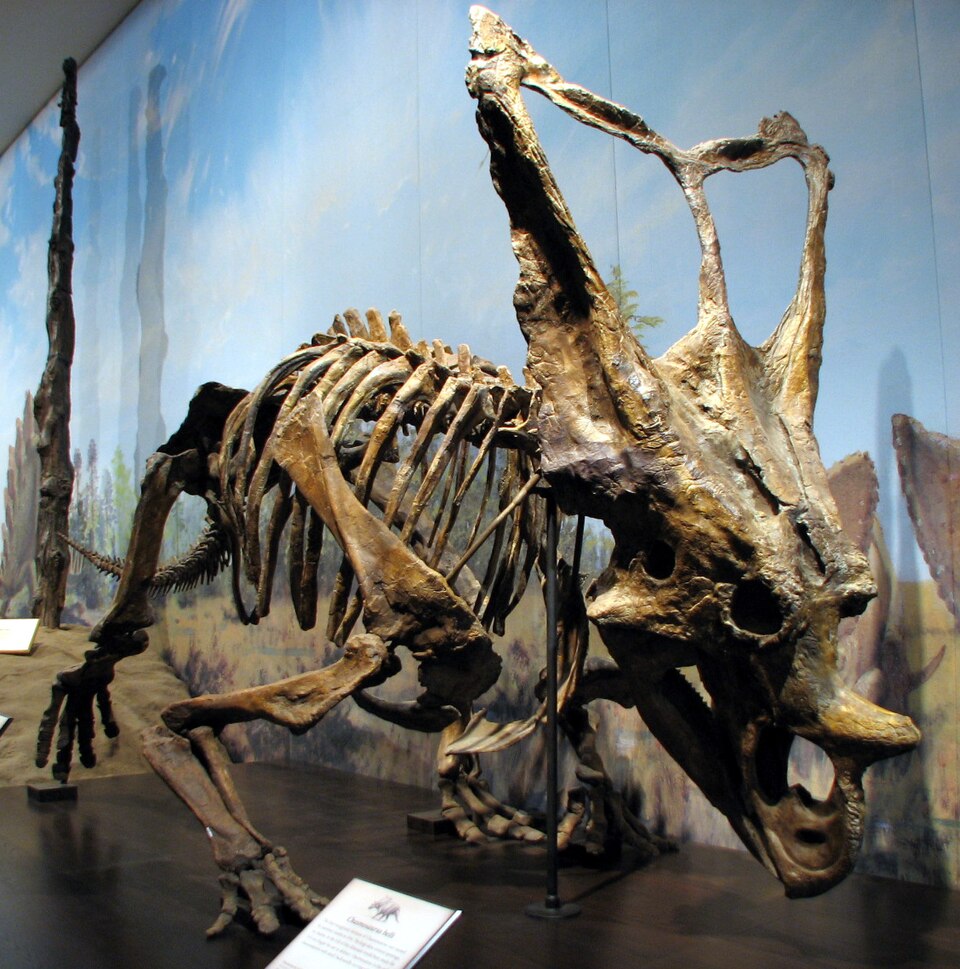
The ceratopsians—the horned dinosaurs—achieved their greatest diversity in the Late Cretaceous of North America and Asia, with dozens of genera distinguished by elaborately varied horn and frill configurations.3 Triceratops, Styracosaurus, Centrosaurus, and their relatives formed enormous herding populations inferred from bone beds preserving hundreds to thousands of individuals. The ecological role these animals filled was broadly analogous to modern large ungulate herds, and their sheer abundance suggests they were a primary structuring force in Late Cretaceous terrestrial food webs. The hadrosaurs, or duck-billed dinosaurs, were equally diverse and numerous, occupying both upland and lowland environments across the northern continents.
Theropod diversity in the Cretaceous encompassed an extraordinary range of body plans and ecologies. Beyond the large tyrannosaurs that are most familiar from Late Cretaceous deposits of North America and Asia, the period saw the flourishing of spinosaurids—semi-aquatic fish-eating giants—abelisaurids in Gondwana, and a proliferation of small-bodied coelurosaurs including the dromaeosaurs, troodontids, and oviraptorosaurs.3 Many of these smaller theropods were feathered, and the Cretaceous fossil record documents the full spectrum of the continuum between dinosaurs and birds, with forms like Microraptor and Anchiornis showing aerodynamic feathered forelimbs in forms that were not yet capable of modern-style flight. The theropod radiation of the Cretaceous represents one of the most ecologically diverse dinosaurian adaptive radiations, spanning body masses from under 100 grams in some microraptoran forms to over 8,000 kilograms in the largest tyrannosaurs.9
In the understory of these dinosaur-dominated landscapes, early mammals were quietly diversifying. Cretaceous mammals were uniformly small—rarely exceeding the size of a rat—but already included a surprising ecological range. Multituberculates, with their rodent-like teeth, were the most species-rich mammalian group of the Cretaceous, filling herbivorous niches in forests and scrublands. Symmetrodonts and eupantotheres occupied insectivorous and omnivorous roles.14 Some Cretaceous mammals show evidence of arboreal habits, others of semi-fossorial lifestyles, and the Chinese Cretaceous mammal Repenomamus was large enough to have preyed on small dinosaurs, as demonstrated by a juvenile Psittacosaurus preserved in its stomach. These mammals were not marginal players in Cretaceous ecosystems, but active participants in terrestrial food webs—even if their eventual dominance awaited the extinction of their large reptilian competitors.
The angiosperm revolution
No ecological transformation of the Cretaceous rivals in long-term consequence the rise of the flowering plants. When the period opened, terrestrial vegetation was dominated by the same groups that had prevailed through the Jurassic: conifers, cycads, bennettitaleans, ferns, and horsetails. Angiosperms, if present at all in the earliest Cretaceous, were rare and ecologically marginal. By the close of the period, flowering plants had become the dominant component of most terrestrial floras, a transition that restructured every aspect of terrestrial ecosystems from the ground up.5
The earliest confident angiosperm fossils appear in the Early Cretaceous, around 130 to 135 million years ago, as small, herbaceous plants occupying disturbed or riparian environments. From this foothold, the group diversified with extraordinary speed. By the Albian and Cenomanian stages (approximately 100–95 Ma), angiosperms were making up a substantial fraction of palynofloras across Europe, North America, and Africa. By the Campanian and Maastrichtian (84–66 Ma), they constituted the majority of plant species in most low-to-mid latitude environments and had begun to colonize higher-latitude forests as well.5
The ecological success of flowering plants was not merely a matter of competitive superiority over individual plant groups. Angiosperms transformed the entire structure of terrestrial ecosystems through their coevolutionary relationships with animals. The development of enclosed carpels encasing seeds within nutritious fruits created entirely new food resources for vertebrates, driving the diversification of fruit-eating birds and mammals. More consequentially, the elaboration of diverse floral morphologies—petals, nectar glands, specialized pollen-dispensing structures—drove an explosive coevolution with insect pollinators.19 Bee diversity, beetle diversity, and Lepidoptera all expanded in close correspondence with angiosperm diversification, and the insect-rich canopy of Late Cretaceous angiosperm forests provided the food base for the diversification of insectivorous birds, small mammals, and lizards. The replacement of gymnosperm-dominated forests by angiosperm-dominated ones did not merely change which plants occupied the landscape; it reorganized the entire trophic architecture of terrestrial ecosystems.
The effect of this vegetation change on herbivorous dinosaurs remains a subject of active research. The hadrosaurs and ceratopsians, with their elaborate dental batteries capable of processing tough fibrous plant material, have been interpreted as specialized consumers of angiosperm vegetation, though they certainly consumed conifers and ferns as well. The cycads and bennettitaleans that had been major components of Jurassic herbivore diets declined dramatically during the Cretaceous in parallel with the angiosperm rise—a correlation suggesting that the herbivorous dinosaur fauna and the plant community co-evolved during this interval, each shaping the other's trajectory.4
Marine ecosystems
The warm, nutrient-rich seas of the Cretaceous supported marine ecosystems of extraordinary productivity and diversity.1, 2 At the base of the food web, calcareous plankton—particularly the coccolithophores and planktonic foraminifera—flourished in greenhouse-warmed surface waters and produced the vast chalk deposits that give the period its name (from the Latin creta, meaning chalk). These chalk formations, preserved today from the White Cliffs of Dover to the chalks of Kansas, testify to rates of biological carbonate production that rivaled or exceeded those of any comparable interval in Earth's history.
The ammonites reached their final and in many respects most diverse expression in the Cretaceous. Hundreds of genera are known from Cretaceous deposits, including the typical coiled forms but also an extraordinary array of heteromorph ammonites with uncoiled, paperclip-shaped, helically coiled, or even hook-shaped shells. These heteromorphs, long considered evolutionary dead ends, are now understood as highly adapted specialists occupying precise ecological niches: some were likely slow-moving planktonic predators, others benthic scavengers, others active swimmers in the midwater column.7 The inoceramid bivalves—large, flat-shelled clams that could reach over a meter in diameter—were among the most abundant organisms on Cretaceous sea floors, forming dense populations on both oxygenated and low-oxygen substrates and serving as substrates for epifaunal communities of oysters, bryozoans, and serpulid worms.15
In the reef-building realm, the Cretaceous witnessed a fundamental replacement of the Jurassic coral-sponge reef framework by a novel reef type constructed by rudist bivalves. Rudists were bizarre mollusks whose two shells were radically asymmetric: one formed a tall conical tube anchored to the substrate, the other a flat lid. Packed densely together, rudist thickets formed extensive reef-like structures across shallow tropical carbonate platforms from the Caribbean through the Tethys. Rudist reefs did not simply occupy the same ecological space as modern coral reefs—their structural geometry differed and they appear to have been far less dependent on photosynthetic symbionts—but they functioned as biogenic carbonate factories that shaped shallow-water sedimentation patterns and provided habitat for diverse communities of fish, echinoderms, and mollusks.8
At the apex of Cretaceous marine food webs stood the mosasaurs, a group of large marine lizards closely related to monitor lizards and snakes that diversified explosively in the Late Cretaceous. Mosasaurs ranged from small, dolphin-sized generalists to giants exceeding 17 meters in length, and included specialists for different prey: some had crushing dentition suited for hard-shelled prey, others blade-like teeth for fish, and some of the largest genera appear to have been apex predators consuming other marine reptiles. The plesiosaurs persisted into the Cretaceous alongside the mosasaurs, including the long-necked elasmosaurids with necks containing up to 76 vertebrae and the short-necked, large-headed polycotylids and pliosaurids. At least some plesiosaurs gave birth to live young, as documented by a remarkable specimen of the polycotylid Polycotylus latippinus preserving a fetal skeleton within the body cavity of an adult.16 Giant marine turtles also patrolled Cretaceous seas; the archelon Archelon ischyros from the Western Interior Seaway reached over 4.5 meters in length, making it the largest turtle known to have existed.17
Aerial ecosystems
The skies of the Cretaceous were dominated by two distinct groups of flying vertebrates: the pterosaurs, which had held aerial supremacy since the Triassic, and an increasingly diverse assemblage of early birds that had radiated from their theropod ancestors during the latest Jurassic and Early Cretaceous.9, 18
Pterosaurs reached their most spectacular dimensions in the Cretaceous. The azhdarchids—a family of large to enormous pterosaurs named for the Uzbek word for a mythological dragon—include the largest animals ever to achieve powered flight. Quetzalcoatlus northropi from the Late Cretaceous of Texas had a wingspan estimated at 10 to 11 meters and stood as tall as a modern giraffe when on the ground. Analysis of azhdarchid limb proportions and their occurrence in inland, non-marine environments suggests they were primarily terrestrial stalkers—analogous to large modern storks or ground hornbills—that walked on all fours and used their long, stiff necks to probe for prey in vegetation and on open ground rather than being primarily aerial hunters over water.9 Smaller pterosaurs remained diverse throughout the Cretaceous, occupying fish-eating, insectivorous, and generalist ecological roles in coastal and inland environments.
Early birds in the Cretaceous were divided between two major groups: the Enantiornithes and the Ornithuromorpha, the latter including the lineage that would eventually give rise to all living birds. Enantiornithines—sometimes called the "opposite birds" for subtle anatomical features of their shoulder girdle—were the dominant birds of the Cretaceous in terms of species diversity, with dozens of genera known from exceptionally preserved specimens in China, Spain, Mongolia, and elsewhere.18 They retained teeth and clawed wings, and many show evidence of arboreal habits, roosting in trees and likely exploiting seeds, insects, and small vertebrates as food. The ornithuromorph birds, by contrast, were more diverse in body plan and included both arboreal and wading forms; some were fully aquatic, with diving adaptations convergent on modern loons and grebes. The simultaneous presence of large pterosaurs and multiple bird lineages in Cretaceous aerial ecosystems represents a level of flying vertebrate diversity with no modern parallel, though competition between these groups for ecological space remains debated.9
Polar ecosystems
One of the most counterintuitive revelations of Cretaceous paleontology is that dinosaurs occupied polar environments at surprisingly high latitudes. The absence of permanent polar ice and the distribution of warm ocean currents in the Cretaceous allowed forests to extend well into the Arctic and Antarctic circles, and fossil evidence confirms that dinosaurs lived within these high-latitude ecosystems year-round or seasonally.10, 11
The Prince Creek Formation of northern Alaska, deposited within the Arctic Circle at paleolatitudes of approximately 80 to 85 degrees north, has yielded the bones and teeth of at least a dozen dinosaur species, including hadrosaurs, ceratopsians, pachycephalosaurs, tyrannosaurs, and therizinosaurids.11 These animals lived in an environment that, while warm by modern Arctic standards, still experienced polar darkness for several months each year. Whether the Arctic dinosaurs were year-round residents or seasonal migrants has been debated, but the presence of small juvenile animals—which could not have migrated thousands of kilometers with mature herds—strongly suggests that at least some species bred and overwintered at high latitudes.11
In the southern hemisphere, Early Cretaceous dinosaur-bearing formations from Seymour Island and other localities in the Antarctic Peninsula document a similarly diverse fauna of ornithopod dinosaurs and ankylosaurs living within what was then a forested, high-latitude environment at approximately 65 to 70 degrees south.12 Oxygen isotope data from dinosaur bone apatite at multiple Cretaceous high-latitude localities are consistent with warm-blooded metabolisms capable of sustaining activity in cool, seasonally dark conditions, complementing anatomical evidence from bone histology showing rapid growth rates more consistent with endothermy than with ectothermy.10 The polar dinosaur record thus provides independent evidence for the physiological sophistication of these animals, confirming that they were not cold-blooded reptiles in the traditional sense but active, metabolically elevated animals capable of exploiting environments far outside the tropical and subtropical core of Mesozoic continental landmasses.
End of the Cretaceous world
The Cretaceous world was terminated at the Cretaceous-Paleogene boundary, precisely dated to 66.043 ± 0.011 million years ago, by the impact of an asteroid approximately 10 to 15 kilometers in diameter with the shallow carbonate and evaporite platform of what is now Mexico's Yucatán Peninsula. The Chicxulub structure, buried beneath kilometers of younger sediment, is approximately 180 kilometers in diameter, making it the largest confirmed impact structure of the Phanerozoic.13
The killing mechanisms of the impact were multiple and cascading. Within hours, re-entering ejecta heated the atmosphere sufficiently to ignite wildfires across continental North America. Within days, a curtain of dust, soot, and sulfate aerosols from the vaporization of Yucatán's sulfur-rich evaporites blanketed the global stratosphere, blocking sunlight and collapsing photosynthesis for months to years. Global temperatures fell by an estimated 8 to 11 degrees Celsius within weeks of the impact. Without light or warmth, the primary producers at the base of both terrestrial and marine food webs failed, and the food chains dependent on them unraveled from the top down. Any large animal requiring abundant daily food intake—which is to say, any non-avian dinosaur—faced starvation within weeks to months of the impact.13
The end-Cretaceous extinction was highly selective in ways that illuminate the kill mechanism. Non-avian dinosaurs were eliminated entirely, along with the mosasaurs, non-sea-turtle marine reptiles, pterosaurs, ammonites, rudist reef builders, and the inoceramid bivalves. Planktonic foraminifera suffered extinction rates approaching 90 percent. In contrast, crocodilians, turtles, lizards, snakes, birds, and small mammals passed through the boundary with comparatively modest losses—a selectivity that reflects the advantages of small body size, dietary flexibility, low metabolic demands, and access to detritus-based food chains that persisted even when primary production collapsed. The birds that survived were predominantly seed-eaters and generalists; the mammals that survived were small, probably omnivorous or insectivorous, and thermally buffered by their endothermic physiology.13
The 80 million years of the Cretaceous had built an exceptionally diverse and productive biosphere: warm seas teeming with ammonites and mosasaurs, continents roamed by herds of horned and crested dinosaurs, forests transformed by the spread of flowering plants, and skies shared between giant pterosaurs and an increasingly diverse avian fauna.3, 5 The Chicxulub impact did not merely extinguish individual species. It dismantled entire ecological architectures that had taken tens of millions of years to assemble, clearing the stage for the Cenozoic reorganization of life that followed—a world defined not by reptilian dominance but by the mammals and birds that survived the catastrophe that closed the Mesozoic.13
References
A new hypsilophodontid dinosaur from Antarctica: palaeobiogeographical and evolutionary implications
The Chicxulub asteroid impact and mass extinction at the Cretaceous-Paleogene boundary