Overview
- The observable universe spans 93 billion light-years, contains roughly 2 trillion galaxies and 200 billion trillion stars, and is approximately 13.8 billion years old — yet on the standard theistic picture, its purpose centers on human beings who appeared in the last 300,000 years on a single planet orbiting one of those stars.
- The argument from scale contends that this vast spatial and temporal disproportion between the universe and humanity is more probable on naturalism (where humans are an unplanned byproduct of impersonal processes) than on theism (where the cosmos exists for a purpose connected to human beings), thereby constituting evidence against anthropocentric theism.
- Theistic responses include the appeal to divine extravagance (God may create abundantly for reasons unrelated to human utility), the fine-tuning rejoinder (a universe of this size may be necessary for life-permitting conditions), and skeptical theism (human inability to discern God’s reasons for creating a vast cosmos does not entail that no such reasons exist) — critics reply that these responses concede the evidential force of scale rather than neutralizing it.
The argument from scale is the contention that the sheer size, age, and structure of the universe constitute evidence against theistic worldviews that assign a central role to human beings. The observable universe is approximately 93 billion light-years in diameter, contains on the order of 2 trillion galaxies and 200 billion trillion (2 × 10²³) stars, and has existed for roughly 13.8 billion years.14, 15 Homo sapiens emerged within the last 300,000 years on a single planet orbiting an unremarkable star in one arm of one galaxy. On the traditional theistic picture — particularly the Abrahamic traditions — the cosmos was created by a personal God whose purposes are bound up with the existence, moral development, and ultimate destiny of human beings. The argument from scale holds that this cosmic disproportion is deeply unexpected on such a view, while it is exactly what one would predict on a naturalistic hypothesis under which humans are an unplanned product of impersonal physical processes.1, 2
The argument is not a deductive proof that God does not exist. It is a probabilistic, evidential argument: the scale of the universe is more likely given naturalism than given anthropocentric theism, and therefore constitutes evidence — possibly quite strong evidence — that favors the former over the latter. It can be seen as a species of argument from parsimony: a universe fine-tuned for human flourishing would not obviously require 2 trillion galaxies, billions of years of cosmic evolution before the appearance of life, and a spatial extent that renders nearly all of the cosmos permanently inaccessible to human beings.1, 4
The cosmic data
The empirical basis of the argument rests on measurements from modern cosmology and astrophysics. The Planck satellite’s observations of the cosmic microwave background radiation, combined with other data sets, yield a universe age of 13.799 ± 0.021 billion years.15 The observable universe — the region from which light has had time to reach us since the Big Bang — has a comoving diameter of approximately 93 billion light-years, owing to the metric expansion of space. Beyond this observational horizon lies an unknown quantity of additional universe that may be far larger or even spatially infinite.9
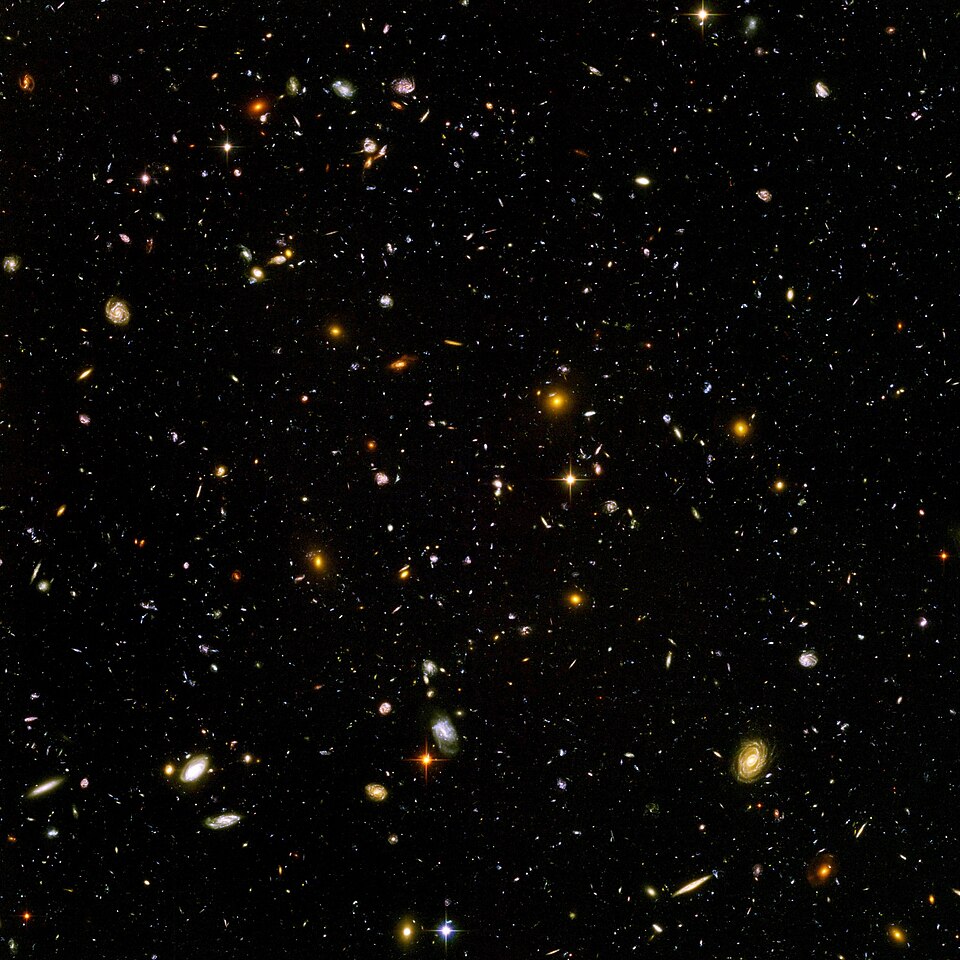

A 2016 analysis by Conselice et al., synthesizing deep Hubble Space Telescope survey data with theoretical models, estimated the total number of galaxies in the observable universe at approximately 2 × 10¹² (2 trillion), roughly ten times higher than previous estimates based on direct galaxy counts.14 Each galaxy contains on the order of 100 billion to 400 billion stars. The resulting total number of stars in the observable universe is estimated at roughly 2 × 10²³. Many of these stars are orbited by planets: exoplanet surveys suggest that there are more planets than stars in the Milky Way alone, implying a total planet count in the observable universe that runs into the trillions of trillions.9, 14
The temporal scale is equally striking. The first atoms formed approximately 380,000 years after the Big Bang. The first stars ignited roughly 200 million years later. The Sun and Earth formed about 4.6 billion years ago — more than 9 billion years after the Big Bang. Life on Earth appeared within a few hundred million years of the planet’s formation, but complex multicellular life did not emerge until roughly 600 million years ago, anatomically modern humans not until approximately 300,000 years ago, and recorded civilization not until approximately 5,000 years ago. On a calendar in which the age of the universe is compressed to a single year, human beings appear in the final seconds before midnight on December 31st.10, 15
The argument stated
The argument from scale was given its most systematic philosophical formulation by Nicholas Everitt in The Non-Existence of God (2004) and a companion paper in Religious Studies the same year. Everitt’s reasoning can be stated as follows:1, 2
P1. If the God of traditional theism existed, the universe would be expected to be structured in a way that reflects God’s purposes for humanity — a universe hospitable to human life, proportioned to human significance, and organized in a way that makes divine intent discernible.
P2. The actual universe is vastly larger, older, and more hostile to human life than would be expected if it were designed with human beings as its central purpose.
P3. This disproportion between the actual universe and a human-centered universe is much more probable on naturalism than on theism.
C. Therefore, the scale of the universe constitutes significant evidence against traditional theism.
The first premise relies on a conditional prediction. Everitt argues that if a personal God created the universe for the sake of human beings (or for the sake of a relationship with creatures like human beings), one would expect the cosmos to exhibit certain features: a size and structure reasonably commensurate with human needs, a timescale in which human history occupies a substantial fraction of cosmic history, and an arrangement in which the conditions for human flourishing are not confined to an infinitesimal fraction of the total space.1
The second premise is an empirical observation. As documented above, human beings occupy a vanishingly small portion of the universe in both space and time. The overwhelming majority of the cosmos — the interiors of stars, the voids between galaxy clusters, the radiation-filled vacuum of intergalactic space — is not merely inhospitable but lethal to human life. Even within our own solar system, Earth is the only body on which unprotected human survival is possible. The cosmic environment, taken as a whole, is not one that an impartial observer would identify as having been designed for the benefit of a species confined to one planet.1, 10
The third premise is a comparative likelihood judgment. On naturalism, the universe’s size and age are explained by the physics of cosmic expansion and structure formation: a universe governed by general relativity and the standard model of particle physics will naturally expand, cool, form galaxies and stars over billions of years, and produce habitable conditions only in rare, localized environments. No special explanation is needed for the disproportion between cosmic scale and human significance, because naturalism does not predict any such proportion in the first place. On theism, additional explanatory resources are required: the theist must explain why God would create a universe so vastly in excess of what human beings need, can observe, or can inhabit.1, 4
Historical precedents
Although Everitt gave the argument its contemporary philosophical structure, the intuition behind it has a long history. Bertrand Russell, in “Is There a God?” (1952) and in his earlier debates with Frederick Copleston, noted the implausibility of supposing that the entire cosmos was created for the benefit of creatures on one small planet. Russell wrote that it is difficult to think that “an Omnipotent, Omniscient, and All-Merciful being” would have set the cosmos going with the long-range aim of producing human beings on this particular planet, given the apparent indifference of the universe to human welfare.16
Carl Sagan articulated the argument in popular form in Pale Blue Dot (1994), reflecting on the famous photograph of Earth taken by Voyager 1 from a distance of 6 billion kilometers. In that image, Earth appears as a fraction of a pixel suspended in a sunbeam. Sagan wrote that the image underscores the “folly of human conceits” and the “delusion that we have some privileged position in the Universe.” While Sagan did not formulate a rigorous philosophical argument, his observations capture the phenomenological force of the scale problem: the sheer visual evidence of Earth’s insignificance against the cosmic backdrop makes anthropocentric claims about the purpose of the universe seem implausible on their face.10
J. J. C. Smart, in his contributions to the Atheism and Theism volume (1996; 2nd ed. 2003), pressed a similar point: the spatiotemporal vastness of the cosmos, with its billions of galaxies receding into the distance and its billions of years of pre-human history, is far more naturally accommodated by a naturalistic worldview in which the universe simply is what it is, than by a worldview in which the entire enterprise was undertaken for the sake of beings who appeared only at the very end and occupy only a tiny corner.13
The fine-tuning rejoinder and its limits
The most common theistic response to the argument from scale is the appeal to fine-tuning. Theists such as Richard Swinburne and Robin Collins have argued that a universe of this size and age may be physically necessary for the existence of embodied intelligent beings. The production of heavy elements (carbon, oxygen, iron) requires stellar nucleosynthesis, which requires stars, which require galaxies, which require billions of years of gravitational collapse from primordial density fluctuations. A universe that produced carbon-based life in a shorter time or a smaller volume might not be physically possible, given the laws and constants of physics.5, 6, 7
This response has force, but it also has limits. Even granting that a universe capable of producing carbon-based life must be old enough for stellar nucleosynthesis (requiring at least several billion years), the argument does not obviously require 2 trillion galaxies. The Milky Way alone would suffice to produce a habitable planet; the existence of billions of other galaxies, most of them permanently beyond any possible human contact, remains unexplained by the fine-tuning rejoinder. Everitt argues that the fine-tuning response addresses the temporal scale (why the universe must be old) but not the spatial scale (why it must be so large) or the proportional scale (why human beings should occupy so small a fraction of it).1, 2
Moreover, the fine-tuning rejoinder concedes a central premise of the argument: that the universe is not, on its face, what one would expect from a God who created it for human purposes. The theist is offering a secondary explanation — the universe must be this way for physical reasons — that mitigates the evidential force of scale but does not eliminate it. The naturalist can reply that the need for such secondary explanations is itself evidence that the theistic hypothesis is not the best account of the data: if the universe were designed for human beings, one would not expect to need elaborate explanations for why it looks as though it were not.1, 4
Divine extravagance and skeptical theism
A second theistic response appeals to what might be called divine extravagance: God may have reasons for creating a universe of immense size and beauty that are not reducible to human utility. Swinburne has suggested that a vast, elegant cosmos may glorify God or may have value in itself, apart from its usefulness to human beings.5 On this view, the universe is not a machine built to minimal specifications for producing humans; it is a work of art whose scale reflects the magnitude of its creator. Just as a human artist may produce a work far larger and more complex than what is strictly necessary, God may create a cosmos whose grandeur exceeds any narrowly anthropocentric requirement.
Critics argue that this response is ad hoc. The claim that God creates extravagantly to manifest divine glory is not independently motivated by theistic theology; it is introduced specifically to accommodate the observation of cosmic scale. Furthermore, it generates its own problems: if God values the existence of vast, beautiful cosmic structures for their own sake, it becomes unclear why human beings should be regarded as the purpose of creation at all. The divine extravagance response threatens to undermine the anthropocentrism it is invoked to protect, by suggesting that humans may be a minor byproduct of God’s creative activity rather than its central object.1, 12
A third response draws on skeptical theism: given human cognitive limitations, we are not in a position to judge what size universe God would create. Stephen Wykstra and Michael Bergmann have argued, in the context of the evidential problem of evil, that the gap between human cognition and divine omniscience is so vast that humans cannot reliably assess what God would or would not do. Applied to the argument from scale, this response holds that we simply cannot know whether a smaller or younger universe would have served God’s purposes equally well — those purposes may involve considerations beyond our comprehension.11
The standard objection to skeptical theism applies here as well: if the gap between human and divine cognition is so great that we cannot assess what God would do, then natural theology collapses in both directions. We can no longer appeal to the order, beauty, or fine-tuning of the universe as evidence for God, because we cannot know whether God would create an orderly, beautiful, or fine-tuned universe. Skeptical theism, applied consistently, undermines theistic arguments at least as effectively as it undermines atheistic ones.4, 11
The spatial and temporal arguments distinguished
Stephen Maitzen has distinguished the spatial dimension of the argument (the universe is too large) from what he calls the argument from neglect, which focuses on temporal factors. Maitzen’s argument from neglect (2004) observes that if God exists and desires a relationship with human beings, the temporal structure of the cosmos is puzzling: for 13.5 billion years, there were no human beings for God to relate to, and for the vast majority of the 300,000 years during which humans have existed, the majority of the species lacked access to any putative divine revelation. On the Abrahamic picture, God waited until roughly 3,000–4,000 years ago to reveal himself to a small population in the ancient Near East, leaving the rest of humanity — geographically, temporally, and culturally — without access to the message for millennia.3
Maitzen argues that this temporal neglect is difficult to reconcile with a God who values human beings and desires their well-being. A loving parent does not leave a child unattended for years before initiating contact. The temporal disproportion between cosmic history and human history, combined with the temporal disproportion between human history and the history of divine revelation, creates a cumulative case against the claim that the universe was created for the sake of a divine–human relationship.3
The combined force of the spatial and temporal arguments is greater than either alone. The spatial argument alone might be met by fine-tuning considerations (a large universe may be physically necessary). The temporal argument alone might be met by appeals to divine patience or the necessity of a long evolutionary process. But the conjunction of both — a universe that is both overwhelmingly large and overwhelmingly old relative to the beings it allegedly exists for, in which those beings appear only in the last instant and on only one of trillions of trillions of planets — presents a more formidable evidential challenge.1, 3
Scope and limitations
The argument from scale is specifically targeted at anthropocentric theism — versions of theism on which human beings are the primary intended inhabitants of the cosmos or the central objects of divine concern. It has less force against theistic views that do not assign special significance to human beings, such as process theology or certain mystical traditions in which the divine purpose encompasses all of creation equally. If God’s purposes include the flourishing of all possible forms of consciousness throughout the cosmos, then the existence of a vast universe with potentially many inhabited worlds might be expected rather than surprising.1, 4
The argument is also less effective against deistic views on which God created the universe but does not intervene in it or maintain a personal relationship with its inhabitants. A deistic God who sets the laws of physics and then allows the universe to develop on its own would not be expected to produce a cosmos tailored to human specifications. The argument from scale thus presupposes a fairly specific target: the God of the Abrahamic traditions, who is said to have created the universe with human beings in mind, to have revealed himself to human beings through prophets and scriptures, and to have a plan for human salvation.1, 12
Defenders of the argument have responded that this specificity is a feature, not a limitation. The vast majority of theists in the world belong to Abrahamic traditions (Christianity, Islam, Judaism) that do assign central importance to human beings. The argument from scale is not intended to refute all possible conceptions of divinity but to challenge the conceptions actually held by most religious believers. To the extent that theists retreat from anthropocentrism in response to the argument — conceding that human beings may not be the central purpose of creation — the argument has succeeded in forcing a significant theological revision, even if it has not established atheism.1, 2, 13
The argument from scale thus functions as part of a broader cumulative case rather than a standalone proof. Its evidential weight depends on one’s prior assessment of theism and naturalism, on how one weighs the fine-tuning rejoinder and other theistic responses, and on how it interacts with other arguments in the philosophy of religion. For those who find the fine-tuning argument compelling, the argument from scale may serve as a partial counterweight. For those who already find naturalism more probable, it may function as a confirmation of an existing assessment. In either case, the cosmic data that underlie the argument — the staggering size, age, and inhospitality of the universe relative to its alleged intended inhabitants — remain among the most vivid challenges to the claim that the cosmos was made for us.4, 9