Overview
- Early Israelite religion was not monotheistic but monolatrous — Yahweh was worshipped as the national deity while the existence of other gods was openly acknowledged, as reflected in texts such as Psalm 82, Deuteronomy 32:8-9, and the prophetic polemics against Baal, Asherah, and the host of heaven.
- The merger of Yahweh with the Canaanite high god El, attested by the preservation of El epithets in Genesis and the equation of the two deities in later Israelite tradition, was a pivotal step in elevating Yahweh from a regional storm deity to the supreme god of the cosmos.
- Explicit monotheism — the categorical denial that other gods exist — emerged only during the Babylonian exile of the sixth century BCE, articulated most clearly in Second Isaiah's declarations that 'besides me there is no god,' representing the culmination of a centuries-long theological development from polytheism through monolatry to monotheism.
The monotheism of Judaism, Christianity, and Islam — the conviction that only one God exists — did not appear fully formed in the earliest strata of Israelite religion. The Hebrew Bible itself preserves evidence of a long and uneven development from a world in which multiple gods were acknowledged and worshipped, through a stage in which Yahweh alone was to be worshipped while other gods were still assumed to exist, to the categorical denial that any god besides Yahweh exists at all. Scholars describe this trajectory using a set of technical distinctions: polytheism, the worship of many gods; henotheism, the devotion to one god without denying the existence of others; monolatry, the exclusive worship of one god while acknowledging other gods' reality; and monotheism, the belief that only one god exists.2, 7 The boundaries between these categories are not always sharp, and individual biblical texts can resist easy classification, but the overall direction of movement — from plurality to exclusivity to ontological uniqueness — is one of the most broadly agreed-upon conclusions in the modern study of Israelite religion.
This article traces that development through the biblical and archaeological evidence: from the divine council texts that presuppose a pantheon, through the merger of Yahweh and El, the persistent worship of other deities alongside Yahweh, the Deuteronomic reform's attempt to enforce exclusive loyalty, and the emergence during the Babylonian exile of an unambiguous monotheism that denied the very existence of other gods.
Defining the terms
The vocabulary used to describe stages of religious belief requires careful definition, because the same terms are sometimes used loosely in popular discussion. Polytheism refers to any religious system in which multiple deities are acknowledged and worshipped, each possessing genuine divine power and agency. The religions of ancient Mesopotamia, Egypt, Greece, and Canaan were polytheistic in this sense, with elaborate pantheons organized in hierarchies of power and function.9 Henotheism, a term coined by the nineteenth-century scholar Max Müller, describes the practice of worshipping one particular god as supreme without denying the reality of other gods — a stance in which the devotee's god is the greatest god, but not the only god.7
Monolatry is closely related to henotheism but carries a more prescriptive connotation: it refers to a system in which one god demands exclusive worship from a particular community, even though other gods are acknowledged to exist and may legitimately be worshipped by other peoples. The first commandment of the Decalogue — "You shall have no other gods before me" (Exodus 20:3, NRSV) — is a monolatrous rather than a monotheistic statement: it prohibits the worship of other gods but does not deny their existence.2, 5 Monotheism, by contrast, makes an ontological claim: there is only one God, and all other supposed deities are nonentities, figments of human error, or at best subordinate beings of a fundamentally different order. The distinction between monolatry and monotheism is the crucial one for understanding the development traced in this article: the question is not merely whom Israel worshipped, but what Israel believed about the reality of other gods.7
Robert Karl Gnuse has argued that these categories should be understood not as rigid stages but as tendencies that coexisted within Israelite society at any given period, with different social groups holding different positions simultaneously. The prophets who demanded exclusive Yahweh worship in the eighth century BCE were not necessarily representative of popular belief, which remained far more pluralistic.7, 8 The trajectory from monolatry to monotheism was neither linear nor unanimous, but unfolded through conflict between competing visions of Israelite identity over several centuries.
The divine council
Among the most striking evidence that early Israelite religion presupposed a plurality of gods is the motif of the divine council — an assembly of divine beings over which a supreme deity presides. This concept, well attested in Ugaritic, Mesopotamian, and other ancient Near Eastern literatures, appears in several biblical texts that have resisted later monotheistic reinterpretation.9, 15
Psalm 82 provides the clearest example. The psalm opens: "God stands in the divine council; among the gods he renders judgment" (Psalm 82:1). The Hebrew uses elohim for both the presiding deity and the members of the council, and the psalm proceeds to depict the supreme god condemning the other gods for failing to execute justice: "I said, 'You are gods, sons of the Most High, all of you; nevertheless, you shall die like mortals, and fall like any prince'" (Psalm 82:6-7, NRSV). The text presupposes that other gods genuinely exist, that they have been assigned responsibilities for governing the nations, and that they have failed in those responsibilities — a scenario that makes no sense if the author believed that only one god existed.2, 15 Mark S. Smith has argued that Psalm 82 represents a "narrativized" account of the death of the gods, in which the old polytheistic framework is being dismantled from within: the other gods are condemned and stripped of their divinity, paving the way for monotheism.2
Deuteronomy 32:8-9 preserves an even more revealing picture of the divine order. The Masoretic Text, the standard Hebrew text preserved by medieval Jewish scribes, reads: "When the Most High divided the nations, when he separated the sons of Adam, he fixed the boundaries of the peoples according to the number of the sons of Israel." But the Dead Sea Scrolls manuscript 4QDeutj and the Greek Septuagint both read "sons of God" (bene elohim or bene elim) rather than "sons of Israel" — and most modern text critics regard this as the original reading, with the Masoretic Text reflecting a later theological correction that removed the reference to other divine beings.3, 4 In the earlier reading, the passage describes the Most High (Elyon) distributing the nations of the world among the members of the divine council, with each god receiving a nation as his allotted portion: "For Yahweh's portion is his people, Jacob his allotted heritage" (Deuteronomy 32:9, NRSV). The implication is that Yahweh was one among a group of divine sons, each assigned a nation to govern — a picture entirely consistent with the Canaanite model of a supreme god (El) presiding over a council of subordinate deities.3, 2
The divine council motif also appears in 1 Kings 22:19-22, where the prophet Micaiah describes a vision of Yahweh "sitting on his throne, with all the host of heaven standing beside him on his right hand and on his left," deliberating with the assembled spirits about how to lure King Ahab to his death. Similarly, Job 1-2 depicts the "sons of God" (bene ha-elohim) presenting themselves before Yahweh, with the Adversary (ha-satan) among them. Lowell Handy has demonstrated that the behaviour of these divine beings in the council scenes mirrors the structure of the Syro-Palestinian pantheon, in which lesser deities report to and receive assignments from a higher deity.9
Yahweh and El
One of the most consequential developments in Israelite religion was the identification of Yahweh with El, the head of the Canaanite pantheon. A substantial body of evidence indicates that Yahweh and El were originally distinct deities who were merged at some point during the pre-monarchic or early monarchic period, with Yahweh absorbing El's attributes, titles, and position at the head of the divine council.1, 3
In the Ugaritic texts discovered at Ras Shamra (ancient Ugarit) on the Syrian coast beginning in 1929, El ('ilu) is the supreme deity, the father of the gods, the creator of creatures, and the presiding authority of the divine assembly. El is depicted as an aged, wise, and benevolent figure, dwelling at the source of the rivers and the springs of the two deeps. His consort is Athirat (the Canaanite form of Asherah), and his sons include Baal, the storm god, and other deities of the Ugaritic pantheon.2, 3 Yahweh, by contrast, does not appear in any known Ugaritic text. The earliest plausible extra-biblical references to Yahweh associate him with the southern regions — Seir, Edom, Teman, and the Sinai — suggesting that he originated as a deity of the southern desert or steppe, possibly connected with Midianite or Kenite groups, before being adopted by the Israelites.4, 1
The Hebrew Bible preserves numerous traces of El's independent identity. The patriarchal narratives in Genesis use a series of El titles — El Elyon ("God Most High," Genesis 14:18-22), El Shaddai ("God Almighty," Genesis 17:1), El Olam ("the Everlasting God," Genesis 21:33), El Roi ("the God who sees," Genesis 16:13) — that correspond to epithets of the Canaanite El rather than to known attributes of Yahweh.3, 1 Furthermore, Exodus 6:2-3 explicitly states that God appeared to the patriarchs as El Shaddai, "but by my name Yahweh I did not make myself known to them" — a passage that preserves the memory of a time when the patriarchal deity was known by a different name than Yahweh.3
Frank Moore Cross argued in his landmark study Canaanite Myth and Hebrew Epic (1973) that the identification of Yahweh with El was the primary mechanism by which Yahweh rose to supremacy in the Israelite pantheon. By absorbing El's role as creator, father of the gods, and head of the divine council, Yahweh inherited a cosmic scope that his original character as a storm and warrior deity did not possess.3 Smith has refined this argument by distinguishing between two processes: the convergence of Yahweh and El, in which the two deities were identified and their attributes merged, and the differentiation of Yahweh from Baal, in which features associated with Baal (storm theophany, conflict with the sea) were appropriated for Yahweh while Baal himself was rejected as a rival.1 Both processes contributed to the distinctive profile of the Israelite god: a deity who combined El's cosmic authority with Baal's dynamic power, while eventually excluding all other gods from legitimate worship.
Other gods in Israelite worship


The Hebrew Bible's own polemics against the worship of gods other than Yahweh constitute evidence that such worship was widespread, persistent, and not confined to the margins of Israelite society. The prophets would not have devoted so much energy to denouncing practices that were rare or marginal. The archaeological record confirms and extends the biblical picture, revealing a religious landscape far more pluralistic than the later editors of the Hebrew Bible wished to acknowledge.8, 12
The goddess Asherah provides the most extensively documented case. In the Ugaritic texts, Athirat is the consort of El, and inscriptions from two Israelite sites — Kuntillet Ajrud in the northeastern Sinai (c. 800 BCE) and Khirbet el-Qom in the Judean hill country (c. 750 BCE) — contain blessings invoking "Yahweh and his Asherah" (yhwh w'shrth).10, 11 Whether "his Asherah" refers to the goddess herself or to a cultic object (a wooden pole or stylized tree associated with her worship) remains debated, but in either case the inscriptions demonstrate that Asherah was closely associated with Yahweh worship in both the northern and southern kingdoms during the eighth century BCE.11, 8 The Hebrew Bible itself attests to the presence of an Asherah image in the Jerusalem Temple, placed there by King Manasseh and removed by Josiah (2 Kings 21:7; 2 Kings 23:6). William Dever has argued that the worship of Asherah alongside Yahweh was the normative practice of Israelite folk religion, not an aberration, and that the biblical writers who condemned it represented a reforming minority.8
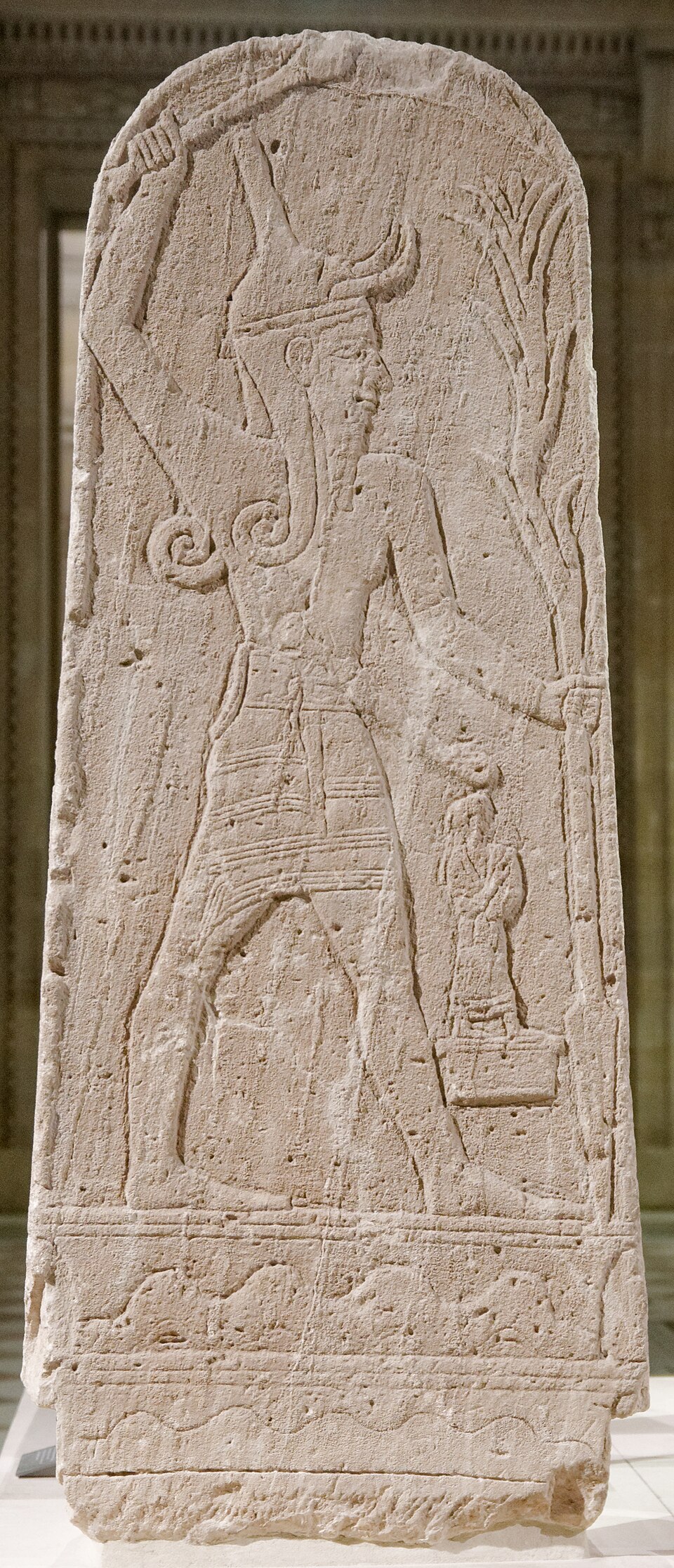
The storm god Baal was the principal rival to Yahweh in the prophetic literature. The Elijah cycle in 1 Kings 18 narrates a dramatic contest between Yahweh and Baal on Mount Carmel, and the prophet Hosea repeatedly condemns Israel for "going after the Baals" (Hosea 2:13; Hosea 11:2). Archaeological evidence from sites across Iron Age Israel confirms the widespread veneration of Baal, including inscriptions, figurines, and place-names compounded with ba'al.1, 13, 16 John Day has demonstrated that several attributes of Yahweh in the Hebrew Bible — his mastery over the sea, his conflict with the sea monster Leviathan, his manifestation in thunderstorm theophany — were originally characteristics of Baal in the Ugaritic tradition, subsequently transferred to Yahweh as part of the process Smith calls "differentiation."16
Other deities attested in Israelite worship include the "host of heaven" — the sun, moon, and stars worshipped as divine beings, a practice condemned in Deuteronomy 4:19 and 2 Kings 23:5. The prophet Ezekiel, writing from Babylon, described a vision of abominations within the Jerusalem Temple itself: women weeping for the Mesopotamian god Tammuz at the Temple gate (Ezekiel 8:14), and men bowing to the sun with their backs to the Temple's inner sanctuary (Ezekiel 8:16). The prophet Jeremiah records women making offerings to the "Queen of Heaven" — probably the goddess Ishtar or a syncretized form of Astarte — and their defiant refusal to stop: "We will do everything that we have vowed, make offerings to the queen of heaven and pour out libations to her, just as we and our ancestors, our kings and our officials, used to do in the towns of Judah and in the streets of Jerusalem" (Jeremiah 44:17, NRSV).5, 12 The passage is remarkable for the explicit claim that this worship was traditional, publicly practiced, and endorsed by the royal establishment — the opposite of the peripheral and foreign phenomenon that the Deuteronomistic editors wished to portray.
The Deuteronomic reform
The most significant pre-exilic attempt to enforce exclusive Yahweh worship was the reform attributed to King Josiah of Judah, dated to approximately 622 BCE. According to 2 Kings 22-23, workers renovating the Jerusalem Temple discovered a "book of the law" (sepher ha-torah), which the king had read aloud to the assembled people. The contents of the book alarmed Josiah, and he initiated a sweeping reform: he destroyed the high places (bamot) throughout Judah where sacrifice had been offered at local shrines, removed the Asherah image from the Temple, abolished the worship of the host of heaven, desecrated the altar at Bethel in the former northern kingdom, and centralized all legitimate worship at the Jerusalem Temple.14, 5

Most scholars identify the discovered book with some form of Deuteronomy, or at least its legal core (chapters 12-26), which demands the centralization of worship at a single chosen sanctuary and prohibits the veneration of any deity other than Yahweh.4, 14 The reform was simultaneously a theological and a political program. By centralizing worship in Jerusalem and destroying the provincial shrines where local forms of Yahwism — often incorporating Asherah, Baal, and astral worship — had flourished for centuries, Josiah concentrated religious authority in the capital and under royal control. Römer has argued that the Deuteronomic movement represented the ideology of a scribal elite centered in Jerusalem who sought to redefine Israelite identity around exclusive loyalty to Yahweh and obedience to a written law — a program that served the political interests of the Davidic monarchy as much as it served theological ones.4
The historicity of the reform as described in 2 Kings is itself debated. Finkelstein and Silberman have argued that the account of the reform was shaped, if not largely composed, by later Deuteronomistic editors writing during or after the exile, who projected their theological program back onto the reign of Josiah as a golden age of faithfulness.14 Others, including Albertz, have maintained that the basic outline of the reform is historical, even if the narrative has been idealized in the retelling.5 What is not disputed is the theological significance of the Deuteronomic program: it represents the most forceful assertion of exclusive Yahweh worship in the pre-exilic period, even though it stops short of denying the existence of other gods. Deuteronomy's rhetoric is monolatrous — "You shall have no other gods before me" — rather than monotheistic. The other gods are real enough to be dangerous; they are forbidden precisely because they pose a genuine temptation.2, 7
The exile and the emergence of monotheism
The destruction of Jerusalem and the Temple by the Babylonians in 586 BCE and the subsequent exile of the Judean elite to Babylon constituted the most traumatic crisis in Israelite history — and, paradoxically, the crucible in which monotheism was forged. The theological problem posed by the exile was acute: if Yahweh was Israel's god and Jerusalem was his dwelling, what did the destruction of his Temple and the deportation of his people mean? One possible answer — that Yahweh had been defeated by the gods of Babylon — was precisely the answer that the exilic theologians refused to accept. Instead, they reinterpreted the catastrophe as Yahweh's own judgment upon Israel for its unfaithfulness, which required Yahweh to be not merely Israel's god but the god of all nations, sovereign over Babylon itself.6, 7
The decisive theological breakthrough appears in Second Isaiah (Isaiah 40-55), a collection of oracles composed by an anonymous prophet during the exile, conventionally dated to the 540s BCE as the Persian king Cyrus was preparing to conquer Babylon. These chapters contain the first unambiguous monotheistic declarations in the Hebrew Bible — statements that go beyond demanding exclusive worship of Yahweh to categorically denying the existence of any other god:
Isaiah 45:5, NRSV"I am Yahweh, and there is no other; besides me there is no god."
Isaiah 43:10-11, NRSV"Before me no god was formed, nor shall there be any after me. I, I am Yahweh, and besides me there is no saviour."
Isaiah 44:6, NRSV"I am the first and I am the last; besides me there is no god."
The rhetorical force of these declarations lies in their absolute character. Earlier texts had commanded Israel not to worship other gods; Second Isaiah denies that there are other gods to worship. The gods of the nations are mocked as blocks of wood and metal, the products of human craftsmanship, devoid of any power or reality (Isaiah 44:9-20). This is a qualitative shift from the monolatry of Deuteronomy to a full ontological monotheism: not "worship only Yahweh" but "only Yahweh exists as God."2, 6, 7
Gnuse has argued that the emergence of monotheism during the exile followed a pattern of "punctuated equilibrium" — long periods of relative theological stability interrupted by rapid development in response to crisis. The exile was precisely such a crisis: the loss of land, Temple, and monarchy forced a fundamental reconceptualization of the relationship between Yahweh and the world. If Yahweh was sovereign over history — if the exile was his doing, and the rise of Cyrus was his instrument — then there could be no other power in the cosmos that operated independently of his will.7 Albertz has similarly argued that the exile stripped away the institutional supports of Israelite religion (the Temple, the monarchy, the land) and forced the community to define its identity through theology and text rather than through territory and cult, creating the conditions for a more abstract and universal conception of God.6
The trajectory summarized
The development from polytheism to monotheism in ancient Israel can be outlined in broad stages, though the transitions were gradual, contested, and never complete at any single moment. In the pre-monarchic period (before c. 1000 BCE), the Israelites participated in the broader Canaanite religious world, worshipping El, Baal, Asherah, and other deities alongside Yahweh, who was emerging as the distinctive national god of the tribal confederation. The merger of Yahweh and El during this period gave Yahweh the attributes of cosmic sovereignty that would later undergird monotheistic claims.1, 3
During the monarchic period (c. 1000-586 BCE), official Yahwism became increasingly exclusivist under prophetic and Deuteronomic influence, demanding that Yahweh alone receive Israel's worship. But popular religion remained pluralistic, as the archaeological evidence from Kuntillet Ajrud, Khirbet el-Qom, and hundreds of domestic shrines and figurines attests.8, 10, 12 The Deuteronomic reform of 622 BCE represented the most aggressive attempt to enforce monolatry, but its theological framework still assumed the existence of other gods. Only during the Babylonian exile (586-539 BCE) did the prophetic tradition take the final step, with Second Isaiah declaring that Yahweh was not merely the greatest god but the only god — that the deities of the nations were nothing at all.2, 6
Stages in the development of Israelite theology1, 2, 7
The post-exilic period consolidated the monotheistic achievement. The priestly editors who gave the Pentateuch its final form reframed earlier traditions in monotheistic terms, and the later wisdom literature (Ecclesiastes, Wisdom of Solomon) explored the philosophical implications of belief in a single creator god. But traces of the older worldview were never entirely erased. The divine council survives in Psalm 82 and Job 1-2; the separate identity of El persists in the patriarchal narratives; and the prophetic denunciations of Asherah and Baal worship testify to a long period in which Israelite religion was far more complex and contested than the final form of the biblical text, read on its own terms, might suggest.1, 2, 15
Scholarly frameworks
The reconstruction outlined above reflects a broad scholarly consensus, but there are significant disagreements about the details and mechanisms of the transition. Cross emphasized the continuity between Canaanite and Israelite religion, arguing that Yahwism was essentially a transformation of the El cult and that the key development was the identification of Yahweh with El, not the rejection of Canaanite religion as a whole.3 Smith built on Cross's work but gave greater weight to the process of differentiation from Baal, arguing that the confrontation with Baal worship — not merely the merger with El — was the engine that drove Israelite religion toward exclusivism.1
Römer has situated the development within the political history of the ancient Near East, arguing that the rise of the Neo-Assyrian Empire in the eighth and seventh centuries BCE created the conditions for monolatry by providing a model of a single imperial deity (Ashur) who demanded the loyalty of all subjects, and that the collapse of Assyria and the subsequent Babylonian exile created the conditions for monotheism by removing the political framework within which other gods had been understood to operate.4 Albertz has emphasized the social dimensions of the transition, arguing that different stages of religious development corresponded to different social and institutional contexts: family religion remained pluralistic long after official state religion had become exclusivist, and the exile finally dissolved the distinction between official and popular religion by destroying the institutions (Temple, monarchy) that had maintained it.5, 6
Dever, approaching the question from archaeology rather than textual criticism, has argued that the biblical account of Israelite religion is fundamentally misleading because it represents the perspective of a literate urban elite whose views were not shared by the majority of the population. The archaeological evidence — hundreds of female figurines, domestic shrines, inscriptions mentioning Asherah — reveals a "folk religion" that persisted alongside and often in tension with the official Yahwism promoted by the biblical writers.8, 17 Zevit has similarly argued that the worship of multiple deities was not a deviation from Israelite religion but was, for most of Israel's history, Israelite religion itself — the normative practice of the majority, against which the monotheistic minority eventually prevailed.18
What unites these diverse approaches is the recognition that monotheism was not the starting point of Israelite religion but its destination — a hard-won theological achievement that emerged through centuries of cultural contact, prophetic polemic, political upheaval, and national catastrophe. The Hebrew Bible preserves both the outcome and, in its older strata, the traces of the long road that led there.
References
The Origins of Biblical Monotheism: Israel's Polytheistic Background and the Ugaritic Texts
A History of Israelite Religion in the Old Testament Period, Vol. I: From the Beginnings to the End of the Monarchy
A History of Israelite Religion in the Old Testament Period, Vol. II: From the Exile to the Maccabees
Kuntillet ʿAjrud (Horvat Teman): An Iron Age II Religious Site on the Judah-Sinai Border
The Bible Unearthed: Archaeology's New Vision of Ancient Israel and the Origin of Its Sacred Texts
The Divine Council in Late Canonical and Non-Canonical Second Temple Jewish Literature