Overview
- The New Testament survives in approximately 5,800 Greek manuscripts that contain an estimated 300,000 to 400,000 individual textual variants — more variants than words in the New Testament itself.
- The vast majority of variants are inconsequential (spelling differences, word-order changes, scribal slips), but a small number affect the meaning of theologically significant passages, including the divinity of Christ, the doctrine of the Trinity, and the ending of the Lord's Prayer.
- The Old Testament manuscript tradition, illuminated by the Dead Sea Scrolls, reveals that the Hebrew text existed in multiple forms before standardization, with some Qumran manuscripts differing from the Masoretic Text in ways that align with the Septuagint or the Samaritan Pentateuch.
A textual variant is any place where the surviving manuscripts of a biblical text disagree with one another in wording. Because the books of the Bible were transmitted by hand-copying for over a thousand years before the invention of the printing press, and because no two handwritten copies of any extended text are ever perfectly identical, the manuscript tradition of both the Old and New Testaments contains a large number of places where different copies preserve different readings. The New Testament alone survives in approximately 5,800 Greek manuscripts, and the total number of variant readings among these manuscripts has been estimated at between 300,000 and 400,000 — a figure that exceeds the total number of words in the Greek New Testament.1, 5
The overwhelming majority of these variants are trivial: differences in spelling, word order, the presence or absence of the Greek article, and other features that affect neither translation nor meaning. A smaller but still substantial number involve the substitution, addition, or omission of words and phrases that alter the sense of individual sentences. A still smaller number affect passages of direct theological significance — the divinity of Christ, the nature of the atonement, the text of prayers and liturgical formulas. This article examines the most significant textual variants in both the Old and New Testaments, presenting the manuscript evidence for each and quoting the affected passages so the reader can see exactly what is at stake in each case.1, 2
The scale and types of variation
Textual variants in the New Testament are conventionally classified into four broad categories based on the type of change involved: substitutions (one word or phrase replaced by another), additions (words or phrases present in some manuscripts but absent from others), omissions (the reverse), and transpositions (the same words appearing in a different order).1 Each of these types can arise through either accidental or intentional scribal activity. Accidental variants include errors of sight (skipping a line, repeating a line, confusing similar-looking letters), errors of hearing (in cases where manuscripts were produced by dictation), and errors of memory (substituting a familiar word or phrase from a parallel passage). Intentional variants include grammatical corrections, stylistic improvements, harmonizations with parallel texts, and theological alterations aimed at clarifying or strengthening doctrinal points.1, 4

Studies of the earliest surviving papyri have documented the scribal habits of individual copyists in detail. An analysis of the six earliest extensive New Testament papyri (P45, P46, P47, P66, P72, and P75) found that scribes differed dramatically in their accuracy and their tendency toward particular kinds of error. The scribe of P75, for instance, copied with exceptional care and produced a text very close to that of Codex Vaticanus, written over a century later. The scribe of P66, by contrast, made frequent errors and then corrected many of them, sometimes introducing additional errors in the correction. The scribe of P45 tended to paraphrase, producing readings that simplified or shortened the text.12, 13 These documented differences among individual scribes illustrate the range of human factors that contributed to the accumulation of variants across the manuscript tradition.
The sheer number of variants — exceeding the word count of the text itself — requires context. Each variant is counted once for each manuscript in which it appears. A single word that differs in two thousand manuscripts from the reading in three thousand others counts as one variant attested in thousands of witnesses. The large total reflects the large number of surviving manuscripts: the more copies that survive, the more variants can be counted. The New Testament's manuscript base is far larger than that of any other ancient text, and its variant count is correspondingly higher. A text surviving in only a handful of manuscripts will have far fewer documented variants, though this does not mean the surviving copies are more accurate — it means there are fewer witnesses available to reveal where they disagree.1, 6
Variants affecting Christology
Several of the most theologically consequential variants in the New Testament involve passages that bear on the identity and nature of Jesus. In each of the following cases, different manuscripts preserve readings that carry different implications for the relationship between Jesus and God.
John 1:18. This verse, at the conclusion of the Gospel of John's prologue, describes who has made God known. The manuscripts divide between two readings. One reads:
No one has ever seen God. It is God the only Son, who is close to the Father's heart, who has made him known. (NRSV)
The Greek behind "God the only Son" is monogenes theos (μονογενὴς θεός), "the only-begotten God" or "the unique God." The alternative reading is monogenes huios (μονογενὴς υἱός), "the only-begotten Son." The reading theos ("God") is found in P66 (circa 200 CE), P75 (early third century), Codex Sinaiticus (original hand, fourth century), and Codex Vaticanus (fourth century). The reading huios ("Son") is found in Codex Alexandrinus (fifth century), Codex Ephraemi Rescriptus (fifth century), and the vast majority of later Byzantine manuscripts.2, 4, 9 The difference is a single word, but it determines whether the verse identifies Jesus as "the only-begotten God" or "the only-begotten Son" — two distinct theological formulations. Modern critical editions print theos on the basis of the earlier manuscript evidence.3
1 Timothy 3:16. This verse contains what appears to be an early christological hymn or confession. The manuscripts diverge on the opening word. One reading states:
Without any doubt, the mystery of our religion is great: He was revealed in flesh, vindicated in spirit, seen by angels, proclaimed among Gentiles, believed in throughout the world, taken up in glory. (NRSV)
The Greek behind "He" is hos (ὅς), a relative pronoun. The alternative reading is theos (θεός), "God," which would yield "God was revealed in flesh." In Greek uncial (capital-letter) script, the difference between ΟΣ (hos) and ΘΣ (the abbreviated form of theos) is a single horizontal stroke through the center of the first letter. Codex Sinaiticus reads hos in its original hand, though a later corrector altered it to theos. Codex Alexandrinus has been the subject of prolonged examination: a horizontal stroke is visible in the letter, but ink analysis and microscopic study have not resolved with certainty whether the stroke was original or added later. Codex Ephraemi Rescriptus reads theos. The majority of later Byzantine manuscripts read theos.1, 2 The variant thus determines whether the hymn begins "He who was revealed in flesh" or "God was revealed in flesh" — the latter being a direct affirmation of divine incarnation, the former a statement whose referent depends on context.
Hebrews 2:9. This verse states that Jesus tasted death "for everyone." The standard reading in most manuscripts is:
But we do see Jesus, who for a little while was made lower than the angels, now crowned with glory and honor because of the suffering of death, so that by the grace of God he might taste death for everyone. (NRSV)
The phrase "by the grace of God" translates chariti theou (χάριτι θεοῦ). A small number of manuscripts, including a tenth-century minuscule (MS 1739, which is known to preserve early readings) and citations in several patristic writers, read instead choris theou (χωρὶς θεοῦ), "apart from God." This variant changes the meaning from "by the grace of God he tasted death for everyone" to "apart from God he tasted death for everyone" — a reading that could be understood as referring to the divine absence experienced by Jesus on the cross.2, 23 The two readings are phonetically similar and visually close in certain uncial scripts, which may explain how one could have been substituted for the other during copying, but the theological implications are substantially different.
Variants in the Gospel narratives
Beyond the large-scale additions treated in the article on later additions, the Gospels contain numerous smaller variants that affect the meaning of individual episodes in the life of Jesus as presented in the texts.
Mark 1:41. When a leper approaches Jesus and asks to be healed, the text describes Jesus' emotional response before he touches the man. Most manuscripts read that Jesus was "moved with pity" (splanchnistheis, σπλαγχνισθείς). Codex Bezae (D, fifth century) and several Old Latin manuscripts read instead that Jesus was "moved with anger" (orgistheis, ὀργισθείς).2, 10 The passage in Mark 1:40–42 reads, with the variant indicated:
A leper came to him begging him, and kneeling he said to him, "If you choose, you can make me clean." Moved with [pity / anger], he stretched out his hand and touched him, and said to him, "I do choose. Be made clean!" Immediately the leprosy left him, and he was made clean. (NRSV, with variant noted)
The reading "anger" is the more difficult reading — it is harder to explain why a scribe would change "pity" to "anger" than the reverse. Scribes working to present Jesus favorably would be more likely to soften "anger" to "pity" than to change "pity" to "anger." The reading "anger" is preserved in Codex Bezae and in Latin manuscripts that represent a text type predating the Byzantine standardization.4, 10
Luke 2:33. In the account of the infant Jesus being presented at the temple, the text describes the reaction of those present to Simeon's words. Most early manuscripts, including P4 (late second or early third century), Codex Sinaiticus, and Codex Vaticanus, read "his father and his mother" (ho pater autou kai he meter). Later Byzantine manuscripts read "Joseph and his mother," replacing "his father" with the proper name. The change avoids calling Joseph the "father" of Jesus, a description that could be seen as conflicting with the doctrine of the virgin birth as presented in the preceding narrative.2, 4 The passage, with the variant, reads:
And [his father and his mother / Joseph and his mother] were amazed at what was being said about him. (NRSV, with variant noted)
A similar variant occurs at Luke 2:43, where early manuscripts read "his parents" (hoi goneis autou) and some later manuscripts read "Joseph and his mother." The pattern across both verses is consistent: later manuscripts alter language that could imply Joseph's paternity.4
Matthew 24:36. In the Olivet Discourse, Jesus discusses the timing of the end. The verse reads in most manuscripts:
But about that day and hour no one knows, neither the angels of heaven, nor the Son, but only the Father. (NRSV)
The phrase "nor the Son" (oude ho huios) is present in Codex Sinaiticus, Codex Vaticanus, and other early witnesses, and it is present in the parallel passage at Mark 13:32 in all manuscripts. In Matthew 24:36, however, a number of later manuscripts omit "nor the Son," producing a text in which only "the angels of heaven" are said not to know the day and hour, while the Son's ignorance goes unmentioned. The omission removes a statement that attributes limited knowledge to Jesus — a statement preserved without variation in Mark's version of the same saying.2, 4
Harmonization between parallel texts
Because the Synoptic Gospels (Matthew, Mark, and Luke) share extensive parallel material, scribes frequently harmonized the text of one Gospel with the wording of a parallel passage in another. These harmonizations typically bring a shorter or more distinctive reading into conformity with a longer, more familiar, or more theologically complete version found in a parallel account.1, 4
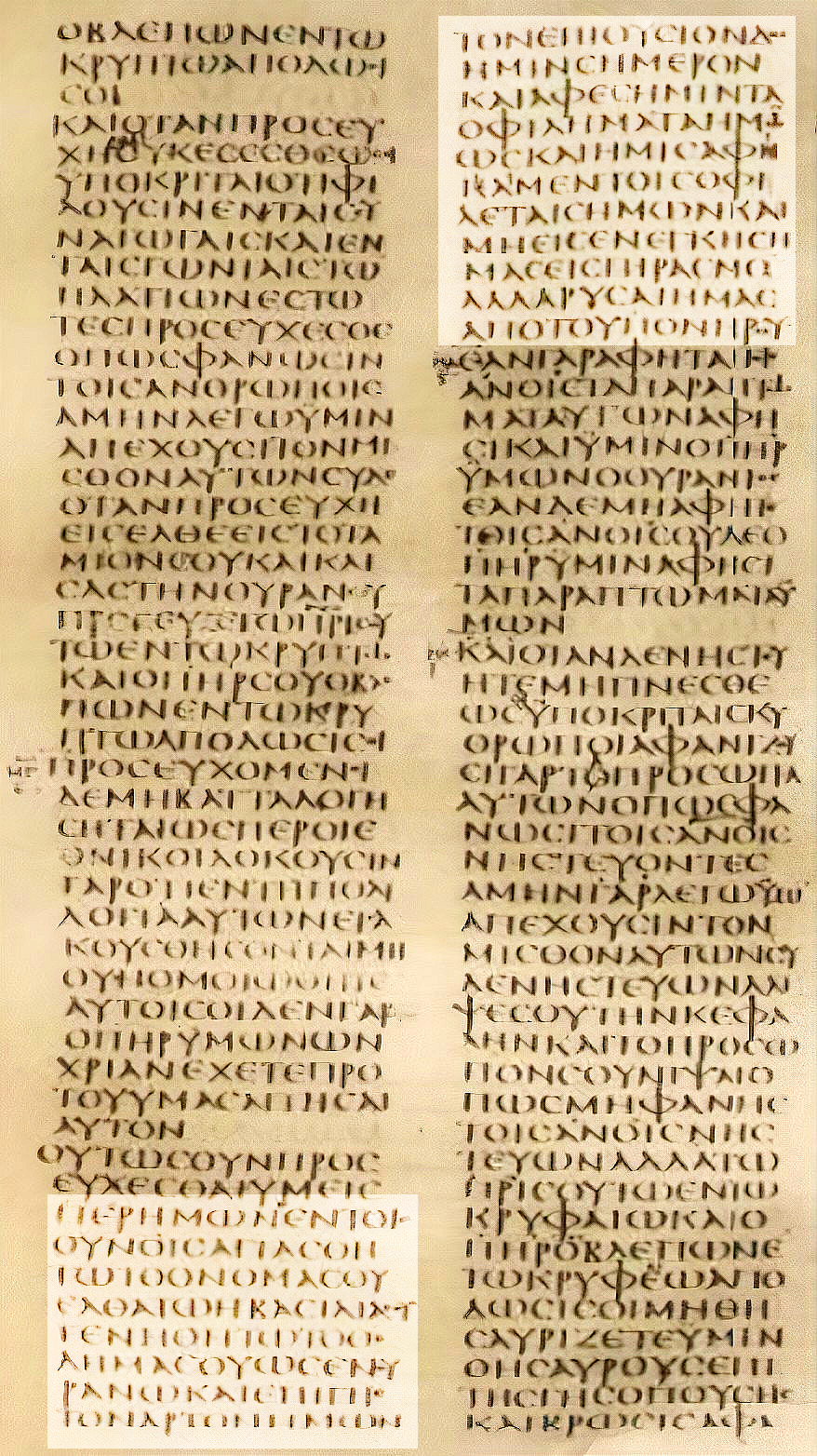
The Lord's Prayer. The prayer as recorded in Matthew 6:9–13 and Luke 11:2–4 differs in length and wording between the two Gospels. The Matthean form, which is the version familiar from liturgical use, is longer. The Lukan form, as preserved in the earliest manuscripts, is shorter. In the earliest witnesses to Luke 11:2–4, including P75 and Codex Vaticanus, the prayer reads:
Father, hallowed be your name. Your kingdom come. Give us each day our daily bread. And forgive us our sins, for we ourselves forgive everyone indebted to us. And do not bring us to the time of trial. (NRSV)
In Matthew 6:9–13, the prayer reads:
Our Father in heaven, hallowed be your name. Your kingdom come. Your will be done, on earth as it is in heaven. Give us this day our daily bread. And forgive us our debts, as we also have forgiven our debtors. And do not bring us to the time of trial, but rescue us from the evil one. (NRSV)
Later manuscripts of Luke expand the Lukan version to match Matthew's, adding "Our" before "Father," adding "who art in heaven," adding "your will be done, on earth as it is in heaven," and adding "but deliver us from the evil one." The result is that in many later manuscripts, both Gospels contain essentially the same prayer, whereas in the earliest manuscripts, the two versions are distinct.1, 2
The doxology appended to the Matthean Lord's Prayer — "For yours is the kingdom and the power and the glory forever. Amen" — is itself a textual variant. It is absent from the earliest manuscripts of Matthew, including Codex Sinaiticus and Codex Vaticanus, and does not appear in the Lukan version in any manuscript. It first appears in the Didache (a late first- or early second-century Christian manual) and in later Greek manuscripts of Matthew. The doxology entered the Textus Receptus and from there the King James Version, where it concludes the prayer that millions of English speakers know by heart.2, 3
Mark 9:29. In the account of the exorcism of a boy with an unclean spirit, Jesus tells the disciples that "this kind can come out only through prayer." Later manuscripts add "and fasting" (kai nesteia), producing "this kind can come out only through prayer and fasting." The addition reflects the growing importance of fasting as an ascetic practice in the early church and appears to have been added to bring the text into line with developing Christian practice.2, 4
Old Testament textual plurality
The textual situation of the Old Testament, while different in character from that of the New Testament, also involves significant variation among the surviving witnesses. Before the discovery of the Dead Sea Scrolls in 1947 and the years following, the earliest known Hebrew manuscripts of most Old Testament books dated to approximately the ninth or tenth century CE — the Masoretic manuscripts produced by Jewish scribes known as the Masoretes, who standardized the consonantal text and added vowel pointing. The Dead Sea Scrolls pushed the manuscript evidence back by roughly a thousand years, to the third century BCE through the first century CE, and revealed that the Hebrew text existed in multiple forms during the Second Temple period.14, 15

_-_Google_Art_Project.jpg)
Among the approximately 200 biblical manuscripts found at Qumran, three broad textual types are represented: manuscripts that closely match the consonantal text later standardized by the Masoretes, manuscripts that align more closely with the Hebrew text behind the Septuagint (the Greek translation produced in the third and second centuries BCE), and manuscripts that agree with the Samaritan Pentateuch. Some manuscripts do not align closely with any of these three traditions and appear to represent independent textual forms.15, 16
Exodus 1:5. The Masoretic Text of Exodus 1:5 states that "the total number of people born to Jacob was seventy." The Septuagint reads "seventy-five." A fragment from Qumran Cave 4 (4QExod-a) agrees with the Septuagint's reading of seventy-five, indicating that the Septuagint translators were not inventing a number but translating from a Hebrew text that contained the higher figure. The Acts of the Apostles 7:14, in which Stephen recounts the history of Israel, also gives the number as seventy-five, following the Septuagint tradition rather than the Masoretic Text.14, 16
Deuteronomy 32:8. In the Song of Moses, the Masoretic Text reads:
When the Most High apportioned the nations, when he divided humankind, he fixed the boundaries of the peoples according to the number of the sons of Israel. (NRSV footnote, following MT)
The phrase "sons of Israel" translates the Hebrew bene yisra'el (בְּנֵי יִשְׂרָאֵל). A manuscript from Qumran (4QDeut-j) reads bene 'elohim (בני אלוהים), "sons of God," and the Septuagint reads angelon theou (ἀγγέλων θεοῦ), "angels of God." The NRSV main text follows the Qumran reading:
When the Most High apportioned the nations, when he divided humankind, he fixed the boundaries of the peoples according to the number of the gods. (NRSV)
The difference between "sons of Israel" and "sons of God" (or "gods") is substantial. The Masoretic reading implies that God divided the nations according to the twelve tribes of Israel. The Qumran and Septuagint readings imply a divine council in which the Most High ('Elyon) assigned each nation to a member of the heavenly assembly, a concept that appears elsewhere in the Hebrew Bible at Psalm 82:1 and 1 Kings 22:19–22.14, 15, 21
1 Samuel 17–18. The account of David and Goliath in 1 Samuel 17–18 differs substantially between the Masoretic Text and the Septuagint. The Masoretic Text is considerably longer, containing approximately 85 verses in chapters 17–18. The Septuagint lacks approximately 39 of these verses — nearly half the narrative. Among the material absent from the Septuagint is the passage in which Saul asks who David is (17:55–58), despite David having already been introduced as Saul's armor-bearer and musician in 16:14–23. A manuscript from Qumran (4QSam-a) preserves portions of this section and in the surviving fragments aligns more closely with the shorter Septuagint text than with the longer Masoretic Text. The two versions of the narrative differ not only in length but in their presentation of David's relationship to Saul: in the shorter Septuagint version, the introduction of David as Saul's musician in chapter 16 flows directly into the Goliath narrative without the doubled introduction found in the Masoretic Text.15, 22
The two editions of Jeremiah
The most dramatic example of Old Testament textual variation involves the Book of Jeremiah. The Septuagint text of Jeremiah is approximately one-eighth shorter than the Masoretic Text — roughly 2,700 Hebrew words shorter. The Septuagint version also arranges the oracles against foreign nations in a different location: in the Masoretic Text, these oracles appear in chapters 46–51, near the end of the book. In the Septuagint, they appear after 25:13, in the middle of the book. The order of the individual oracles within this collection also differs between the two versions.15, 20
The discovery at Qumran of Hebrew fragments of Jeremiah in both a longer form (close to the Masoretic Text) and a shorter form (close to the Septuagint's Hebrew source text) demonstrated that the two versions of Jeremiah circulated in Hebrew, side by side, before either was standardized. The fragment 4QJer-b represents a Hebrew text that corresponds to the shorter Septuagint version, while 4QJer-a represents the longer Masoretic form. This means the Septuagint translators were not abbreviating the text but translating from a genuinely shorter Hebrew edition of Jeremiah that coexisted with the longer edition in the pre-standardization period.14, 15
The two editions of Jeremiah are not merely different in length. The shorter edition lacks many of the expansions and doublets found in the longer edition: phrases repeated within the same passage, explanatory glosses, additions that specify what the shorter text leaves implicit. A passage that reads "the LORD" (YHWH) in the shorter edition may read "the LORD of hosts" (YHWH tseva'ot) in the longer edition. A prophecy that appears once in the shorter edition may appear twice in the longer edition, in slightly different form. The pattern is consistent with a process in which an earlier, shorter edition of Jeremiah was progressively expanded through editorial additions, with the Masoretic Text representing a later stage of this editorial process and the Septuagint preserving the earlier stage.15, 20
Significant variants compared
Selected textual variants with theological or narrative significance1, 2, 3
| Passage | Reading in earliest manuscripts | Alternative reading | Key witnesses |
|---|---|---|---|
| John 1:18 | "the only-begotten God" (monogenes theos) | "the only-begotten Son" (monogenes huios) | P66, P75, ℵ, B vs. A, C, Byzantine MSS |
| 1 Timothy 3:16 | "He who" (hos) | "God" (theos) | ℵ* vs. ℵc, A (?), Byzantine MSS |
| Hebrews 2:9 | "by the grace of God" (chariti theou) | "apart from God" (choris theou) | P46, ℵ, A, B vs. MS 1739, patristic citations |
| Mark 1:41 | "moved with pity" (splanchnistheis) | "moved with anger" (orgistheis) | ℵ, A, B, Byzantine MSS vs. D, Old Latin |
| Luke 2:33 | "his father and his mother" | "Joseph and his mother" | P4, ℵ, B vs. A, Byzantine MSS |
| Matthew 24:36 | "nor the Son" included | "nor the Son" omitted | ℵ, B vs. many Byzantine MSS |
| Lord’s Prayer doxology (Matt 6:13) | Absent | "For yours is the kingdom…" | ℵ, B, D vs. Byzantine MSS, Didache |
| Luke 11:2–4 | Short form of Lord’s Prayer | Expanded to match Matthew | P75, B vs. later Byzantine MSS |
| Deuteronomy 32:8 | "sons of God" (bene ’elohim) | "sons of Israel" (bene yisra’el) | 4QDeut-j, LXX vs. Masoretic Text |
The table presents a selection of variants where the choice between manuscript readings changes the theological content or narrative meaning of the passage. In several cases the earliest manuscripts preserve a reading that is theologically more ambiguous or more difficult, while later manuscripts preserve a reading that resolves the ambiguity in a doctrinally clearer direction.1, 4
The direction of theological alteration
When the variants catalogued above are examined as a group, a directional pattern emerges in the New Testament transmission. In John 1:18, the earlier manuscripts read "God" (theos) while the later manuscripts read "Son" (huios); this is a case where the earlier reading is the one with higher christological content. In 1 Timothy 3:16, the situation is reversed: the earlier manuscripts read the ambiguous pronoun "he who" (hos) while the later manuscripts read "God" (theos), heightening the christological claim. In Matthew 24:36, later manuscripts remove the Son's stated ignorance. In Luke 2:33, later manuscripts remove the identification of Joseph as Jesus' father. In Mark 1:41, later manuscripts replace anger with pity.4
The pattern is not uniformly in one direction across all variants — John 1:18 runs counter to the general trend — but the majority of christologically significant variants in the later manuscript tradition move toward eliminating readings that could be seen as diminishing the divinity, omniscience, or moral perfection of Jesus. This directional pattern is visible not in any single variant but in the cumulative weight of variants across hundreds of manuscripts: later copies tend to read in ways that are theologically smoother than earlier copies.4, 19
This pattern does not require a coordinated effort or a conspiracy of scribes. It is consistent with the ordinary processes of scribal transmission, in which a copyist encountering a difficult reading — one that seemed theologically ambiguous, potentially heterodox, or in tension with the scribe's understanding of doctrine — would instinctively prefer or substitute a reading that resolved the difficulty. Over centuries and thousands of acts of copying, these small individual adjustments accumulated into a detectable trend.1, 4
Text types and manuscript families
Textual critics have long observed that New Testament manuscripts tend to cluster into groups that share distinctive patterns of readings. These groups, called text types or textual families, reflect the geographic and institutional history of manuscript transmission. While the boundaries between text types are debated and many manuscripts contain mixed readings, the broad groupings provide a framework for understanding how the text was transmitted differently in different regions.1, 17
The Alexandrian text type is represented by manuscripts associated with Egypt, including the early papyri P66 and P75 and the great fourth-century codices Sinaiticus and Vaticanus. Alexandrian manuscripts tend to preserve shorter, more difficult readings and show less evidence of harmonization and theological smoothing. The Alexandrian text forms the primary basis for modern critical editions of the Greek New Testament, including the Nestle-Aland 28th edition.3, 7, 8
The Western text type is represented most prominently by Codex Bezae (D, fifth century), a bilingual Greek-Latin manuscript, and by the Old Latin translations. Western manuscripts are characterized by paraphrase, expansion, and distinctive readings not found in other text types. The Western text of Acts, for example, is approximately 8.5 percent longer than the Alexandrian text of Acts, containing additional details, speeches, and narrative elements throughout. Some of these additions appear ancient, and the question of whether the shorter or longer text of Acts is closer to the original remains a subject of active analysis.10, 11
The Byzantine text type (also called the Majority Text) is found in the vast majority of surviving Greek manuscripts, most of which date from the ninth century and later. Byzantine manuscripts tend to be longer and smoother than Alexandrian witnesses, showing extensive harmonization between parallel passages, the addition of clarifying phrases, and the incorporation of readings from multiple older text types into a conflated text. The Byzantine text type formed the basis for the Textus Receptus compiled by Erasmus and subsequent editors, and through it for the King James Version and other Reformation-era translations.1, 17, 18
Approximate distribution of New Testament Greek manuscripts by text type1, 17
The numerical dominance of Byzantine manuscripts — roughly four out of every five surviving Greek New Testament manuscripts belong to this type — reflects the survival conditions of medieval manuscript production rather than the antiquity of the text type. Byzantine manuscripts survive in large numbers because they were produced in the scriptoria of the medieval Greek-speaking church over a period of many centuries. Alexandrian manuscripts survive in smaller numbers but include the earliest and most extensively studied witnesses to the text. The relationship between numerical majority and textual antiquity is thus inverse: the text type represented in the most manuscripts is the one that developed latest in the history of transmission.1, 6, 17
Impact on modern translation
The choice of which manuscripts to follow determines the text that appears in modern translations, and different translation traditions make different choices. Translations based on modern critical Greek texts (NRSV, ESV, NIV, NASB) follow the Nestle-Aland / UBS edition, which is eclectic — it selects readings from across the manuscript tradition based on a combination of external evidence (the age, distribution, and quality of the manuscripts) and internal evidence (which reading best explains the origin of the others). Translations based on the Textus Receptus (KJV, NKJV) follow the late Byzantine text that was the standard Greek text in the Reformation period.1, 3, 18
The practical result is that certain verses, phrases, and words present in the KJV are absent or altered in modern translations — not because the translators have removed them but because the underlying Greek text differs. The doxology of the Lord's Prayer ("For thine is the kingdom, and the power, and the glory, for ever. Amen") appears in the KJV at Matthew 6:13 but is relegated to a footnote in the NRSV and ESV. The phrase "nor the Son" appears in Matthew 24:36 in the NRSV and ESV (following the earlier manuscripts) but is absent from the KJV (following later manuscripts that omit it). The reading "God was manifested in the flesh" at 1 Timothy 3:16 appears in the KJV, while the NRSV reads "He was revealed in flesh."2, 3
These differences between translation traditions are not matters of interpretive preference or liberal versus conservative theology. They are the direct consequence of which manuscripts the translators' Greek text is based on. Where the manuscripts disagree, every printed edition of the Greek text — and every translation based on it — must choose one reading and note the other. The existence of textual variants thus means that there is no single "original text" available in any single manuscript. Every printed Greek New Testament and every translation is a reconstruction, assembled from the evidence preserved across thousands of imperfect witnesses.1, 6, 11
Scope and limits of variation
The textual variants examined in this article represent the most theologically significant cases — the places where manuscript disagreement affects doctrinal claims, narrative meaning, or the content of widely known passages. They do not represent the typical variant. The vast majority of the 300,000 to 400,000 variants in the New Testament manuscript tradition involve differences that are either untranslatable (variations in Greek spelling that do not affect meaning), trivial (differences in word order that produce identical meaning in English), or confined to a single manuscript and clearly the product of an individual scribe's error.1, 5
The existence of these variants does not mean the text of the Bible is unknowable. The abundance of manuscripts, combined with the tools of textual criticism developed over five centuries, allows the reconstruction of an early form of the text with a high degree of confidence for the vast majority of passages. The variants that remain genuinely unresolved — where the manuscript evidence is evenly divided and the original reading cannot be determined with certainty — constitute a small fraction of the total text. The Nestle-Aland 28th edition marks these genuinely uncertain readings in its critical apparatus, and no fundamental narrative or teaching of the New Testament rests solely on a passage whose text is in serious doubt.3, 6
What the variants do reveal is the character of the transmission process itself. The biblical text was not transmitted in a sealed container but through the hands and minds of thousands of scribes, each of whom brought their own training, their own theological commitments, and their own capacity for error to the task. The manuscript tradition preserves not just the text but the history of its transmission — a record of how the text was read, understood, and occasionally reshaped by those who copied it across fifteen centuries of handwritten reproduction.1, 11, 13
References
The Orthodox Corruption of Scripture: The Effect of Early Christological Controversies on the Text of the New Testament
The Text of the New Testament in Contemporary Research: Essays on the Status Quaestionis
The Dead Sea Scrolls Bible: The Oldest Known Bible Translated for the First Time into English