Overview
- The Achaemenid Empire, founded by Cyrus the Great around 550 BCE and expanded under Darius I, became the largest empire the ancient world had yet seen, spanning from Egypt and Anatolia to the Indus Valley at its height.
- Achaemenid administrative innovations including the satrapy system, the Royal Road, a standardized postal network, and the daric coinage established models of imperial governance that influenced successor states for centuries.
- The empire's material legacy is preserved in monumental sites such as Persepolis, Pasargadae, and Susa, and in multilingual royal inscriptions like the Behistun relief, which provided a key to deciphering Old Persian cuneiform.
The Achaemenid Empire (c. 550–330 BCE), also known as the first Persian Empire, was the largest political entity the ancient world had yet produced. At its greatest territorial extent under Darius I (r. 522–486 BCE), it stretched from the Nile Valley and the Aegean coast of Anatolia in the west to the Indus River in the east, encompassing an estimated 5.5 million square kilometres and governing tens of millions of subjects drawn from dozens of ethnic and linguistic groups.1, 14 Founded by Cyrus II ("the Great") following his conquest of the Median, Lydian, and Neo-Babylonian kingdoms, the empire pioneered administrative techniques — satrapies, a royal road network, standardized coinage, and a relay postal system — that set enduring precedents for imperial governance across western Asia and the Mediterranean.2, 8
Founding and expansion under Cyrus
Cyrus II came to power around 559 BCE as king of Anshan, a vassal territory of the Median Empire in southwestern Iran. By approximately 550 BCE he had overthrown his Median overlord Astyages, uniting the Median and Persian kingdoms and gaining control of the Iranian plateau.2, 3 He moved swiftly westward, defeating Croesus of Lydia around 547 BCE and absorbing the wealthy Greek city-states of the Anatolian coast. In 539 BCE, Cyrus captured Babylon, bringing ancient Mesopotamia and its vast agricultural hinterland under Persian rule.1, 4
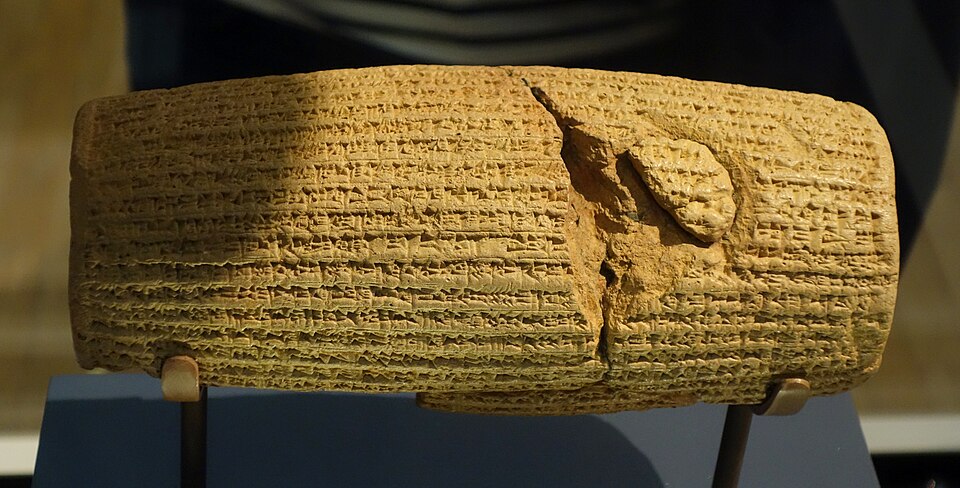

The so-called Cyrus Cylinder, a clay document inscribed in Akkadian cuneiform and deposited in the foundations of the Esagila temple in Babylon, records Cyrus's claim to have restored deported peoples and their cult images to their homelands. Although sometimes characterised in popular literature as a charter of human rights, scholars interpret it more cautiously as a conventional Mesopotamian royal legitimation text, albeit one that reflects a genuine policy of respecting local religious institutions.4, 1 Cyrus's son Cambyses II extended the empire into Egypt around 525 BCE, adding the Nile Valley and parts of Libya to Persian dominion.2
Darius I and imperial administration
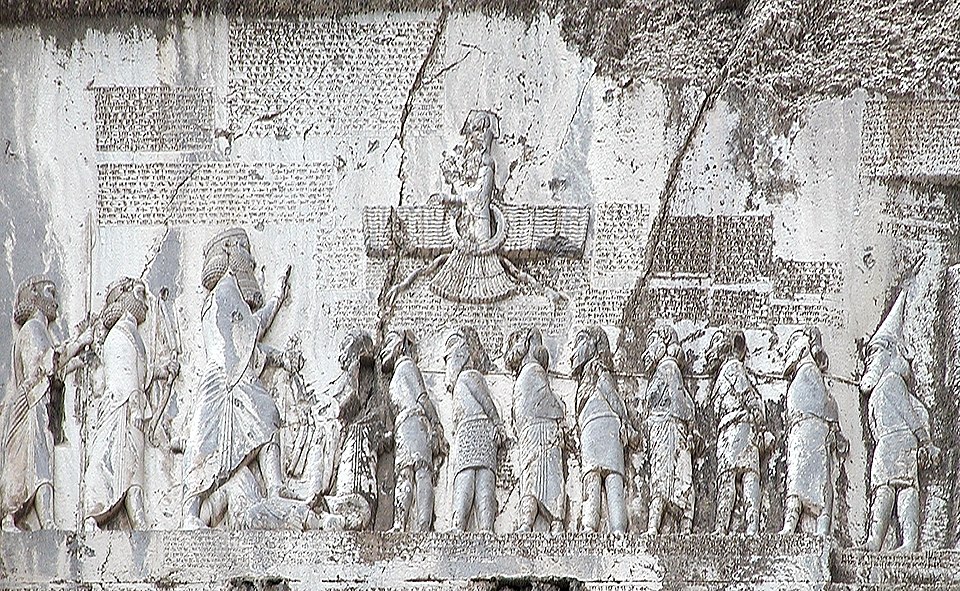
Following a period of dynastic crisis after Cambyses' death, Darius I seized the throne in 522 BCE and spent the first years of his reign suppressing revolts across the empire. He commemorated his victory in the monumental Behistun inscription, carved high on a limestone cliff in western Iran in three languages — Old Persian, Elamite, and Babylonian Akkadian. The trilingual text, analogous in its decipherment significance to the Rosetta Stone, proved essential to the nineteenth-century recovery of Old Persian cuneiform.7, 8

Darius systematised the empire's administration by dividing it into approximately twenty provinces called satrapies, each governed by a royally appointed satrap responsible for collecting tribute, administering justice, and maintaining order. To prevent satrapal independence, Darius stationed military garrisons that reported directly to the crown and dispatched royal inspectors known as the "King's Eyes" to audit provincial affairs.11, 8 He introduced the daric, a standardised gold coin of approximately 8.4 grams, which facilitated long-distance trade and tax collection across the empire's diverse economies.2, 11
The empire's communications infrastructure centred on the Royal Road, a maintained highway stretching approximately 2,700 kilometres from Sardis in western Anatolia to Susa in southwestern Iran. According to Herodotus, mounted couriers operating in relays along this road could deliver a message across the empire in as few as seven days, a distance that would take a caravan roughly ninety days to traverse.17, 3 The Persepolis Fortification Tablets, an archive of some 30,000 Elamite administrative documents discovered at Persepolis, document the provisioning of travellers along the road network, revealing a sophisticated bureaucratic apparatus that tracked rations, authorised travel, and coordinated the movement of workers and officials across vast distances.12, 16
Persepolis and material culture
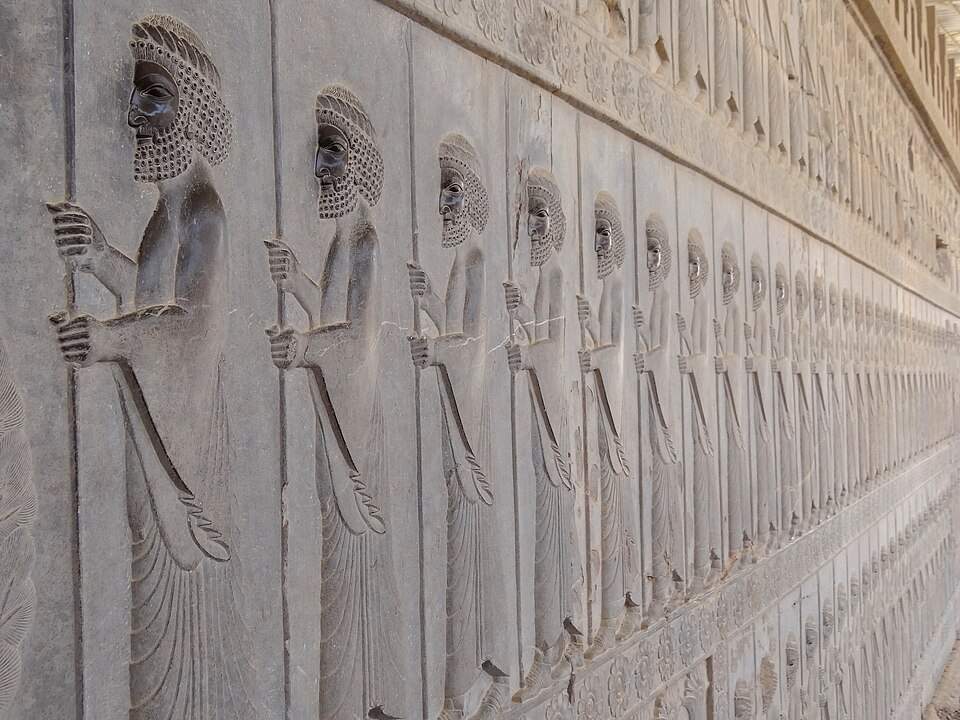
Darius began construction of Persepolis around 518 BCE on a massive stone terrace in the highlands of Fars province. The ceremonial capital, continued under Xerxes I and Artaxerxes I, featured monumental stairways adorned with reliefs depicting delegations from the empire's subject nations bearing tribute — a visual programme that declared the empire's universalist ideology.5, 3 The Apadana reliefs at Persepolis remain among the most important surviving records of Achaemenid-era costume, ethnicity, and material culture, depicting twenty-three distinct delegations with their characteristic dress, animals, and trade goods.5
.jpg)
Excavations at Pasargadae, Cyrus's earlier capital, revealed a palace complex with a distinctive garden layout that may represent the earliest archaeologically attested example of the formal Persian garden, the pairidaeza from which the English word "paradise" derives.13 The administrative capital at Susa, built on the ruins of the ancient Elamite city, served as the primary seat of government for much of the empire's history, and its palace incorporated materials and craftsmen drawn from across the imperial domains, as documented in the foundation inscription of Darius known as the Susa Charter.6, 1
Approximate tribute by satrapy as reported by Herodotus3, 11
| Satrapy | Region | Annual tribute (silver talents) |
|---|---|---|
| Babylonia (IX) | Southern Mesopotamia | 1,000 |
| Egypt (VI) | Nile Valley | 700 |
| Lydia (III) | Western Anatolia | 500 |
| Media (X) | Northwestern Iran | 450 |
| India (XX) | Indus Valley | 360 (in gold dust) |
| Ionia (I) | Aegean coast | 400 |
Religion and royal ideology
The religious landscape of the Achaemenid Empire was characterised by a degree of pluralism unusual in the ancient world. The royal inscriptions of Darius and Xerxes invoke Ahura Mazda as the supreme deity and the divine patron of legitimate kingship, language that aligns broadly with Zoroastrian theology.10, 8 However, the precise relationship between the Achaemenid kings and institutional Zoroastrianism remains debated. The inscriptions do not mention Zarathustra by name, and certain royal practices — such as the apparent veneration of other deities including Mithra and Anahita in later inscriptions — complicate a straightforward identification of the dynasty as exclusively Zoroastrian.10, 2
What is clear is that the Achaemenid kings generally refrained from imposing their own religious traditions on subject peoples. Cyrus restored Babylonian temples, Darius supported the rebuilding of the Jewish temple in Jerusalem as attested in the Hebrew Bible, and Egyptian temples continued to function under Persian patronage.1, 4 This policy of religious accommodation served the practical purpose of securing loyalty from diverse populations across an empire of unprecedented ethnic complexity.
Interactions with Greece
The western frontier of the empire brought the Achaemenids into direct contact and repeated conflict with the city-states of ancient Greece. The Ionian Revolt of 499–494 BCE, in which Greek-speaking cities on the Anatolian coast rebelled against Persian rule with limited support from Athens, prompted Darius to launch punitive expeditions against mainland Greece. The first, in 492 BCE, was disrupted by a storm off Mount Athos; the second culminated in the Persian defeat at the Battle of Marathon in 490 BCE.9, 8
Xerxes I mounted a far larger invasion in 480 BCE, crossing the Hellespont with an army that, while certainly large, was almost certainly smaller than the figures of over one million given by Herodotus. After the famous Greek stand at Thermopylae and the destruction of Athens, the Persian fleet was defeated at Salamis and the army at Plataea in 479 BCE, ending major Achaemenid military operations in the Aegean.9, 3 Despite these setbacks, the empire remained powerful for another 150 years, and Persian diplomacy and gold continued to exert significant influence on Greek interstate politics throughout the fifth and fourth centuries BCE.8
Decline and conquest by Alexander
The empire experienced periods of internal instability during the fourth century BCE, including satrapal revolts and disputed successions, though it remained a coherent political entity until the invasion of Alexander III of Macedon. Beginning in 334 BCE, Alexander defeated Achaemenid forces at the Granicus, Issus, and decisively at Gaugamela in 331 BCE, where the last king, Darius III, fled the field.15, 8 Alexander occupied Babylon, Susa, and Persepolis in rapid succession, and in 330 BCE Persepolis was burned — whether deliberately or accidentally remains disputed by ancient sources.15, 5 Darius III was murdered by his own courtiers shortly thereafter, ending the Achaemenid dynasty after roughly 220 years of rule.
The empire's administrative legacy, however, long outlasted its political existence. Alexander and his Seleucid successors retained the satrapy system, the road network, and much of the bureaucratic infrastructure that had governed the empire. Achaemenid models of provincial administration influenced the Parthian and Sasanian empires that followed, and through them left an enduring imprint on the political traditions of western Asia.8, 14
Archaeological and textual evidence
Knowledge of the Achaemenid Empire derives from a convergence of archaeological, epigraphic, and literary sources. The royal inscriptions at Behistun, Persepolis, and Naqsh-e Rostam provide the dynasty's own voice in Old Persian, Elamite, and Babylonian.7 The Persepolis Fortification and Treasury Tablets, numbering in the tens of thousands, offer an unparalleled window into the daily economic operations of the imperial heartland, documenting ration distributions, labour assignments, and religious offerings with bureaucratic precision.12, 16
External literary sources, particularly the Greek historians Herodotus, Xenophon, and Ctesias, provide narrative accounts of Achaemenid history, though these must be read critically as products of a culture that was frequently at war with Persia. Archaeological excavations at Persepolis (begun by Ernst Herzfeld in 1931 and continued by Erich Schmidt), Pasargadae, Susa, and numerous provincial sites across the former empire continue to refine understanding of Achaemenid material culture, economic organisation, and artistic traditions.5, 13, 6 The synthesis of these diverse evidence streams has transformed scholarly understanding of the Achaemenid Empire from the "barbarian" caricature of Greek literary tradition into a picture of a sophisticated, administratively innovative, and culturally pluralistic imperial system.1, 8
References
Darius in Scythia and Scythia in the Achaemenid period: problems of historical interpretation
Pasargadae: A Report on the Excavations Conducted by the British Institute of Persian Studies