Overview
- Gobekli Tepe is a monumental Pre-Pottery Neolithic site in southeastern Turkey dating to approximately 9500-8000 BCE, featuring massive T-shaped limestone pillars arranged in circular enclosures that represent the earliest known large-scale megalithic architecture.
- The site was constructed by hunter-gatherer communities before the advent of agriculture or permanent settlement, challenging the long-held assumption that monumental architecture required sedentary, farming societies with surplus food production.
- Zooarchaeological and botanical evidence suggests the site served as a regional gathering place for ritual feasting, and its discovery has prompted a fundamental reassessment of the social complexity achievable by pre-agricultural societies in the ancient Near East.
Gobekli Tepe is a monumental Pre-Pottery Neolithic archaeological site located on a limestone ridge approximately 15 kilometres northeast of the modern city of Sanliurfa in southeastern Turkey. Dating to approximately 9500-8000 BCE, the site contains the earliest known examples of large-scale megalithic architecture: massive T-shaped limestone pillars, some standing over 5 metres tall and weighing up to 10 metric tons, arranged in circular and oval enclosures and decorated with elaborate carved reliefs of animals, abstract symbols, and anthropomorphic features.1, 2 The site was constructed by communities of hunter-gatherers during the Pre-Pottery Neolithic A (PPNA) and Pre-Pottery Neolithic B (PPNB) periods, several centuries before the emergence of agriculture, permanent villages, or pottery in the region. This chronological priority has made Gobekli Tepe one of the most significant archaeological discoveries of the past half-century, challenging foundational assumptions about the relationship between social complexity, subsistence strategies, and monumental construction in human prehistory.1, 13
Gobekli Tepe was inscribed as a UNESCO World Heritage Site in 2018 under criteria recognising its outstanding universal value as one of the first manifestations of human-made monumental architecture and as testimony to the creative genius of early Neolithic societies.11, 19
Discovery and excavation history
The mound at Gobekli Tepe was first noted in a survey conducted by the University of Chicago and the University of Istanbul in 1963, but its significance was not recognised at the time; surface finds of flint artefacts led surveyors to classify it as a medieval cemetery with limited prehistoric remains.13 The site's true nature was identified in 1994 by Klaus Schmidt, a German archaeologist from the German Archaeological Institute (Deutsches Archäologisches Institut, or DAI), who recognised the surface scatter of large limestone fragments and flint tools as evidence of a major Pre-Pottery Neolithic occupation. Schmidt began systematic excavations in 1995 in collaboration with the Sanliurfa Museum, and he directed fieldwork at the site continuously until his death in 2014.1, 18
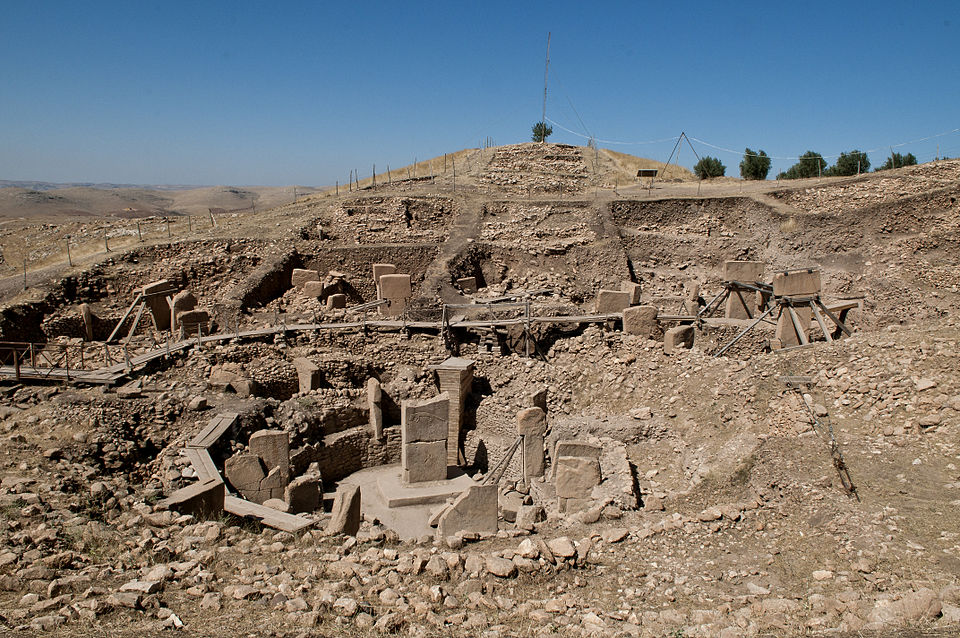

Under Schmidt's direction, excavations uncovered four major circular enclosures (designated Enclosures A through D) in the site's main excavation area on the southwestern slope, as well as several smaller rectangular structures in adjacent areas. Schmidt interpreted the site as a ritual centre, a "cathedral on a hill" built by hunter-gatherer communities from across the surrounding region, and argued provocatively that the impulse toward communal ritual and monumental construction may have preceded and even stimulated the transition to settled agricultural life.13, 18 Following Schmidt's death, the project continued as a joint undertaking of Istanbul University, the Sanliurfa Museum, and the DAI, with Turkish prehistorian Necmi Karul assuming the directorship of field operations.10 As of the most recent published field reports, only approximately five to ten percent of the site's total area has been excavated, and geophysical surveys indicate that numerous additional enclosures and structures remain buried beneath the mound.10, 14
Stratigraphy and chronology
The stratigraphy of Gobekli Tepe comprises three principal layers, numbered from the surface downward. Layer I consists of mixed surface sediments resulting from centuries of agricultural ploughing and erosion. Layer II, assigned to the early and middle PPNB period (roughly 8500-8000 BCE), contains smaller rectangular buildings, some with a single pair of T-shaped pillars or none at all. Layer III, the oldest exposed occupation level and the source of the site's most spectacular architecture, dates to the late PPNA period (approximately 9500-9000 BCE) and contains the large circular enclosures with their rings of monumental T-shaped pillars surrounding a pair of taller central pillars.1, 2, 3
Establishing a reliable absolute chronology for the monumental enclosures has presented significant methodological challenges. At the end of their use-life, the Layer III enclosures were filled with large quantities of limestone rubble, sediment, animal bones, and stone tools, creating a complex depositional sequence in which most radiocarbon samples come from the fill rather than from the construction or primary use of the structures.3 Because the fill material could have been deposited at any time during or after the enclosures' active use, dates obtained from it provide only a terminus ante quem rather than a date of construction. A radiocarbon date obtained directly from wall plaster within Enclosure D yielded a calibrated age of approximately 9745-9314 BCE at 95.4% confidence, placing the construction firmly within the PPNA and confirming that the monumental enclosures are among the oldest known stone structures of their scale anywhere in the world.4
The transition from the monumental circular architecture of Layer III to the smaller rectangular buildings of Layer II mirrors a broader regional pattern observed across the Pre-Pottery Neolithic of the northern Fertile Crescent, in which communal, curvilinear structures gave way to more modular, rectilinear domestic architecture during the PPNB. At Gobekli Tepe, this shift was accompanied by a reduction in pillar size, a decrease in the complexity of carved decoration, and an apparent loss of the communal organisational capacity required to quarry, transport, and erect multi-ton monoliths.2, 12
Architecture and the T-shaped pillars
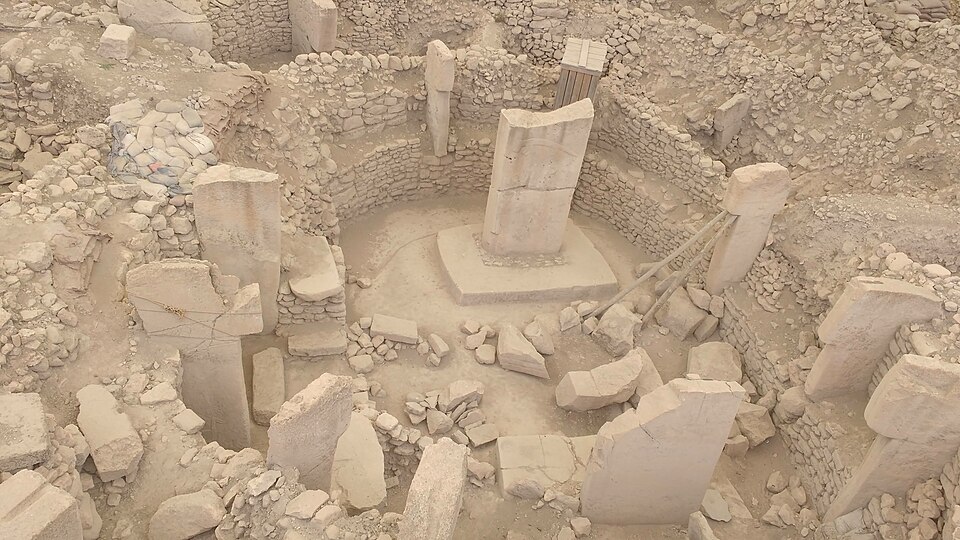
The defining architectural feature of Gobekli Tepe is the T-shaped limestone pillar. These monoliths were quarried from the bedrock plateau adjacent to the site, shaped using flint picks and stone hammers, and transported to prepared positions within the enclosures. The largest pillars in the Layer III enclosures stand approximately 5.5 metres tall and weigh an estimated 8 to 10 metric tons. An unfinished pillar still attached to the bedrock in the nearby quarry measures approximately 7 metres in length and would have weighed roughly 50 metric tons had it been completed, suggesting that even larger constructions may have been planned but never realised.2, 18
The T-shape of the pillars is anthropomorphic. The vertical shaft represents a stylised human body, and the horizontal top represents a head, as confirmed by pillars that bear carved arms with hands clasped together over the abdomen, depictions of belts, loincloths of fox skin, and stola-like garments draped from the shoulders. Despite these humanoid attributes, the pillars are consistently depicted without facial features, lending them an enigmatic, faceless quality that has invited extensive scholarly discussion about whether they represent ancestors, deities, or other symbolic entities.2, 20
Each of the four excavated Layer III enclosures follows a broadly similar plan: a roughly circular or oval enclosure, 10 to 30 metres in diameter, defined by stone walls or benches into which a ring of T-shaped pillars is integrated, with a pair of taller, freestanding central pillars oriented roughly north-south.1, 7 Analysis by Haklay and Gopher using standard-deviation mapping algorithms demonstrated that the centres of Enclosures B, C, and D form an equilateral triangle, indicating that these three structures were planned and possibly initiated as a single integrated architectural project. This finding implies a degree of geometric knowledge and large-scale spatial planning that was previously thought to have emerged only after the transition to farming.7
The quarrying and transport of the pillars required substantial coordinated labour. The limestone plateau surrounding Gobekli Tepe is naturally banked in strata of 0.6 to 1.5 metres thickness, separated by horizontal fault lines. Quarry workers exploited this natural layering by carving channels around the desired workpiece with flint tools and then levering the pillar free along the fault plane using wooden beams and wedges. Experimental archaeology has estimated that a team of approximately thirty workers could quarry a 7-metre pillar in nine to ten months using only basalt hammers, and that transporting and erecting the finished pillar would have required additional organised labour teams of comparable size.2, 18
Iconography and carved reliefs
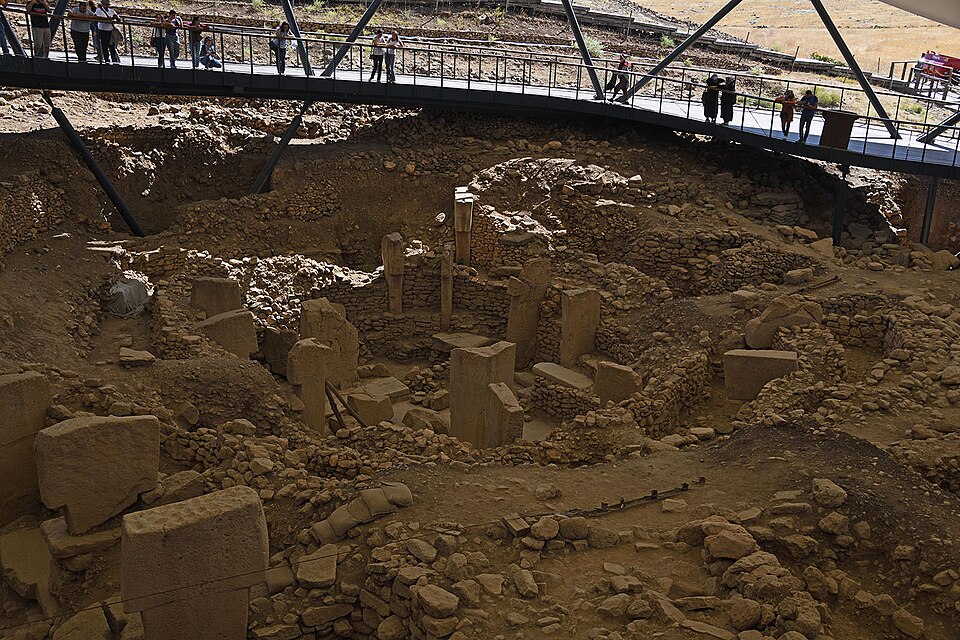

The pillars and walls of Gobekli Tepe bear an extraordinarily rich programme of carved reliefs and three-dimensional sculptures that constitute one of the earliest known bodies of monumental art. The vast majority of the carvings depict wild animals, rendered in low and high relief with considerable naturalistic skill. The most frequently represented species are snakes, foxes, wild boar, aurochs (wild cattle), gazelles, cranes, vultures, and scorpions, with rarer depictions of lions, spiders, and ducks. Zooarchaeologist Joris Peters and Klaus Schmidt noted that many of the animals are depicted in aggressive or sexually charged postures, including foxes and lions shown with bared teeth and erect phalluses, and suggested that the iconographic programme carries mythological or narrative meaning that extends well beyond simple decoration.2, 5
Certain enclosures appear to be dominated by particular animal species. Enclosure A features a high proportion of snake reliefs, while Enclosure C prominently displays wild boar. Enclosure D, the largest and most elaborately decorated of the excavated enclosures, contains the famous Pillar 43, sometimes called the "Vulture Stone," which displays a dense composition of vultures, scorpions, and a headless human figure, leading some scholars to propose connections to death ritual, excarnation, or cosmological narratives.2, 6 The significance of this imagery remains debated, and Schmidt cautioned against reductive interpretations, arguing that the diversity of species and compositions across the site suggests a complex and multi-layered symbolic system rather than a single unified narrative.2
Beyond animal imagery, abstract geometric symbols appear on many pillars, including H-shapes, crescents, and arrangements of circles and lines. The anthropomorphic elements of the pillars themselves, with their carved arms, hands, and garments, represent a distinct iconographic layer that may relate to ancestor veneration or to the depiction of supernatural beings. Three fragmentary human skulls recovered from the site's fill deposits bear deliberate modifications, including deep incisions along the sagittal axis and, in one case, a drilled perforation that would have allowed the skull to be suspended from a cord. These modified crania provide evidence for a previously undocumented form of Neolithic skull cult and suggest that the treatment of the dead played a significant role in the ritual practices conducted at the site.6
Subsistence and ritual feasting

One of the most striking aspects of Gobekli Tepe is the near-total absence of evidence for permanent habitation. No domestic structures, hearths, storage facilities, or middens characteristic of settled occupation have been identified. Instead, the site's fill deposits contain extraordinarily large quantities of animal bones, primarily from wild species including gazelle, aurochs, wild boar, and various birds, in volumes that far exceed those recovered from contemporary settlement sites in the region. These faunal assemblages have been interpreted as the refuse of large-scale communal feasts held at the site by groups of hunter-gatherers who gathered periodically from across the surrounding landscape.5, 8
Zooarchaeological analysis has shown that gazelle, one of the most commonly represented species in the bone assemblages, were only seasonally present in the Urfa region, suggesting that gatherings and feasting events may have been timed to coincide with periods of peak game availability.5 The hypothesis that Gobekli Tepe served as a supra-regional gathering place for ritual feasting is further supported by the discovery of large stone vessels, some with capacities exceeding 150 litres, which may have been used for the preparation of fermented beverages. Chemical residue analysis of some vessels has detected traces of oxalate, a compound associated with the brewing of grain-based drinks, raising the possibility that beer production may have been among the earliest motivations for the intensive processing of wild cereals in the region.5, 9
The botanical evidence from the site includes large quantities of processed wild einkorn wheat and other cereals. Grinding stones and other processing equipment recovered from the deposits indicate that cereal preparation was a significant activity, even though the grains were morphologically wild rather than domesticated. This evidence has contributed to the broader hypothesis that the social demands of sustaining large labour forces for monument construction and communal feasting may have provided an impetus for the intensification of cereal exploitation that eventually led to the Neolithic revolution and full domestication.9, 13
Animal species represented in faunal remains at Gobekli Tepe5, 8
The question of deliberate infilling
One of the most debated aspects of Gobekli Tepe concerns the enormous quantities of fill material that buried the Layer III enclosures. Schmidt originally proposed that the monumental enclosures were intentionally and ritually backfilled with limestone rubble, sediment, animal bones, and stone tools at the end of their use-life, in a deliberate act of burial that may have carried symbolic or ceremonial significance. This interpretation was based on the sheer volume of fill, the absence of natural erosion profiles, and the seemingly intentional deposition of artefacts within the fill matrix.1, 18
Since Schmidt's death, however, subsequent researchers have increasingly questioned whether the backfilling was a single deliberate act or a more gradual process involving a combination of building collapse, erosion of material from higher portions of the mound, and incremental deposition over extended periods. The highly fragmented condition of both the animal and human bone within the fill, as well as the mixed and unsorted character of much of the deposit, is consistent with natural and semi-natural site formation processes rather than a single episode of intentional burial.12, 16 Recent archaeoseismological research has also raised the possibility that earthquake damage contributed to the structural collapse and subsequent burial of some enclosures, adding a taphonomic factor that was not considered in earlier interpretations.16 The question remains unresolved, and the infilling process may ultimately have involved elements of both intentional deposition and natural accumulation at different times and in different parts of the site.
Broader significance and ongoing debates
The discovery of Gobekli Tepe has had a profound impact on scholarly understanding of the Pre-Pottery Neolithic period and of the social capacities of hunter-gatherer societies more broadly. Schmidt's central thesis, that the construction of the site demonstrates a capacity for large-scale communal organisation among pre-agricultural peoples that had not previously been recognised, has been widely accepted in its general outlines even as specific elements of his interpretation have been challenged or refined.13, 12 The site has become a key case study in debates about the origins of social complexity, the role of ritual and belief systems in driving economic and technological change, and the relationship between monumentality and sedentism.
Schmidt's most provocative claim, that "first came the temple, then the city," inverted the conventional model in which agricultural surplus was understood as a prerequisite for the emergence of specialised architecture, social stratification, and organised religion. However, more recent analyses have urged caution regarding the characterisation of Gobekli Tepe as a purely ritual site devoid of any domestic function. Kinzel and Clare have argued that the strict dichotomy between "temple" and "settlement" may be an artificial imposition of modern Western categories onto a Neolithic context in which ritual and daily life were likely inseparable, and have called for a more nuanced interpretation that acknowledges the possibility of seasonal or intermittent habitation alongside ceremonial activity.12
Gobekli Tepe is now understood to be not an isolated phenomenon but part of a wider regional tradition of monumental construction during the Pre-Pottery Neolithic of southeastern Anatolia. The Tas Tepeler ("Stone Hills") programme, an initiative of the Turkish Ministry of Culture, has identified approximately twelve contemporary sites in the Urfa region that share key architectural features, particularly the T-shaped pillar tradition. Among these, Karahan Tepe, located approximately 35 kilometres southeast of Gobekli Tepe, has yielded particularly striking discoveries since systematic excavations began in 2019, including numerous anthropomorphic pillars and a range of architectural forms that both parallel and diverge from those at Gobekli Tepe.15, 17 Together, these sites reveal a shared symbolic and architectural tradition spanning the Urfa plain during the tenth and ninth millennia BCE, suggesting that the capacity for monumental construction was distributed across multiple communities rather than concentrated at a single centre.
The ongoing excavations at Gobekli Tepe and its neighbouring sites continue to generate new data that refine and complicate earlier interpretations. With the vast majority of the site still unexcavated, future fieldwork is likely to produce further surprises. What is already clear, however, is that Gobekli Tepe has fundamentally altered the archaeological understanding of what pre-agricultural societies were capable of achieving, and that the origins of monumental ritual architecture must now be sought not in the aftermath of the agricultural revolution but in its very earliest preconditions.10, 13
References
Gobekli Tepe: the Stone Age sanctuaries. New results of ongoing excavations with a special focus on sculptures and high reliefs
The role of cult and feasting in the emergence of Neolithic communities. New evidence from Gobekli Tepe, south-eastern Turkey
Modified human crania from Gobekli Tepe provide evidence for a new form of Neolithic skull cult
Feasting, social complexity, and the emergence of the early Neolithic of Upper Mesopotamia: a view from Gobekli Tepe
Gobekli Tepe, Turkey. A brief summary of research at a new World Heritage Site (2015-2019)
Paradise found or common sense lost? Gobekli Tepe's last decade as a pre-farming cult centre
Shaking up the Neolithic: tracing seismic impact at Neolithic Gobekli Tepe/Southeast-Turkiye
Gobekli Tepe and the Sites around the Urfa Plain (SE Turkey): recent discoveries and new interpretations
Decision 42 COM 8B.34: examination of nominations to the World Heritage List (Gobekli Tepe)
Materialien zur Deutung der zentralen Pfeilerpaare des Gobekli Tepe und weiterer Orte des obermesopotamischen Frühneolithikums